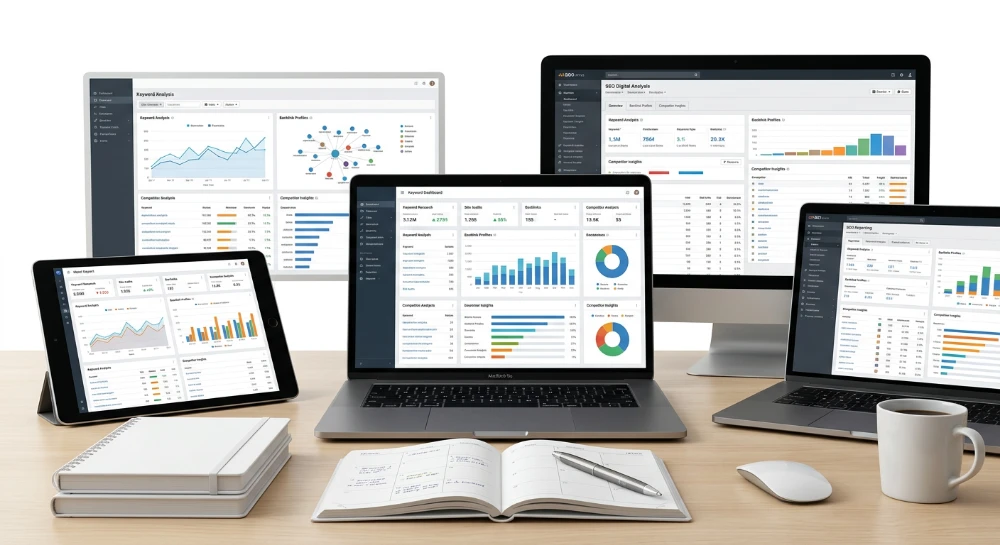
Finding the right SE Ranking alternative depends on which SEO capabilities a marketing team needs to prioritize. While the platform provides a standard all-in-one suite covering website audits, keyword tracking, backlink monitoring, competitor analysis, and white-label reports, agencies and in-house teams often reach a point where they need specialized functionality or different resource limits.
Platform migration typically stems from the need to scale domain analytics, improve client reporting workflows, or restructure software costs. Teams moving away from standard all-in-one tools may require deeper historical backlink indices, highly granular local rank tracking, or desktop-based analysis environments. Pricing models also drive many transitions. Rather than managing monthly subscription tiers tied to rank tracking frequency, operators often look for flat-rate enterprise limits or strict pay-as-you-go models-such as SeLinkPro-where billing is tied directly to active technical page crawls and automated backlink checks.
Comparing these platforms requires looking past surface-level dashboards to assess data accuracy, search volume metrics, and integration capabilities. A suitable replacement will align with a team's specific daily operations, whether that means prioritizing off-page metric research, streamlining on-page content relevance, or automating client-facing data presentation.
Core evaluation criteria for SEO platforms
Assessing a replacement for an existing SEO tool requires a structured evaluation of technical capabilities and data handling. When comparing alternatives, teams should weigh the following technical and operational criteria based on their specific workflow requirements:
- Data accuracy: The reliability of the underlying databases, including the frequency of rank tracking updates, the depth of the backlink index, and the precision of the technical crawler in identifying rendering or indexing blockers.
- Search volume accuracy: The methodology used to report search demand. Platforms may rely on Google Keyword Planner data, clickstream analytics, or a proprietary blend. The frequency of search volume updates dictates how well the tool reflects seasonal or trending queries.
- Keyword difficulty metrics: The specific algorithm the platform uses to score competition. Evaluation involves checking whether the difficulty score relies purely on the link authority of ranking pages or incorporates on-page relevance, content length, and search intent factors.
- Access to historical data: The depth of retroactive data available for analysis. Access to historical SERP snapshots, past ranking fluctuations, and archived backlink acquisition or loss logs is necessary for diagnosing traffic drops and identifying long-term algorithmic trends.
- Multi-language support: The capability to track non-English queries, support localized search engines, analyze international search volumes, and accurately audit technical internationalization signals such as hreflang tags.
- API access: The availability of programmatic endpoints for extracting data. Technical and enterprise teams evaluate API rate limits, available endpoints, and potential extra costs to integrate ranking or backlink data into custom data warehouses or proprietary dashboards.
- CRM integrations: The ability to connect organic search data directly with customer relationship management systems. Direct integration helps marketing teams align search visibility and keyword performance with actual lead generation and sales pipeline tracking.
- Data visualization features: The presentation and formatting of complex data sets. This includes customizable charts, the ability to overlay multiple metrics on a single graph, and automated reporting formats suitable for internal stakeholders or client-facing deliverables.
Reverse engineer top SERP rankings and compare 50+ on-page SEO metrics to outrank competitors.
Semrush for All-in-One SEO tool suites
Semrush operates as a comprehensive alternative for teams that require an all-in-one SEO tool suite. Rather than deploying separate applications for distinct tasks, this platform centralizes the core capabilities of SEO analysis, including website audits, keyword tracking, backlink monitoring, and competitor analysis. This consolidation allows search marketing teams to manage multiple data streams within a unified environment, minimizing the need to export and merge data sets across disconnected applications.
A primary distinction when evaluating Semrush against SE Ranking workflows lies in its per-project pricing model. While some platforms offer highly flexible tracking configurations or charge purely by aggregate data volume, Semrush structures a significant portion of its tracking and auditing capabilities around defined projects. This structural difference directly affects how agencies and in-house teams scale their operations and distribute their platform allowances.
The per-project organizational model introduces several practical considerations for SEO workflows:
- Resource distribution: Platform limits, such as the maximum number of pages audited or individual keywords tracked, must be managed across a fixed number of active project slots.
- Client onboarding friction: Agencies adding new client domains must evaluate their account capacity based on available project allowances, rather than simply relying on total aggregate keyword tracking capacity.
- Workflow segmentation: Data for a specific campaign or domain is isolated within its designated project dashboard. This centralizes performance reporting for a single site but requires administrators to actively monitor project quotas as new campaigns are launched.
Selecting an all-in-one suite with project-based billing depends heavily on the structure of the organization's search campaigns. Teams focused on managing a few large-scale enterprise domains often align naturally with a project-based environment, as the consolidated dashboard keeps extensive domain data organized. Conversely, organizations managing a high volume of smaller websites, scattered local SEO campaigns, or numerous temporary tracking initiatives must carefully align their workflow requirements with project limits to avoid capacity bottlenecks.
Ahrefs and Moz pro for domain analytics
Off-page analysis requires distinct datasets for evaluating link profiles and competitor performance. Ahrefs and Moz Pro provide specialized alternatives for domain analytics, differing from standard all-in-one workflows by emphasizing deep link evaluation over consolidated project tracking.
Ahrefs and backlink database analytics
Ahrefs builds its domain analytics around its backlink database. This platform supports workflows that prioritize off-page SEO research, link acquisition, and competitor backlink monitoring. The analytics rely on crawling infrastructure to catalog incoming links, referring domains, and anchor text distribution.
Using Ahrefs as an alternative centers on extracting detailed link data. The provided analytics support campaigns that require mapping competitor link profiles or identifying exact referring domains to evaluate off-page search visibility.
Moz pro and domain authority evaluation
Moz Pro approaches domain analytics with a focus on its proprietary evaluation metrics. Its relevance for off-page analysis relies heavily on Domain Authority evaluation. Instead of solely cataloging raw link volume, Moz Pro provides metrics designed to estimate the comparative strength of a website based on its link profile.
This alternative aligns with workflows focused on qualifying link prospects and assessing search competition. Teams use domain authority evaluation to set baseline thresholds for link outreach targets or to measure the competitive gap between their domains and ranking competitors.
Workflow distinctions
The distinction between these two platforms centers on how they process off-page data:
- Ahrefs serves workflows requiring direct access to a backlink database for reverse-engineering competitor link networks.
- Moz Pro serves workflows requiring standardized domain authority evaluation to score and sort link prospects efficiently.
Both platforms isolate off-page metrics into dedicated domain analytics tools. Teams must determine whether their link-building strategy requires granular backlink database access or streamlined authority scoring metrics to evaluate off-page performance.
Bulk domain metrics and PBN checker
Screen vendors with our bulk domain metrics and PBN checker to detect toxic networks and avoid link fraud.
SEO PowerSuite for Desktop-Based analysis
Unlike cloud-based platforms that process data on vendor servers, SEO PowerSuite operates as a desktop-based application. This structural distinction requires users to install the software locally on their machines, shifting the processing load and data storage from a third-party cloud to the user's own hardware.
This alternative fits workflows where organizations prefer local data retention or need to manage their own hardware resources for data collection. Running an SEO platform locally means the user operates independently of web browser sessions, but it requires active management of hardware capacity, software updates, and network configurations when executing heavy queries.
Modular application structure
Rather than providing a single unified web interface, SEO PowerSuite divides its core capabilities into separate installed modules. Each module functions as an independent desktop application dedicated to a specific phase of SEO analysis.
Rank tracker
The included Rank Tracker module manages search visibility monitoring and keyword data collection. Because the application runs directly on a local machine, rank checking executes through the user's network connection rather than relying on a centralized cloud database. Organizations utilizing a desktop-based tracking workflow must configure and manage their own proxy servers to distribute requests and prevent search engines from rate-limiting the local IP address during large rank-checking tasks.
WebSite auditor
The suite also includes the WebSite Auditor module for technical analysis and on-page evaluations. This application crawls domains using the host computer's available memory and CPU. By executing technical audits locally, teams can evaluate site architecture, identify status code errors, and analyze page structures without operating under a cloud vendor's remote crawling limits. However, the speed and scale of the crawl remain directly tied to the processing capabilities of the machine running the software.
Mangools for interface simplicity and keyword research
For organizations and independent practitioners evaluating SE Ranking alternatives, Mangools presents a platform built specifically around user interface simplicity. Rather than consolidating every possible SEO metric into a dense, multi-layered dashboard, the Mangools interface is designed to reduce the learning curve and present data through straightforward visual layouts. This approach serves teams that prioritize intuitive navigation and rapid data interpretation over exhaustive, enterprise-level technical configurations.
A core component of this streamlined workflow is the included KWFinder tool. Dedicated entirely to keyword research, KWFinder allows users to isolate search volume analysis, evaluate target queries, and identify new search opportunities within a focused research environment. By separating keyword discovery from broader site auditing or daily rank tracking functions, the tool maintains a clean interface tailored specifically to content planning and search query evaluation.
Choosing Mangools over a more complex all-in-one suite involves a deliberate trade-off between dashboard density and usability. The platform design enables immediate onboarding for content creators and marketers performing routine keyword research workflows. However, technical SEO teams that require highly customizable data visualizations, simultaneous cross-referencing of technical audits with backlink profiles, or complex data-mining capabilities may find that the strict emphasis on interface simplicity limits their ability to conduct deep cross-metric analysis.
Bulk Google and Yandex index checker
Verify agency reports and track live SERP status in Google and Yandex to protect your SEO ROI.
Nightwatch and AccuRanker for specialized rank tracking
Moving away from comprehensive platforms often occurs when a team's primary bottleneck is rank tracking precision rather than general SEO analysis. Dedicated rank trackers remove broad auditing and backlink modules to focus entirely on search visibility monitoring. Nightwatch and AccuRanker represent two specialized alternatives, each addressing a different dimension of search tracking.
Nightwatch serves as an alternative for campaigns that depend on hyper-local search visibility. Its relevance in this comparison centers on its Local Rank Tracker capabilities. While standard SEO suites typically track keywords at the national or broad city level, specialized local tracking focuses on monitoring search engine results pages (SERPs) across specific postal codes, neighborhoods, or custom geographic coordinates. This granularity helps search marketers operating multi-location businesses or local service campaigns evaluate how organic results and map packs fluctuate across narrow geographic areas.
AccuRanker addresses a different workflow, tailored for teams managing large-scale keyword sets that require advanced search query analytics. Rather than focusing primarily on local geographic nuances, AccuRanker focuses on deep data segmentation and visibility trends. Its search query analytics capabilities allow teams to categorize high volumes of keyword data, isolate specific search intents, and analyze visibility shifts across distinct product categories or content silos. This approach supports enterprise sites or large e-commerce operations that need to evaluate organic performance at the aggregate category level rather than just tracking individual keyword positions.
Choosing a dedicated tracker over an all-in-one suite requires evaluating the specific tracking requirements of the project. A standalone rank tracking implementation changes the daily workflow in several ways:
- Organizations prioritizing precise local footprint monitoring often select Nightwatch to isolate geographic rank fluctuations that broader tools might miss.
- Teams requiring deep segmentation and historical filtering of large keyword databases generally favor AccuRanker for its query analytics architecture.
- Agencies or internal teams that rely on cross-referencing rank drops directly with recent technical audits or lost backlinks typically remain with unified platforms to prevent data fragmentation.
Adopting either Nightwatch or AccuRanker means separating the rank tracking workflow from broader diagnostic processes, requiring teams to maintain separate systems or integrations for their technical audits and off-page research.
AgencyAnalytics for client reporting workflows
For agencies and marketing teams where data presentation is the primary operational bottleneck, AgencyAnalytics serves as an alternative focused specifically on client reporting workflows. While standard SEO analysis platforms prioritize diagnostic tools and proprietary crawl engines, AgencyAnalytics is designed primarily to consolidate marketing data into accessible, client-facing formats.
The platform's utility centers on its white-labelled reporting capabilities. Teams can configure dashboards and document exports that carry their own agency branding, masking the underlying tool infrastructure from stakeholders. This supports organizations that need to present SEO metrics without requiring clients to navigate complex technical interfaces. Additionally, AgencyAnalytics includes support for scheduled auto-reports, enabling teams to automate the delivery of performance updates on fixed daily, weekly, or monthly cadences.
Shifting to a reporting-centric alternative requires adjusting the broader SEO workflow. Because AgencyAnalytics focuses on formatting and distributing data rather than deep technical discovery, teams typically maintain separate systems for their granular website audits or backlink research. The decision to adopt this platform generally depends on whether an agency spends more time diagnosing technical SEO issues or assembling the resulting data for external review. Organizations experiencing high administrative overhead in their monthly reporting cycles often utilize AgencyAnalytics to handle client communication, reserving their specialized diagnostic software strictly for internal analysis.
Run a deep technical crawl to identify 4xx errors, missing meta tags, and indexation blockers.
SeLinkPro for Pay-As-You-Go technical audits and backlink monitoring
Organizations with fluctuating project volumes often encounter operational friction when tied to standard subscription tiers. SeLinkPro provides an alternative structured around a strict pay-as-you-go billing model. The platform operates with no monthly subscriptions, requiring users to fund an account balance and deducting costs solely based on the specific diagnostic tasks executed. This economic approach separates it from conventional all-in-one SEO analysis suites that charge fixed recurring rates regardless of platform utilization.
For on-page discovery, SeLinkPro provides a technical SEO audit tool that crawls sites to evaluate indexing blockers, server errors, and architectural faults. The engine checks variables such as redirect chains, broken links, canonical configurations, and rendering bottlenecks. Under the platform's usage-based pricing, technical audits incur a cost of $0.005 per page crawled. This per-URL billing structure allows technical teams to scale crawling operations for massive enterprise domains or small client sites without triggering arbitrary plan limits or requiring subscription upgrades.
The platform applies a similar workflow to its SEO competitor analysis tool, which reverse-engineers top search engine results for targeted queries. The module compares on-page metrics, technical performance, and semantic content structures across competing domains. To support agency delivery processes, SeLinkPro natively generates exportable white-label HTML reports for competitor analysis. This capability allows teams to extract SERP data and technical gaps directly into unbranded formats for immediate external presentation.
For off-page evaluation, the platform includes an automated backlink monitor tool designed to track vendor-delivered link placements. Rather than simply counting historical link acquisition, the monitoring engine continuously polls donor pages to detect silent link rot and stealthy technical alterations. The system logs unannounced injections of nofollow attributes, sudden exclusions in robots.txt files, and alterations to exact match anchor texts. By capturing historical snapshots of target pages, the monitor maintains an audit ledger that teams use to track link degradation over time and isolate specific vendor compliance failures.