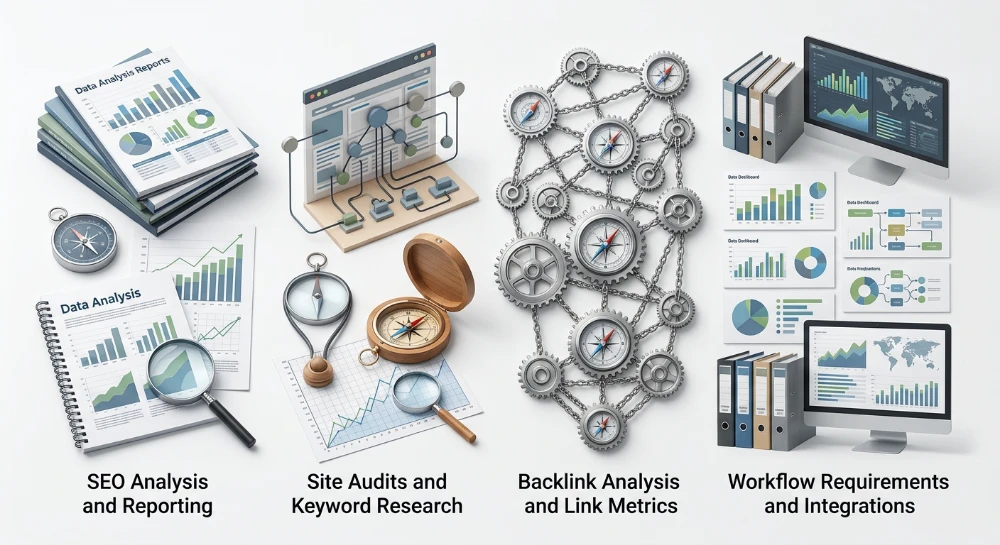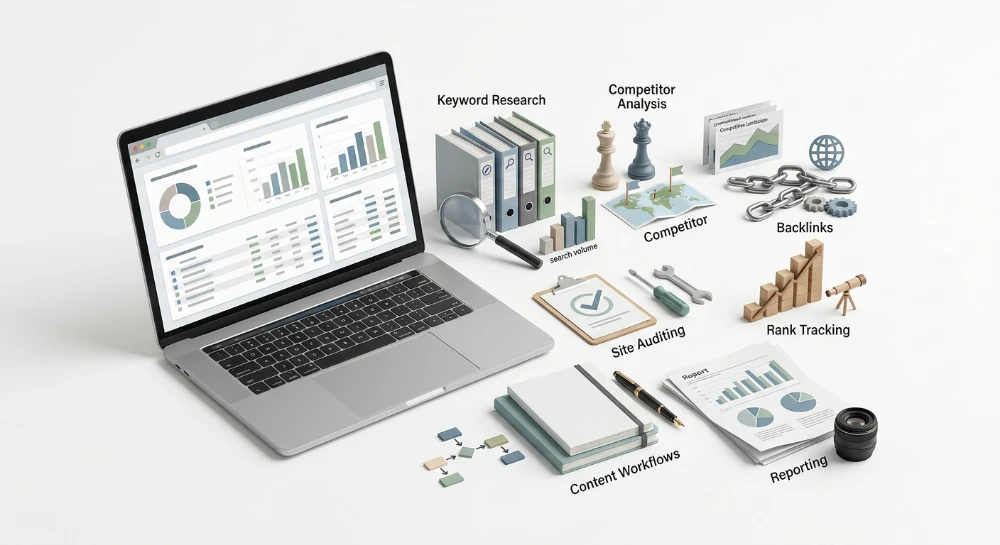
Comparing Ahrefs alternatives involves assessing how different platforms execute core workflows like backlink tracking, keyword research, and technical site audits. While Ahrefs provides a comprehensive data suite for search analysis, specific operational limitations or budget constraints frequently prompt webmasters and marketers to evaluate other market options.
The search for a replacement is usually driven by distinct technical or financial criteria. Teams often seek alternatives to avoid strict credit-based usage limits and API paywalls that restrict bulk data extraction. In other cases, the shift is motivated by the need for more specialized technical SEO audit environments, or a requirement to verify metrics against competing link index sizes and distinct keyword databases.
Because daily search marketing workflows vary widely-from high-volume agency reporting to targeted, pay-as-you-go technical troubleshooting-there is no universal substitute. Selecting a viable alternative depends entirely on matching a project's operational scope against the unique data collection methods, crawling capabilities, and billing structures of each available platform.
Semrush as a direct Full-Suite alternative
Semrush operates as a comprehensive search marketing platform, making it a structural alternative for teams moving away from Ahrefs. Because it combines organic research, technical auditing, and link tracking into a single environment, it targets similar enterprise and agency use cases that require an all-in-one search analysis platform. Evaluating Semrush against Ahrefs rarely centers on finding a narrow specialized utility. Instead, it involves comparing the execution of overlapping core workflows across distinct proprietary data indexes.
Keyword research is a primary area of workflow overlap. Both platforms provide extensive metrics on search volume, keyword difficulty, and search engine results page features. When organizations evaluate Semrush as a replacement, the decision relies heavily on comparing the respective keyword databases. This involves assessing how each platform handles long-tail queries, regional search variations, and niche industries. Teams often run parallel queries during a transition to determine which database offers more complete coverage for their target markets.
Backlink analysis forms the second major functional overlap. Transitioning away from Ahrefs requires a platform capable of executing detailed link profile audits, identifying new inbound links, and analyzing competitor link acquisition strategies. Users evaluate Semrush in this context by comparing its referring domains data against their historical benchmarks. The practical assessment focuses on how the Semrush crawler discovers newly placed links, categorizes link attributes, and reports backlink attrition compared to the Ahrefs link index.
For agencies and enterprise teams deciding between these two comprehensive platforms, the evaluation depends on aligning specific data collection capabilities with daily operational requirements:
- Database scope: Comparing the raw size, regional coverage, and update frequency of keyword databases relevant to specific client campaigns.
- Referring domains data: Verifying the accuracy and discovery speed of the backlink index for ongoing link acquisition monitoring.
- Suite capability: Determining if the platform's execution of core workflows effectively replaces the need to combine multiple specialized applications.
Reverse engineer top SERP rankings and compare 50+ on-page SEO metrics to outrank competitors.
SE ranking and Moz pro for core SEO workflows
For teams transitioning from Ahrefs, Moz Pro provides a comparable workflow for general search analysis. It consolidates foundational SEO tasks into a centralized interface, allowing users to move between site auditing, keyword evaluation, and competitor research using a similar operational logic. This makes it a practical alternative for users who rely on an all-in-one platform for daily search metrics and general diagnostic work rather than strictly specialized technical extraction.
SE Ranking covers similar foundational SEO tasks but contrasts with both Moz Pro and Ahrefs in how it structures user access and billing. The primary distinction lies in how it differs in pricing models. Rather than relying entirely on rigid, flat-rate subscription tiers that bundle preset limits across all tools, SE Ranking allows organizations to adjust subscription parameters based on exact usage needs. Users evaluate this model by calculating their specific requirements for keyword volume and rank tracking update frequencies, which directly dictates the final cost rather than forcing an upgrade to a higher enterprise tier for a single feature limit.
Evaluating either platform as a replacement requires examining how they execute daily operational tasks. Both tools handle core workflows through the following mechanisms:
- Rank tracking: Monitoring target keyword positions across specified search engines and regional markets to measure ongoing organic visibility and identify position fluctuations over time.
- SERP feature monitoring: Scanning search results to detect the presence or loss of featured snippets, image packs, local results, and related questions, providing necessary context for why organic traffic may shift even when standard positions remain static.
- Backlink analysis: Evaluating inbound link profiles to measure referring domains, assess anchor text distribution, and identify link attrition, serving as a direct substitute for ongoing off-page monitoring routines.
Majestic for dedicated backlink profile analysis
Majestic operates strictly as a specialized backlink analysis engine rather than an all-in-one search platform. Users select this tool when their primary evaluation criteria are link index size and referring domains data, bypassing the need to combine off-page research with keyword tracking or technical audits in a single interface.
As a direct substitute for Ahrefs' link exploration tools, Majestic focuses entirely on mapping inbound link profiles. Evaluating this alternative requires comparing how the platform's crawler discovers and reports link relationships. The substitution logic relies on isolating off-page analysis into a dedicated workflow.
Practitioners replacing Ahrefs for link research evaluate Majestic against the following specific data criteria:
- Link index size: Comparing the volume of indexed URLs to determine how many inbound links the crawler actively records and reports for a given target.
- Referring domains data: Assessing the capacity to isolate unique linking root domains from total raw backlinks to evaluate external signals accurately.
- Backlink profile analysis: Extracting source URLs, target pages, and anchor text distribution to audit existing link profiles or reverse-engineer competitor off-page strategies.
The primary trade-off when adopting Majestic is the strict separation of SEO workflows. Because the platform focuses exclusively on backlink profiling and link data extraction, teams use it to fulfill a single specialized requirement rather than consolidating their entire search analysis process into one platform.
Bulk domain metrics and PBN checker
Screen vendors with our bulk domain metrics and PBN checker to detect toxic networks and avoid link fraud.
Screaming frog SEO spider and SEO PowerSuite
Shifting from a cloud-based platform to a desktop application fundamentally changes how search analysis and site crawling are managed. Desktop alternatives process data using local hardware resources rather than server-side infrastructure, appealing to users who need to bypass the strict usage allowances inherent in web-based subscriptions.
Screaming frog SEO spider for technical audits
Screaming Frog SEO Spider serves as a direct alternative to cloud-based site audit tools. While Ahrefs manages technical evaluations through its proprietary servers, Screaming Frog executes technical site audits directly from the user's local machine.
The primary evaluation criterion when adopting this alternative is how site crawling limits are enforced. Cloud platforms restrict technical audits using monthly URL crawl credits tied to specific subscription tiers. Once the allowance is depleted, auditing stops until the next billing cycle. In contrast, Screaming Frog's site crawling limits are dictated entirely by the allocated memory and storage of the local hardware. Practitioners auditing massive domains configure local RAM settings or use database storage mode to process millions of URLs without encountering arbitrary credit caps.
This creates a specific trade-off: organizations remove recurring cloud limits for technical SEO audits but assume responsibility for supplying the necessary hardware capacity to run deep site extractions.
SEO PowerSuite and desktop bundling
SEO PowerSuite provides an alternative through a desktop bundle approach. Rather than unifying backlink analysis, keyword research, and site auditing into a single web dashboard, the suite separates these workflows into distinct local applications.
The core distinction for SEO PowerSuite lies in its pricing and licensing model. It offers lifetime license options, which contrasts directly with the cloud-based credit systems utilized by platforms like Ahrefs. Users evaluate this model when their primary goal is to minimize recurring subscription costs and eliminate the ongoing depletion of credits for routine reporting and data extraction.
| Evaluation Criterion | Cloud Environments (Ahrefs) | Desktop Alternatives |
|---|---|---|
| Technical Crawling Limits | Restricted by monthly credit allowances and subscription tiers | Determined by local hardware memory and storage capacity |
| Pricing Structure | Cloud-based recurring credit system | Lifetime license options and hardware-based execution |
| Workflow Design | Unified web-based dashboard | Separated desktop bundle approach |
By moving the processing burden to local hardware, desktop alternatives allow teams to run extensive technical evaluations and continuous data updates independently of cloud-based paywalls, provided their local machines can handle the required data loads.
SpyFu and mangools for niche research workflows
When search analysis requirements narrow to specific tasks, organizations frequently evaluate alternatives that isolate exact workflows. Rather than adopting a broad platform intended for every aspect of search optimization, teams utilize SpyFu and Mangools as specialized alternatives for targeted research.
Mangools serves as a highly relevant alternative for users focused primarily on keyword research. Comprehensive platforms bundle technical site auditing and extensive backlink exploration into their core offerings, which exceeds the requirements of strictly content-focused workflows. Mangools isolates keyword evaluation, providing a focused environment for identifying search terms and analyzing search engine results.
SpyFu provides a distinct alternative designed specifically for competitor analysis. Its primary distinction is a specific overlap in PPC insights, catering directly to users who combine organic and paid search evaluations. While broader platforms prioritize organic link data and technical health, SpyFu aligns with workflows that require evaluating a competitor's search visibility across both SEO rankings and paid search campaigns simultaneously.
| Alternative Platform | Primary Workflow Focus | Evaluation Criterion |
|---|---|---|
| Mangools | Keyword Research | Chosen when the primary requirement is isolating keyword ideation and evaluation without full-suite technical overhead. |
| SpyFu | Competitor Analysis | Chosen when the workflow requires combined insights from both organic search visibility and PPC campaigns. |
Bulk Google and Yandex index checker
Verify agency reports and track live SERP status in Google and Yandex to protect your SEO ROI.
Sistrix and serpstat for search visibility signals
When evaluating alternatives to Ahrefs' main dashboard, Sistrix and Serpstat provide specific capacities for handling rank tracking and visibility metrics. Teams analyzing domain presence utilize these platforms to monitor ranking positions and evaluate how a site performs across search environments.
Sistrix is highly relevant for tracking broad visibility signals across search engines. The platform evaluates domain performance by analyzing overall search visibility, making it a practical substitute for workflows that prioritize market share analysis over backlink exploration. Users rely on Sistrix to track these broad signals to gauge how a domain ranks relative to competitors and how its search presence changes over time.
Serpstat serves as another platform covering core workflows. It provides rank tracking capabilities alongside broader search analysis functions. Users can substitute Ahrefs' dashboard with Serpstat to monitor keyword positions and evaluate domain visibility trends. By integrating tracking metrics with standard research functions, Serpstat supports workflows that require combining visibility monitoring with general search optimization tasks.
| Alternative Platform | Visibility Focus |
|---|---|
| Sistrix | Tracking broad visibility signals across search engines to evaluate overall domain performance. |
| Serpstat | Covering core workflows while providing rank tracking and visibility metrics alongside general search analysis. |
SeLinkPro for Pay-As-You-Go technical audits and link monitoring
SeLinkPro operates as an alternative for teams seeking to avoid the credit-based subscription limits typical of all-in-one search platforms. Instead of utilizing recurring monthly tiers, the platform functions on a strict Pay-As-You-Go economy with no monthly subscriptions and a minimum deposit requirement of $5.00. This structure allows organizations to execute specific research, auditing, and monitoring tasks without committing to ongoing plan quotas or losing unused credits at the end of a billing cycle.
For workflows requiring domain evaluation, SeLinkPro includes a bulk domain metrics tool that aggregates multiple industry metrics into a single interface. It natively retrieves Ahrefs Domain Rating (DR) and organic traffic estimations without requiring users to supply third-party API keys. By consolidating these metrics, the platform supports link prospect evaluation and backlink auditing directly within the application.
The platform provides a technical SEO audit engine designed to evaluate site architecture and crawling access. The crawler detects server 5xx errors, identifies infinite 301 redirect chains, and locates indexing blockers such as hidden canonicals or injected noindex directives. It also classifies frontend rendering types, identifying server-side rendering (SSR), client-side rendering (CSR), or broken rendering implementations that could interfere with search engine crawling and indexation.
For post-acquisition link management, SeLinkPro features an automated backlink monitor that continuously polls vendor pages. The engine tracks target URLs to detect silent link rot and logs stealthy modifications, such as injected rel attribute changes including nofollow, sponsored, or ugc. It follows full HTTP paths to catch malicious 301 chains or 404 dead ends, providing an audit ledger to document when backlink degradation or unapproved changes occur.
| Platform Module or Action | Pay-As-You-Go Pricing Model |
|---|---|
| Technical SEO Audit | $0.005 per page crawled |
| Bulk Indexation Check | $0.004 per URL |
| Bulk Domain Metrics | $0.04 per domain check |
| Semantic Relevance Tracker | $0.04 per content parse |
| Competitor Analysis | $0.004 per SERP query + $0.01 per page parse + $0.08 per domain metrics check |