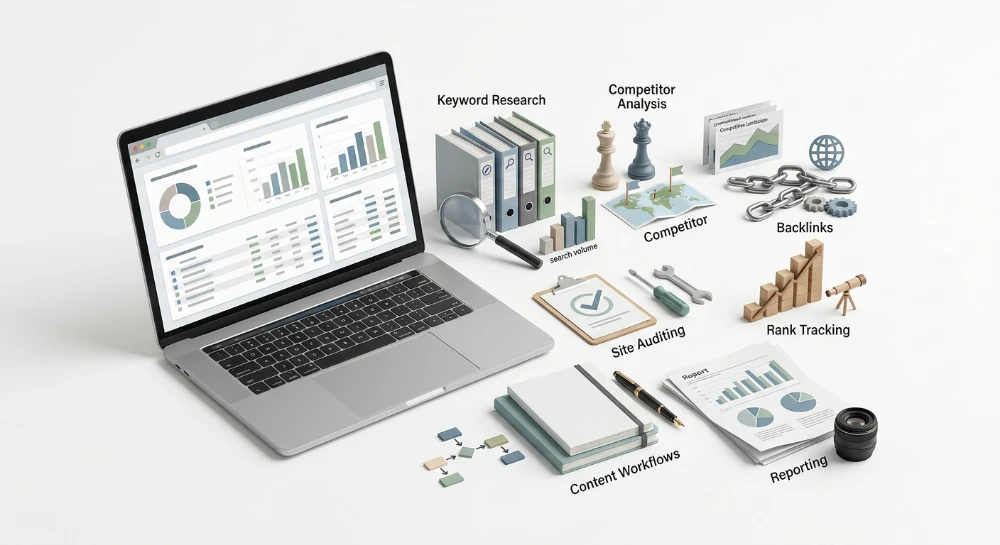
Replacing Semrush involves finding a platform capable of handling an extensive range of competitive and technical SEO data. Because Semrush operates as a massive all-in-one suite, a successful transition means systematically mapping existing daily workflows across keyword research, competitive intelligence, website audits, backlink analytics, rank tracking, and content marketing to a new ecosystem.
The immediate comparison problem hinges on whether a replacement must replicate that centralized architecture or if specialized tools can handle individual modules more efficiently. Different alternatives offer distinct operational models, ranging from direct full-suite cloud competitors and white-label agency platforms to one-time-license desktop software and strict pay-as-you-go technical utilities.
Identifying the appropriate structural alternative requires testing how these platforms process core diagnostic data. Practitioners must verify a replacement's capacity to estimate search volume and keyword difficulty, diagnose technical crawl barriers, monitor referring domains, and track local SERP movements without disrupting established reporting pipelines.
Core criteria for evaluating SEO platforms
Validating a new SEO tool relies on strict diagnostic requirements across primary data categories. The evaluation isolates specific data outputs and functional thresholds necessary to maintain continuity in search analysis.
- Keyword Research: The platform must supply search volume estimates, keyword difficulty metrics, and keyword search intent classifications to qualify target queries accurately.
- Competitive Research: Visibility analysis requires Share of Voice reporting and competitor benchmarking to quantify positioning against identified market rivals.
- Backlink Analytics: Off-page evaluation depends on the capacity to monitor referring domains and manage active link-building workflows without data interruption.
- Website Audits: Diagnostic tools must execute technical diagnostics and verify overall crawlability to expose architectural barriers and indexing blockers.
- Rank Tracking: Ongoing performance measurement requires daily rank tracking updates and granular local SERP tracking configured for distinct geographic targets.
Alongside these functional modules, architectural and administrative features determine overall platform fit for different workflows. The operational evaluation focuses on specific integration, reporting, and billing criteria.
- API access: Programmatic data extraction allows teams to bypass default interfaces and funnel raw metrics directly into external data warehouses or business intelligence environments.
- Custom dashboards: Adaptable reporting layers support the creation of targeted internal displays and tailored client-facing deliverables without relying on fixed vendor templates.
- Usage-based credit systems: As a structural alternative to standard tiered SaaS subscriptions, these billing models tie costs directly to exact consumption, such as the number of pages crawled, queries processed, or domains analyzed.
Reverse engineer top SERP rankings and compare 50+ on-page SEO metrics to outrank competitors.
Ahrefs for backlink analytics and competitive research
Ahrefs operates as a full-suite platform, providing parallel capabilities for teams transitioning away from Semrush. Rather than functioning as a specialized point tool, it is structured to replace the broader toolset required for comprehensive off-page evaluation and market analysis.
The platform addresses the core evaluation criteria for off-page and market analysis through two primary workflows:
- Backlink Analytics: Ahrefs catalogs referring domains and tracks inbound link data. This visibility into off-page signals supports active link-building workflows by allowing search teams to evaluate prospective donor domains, utilize metrics such as Ahrefs DR to assess relative authority, and map competitor link profiles to identify acquisition targets.
- Competitive Research: The platform facilitates competitor benchmarking by analyzing organic search footprints and keyword overlap. This capability allows teams to quantify their positioning against identified market rivals, evaluate search visibility gaps, and model competitive strategies without relying on Semrush reporting templates.
Because both platforms are designed as comprehensive suites, migrating to Ahrefs shifts the specific interface and proprietary metrics used for analysis while maintaining the underlying capacity to execute large-scale backlink and competitor evaluations.
SE ranking for agencies and White-Label reporting
For agencies transitioning away from Semrush, the evaluation process often extends beyond raw data collection to include how that data is packaged and presented to stakeholders. SE Ranking serves as an alternative platform that specifically addresses these operational requirements through agency-friendly packaging and presentation features.
The platform distinguishes itself by focusing on the delivery of SEO analysis to third parties. While it performs standard search analysis, its structural distinction lies in its documented support for white-label reports. This capability allows search teams to strip the platform's proprietary branding from their exports and apply their own agency branding to client-facing deliverables.
For organizations evaluating platform fit based on reporting and client management capabilities, SE Ranking supports the following agency-focused workflows:
- White-Label Deliverables: Reports can be generated and exported without the SE Ranking logo, ensuring that audits, ranking data, and competitor research appear as native agency documents when distributed to clients.
- Custom Dashboards: The platform allows agencies to configure specific views for individual clients. This addresses the need to filter broad SEO data into targeted dashboards that display only the campaign metrics relevant to a particular account.
- Agency-Friendly Packaging: The platform is structured to accommodate multi-client management, allowing teams to separate distinct projects, domains, and deliverables within a single account environment rather than mixing client data.
By integrating these management and presentation features directly into its workflow, SE Ranking provides a specialized alternative for teams whose primary requirement is processing SEO data into branded, client-ready analysis.
Bulk domain metrics and PBN checker
Screen vendors with our bulk domain metrics and PBN checker to detect toxic networks and avoid link fraud.
SEO PowerSuite as a desktop software alternative
Most alternatives to Semrush operate as cloud-based platforms. SEO PowerSuite diverges from this standard architecture by functioning as a locally installed software suite. Instead of accessing a web-based service through a browser, users run the application directly from their own machines. This fundamental structural difference changes how the software is licensed, deployed, and managed.
The core distinction lies in the platform's financial and licensing model. While Semrush and similar cloud platforms rely on standard web-based Software-as-a-Service (SaaS) subscriptions, SEO PowerSuite operates as a one-time-license desktop tool. This configuration provides a distinct procurement path for organizations seeking to bypass recurring monthly or annual software fees.
Transitioning from a cloud environment to a desktop application alters the practical mechanics of executing SEO workflows. Organizations evaluating this structural shift must account for the following implementation differences:
- Local Resource Utilization: Web-based platforms execute heavy database queries and site audits on their own external servers. A desktop application relies on the user's local hardware processor, memory, and internet bandwidth to complete these tasks.
- Data Storage and Governance: Project files, historical search data, and audit configurations are stored directly on the user's local hard drive or internal network. This addresses specific data governance requirements for teams that restrict proprietary site analysis from being hosted on third-party cloud infrastructure.
- Software Procurement: Shifting from a recurring SaaS subscription to a one-time software license alters the payment structure, treating the SEO toolkit as a localized asset rather than an ongoing operational service.
By moving the processing workload and data storage to the user's local environment, SEO PowerSuite provides a clear architectural departure for teams whose primary decision criteria revolve around software licensing models and internal data control.
SpyFu for PPC research and competitor keywords
Organizations evaluating alternatives to Semrush often find that their daily operations do not require a single, unified search platform. For teams that prioritize search marketing intelligence, SpyFu functions as a specialized alternative built specifically for competitive research.
This specialization isolates two distinct operational areas in the search marketing workflow:
- Competitor Keyword Research: Mapping the search terms that trigger competing domains in organic search results to analyze ranking overlaps and identify keyword gaps.
- PPC Research: Tracking paid search visibility to evaluate the specific search queries competitors target within their advertising campaigns.
By isolating paid and organic search data, SpyFu separates itself from platforms that focus primarily on technical SEO. A technical SEO platform centers its architecture around site crawlers designed to diagnose server responses, examine render types, and audit internal linking structures. SpyFu does not operate as a diagnostic site crawler. It relies entirely on external search engine result page data to model competitive visibility, omitting on-page technical diagnostics from its core workflow.
Procurement decisions involving this type of specialized tool depend on how a team divides its search marketing labor. If an organization already utilizes separate tools for technical site auditing and infrastructure analysis, SpyFu provides a dedicated environment for paid and organic keyword intelligence without duplicating technical SEO capabilities.
Run a deep technical crawl to identify 4xx errors, missing meta tags, and indexation blockers.
Specialized alternatives for specific SEO workflows
Organizations do not always adopt a unified platform for their search marketing operations. When a team divides its labor into distinct operational units, adopting specialized tools provides an alternative to purchasing an entire software suite. This modular approach allows practitioners to replace specific Semrush modules with software built exclusively for a single task.
The following specialized tools map directly to distinct SEO workflows:
- Moz Pro: Serves as an alternative for domain evaluation. It is specifically relevant for workflows that rely on analyzing and reporting Domain Authority.
- Majestic: Operates as a specialized replacement for link analysis. Teams utilize Majestic when their backlink auditing workflow requires dedicated backlink indexes rather than a broad suite of marketing tools.
- Mangools: Replaces general keyword research modules by targeting a distinct search criteria. It is relevant for content workflows focused entirely on identifying and targeting low-competition keywords.
- Screaming Frog SEO Spider: Functions as a direct alternative to the Semrush Site Audit module. It operates as a dedicated crawler that extracts on-page data and evaluates technical architecture without bundling off-page or keyword research features.
- Clearscope: Provides an alternative to on-page writing assistants. It isolates the content production workflow, offering a focused environment that supports content optimization based on search relevance requirements.
Selecting from these specialized options depends on the exact technical gaps in an existing software stack. By mapping each tool to its specific operational requirement, organizations construct a customized environment that addresses domain analysis, link auditing, keyword discovery, technical crawling, and content optimization individually.
SeLinkPro for technical audits and Pay-As-You-Go billing
SeLinkPro operates as a modular platform focused entirely on technical SEO, backlink monitoring, and competitor analysis. The platform differs structurally from comprehensive SaaS marketing suites through a strict Pay-As-You-Go billing model. Rather than operating on fixed monthly subscriptions with tiered feature access, users fund an account with a minimum deposit of $5.00 and incur charges only for specific resources consumed. This structure addresses workflows where SEO tool usage fluctuates or where teams require dedicated technical modules without maintaining subscriptions for unused features.
The platform executes technical SEO audits through a crawling engine that analyzes architecture and indexing configurations. The crawler detects server-level 5xx errors, internal and external 4xx broken links, and infinite 301 redirect chains. It also evaluates how page content is delivered by categorizing rendering types into server-side rendering (SSR), client-side rendering (CSR), or flagging broken SSR implementations that block search engine access.
For off-page workflows, SeLinkPro handles automated backlink monitoring. The tracking module continuously polls vendor pages to identify dropped links and stealthy link attribute manipulation. It detects undocumented alterations, such as injected rel="nofollow" tags, inserted rel="noindex" directives, and crawler blocks deployed via hidden canonicals or robots.txt exclusions. By tracking these variables, the platform creates an audit ledger that records historical snapshots of donor pages to identify silent backlink degradation.
The SEO competitor analysis module automates the reverse engineering of top search engine results pages (SERPs). The tool evaluates over 50 specific on-page and technical metrics across ranking URLs. This allows teams to benchmark technical performance, heading structures, and content configurations against active search competitors directly from live SERP data.
Resource consumption is tracked per action across the separate modules:
- Technical SEO Audit: $0.005 per page crawled.
- Competitor Analysis: $0.004 per SERP query, $0.01 per page parse, and $0.08 per domain metrics check.
- Bulk Indexation Check: $0.004 per URL.
- Bulk Domain Metrics: $0.04 per domain check.
Selecting SeLinkPro relies on isolating technical and off-page monitoring from general keyword discovery, replacing bundled monthly allocations with metered execution for specific auditing tasks.