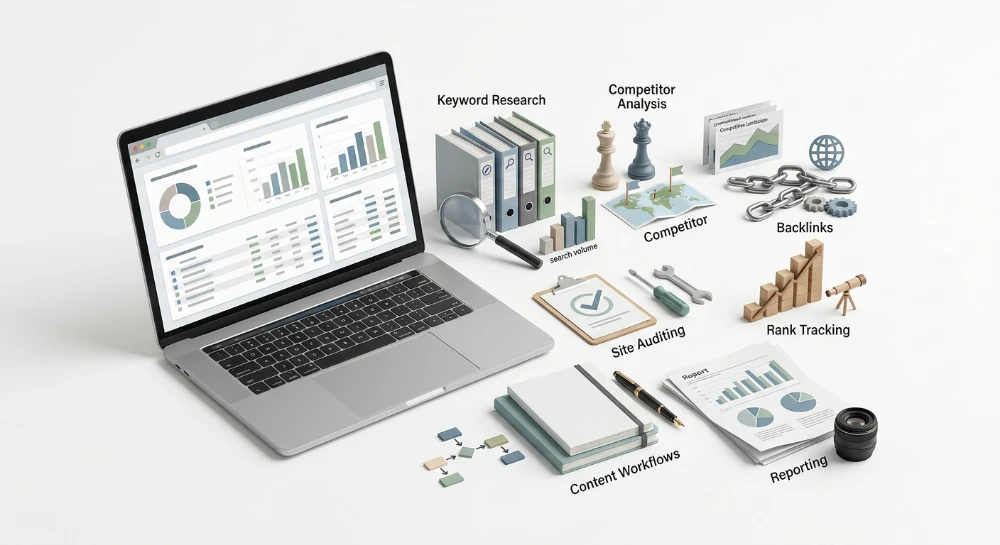
When marketers and webmasters outgrow the data limits or basic reporting features of their initial search marketing software, finding the right Ubersuggest alternative means directly comparing how different platforms handle keyword research, technical site audits, backlink analysis, competitor analysis, and rank tracking. The appropriate replacement depends on whether the current workflow requires massive enterprise-level data indexing, multi-client agency management, or highly specific technical auditing.
A primary distinction among competing SEO tools is the structural difference in their pricing and access models. While many teams transition to comprehensive full-suite platforms that bundle advanced competitive intelligence into higher monthly subscriptions, others shift toward strict pay-as-you-go systems that charge only for exact resources used, such as per-page technical crawls or individual domain metric checks. Balancing these access models against daily data requirements prevents the accumulation of unnecessary software overhead.
Selecting a practical upgrade requires isolating exact workflow gaps rather than looking for a generic identical replacement. Matching a platform’s specific strengths-whether that involves validating PPC keyword difficulty, auditing complex internal link architecture, or automating real-time backlink monitoring-ensures the new software aligns directly with the actual search optimization tasks at hand.
Core evaluation criteria for SEO software replacements
Moving away from an entry-level SEO tool requires a structured evaluation of how a new platform handles data acquisition, system integration, and billing. The decision rests on three foundational pillars: the accuracy of the underlying data sets, the availability of API access for custom reporting, and the alignment of the pricing model with actual usage requirements.
When assessing potential replacements, the software must meet specific data requirements across both organic research and technical auditing. Core capabilities to evaluate include:
- Evaluating search volumes to gauge accurate organic traffic potential across different regions and search engines.
- Assessing keyword difficulty scores to determine the resource investment required to compete for specific queries.
- Analyzing cost-per-click (CPC) metrics to validate commercial intent and understand paid search competition.
- Accessing historical SERP data to track algorithm volatility and monitor long-term competitor performance trends.
- Identifying crawl errors to ensure search engine bots can properly navigate and index the site architecture.
- Evaluating on-page issues to diagnose missing metadata, rendering failures, or structural HTML flaws.
- Tracking search visibility to monitor rank fluctuations for target keywords across specific geographic locations and devices.
- Supporting content optimization by providing semantic recommendations, topical relevance data, and entity extraction.
Beyond the raw metrics, evaluating data accuracy involves checking how frequently a tool updates its backlink index and keyword databases. Stale data can lead to inaccurate competitive analysis or missed technical errors. API access serves as another critical differentiator. Software platforms providing robust APIs allow teams to pull exact metrics into external data visualization dashboards, warehouse data for historical tracking, or automate client reporting workflows. Tools lacking API support often create bottlenecks for agencies or enterprise teams that rely on custom integrations.
Finally, pricing models dictate long-term scalability and operational efficiency. The market offers distinct billing structures, ranging from comprehensive monthly subscriptions that bundle various toolkits under tiered data limits, to strict pay-as-you-go systems. Pay-as-you-go models charge only for the exact resources consumed, such as per-page technical crawls or individual domain metric checks. Aligning the software's pricing structure with the exact frequency of technical audits, backlink monitoring, and keyword research prevents the accumulation of unnecessary software overhead.
Reverse engineer top SERP rankings and compare 50+ on-page SEO metrics to outrank competitors.
SE ranking and mangools: Agency and keyword workflows
SE Ranking and Mangools serve as distinct software alternatives, each addressing different operational requirements for search marketing teams. Evaluating these platforms requires matching their specific capabilities to the team's primary daily tasks, particularly regarding client reporting structures and keyword discovery.
SE Ranking is structured to support multi-client management, making it highly suitable for agency workflows. The platform allows agencies to segment search data across different client accounts and maintain separated campaign environments. Additionally, SE Ranking provides white-label reporting capabilities. This function enables search marketing teams to generate performance documents under their own brand identity, removing third-party software branding before delivering updates to external clients or internal stakeholders.
Mangools addresses a different primary use case through its provision of the KWFinder tool. For users seeking a focused environment for search term analysis, KWFinder offers a comparable workflow for keyword research. The tool is built specifically to facilitate the discovery and evaluation of target queries, providing a streamlined interface for teams whose primary focus is content planning and keyword validation rather than complex client management.
The operational divide between these two alternatives centers on structural complexity and reporting needs:
- SE Ranking aligns with workflows that require managing multiple distinct client campaigns and producing white-label reports for external distribution.
- Mangools aligns with workflows where the primary operational requirement is dedicated keyword research utilizing the KWFinder tool.
Semrush and Ahrefs: Advanced Full-Suite platforms
For users requiring deeper data than standard research tools provide, SEMrush and Ahrefs operate as expanded platforms. Both alternatives move beyond basic keyword discovery to offer extensive datasets, though they approach search analysis with different structural priorities.
SEMrush is built to provide comprehensive competitive intelligence across multiple digital marketing channels. A primary operational difference is that SEMrush supports both organic research and paid research within the same interface. This capability allows search marketers to analyze a competitor's total search engine footprint, evaluating overlapping strategies between SEO campaigns and pay-per-click advertising. Teams can pull data on competing paid search terms, ad copy, and organic rankings to form a broader view of market visibility.
Ahrefs structures its primary workflow around an advanced backlink database. For operations that prioritize off-page SEO and link acquisition research, Ahrefs provides the Site Explorer Tool to facilitate detailed domain analysis. This tool allows users to evaluate an exact URL or an entire domain, revealing historical link profiles, referring domains, and the specific anchor text distribution pointing to competitor assets.
When deciding between these two expanded platforms, the evaluation depends on a team's primary analytical requirements:
- SEMrush aligns with workflows that require broad competitive intelligence, specifically where teams manage both organic search strategy and paid advertising research.
- Ahrefs aligns with workflows that prioritize off-page analysis, requiring deep backlink data and detailed domain evaluation utilizing the Site Explorer Tool.
Bulk domain metrics and PBN checker
Screen vendors with our bulk domain metrics and PBN checker to detect toxic networks and avoid link fraud.
SpyFu, Majestic, and Moz pro: Specialized search analysis
While some organizations require broad, multi-channel platforms, specific search marketing workflows often benefit from tools that focus on a distinct analytical discipline. Platforms such as SpyFu, Majestic, and Moz Pro function as alternatives by providing specialized datasets for targeted SEO and PPC tasks.
SpyFu is structured to support competitor strategies with a distinct focus on PPC keyword validation. Rather than operating strictly as a general-purpose SEO platform, SpyFu evaluates the historical paid search activity of competitor domains. This capability allows search marketers to validate the financial viability of specific keywords by analyzing historical ad placements, overlapping paid and organic search terms, and competitor bidding strategies. Teams utilize SpyFu when the operational requirement is to bridge the gap between organic search research and paid acquisition planning.
Majestic serves a different operational requirement, focusing almost entirely on off-page analysis. It acts as a specialized alternative by supporting deep link profile evaluation. Instead of distributing its resources across content audits and keyword research, Majestic focuses on mapping external backlinks and referring domains. This deep evaluation supports workflows dedicated to link acquisition, competitor backlink auditing, and analyzing the distribution of inbound links across a domain.
Moz Pro provides a different specialization through its distinct Keyword Explorer tool. This tool evaluates search terms by analyzing volume metrics, SERP features, and keyword difficulty. The platform centers its workflow on providing structured keyword data to help teams prioritize target phrases and align content optimization efforts with documented search demand.
When selecting a specialized platform for search analysis, the decision criteria rely on identifying the specific data gap in a team's workflow:
- SpyFu aligns with operations that require PPC keyword validation and detailed analysis of competitor paid search strategies.
- Majestic aligns with off-page workflows that require deep link profile evaluation and historical backlink data.
- Moz Pro aligns with search and content research workflows that specifically require the distinct Keyword Explorer tool for evaluating search term viability.
SeLinkPro: Pay-As-You-Go technical audits and backlink monitoring
SeLinkPro provides a distinct operational model for search engine optimization by removing monthly subscription tiers entirely. Instead of restricting users to fixed account limits or recurring billing, the platform operates on a strict pay-as-you-go economy requiring a minimum deposit of $5.00. This structure supports users who need to run specific data processes without maintaining an ongoing software subscription.
The platform divides its capabilities into modular tools, billing only for the exact volume of data requested during a specific task. This model is applied across its primary workflows for on-page auditing, search result analysis, and off-page tracking:
- Technical SEO Audits ($0.005 per page crawled): The auditing engine evaluates site architecture by detecting active indexing blockers and 5xx server errors. During the crawl, it classifies specific rendering types to verify how content is served to search engines. The tool also utilizes text embeddings to identify instances of near-duplicate content across a domain.
- Competitor Analysis ($0.004 per SERP query + $0.01 per page parse + $0.08 per domain metrics check): This module reverse-engineers the top results on Google for targeted keywords. It pulls the ranking URLs and compares their on-page metrics, allowing teams to evaluate the technical and content configurations of competing pages without a dedicated search research subscription.
- Automated Backlink Monitoring: The platform tracks acquired external links without the URL limits typical of subscription plans. The monitoring engine continuously polls donor pages to track silent link rot and alerts users to stealthy injections of 'nofollow' attributes. It also follows HTTP paths to identify malicious 301 redirect chains that alter how link equity flows to the target domain.
By isolating costs to the specific page crawled, SERP queried, or page parsed, SeLinkPro serves as a targeted utility. It operates as a direct alternative for practitioners who require deep technical evaluations and link monitoring but prefer to tie their software expenses directly to their immediate processing requirements.