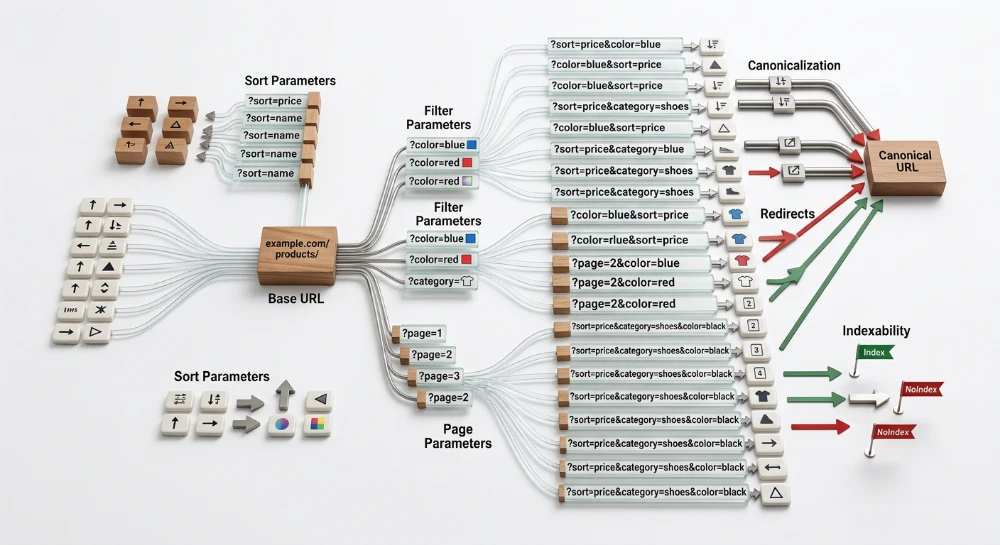
URL parameters provide a highly flexible way to pass data between a server and a browser, enabling essential site functions like faceted filtering, product sorting, and campaign tracking. However, because search engine crawlers treat every unique character string as a distinct web address, a single base page can easily spawn thousands of duplicate URLs through these appended query strings. When variations like ?color=blue, ?sort=price, or ?utm_source=email are added to a URL, the core page content often remains identical or appreciably similar, yet search engines encounter each variation as a completely separate destination.
This structural mechanic behind dynamic URLs poses a specific challenge for duplicate content management. Uncontrolled parameter permutations can create a practically infinite crawl space, potentially spreading ranking signals across redundant variations and making it difficult for search engines to determine which version of a page should be prioritized for indexation. The SEO impact depends heavily on how the parameters interact with the page environment. Some parameters actively filter or alter the content rendered to the user, while others passively track session data without changing the page experience at all.
Effectively managing these dynamic variations requires more than a single, universal fix. A robust strategy evaluates the functional behavior of each query string to determine the correct technical response. By properly identifying parameter types, webmasters can deploy the right combination of canonical tags for signal consolidation, indexability directives to prevent index bloat, and robots.txt rules to preserve crawl efficacy-ensuring that dynamic URL structures serve users without compromising search visibility.
The mechanics of parameter duplication
A URL parameter, often referred to as a query string, modifies a static URL through a strict structural syntax. The dynamic sequence begins with a question mark appended directly to the end of a URL path. Data within this string is formatted into key-value pairs separated by an equals sign. When a URL requires multiple parameters, an ampersand joins each sequential pair. For example, in the URL
/category/shoes?color=black&size=10
, the question mark initiates the query, while the keys
color
and
size
are assigned the specific values
black
and
10
.
Duplication begins at the value level when a single parameter key accepts varying data without changing the core HTML payload. If a web server responds to
?session=1234
and
?session=5678
by delivering the exact same page structure and content, the site has generated two distinct URLs for a single document. Because a parameter value can often be any alphanumeric sequence generated by a tracking system or user session, a single key can spawn a practically unlimited number of URL permutations.
The duplication scales geometrically when multiple parameters are combined. Most web applications and server-side databases process query strings regardless of the sequence in which the parameters appear. As a result, a request for
?size=large&color=blue
functions identically to a request for
?color=blue&size=large
. While the server parses both requests and renders the same resulting page to the user, a search engine crawler evaluates URLs as literal character strings. Any difference in character sequence, including a simple reordering of identical key-value pairs, produces a mathematically distinct URL.
Further duplication occurs when arbitrary or unused parameters are appended to a URL. If a query string contains a key that the server logic does not recognize or actively use to filter the page, the application typically ignores the parameter and serves the default page content. The unrecognized key-value pair remains visible in the URL string, meaning an infinite number of exact duplicate pages can be generated simply by attaching random or unused parameters after the question mark.
Run a deep technical crawl to identify 4xx errors, missing meta tags, and indexation blockers.
Categorizing parameter behavior: Active vs. passive
To manage dynamic URLs effectively, the first step is to audit the functional behavior of each query string parameter. Search engines evaluate the resulting page content to understand how a parameter influences a document. From a technical and SEO perspective, URL parameters fall into two distinct categories: active and passive.
Active parameters
Active parameters change the visible content, structural layout, or specific data returned to the browser. When an active parameter is appended to a URL, the server actively processes the key-value pair and modifies the HTML response accordingly. Common examples of active parameters include:
-
Faceted filtering that narrows a category page, such as
?color=black&size=large -
Sorting controls that reorder the display of items, such as
?sort=price-desc -
Pagination that advances a user through a series of item sets, such as
?page=3 -
Internal site search queries that return specific keyword results, such as
?q=mechanical+keyboards -
Language or localization modifiers that alter the content language, such as
?lang=fr
Because active parameters alter the document, they generate near-duplicate or overlapping content rather than exact duplicates. The SEO challenge with active parameters involves evaluating search intent. A single-facet URL filtering a product list by a popular brand might be valuable for indexation, while a multi-facet URL combining brand, color, size, and a sorting rule likely creates thin, redundant content that dilutes search signals.
Passive parameters
Passive parameters have no effect on the page content or layout. The application, web server, or a client-side analytics script may record the parameter data for operational purposes, but the HTML document delivered to the user is functionally identical to the base URL without the parameter. Common examples of passive parameters include:
-
Traffic tracking codes used by analytics platforms, such as
?utm_source=newsletter&utm_medium=email -
Session IDs used to maintain a user state, authentication, or cart data, such as
?session_id=98765abc -
Affiliate identifiers used to attribute referral traffic or sales, such as
?affiliate_id=12345 -
Click identifiers generated by advertising networks, such as
?gclid=xyz
Passive parameters are primary contributors to exact-duplicate content. Since the server largely ignores these key-value pairs when rendering the page, a search engine crawler evaluates multiple technically distinct URLs that all present the exact same content.
How categorization dictates mitigation strategy
Correctly identifying whether a parameter is active or passive dictates the appropriate technical SEO mitigation strategy. Treating all query strings with a single universal rule often leads to unintended indexing consequences.
For passive parameters, the technical strategy requires consolidation. Since the page content never varies, the objective is to unify all URL permutations into a single authoritative URL. This prevents signal dilution across redundant pages and ensures search engines do not expend crawl capacity retrieving identical documents that differ only by tracking codes.
For active parameters, the technical strategy requires selective crawl and indexation controls. Because the content changes, webmasters must differentiate between useful parameter combinations that satisfy specific search demand and excessive permutations that cause index bloat. Applying a blanket consolidation rule to active parameters can inadvertently strip valuable, distinct content out of a search engine index, while leaving them entirely unmanaged allows exponential combinations of faceted navigation to overwhelm crawler capacity.
Signal dilution, index bloat, and crawl efficacy
Unmanaged URL parameters create compounding technical issues. When a web server generates distinct URLs for mathematically identical or near-identical content, search engines process these permutations as individual documents. This behavior scales rapidly, leading to three distinct but related challenges: signal dilution, index bloat, and reduced crawl efficacy.
Signal dilution across redundant URLs
External websites and internal linking modules often link to parameterized variants rather than the primary URL. For example, marketing campaigns distribute links containing passive tracking parameters, or users share URLs copied directly from a sorted category page.
When search engines encounter these inbound links, the associated ranking signals, such as PageRank and anchor text relevance, are distributed across the various URL permutations. While search engine algorithms attempt to consolidate these signals automatically by identifying a primary canonical URL, relying on algorithmic consolidation is not absolute. Without explicit technical directives, the total link equity intended for a single piece of content remains split among multiple duplicate pages. This distribution weakens the individual ranking signals for any single URL version, potentially reducing the overall visibility of the core content.
Index bloat from parameter permutations
Index bloat occurs when search engines include hundreds or thousands of low-value parameter URLs in their index. This condition frequently stems from additive filters or active parameters that alter page content too slightly to warrant distinct indexation.
A bloated index complicates site architecture evaluation and canonical resolution. When a search engine indexes multiple sorting parameters alongside the base category page, it must determine which version to return for a user query. If the engine selects a parameterized version as the canonical document, search results may present users with highly specific, pre-sorted pages that do not match their broader intent. Additionally, a high ratio of duplicate or near-duplicate parameter pages to unique content pages can lower the average quality of the domain's indexed footprint.
Crawl efficacy and infinite parameter spaces
The most severe operational impact of unmanaged parameters involves crawl capacity. Search engine crawlers operate with practical limits on how many URLs they will request from a given domain within a specific timeframe, often based on server response times and the perceived popularity of the site.
Faceted navigation and active filtering systems can generate an infinite mathematical space of URL combinations. If a category page features ten filters, and each filter has multiple options, the possible parameter strings generated by combining them run into the millions. Because crawlers systematically follow links to discover content, they will request highly complex combinations just as they would distinct product pages.
When search engines expend crawl capacity retrieving excessive low-value parameter permutations, crawl efficacy drops. This inefficiency delays the discovery of newly published pages, slows the processing of updated content, and causes important architectural changes to remain unrecognized for longer periods. Managing operations at this scale requires precise technical controls to prevent crawlers from accessing the infinite combination space entirely.
SEO structure and reciprocal link analyzer
Detect orphan pages, deep click depths, and toxic reciprocal links built by careless agencies.
Diagnosing parameter duplication
Identifying the scope and impact of parameter duplication requires evaluating both the structural presence of dynamic URLs and how search engines interact with them. A thorough diagnostic process relies on simulated crawls, server log analysis, and search engine reporting to build a complete picture of parameter behavior.
Simulating discovery with site audit tools
Site audit tools map the extent of parameter-driven URLs by following internal links and filtering systems. To evaluate parameter duplication accurately, configure the crawler to process URL parameters rather than stripping or ignoring them. This ensures the tool discovers the same complex URL variations that a search engine might encounter.
Once the crawl completes, filter the resulting URL inventory for strings containing question marks or ampersands. Overlapping content can be identified by reviewing pages that share identical title tags, matching H1 elements, or high content similarity scores. By grouping these URLs based on their parameter keys, you can isolate which specific parameters generate redundant pages and which produce unique, indexable content.
Analyzing crawler behavior in web server logs
While site audits reveal what is technically available to crawl, web server logs provide empirical data on exactly what search engine bots are requesting. Filtering server log files for known search engine user agents alongside URL query strings reveals the actual distribution of crawl activity across the parameter space.
Log analysis helps answer specific diagnostic questions:
- Are search engine crawlers spending disproportionate time requesting passive tracking variants or complex faceted filter combinations?
- How frequently do bots revisit parameter URLs compared to the primary canonical pages?
- Are legacy parameters that no longer exist in the current site architecture still being crawled due to historical indexation or external links?
High request volumes to duplicate parameter URLs indicate that search engines are expending capacity on redundant variations. This data helps prioritize which parameter keys require immediate crawl controls or consolidation directives.
Evaluating Google search console canonicalization
To determine how Google interprets specific parameter variants, use the Google Search Console URL Inspection tool. Submitting a known parameterized URL provides visibility into Google's canonicalization decisions for that exact variant.
Review the indexing status report, paying specific attention to the comparison between the user-declared canonical and the Google-selected canonical. If the user-declared canonical points to the clean, non-parameterized URL and Google selects that same URL, the duplication is being handled correctly at the indexation layer.
If Google selects the parameterized version as the canonical, or chooses a different URL entirely, it indicates a signal conflict. This mismatch often occurs when internal linking heavily favors the parameterized URL, when the canonical tag is missing, or when the parameterized page contains content that Google deems substantially different from the declared canonical page. Identifying these mismatches dictates whether the mitigation strategy should focus on updating internal links, enforcing stricter canonical tags, or implementing server-side redirects.
Using canonical tags to consolidate variants
The rel="canonical" link element allows search engines to identify the primary, representative version of a page when multiple URLs return identical or highly similar content. For passive tracking parameters, such as affiliate identifiers or campaign tags, the canonical tag on the parameterized URL should point to the clean, non-parameterized version. This instructs search engines to attribute any link signals associated with the parameterized URL to the primary page.
This consolidation strategy also applies to minor sorting parameters. When a URL parameter merely alters the display order of a product grid or list without changing the core inventory, pointing the canonical tag from the sorted variant to the default category URL prevents search engines from indexing redundant order variations.
Implementation requires placing the canonical link element within the document head or returning it via the HTTP header. The href attribute should contain the absolute URL, including the correct protocol and domain. Using absolute URLs prevents relative path resolution errors that frequently occur when web servers interpret dynamic query strings as directory paths.
<link rel="canonical" href="https://example.com/category/product-page/" />Implementing Self-Referencing canonicals
A self-referencing canonical is a tag placed on the primary, non-parameterized page that points to its own URL. While it may seem redundant to point a page to itself, this configuration serves as a technical safeguard against spontaneous parameter additions.
External websites, social media platforms, and users frequently append custom query strings to URLs when linking or sharing content. If a search engine discovers a link to an internal page with an unrecognized, third-party parameter appended to it, the engine will crawl that specific URL string. If the page lacks a self-referencing canonical, the search engine may index this newly discovered URL as a distinct document.
When a self-referencing canonical is hardcoded or properly generated by the content management system for the primary page, any subsequent rendering of that page with unexpected parameters will output the same canonical tag. As a result, the newly generated parameterized page automatically contains a directive pointing back to the clean URL. This standardizes the indexation signal regardless of how many external tracking parameters are spontaneously appended to the URL in the wild.
Bulk Google and Yandex index checker
Verify agency reports and track live SERP status in Google and Yandex to protect your SEO ROI.
Crawl directives vs. indexation rules for dynamic URLs
Managing parameter-driven URLs requires distinguishing between crawl directives and indexation rules. While canonical tags suggest a preferred URL for signal consolidation, they do not prevent search engines from crawling the alternate parameter combinations. When dealing with extensive dynamic URL generation, technical configurations must use either a robots.txt Disallow rule or a meta robots noindex directive to manage how search engines interact with the resulting pages.
Preserving crawl efficacy with robots.txt disallow
A robots.txt Disallow rule operates at the server level, instructing well-behaved crawlers not to request specific URL paths. This is a strict crawl directive, not an indexation rule.
This approach is required for infinite faceted navigation spaces. E-commerce and large directory sites frequently allow users to filter by multiple attributes simultaneously, such as price, color, brand, and size. Because these parameters can be appended in any order and combined endlessly, they create a mathematical trap for automated crawlers. Permitting a search engine to request millions of parameter combinations uses crawl capacity on mathematically redundant pages.
Implementing a pattern match in the robots.txt file stops the crawler from accessing the specific parameter strings entirely before the server has to render the page.
User-agent: *
Disallow: /*?*sort=*
Disallow: /*?*price=*
Managing additive filters with the noindex directive
The meta robots noindex tag is an indexation rule placed in the HTML header or HTTP response. It permits the search engine to request and crawl the URL but instructs it to omit the page from the search index.
This directive is useful for additive filtering parameters where the resulting page contains unique outbound links that the search engine needs to discover, but the page itself does not warrant standalone indexation. For example, a specialized category filter might display a distinct subset of recently added products. Applying a noindex tag prevents the filtered page from competing in the search index, while still allowing the crawler to read the HTML and follow the product links to discover deeper site content.
Trade-offs in signal consolidation
Selecting between a canonical tag, a noindex directive, and a robots.txt Disallow involves strict trade-offs regarding how ranking signals are processed.
When a parameter URL is blocked by robots.txt, the crawler cannot view its HTML content. Consequently, it cannot read a canonical tag on that page, nor can it follow its outbound links. Any external links pointing to the disallowed URL cannot pass their signals to the primary version of the page, because the search engine cannot crawl the URL to establish the relationship.
Similarly, a noindex directive prevents the page from being indexed, but it does not consolidate ranking signals to another URL. Furthermore, search engines typically treat a long-standing noindex tag as an instruction to eventually stop crawling the page entirely. When this occurs, any links on that page are no longer followed, negating the initial benefit of allowing the page to be crawled for link discovery.
A common configuration failure is combining a canonical tag with a noindex directive on the same parameter URL. These are conflicting instructions. The canonical tag requests that the search engine index the primary URL and consolidate signals, while the noindex tag instructs the engine to drop the page from the index entirely. Search engines usually select one directive to follow and ignore the other. When signal consolidation is the primary goal, a canonical tag without a noindex directive is the required configuration. When preserving crawl capacity against infinite parameters is the priority, a robots.txt Disallow is necessary.
Server-Side consolidation and redirects
While on-page directives manage how search engines interpret URLs after they are crawled, server-side configurations can prevent redundant parameter combinations from being served in the first place. Enforcing strict URL rules at the server or network edge ensures that search engines only discover and process a single, standardized version of a parameterized URL.
Redirecting deprecated parameter structures
When a website undergoes a platform migration or a URL restructuring, legacy parameter paths often remain accessible. For example, a site moving from dynamic database routing to static paths might abandon the
?category=hardware
structure in favor of
/hardware/
. If the old parameter URLs are left active, search engines may continue crawling them alongside the new paths, leading to historical signal dilution and overlapping content.
Implementing a 301 permanent redirect is the required configuration for retiring these paths. The 301 redirect maps the deprecated parameter URL directly to the new URL architecture, instructing search engines to update their index and consolidate historical link signals to the new destination.
A common configuration failure during this cleanup process is attempting to write basic server rewrite rules that only evaluate the URL path. Web servers like Apache and Nginx process the URL path and the query string as distinct entities. To successfully redirect a legacy parameter, the server rule must explicitly evaluate the query string component. In an Apache environment, this typically requires evaluating the query string condition specifically to isolate the parameter before executing the redirect rule. This ensures the old parameters are either cleanly discarded or mapped accurately to the new format, rather than being appended to the destination URL.
Standardizing parameter order and capitalization
A single page can generate dozens of technically unique URLs simply by altering the sequence or casing of its query string. A URL ending in
?color=blue&size=large
returns the exact same content as
?size=large&color=blue
. Similarly, capitalization variations such as
?Color=Blue
create technically distinct URL strings that search engines treat as separate pages.
Rather than relying entirely on canonical tags to resolve these permutations after they are downloaded, server-side enforcement rules can standardize the URL structure dynamically. This is increasingly executed at the edge using a Content Delivery Network (CDN) or via advanced load balancer routing rules.
- Alphabetizing parameters: A server or edge rule can intercept incoming requests containing multiple parameters, automatically sort the key-value pairs alphabetically, and issue a 301 redirect to the standardized URL sequence.
- Enforcing lowercase strings: Unless the application backend explicitly requires case-sensitive parameter values for database queries, a routing rule can force all query strings to lowercase, issuing a 301 redirect if an uppercase character is detected in the request URL.
Implementing strict structural consistency rules prevents search engines from indexing mathematically identical parameter permutations. Because the redirect occurs before the application renders the page, the crawler receives an immediate 301 status code pointing to the correctly ordered and capitalized URL. This method preserves crawl capacity, as the search engine does not need to download the HTML payload of every randomized combination to discover the canonical relationship.