An XML sitemap index file acts as a centralized directory that groups multiple child sitemaps, providing search engines with a single protocol mechanism to discover a website's complete inventory. Unlike a standard sitemap that contains individual page URLs, an index file exclusively lists the URLs of other XML sitemap files. This structural distinction means that auditing a sitemap index requires evaluating both the schema of the parent file and the integrity of the network it references.
Implementing this architecture is a technical necessity for large-scale websites because the sitemaps.org standard restricts individual XML files to strict size and URL limits. By deploying a sitemap index, webmasters can overcome these single-file constraints while organizing hierarchical XML sitemaps logically. This grouping often involves segmenting child sitemaps by content type, site section, or publication date to provide clearer diagnostic data in search engine reporting platforms.
A thorough technical audit of an index file ensures that this hierarchical framework functions without friction. Because the parent index relies entirely on the accessibility of its child files, the review process must confirm strict XML schema compliance, valid HTTP status codes across all referenced sitemaps, and proper crawler directives that allow search engines to parse the entire structure.
When to use a sitemap index file
The decision to implement an XML sitemap index file is driven by two distinct factors: strict protocol constraints and the need for diagnostic organization. According to the sitemaps.org standard, a single XML sitemap cannot contain more than 50,000 URLs or exceed a file size of 50 megabytes when uncompressed. If a website's indexable URL count approaches the 50,000 threshold, or if extensive markup pushes the uncompressed file size beyond 50MB, deploying an index file becomes mandatory. Search engine crawlers typically reject or truncate individual sitemaps that exceed these dimensions, requiring the URLs to be distributed across multiple child sitemaps tied together by a central index.
However, many websites adopt an index file architecture long before reaching these technical ceilings. A single, monolithic sitemap offers no internal segmentation, which means the indexation data provided by search engine reporting platforms is aggregated into one bulk metric. By utilizing an index file to group smaller, logically divided child sitemaps, webmasters can monitor crawl behavior and indexing status with high granularity.
Segmenting a website's URLs into distinct child sitemaps usually follows specific structural patterns:
- Content type: Separating core product pages, informational blog articles, and specialized formats.
- Site section: Grouping URLs by directory hierarchy, such as isolating primary category landing pages from user forums or support documentation.
- Language or region: Organizing localized URLs into distinct sitemaps for multi-regional website architectures.
When a sitemap index file routes these distinct child sitemaps to a search engine, tools such as Google Search Console display discovery, crawl, and indexing statuses for each child file individually. This isolation is highly valuable for troubleshooting. If a website experiences a sudden block in crawling or a drop in indexed pages, a segmented sitemap index allows an SEO practitioner to quickly determine whether the issue is isolated to a specific language folder or a particular product category, eliminating the need to manually extract error patterns from a single, unsegmented list of tens of thousands of URLs.
Run a deep technical crawl to identify 4xx errors, missing meta tags, and indexation blockers.
Index file XML schema and syntax
An XML sitemap index file must adhere strictly to the schema defined by the sitemaps.org protocol. Any deviation from this structure can cause parsing errors, preventing search engine crawlers from discovering the referenced child sitemaps. The file must be saved with UTF-8 encoding and begin with the standard XML declaration.
The structural hierarchy relies on a root element containing individual blocks for each child sitemap. The required syntax components include:
-
The root element: The file must open and close with the
<sitemapindex>tag. This element must also declare the standard namespace attribute. -
Individual sitemap blocks: Each child sitemap referenced in the index must be enclosed within its own
<sitemap>tag. -
The location tag: Inside each sitemap block, a mandatory
<loc>tag specifies the location of the child sitemap. This must be an absolute URL, including the protocol, rather than a relative path.
The optional modification date tag
Alongside the mandatory location tag, each sitemap block can include an optional
<lastmod>
tag. This element indicates the time the referenced child sitemap file was last updated. It does not represent the modification time of the individual web pages contained within that child sitemap.
If included, the timestamp must be formatted according to the W3C Datetime standard. This standard accommodates varying levels of precision. A date-only format (YYYY-MM-DD) is common, though a fully qualified timestamp including hours, minutes, seconds, and time zone designation (YYYY-MM-DDThh:mm:ssTZD) is also valid.
Implementation example
The following example demonstrates a properly formatted XML sitemap index file containing two child sitemaps. It utilizes the required UTF-8 declaration, namespace, absolute URLs, and W3C Datetime formatting:
<?xml version="1.0" encoding="UTF-8"?>
<sitemapindex xmlns="http://www.sitemaps.org/schemas/sitemap/0.9">
  <sitemap>
    <loc>https://www.example.com/sitemap-products.xml</loc>
    <lastmod>2023-10-01</lastmod>
  </sitemap>
  <sitemap>
    <loc>https://www.example.com/sitemap-articles.xml</loc>
    <lastmod>2023-10-05T14:30:00+00:00</lastmod>
  </sitemap>
</sitemapindex>
Because the XML parser is strict, reserved characters within the child sitemap URLs must be entity-escaped. Characters such as ampersands, single quotes, double quotes, greater-than, and less-than signs cannot appear raw in the location tag. Failure to escape these characters is a frequent cause of schema validation errors during search engine ingestion.
Managing size limits and gzip compression
The sitemaps.org protocol establishes strict limits for XML files to ensure search engine crawlers can parse them without consuming excessive server memory. These limits apply equally to the sitemap index file and the individual child sitemaps it references.
A single sitemap index file can contain a maximum of 50,000 child sitemap references. Similarly, each individual child sitemap is capped at 50,000 URLs. Alongside the entry count limit, neither the index file nor any individual child sitemap can exceed 50 megabytes (MB) in size. If a website requires more than 50,000 child sitemaps, multiple sitemap index files must be created.
Implementing gzip compression
To reduce server bandwidth and decrease the time required for a crawler to transfer the data, both sitemap index files and child sitemaps can be compressed using gzip. When compressed, the file extension is updated to include the gzip suffix, resulting in formats such as sitemap_index.xml.gz or child_sitemap.xml.gz.
Because XML relies on repetitive tags and standard schemas, it compresses highly efficiently. Serving gzipped files is a standard practice for large websites. Search engine crawlers automatically recognize the .gz extension and decompress the payload during the fetch process without requiring special configuration directives.
Calculating the 50MB size threshold
A frequent cause of sitemap ingestion failure is miscalculating the file size limit when utilizing compression. The 50MB restriction applies strictly to the uncompressed XML file, not the compressed payload transferred over the network.
Since gzip compression can reduce XML file sizes by up to 80 percent, a sitemap file that is only 12MB when downloaded might easily exceed the 50MB limit once the search engine extracts it. If a crawler decompresses a file and finds the raw XML exceeds 50MB, the file is typically rejected, triggering an error in search engine reporting tools.
When generating sitemaps programmatically or configuring a content management system, the generation script must track the uncompressed byte count before applying compression. If a sitemap index file or a child sitemap reaches either the 50,000 entry threshold or the 50MB uncompressed size limit, the system must paginate the output, close the current document, and generate a new file.
Bulk Google and Yandex index checker
Verify agency reports and track live SERP status in Google and Yandex to protect your SEO ROI.
Child sitemap URL and HTTP requirements
For a search engine to process an XML sitemap infrastructure, the network request for both the parent index file and every referenced child sitemap must return an HTTP 200 OK status code. If a sitemap URL returns a 301 or 302 redirect, the crawler may drop the request or report a fetch error in search engine reporting tools. Similarly, 4xx client errors, such as a 403 Forbidden caused by aggressive bot protection rules, or 5xx server errors prevent the crawler from reading the file.
The sitemap paths defined in the child sitemap elements of the index must point directly to the final, reachable file destination without passing through intermediate redirect chains.
Indexability requirements for payload URLs
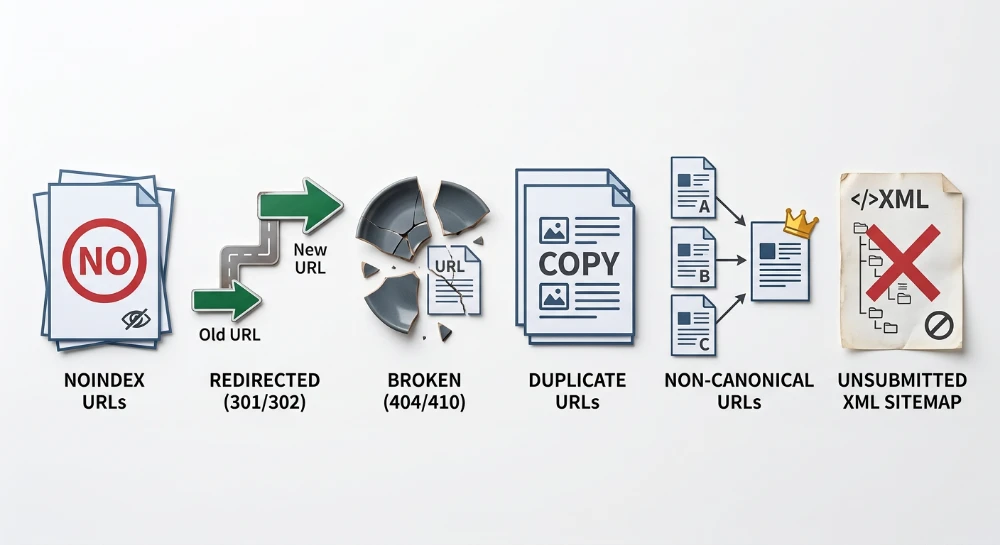
The URLs listed within the child sitemaps are subject to strict inclusion expectations. A sitemap functions as a declared list of canonical, crawlable, and indexable pages. Including non-indexable URLs degrades the reliability of the sitemap as a canonical signal to search engines.
Child sitemaps should exclusively contain indexable URLs. An automated sitemap generation script should be configured to exclude:
- URLs returning 404 Not Found or 410 Gone status codes.
- URLs that respond with 301 or 302 redirects to other destinations.
- Pages containing a noindex directive in the HTML meta tags or X-Robots-Tag HTTP headers.
- URLs blocked from crawling by the robots.txt file.
- Non-canonical versions of pages featuring a rel="canonical" link element pointing to a different URL.
Including invalid URLs creates conflicting instructions. The sitemap protocol tells the crawler that the page is a priority for indexing, while the page itself, or the server response, tells the crawler to discard it. Consistently providing clean child sitemaps ensures that crawling resources are spent on valid pages.
Cross-Site sitemap submission
In standard configurations, child sitemaps must reside on the same domain or subdomain as the index file. A sitemap index hosted on example.com cannot natively point to a child sitemap on a separate domain, such as a content delivery network or a sister brand URL, without specific authorization.
To implement cross-site sitemap submission, search engines require proof of ownership or explicit permission for both domains. This can be established through verification in a centralized webmaster platform, where both properties are verified under the same administrative account.
Alternatively, the target domain hosting the child sitemap can authorize the submission by modifying its robots.txt file. By declaring the absolute URL of the sitemap index from the external domain within the robots.txt file of the target domain, administrators signal that the external index is permitted to submit URLs on its behalf.
Crawler discovery: Robots.txt and manual submission
Search engines rely on explicit signals to locate an XML sitemap index file. The two primary methods for exposing the file to crawlers are the robots.txt Sitemap directive and manual submission through webmaster platforms. Implementing both methods ensures broad discovery across different search engines while providing access to diagnostic reporting.
The robots.txt sitemap directive
The robots.txt file provides a standardized mechanism to point crawlers directly to a sitemap index. Major search engines support the Sitemap directive, allowing bots to discover the file automatically during routine domain crawling.
The directive requires the absolute URL of the sitemap index file. Relative paths are not supported by the protocol. The instruction can be placed anywhere within the robots.txt file, as it operates independently of specific User-agent blocks.
Sitemap: https://www.example.com/sitemap_index.xmlIf a website utilizes multiple sitemap index files, administrators can declare multiple Sitemap directives on separate lines. Declaring the index file in robots.txt operates as a passive discovery method; crawlers add the specified URL to their queue the next time they fetch and parse the robots.txt file.
Google search console submission
While robots.txt enables general crawler discovery, submitting the sitemap index manually to a platform like Google Search Console provides administrative control and reporting data. The Sitemaps report displays when the file was last read, the number of discovered URLs, and any parsing errors encountered during extraction.
To submit the index file, access the Sitemaps report within Google Search Console. Enter the URL of the sitemap index file and execute the submission. Depending on whether the property is verified at the Domain or URL-prefix level, the interface will require either the full absolute URL or the path appended to the verified prefix.
Submitting the top-level index file automatically queues all referenced child sitemaps for discovery. There is no need to submit child sitemaps individually. Once Googlebot successfully fetches and parses the index, the reporting interface groups the discovered child sitemaps under the primary index file entry. Managing submission exclusively at the index level reduces administrative overhead and prevents duplicate reporting, ensuring that any dynamically generated child sitemaps are discovered seamlessly through the main index.
SEO structure and reciprocal link analyzer
Detect orphan pages, deep click depths, and toxic reciprocal links built by careless agencies.
Validation and troubleshooting fetch errors
Deploying an invalid sitemap index file prevents search engines from discovering the nested child sitemaps. Validating the file prior to deployment isolates syntax and structural issues from server or network problems.
Use an XML sitemap validator or an XML parsing tool to check both well-formedness and schema compliance before pushing the file to a production environment. Well-formedness checks confirm that the file contains valid XML syntax, such as properly closed tags, correct UTF-8 encoding, and appropriately escaped special characters in URLs (for example, converting an ampersand to
&
). Schema compliance verifies that the document uses the correct namespace and structure, specifically confirming the use of the
<sitemapindex>
root element rather than the standard
<urlset>
element used for child sitemaps.
Interpreting search console fetch failures
When monitoring the sitemap index in the Google Search Console Sitemaps report, failures are categorized based on whether the crawler could reach the file and whether it could read the contents. A generic "Could not fetch" status often points to a network timeout, a DNS resolution failure, or a general connection issue rather than a structural error within the XML itself.
When diagnosing fetch and parsing errors, evaluate the following specific conditions:
- Non-200 HTTP Status Codes: The crawler requires a 200 OK HTTP response for both the index file and all referenced child sitemaps. If the server responds with a 403 Forbidden, 404 Not Found, or 500 Internal Server Error, the fetch fails. Ensure the submitted URL is the exact, final destination; placing a 301 or 302 redirect on the index file can cause persistent fetch delays or failures.
-
Robots.txt Blocking: A fetch failure will occur if a Disallow rule in the robots.txt file prevents the crawler from accessing the path where the index or child sitemaps are hosted. Verify that the relevant user-agents have permission to crawl the directories containing the
.xmlor.xml.gzfiles. -
Malformed XML: If the file is successfully downloaded but cannot be parsed, Search Console will report specific line-level errors. These typically occur due to structural mistakes, such as missing the protocol (HTTP or HTTPS) in the
<loc>element, including trailing whitespace or blank lines before the opening XML declaration, or employing incorrect date formats in the<lastmod>tag.
Index-Level vs. Child-Level errors
Troubleshooting requires distinguishing between errors at the index level and those at the child sitemap level. A fetch failure or parsing error on the top-level index file stops the discovery process completely; no child sitemaps will be extracted or queued.
If the index file fetches and parses successfully, but individual child sitemaps fail, the Sitemaps report will flag the specific failing child files while maintaining a "Success" status for the main index. Child-level failures are frequently caused by mismatched URLs. The absolute URL declared in the index file's
<loc>
tag must exactly match the live URL of the child sitemap. Differences in protocol (HTTP versus HTTPS), variations in subdomain (www versus non-www), or missing trailing slashes will result in a 404 or redirect during the child sitemap fetch attempt, leaving those specific URLs undiscovered.