As websites scale into extensive e-commerce catalogs or high-volume publishing platforms, manually maintaining static sitemap files becomes impossible. Building reliable dynamic XML sitemaps requires a database-driven approach that automatically captures inventory additions, URL changes, and content removals to keep search engines informed of the current site structure.
For large-scale websites, serving sitemaps dynamically does not mean executing database queries on the fly every time a crawler requests the file. Live queries on massive product tables can exhaust server memory and cause timeout errors. Instead, a robust technical architecture relies on scheduled background tasks to extract URLs, divide them into manageable partitioned files, and save them as cached static output for efficient retrieval.
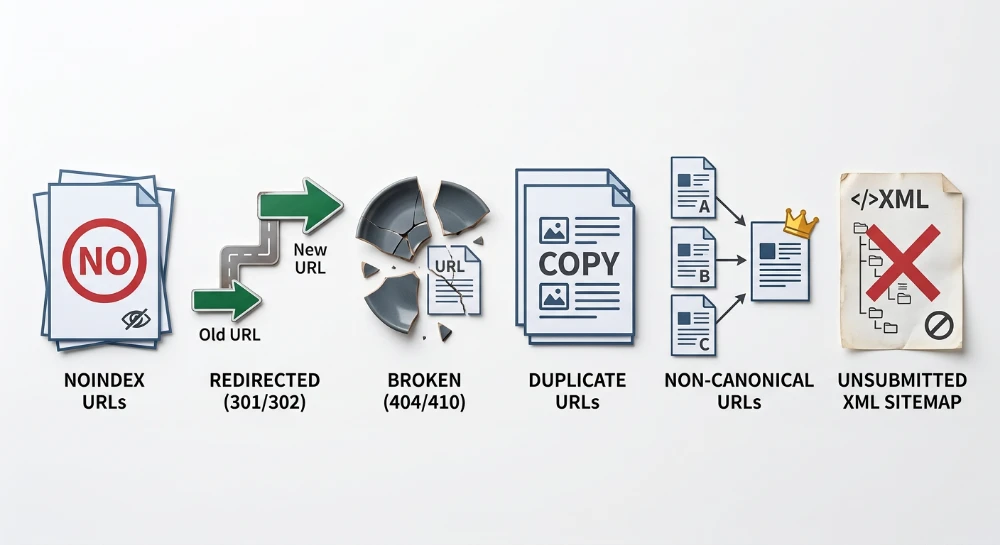
This shift to automated, cached generation is essential for maintaining strict crawl hygiene. By precisely filtering the underlying database queries to include only valid, canonical URLs returning a 200 HTTP status, dynamic sitemap systems prevent search engines from wasting resources on non-indexable pages, redirects, or parameterized duplicates.
Partitioning strategy and sitemap index files
The XML sitemap protocol enforces precise limitations on file capacity. A single sitemap file can contain a maximum of 50,000 URLs and must not exceed 50 megabytes in its uncompressed state. When a website's indexable inventory exceeds either of these thresholds, the URLs must be divided into multiple separate child sitemap files.
To manage multiple partitioned files, the protocol requires a sitemap index file. This file functions as a master directory, listing the specific locations of all individual child sitemaps. Rather than requiring site operators to manage and submit dozens or hundreds of individual sitemap URLs, the index file provides a single entry point. When a crawler processes the index file, it discovers the complete set of partitioned sitemaps referenced within it.
Logical partitioning strategies
While a generation script can arbitrarily slice a database into sequential 50,000-URL chunks, this approach offers little diagnostic value. Grouping URLs into logical partitions allows site managers to isolate crawling patterns and monitor indexation for specific sections of the website.
- Product Category or Taxonomy: Splitting sitemaps by primary category aligns the XML structure with the site architecture. If a coverage report indicates a drop in indexed URLs for a specific category sitemap, the underlying issue is immediately localized to that section's template, query, or database segment.
- Database ID Ranges: For massive catalogs that overwhelm category partitions, splitting by database primary key ranges ensures even file sizes. This approach creates stable archive files; older sitemaps containing existing products remain static, while only the newest partition requires frequent regeneration as new items are added to the database.
- Geographic Region or Language: International architectures benefit from isolating URLs by country or language locale. Grouping localized domains or regional paths into region-specific partitions helps verify whether search engines are successfully crawling the distinct localized variants of the catalog.
Regardless of the chosen grouping logic, the resulting child sitemaps must still adhere to the protocol limits. If a single category or regional partition grows beyond 50,000 URLs or 50 megabytes, it must be further subdivided, resulting in segmented naming structures such as apparel-part-1 and apparel-part-2.
Run a deep technical crawl to identify 4xx errors, missing meta tags, and indexation blockers.
URL inclusion logic: Filtering database queries
A dynamic sitemap functions as an exact ledger of the pages a website intends for search engines to crawl and index. Generating this list requires more than a basic data dump of the primary product table. The database extraction script must enforce strict filtering logic at the query level so that only valid, production-ready URLs populate the XML nodes.
To meet sitemap protocol standards, every URL generated by the database query must satisfy three distinct conditions: it must return a 200 HTTP status code, represent the canonical version of the page, and be fully indexable.
Filtering for 200 HTTP status codes
The sitemap should never contain URLs that result in errors or redirects. The database query must map application-level data states to HTTP routing realities. This requires filtering out records that the application will serve as a 404 Not Found, 410 Gone, 301 Moved Permanently, or 302 Found.
-
Deleted or Inactive Records:
The query must exclude products or categories marked as drafted, disabled, or discontinued, often handled by checking that a
deleted_attimestamp is null or astatusflag equals published. - Redirected Content: If a legacy product URL is configured in the database to redirect to a newer model or a parent category, the legacy URL must be excluded. Only the final 200-status destination URL should appear in the output.
- Soft 404 Prevention: If the application logic automatically serves a 404 or a "product unavailable" state for items with zero inventory, the sitemap query must join the inventory table and exclude out-of-stock items, preventing crawlers from fetching dead pages.
Enforcing canonical URL paths
Large catalogs routinely generate hundreds of dynamic URL variations for a single product through faceted navigation, sorting preferences, and user session tracking. The sitemap generation script must isolate the single canonical path for each entity.
When constructing the URL node, the script should build the absolute URL using only the base slug and the primary category hierarchy stored in the database. All query strings and parameterized variants-such as URLs containing
?sort=price_asc
,
?color=blue
, or tracking parameters-must be systematically excluded from the query. Submitting parameterized duplicates forces crawlers to evaluate redundant content, which obscures the intended site structure and populates search console reports with canonicalization errors.
Excluding Non-Indexable pages
A URL that returns a 200 status code and is properly canonicalized may still be ineligible for the sitemap if it contains a
noindex
directive. The query logic must evaluate the specific database columns or application configurations that control search engine directives.
Generation scripts need to apply a
WHERE
clause or a table join that evaluates SEO metadata fields. If a category, product, or landing page record is flagged to output a
noindex
meta robots tag or an equivalent X-Robots-Tag HTTP header, that record must be dropped from the sitemap query. Common examples of intentional exclusions include internal search result pages, gated wholesale product categories, and promotional landing pages with thin content. Submitting these URLs violates the rule that sitemaps should only present indexable content, triggering "Submitted URL marked 'noindex'" warnings in diagnostic reports.
Generation mechanics: Caching and server load management
Generating sitemaps on the fly-where the application queries the database and renders XML at the exact moment a crawler requests the sitemap URL-is inefficient and risky for large catalogs. A database with hundreds of thousands of active records requires complex joins to evaluate indexability, canonical status, and categorization. Executing these queries synchronously during an HTTP request ties up server resources, delays the response to the crawler, and routinely triggers maximum execution time errors or memory exhaustion limits.
To protect server performance, sitemap generation should be decoupled from web requests and handled by scheduled cron jobs or background queue workers. A background script runs independently of the web server's request-response cycle. This architecture allows the application to iterate through large database tables using chunked queries or database cursors, processing thousands of records at a time without occupying the PHP-FPM workers or WSGI threads needed to serve human traffic.
Moving the generation process to a command-line interface or background task runner also bypasses the strict timeout configurations typically enforced by web servers. A generation query that takes several minutes to aggregate product URLs and format them will fail if the web server drops the connection after thirty or sixty seconds. Background processing gives the script the necessary time and memory to complete execution without crashing.
Writing to static files and configuring headers
Instead of delivering dynamic streams, the background job must write the finalized XML output into static cached files. Depending on the infrastructure, the generation script saves these files directly to the server's public directory or uploads them to an object storage bucket served by a content delivery network. When a search engine crawler requests the sitemap index or a specific partition, the web server merely delivers the pre-generated static file. This reduces the server compute load for that request to a fraction of a millisecond.
Delivering static files requires verifying that the web server supplies the correct HTTP response headers. Depending on the default configuration, some environments may serve files ending in
.xml
as
text/plain
or generic application streams. The server configuration block or CDN routing rules must explicitly serve all sitemap files with the
application/xml
Content-Type header.
If the crawler receives an incorrect Content-Type header, it may reject the payload or fail to parse the document as a valid sitemap. Verifying the header response via a standard HTTP client ensures crawlers accurately identify the file format and process the enclosed URLs.
Bulk Google and Yandex index checker
Verify agency reports and track live SERP status in Google and Yandex to protect your SEO ROI.
XML syntax, encoding, and the lastmod attribute
Programmatic sitemaps must adhere to strict XML standards. A single syntax error can cause search engine crawlers to reject the entire file. Every sitemap must specify UTF-8 encoding in its opening declaration. Following the declaration, the document must use
<urlset>
as the root element and include the standard protocol namespace via the
xmlns
attribute.
The standard opening for a child sitemap requires the following structure:
<?xml version="1.0" encoding="UTF-8"?>
<urlset xmlns="http://www.sitemaps.org/schemas/sitemap/0.9">
Entity escaping in URL paths
URLs dynamically pulled from databases often contain characters that break XML parsing if left unescaped. The sitemap protocol requires all URLs within the
<loc>
tag to be properly escaped using standard HTML entities. The most common point of failure in large catalogs is the ampersand character, which frequently appears in URL parameters for filtered product categories or sorting variables.
Generation scripts must process raw database URLs through an escaping function before writing them to the XML node. Every ampersand must be converted to
&
. For example, a raw path like
/category?sort=price&order=asc
must be written to the sitemap as
/category?sort=price&order=asc
. Additionally, single quotes, double quotes, less-than, and greater-than symbols must be escaped if they appear in the URL string.
Configuring the lastmod signal
The
<lastmod>
tag communicates the date and time the content at the corresponding URL was last modified. For large catalogs, accurate modification dates help crawlers prioritize fetching recently updated products or categories instead of re-crawling unchanged pages.
A frequent implementation error is populating the
<lastmod>
tag with the timestamp of when the sitemap generation script executed. If a script updates the sitemap daily and applies the current date to every URL, the timestamp ceases to represent content freshness. Crawlers evaluate the accuracy of these timestamps against actual page changes. If the sitemap indicates a modification but the page content remains identical, search engines will learn to ignore the
<lastmod>
signal entirely.
Instead, the generation script must retrieve the actual modification timestamp for each specific URL directly from the database. For a product page, this value typically maps to a
last_updated
or
modified_at
column in the inventory table. The date must be formatted according to the W3C Datetime standard, typically as
YYYY-MM-DD
. Appending the specific time and timezone offset is acceptable if the database tracks precise modification events, though the date alone is sufficient for crawl prioritization.
Validating output and handling edge cases
Generating XML sitemaps dynamically introduces the risk of syntax errors scaling across millions of URLs. Integrating programmatic XML validation into the generation pipeline prevents malformed files from reaching production. Validation scripts should check the generated output against the official sitemaps.org XML Schema Definition (XSD) before the files are moved to the public directory. This automated step catches missing namespace declarations, unclosed tags, and unescaped HTML entities before search engine crawlers attempt to parse the file and register fatal syntax errors.
URL validation and orphaned content
While XSD validation ensures the file is readable, functional validation ensures the URLs behave as expected in production. Running a validation script or a scoped headless crawl against a sample of the generated sitemap URLs confirms that the database query logic matches the live environment. The validation step should verify that the extracted URLs resolve with a 200 HTTP status code and contain the correct self-referencing canonical tag, acting as a failsafe against database synchronization delays.
Comparing the sitemap output against a standard site crawl also helps identify orphaned content. If a valid product URL appears in the sitemap but cannot be reached through internal category navigation, it is an orphan. Sitemaps provide a discovery mechanism, but search engines rely on internal links to understand site architecture and distribute crawling priority. Identifying discrepancies between the sitemap URL set and the internally linked URL set highlights structural gaps in the site taxonomy, pagination limits, or missing product grids.
Managing empty child sitemaps
Large catalogs frequently partition sitemaps by logical groupings, such as product category or geographic region. A common edge case occurs when a specific category temporarily contains no active, indexable products. If the generation script creates a child sitemap containing an empty
<urlset>
node, search engine parsers will flag the file as an error.
To handle this condition, the sitemap generation logic must evaluate the total URL count for each partition before writing the XML file to disk. If a database partition yields zero valid URLs, the script must abort file creation for that specific subset. Concurrently, the script generating the sitemap index file must omit the reference to the empty child sitemap. When new products are added and the category becomes active again, the subsequent generation cycle will write the populated child sitemap and restore its corresponding
<sitemap>
entry in the index file.
SEO structure and reciprocal link analyzer
Detect orphan pages, deep click depths, and toxic reciprocal links built by careless agencies.
Submission, API integration, and crawl monitoring
Once dynamic sitemaps are generated and validated, search engines need a reliable mechanism to discover and process them. The standard passive discovery method requires adding a
Sitemap:
directive to the robots.txt file, pointing to the absolute URL of the sitemap index. However, for large catalogs requiring rapid discovery of new or updated URLs, active submission is often necessary.
Historically, automated discovery relied on unauthenticated HTTP ping endpoints to notify search engines of sitemap updates. Following Google's deprecation of its legacy ping endpoint, automated submissions should now utilize the Google Search Console (GSC) API. Programmatic integration with the GSC API allows server-side applications to submit the sitemap index file after a successful generation cycle. This ensures that search engines are notified of substantial catalog additions or modifications using supported, authenticated channels.
Evaluating coverage by partition
After submission, the Google Search Console Sitemaps report acts as the primary diagnostic interface for evaluating how search engines interact with the XML files. When a sitemap index file is processed, GSC exposes parsing status and URL discovery counts for each nested child sitemap. This is where a logical partitioning strategy yields direct diagnostic value.
By navigating to the Page Indexing report and applying a filter for a specific child sitemap, practitioners can isolate indexation coverage rates. If a catalog contains millions of items, an aggregate indexing drop is difficult to troubleshoot. However, evaluating the submitted-to-indexed ratio across separate sitemap partitions makes it possible to determine if an indexing bottleneck is isolated to a specific product category, geographic region, or template type. A low indexation rate on a specific partition often points to underlying quality issues, duplicate content, or localized crawl traps within that subset of the site.
Analyzing crawler fetch behavior
While Search Console provides aggregated reporting, server log analysis is required to verify actual crawler interaction with the sitemap files. Filtering server access logs for requests targeting the
.xml
paths and matching them to verified search engine user agents reveals exact fetch frequency and extraction efficiency.
Log data clarifies whether search engines are traversing the sitemap architecture as intended. If server logs show frequent requests for the sitemap index file but rare requests for the child sitemaps, crawlers may be ignoring the child files. This behavior often occurs if the
lastmod
timestamps on the child sitemaps are not updating, signaling to crawlers that the underlying URLs have not changed and do not require recrawling.
Monitoring the HTTP response codes associated with these fetch requests is equally necessary. A consistent 200 OK status confirms successful delivery. If log files show recurring 5xx server errors or timeouts specifically when crawlers request large XML files, it indicates that the server is struggling to read or serve the cached output under load, requiring infrastructure adjustments to ensure search engines can reliably retrieve the data.