Understanding exactly why URL conflicts between relative and absolute canonical hurt deployments requires examining how search engine crawlers parse raw path structures. Googlebot treats relative paths like /category/routers/ as context-dependent strings attached to the current active hostname. Absolute paths like https://example.com/category/routers/ provide explicit, immutable routing instructions. The canonical link element demands absolute architecture according to RFC 6596 standards to prevent indexation anomalies.
The architectural difference centers entirely on protocol and domain inclusion. Absolute syntax forces engineers to define exact server parameters directly in the source code.
Core configuration parameters required for valid absolute canonicalization include the following directives:
- The specific application layer protocol enforcing HTTPS over HTTP
- The exact host name dictating www or non-www configurations
- The verified root domain and top-level extension
- The precise trailing slash implementation matching the 200 OK server response
Multi-environment CI/CD pipelines introduce high-risk variables during the transition from local servers to production. Codebases relying on relative tags automatically inherit the staging domain's host name during pre-release testing. Staging environments leaking into the SERP fragment link equity across subdomains like staging.example.com instead of consolidating ranking signals on the primary production entity. Google Search Console logs these specific failures under the duplicate, submitted URL not selected as canonical status report. SEO performance collapses when Googlebot crawl budgets waste bandwidth crawling infinite query parameter variations of non-production staging environments.
Valid HTML syntax dictates that the href attribute inside the canonical tag outputs a fully qualified web address. Search algorithms simply ignore relative values.
Canonical tag architecture: Absolute vs relative URL syntax
Structural mechanics of uniform resource locators
The technical anatomy of a web address dictates exactly how search engine crawlers process network graphs. RFC 3986 defines the generic syntax for these identifiers. A fully qualified address splits into five distinct URI components: scheme, authority, path, query, and fragment. Absolute paths explicitly declare the scheme and the complete authority component. Crawlers require zero contextual clues to resolve the destination.
Relative paths abandon the scheme and authority components entirely. They force the user agent or crawler to append the partial path string to the base URI of the current execution environment. This dependency creates catastrophic resolution failures when the execution environment shifts unexpectedly.
The parser calculates the target reference by merging the relative reference with the base URI. If the base URI changes due to parameter injection or cross-domain loading, the resulting canonical target changes dynamically. Absolute syntax prevents this mutation.
| Syntax Architecture | Code Structure Example | Crawler Resolution Logic | Risk Profile |
|---|---|---|---|
| Absolute Path | href="https://www.example.com/category/" | Parses hardcoded scheme, authority, and path. Ignores execution context. | Zero risk of dynamic mutation. Static target string. |
| Root-Relative Path | href="/category/" | Extracts scheme and authority from the current base URI. Appends path. | High vulnerability to cross-domain scraping and protocol mismatches. |
| Document-Relative Path | href="category/" | Extracts base URI up to the last directory. Appends local path. | Extreme vulnerability to URL depth variations and trailing slash errors. |
Cross-Domain path resolution errors
Relative canonicals create severe structural vulnerabilities during cross-domain syndication. Content scrapers and automated aggregation bots copy the raw HTML DOM. They deploy the stolen source code on entirely different root domains. If the original source code relies on a relative canonical tag, the scraper's server executes that relative link against its own base authority.
The resolution engine calculates the base URI as the scraper's domain. Search engine algorithms crawl the syndicated content and process the relative tag. The parsing logic combines the scraper's protocol and host name with the stolen relative path. The algorithm interprets the resulting absolute URL as a valid self-referencing canonical validating the scraper's domain.
The original publisher loses indexing priority instantly. Link equity bleeds directly into the scraper's infrastructure. Scraper sites consistently outrank the original authors when relative tags hijack the canonicalization signal.
Self-Referencing canonical tag requirements
Self-referencing canonicals validate the intended version of a document when duplicate URLs populate the crawl queue. A valid self-canonical must achieve a precise string match with the final rendered URL of the primary entity. Search engines ignore conflicting signals where the self-canonical contradicts the server's primary configuration.
Engineering teams must enforce the following self-referencing requirements for valid URL canonicalization:
- Protocol consistency forcing HTTPS on all secure endpoints without triggering mixed-content warnings
- Subdomain precision isolating www from non-www variations based on the primary DNS configuration
- Path termination matching the exact trailing slash configuration of the 200 OK HTTP response
- Query string exclusion stripping session identifiers, affiliate tags, and pagination parameters that do not alter the core DOM
- Case sensitivity enforcement matching the exact capitalization structure of the server's routing table
RFC compliance and syntax specifications
IETF standards dictate the exact parsing rules for web architectures. RFC 6596 establishes the canonical link relation standard. The specification requires parsers to extract the target IRI. While the core specification technically permits relative URIs, search engine parsers apply much stricter constraints to prevent indexation loops.
Relative references require base URI extraction per RFC 3986 Section 5.1. Ambiguity at this extraction layer breaks canonicalization completely. If a page loads via multiple tracking URLs or varied subdomains, the base URI fundamentally changes. A relative canonical dynamically adopts this flawed base URI, confirming the duplicate parameter as the canonical version.
Absolute syntax neutralizes this dependency. The target string remains strictly static. Crawlers parse the explicit protocol and domain parameters regardless of the entry point, isolating the ranking signals to the exact specified document.
Multi-Environment deployment mechanics and staging misconfigurations
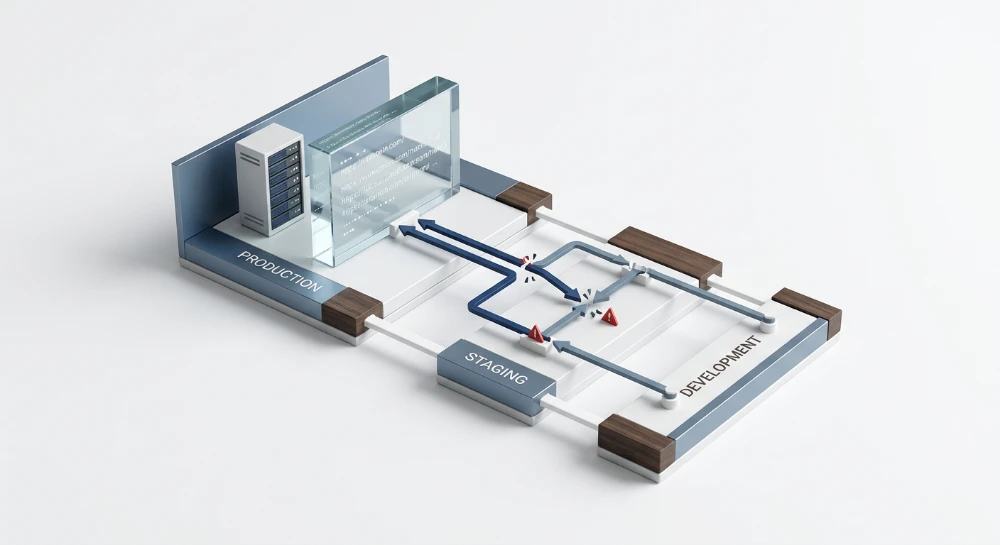
Modern web architecture dictates rigorous deployment phases. Code progresses through distinct environments before public release. Each environment operates on an isolated host configuration. When URL canonicalization rules fail to adapt to these shifts, severe indexation anomalies trigger across the deployment pipeline.
The progression moves from Local Server Deployment to staging servers for QA testing, culminating in the production release. A fundamental architectural flaw occurs when developers hardcode canonical values during local development. The code merges into the main branch. It deploys to staging. It finally ships to production. If the application relies on absolute paths without contextual awareness of the host environment, the production server will broadcast staging paths in its canonical definitions.
Environment variables and dynamic URL configurations
Static strings in header templates destroy deployment logic. Infrastructure demands environment variables to control host definitions dynamically at build time or runtime. The variable
process.env.SITE_URL
serves as the standard mechanism for passing the active domain into the application state.
The build step reads the environment configuration. It injects the value into the routing function generating the canonical tag. A missing production variable forces the system to default to a fallback string. The fallback is almost always the staging domain.
Consider the variable matrix mapping environment states to output logic.
| Deployment Phase | Server Hostname | process.env.SITE_URL | Output Canonical |
|---|---|---|---|
| Local Server Deployment | localhost:3000 | http://localhost:3000 | http://localhost:3000/path/ |
| Staging Environment | staging.domain.dev | https://staging.domain.dev | https://staging.domain.dev/path/ |
| Production Environment | www.domain.com | https://www.domain.com | https://www.domain.com/path/ |
This matrix demands strict adherence to environment-specific configurations. Missing the production variable forces the canonical to return undefined or inherit a hardcoded development string. A trailing slash accidentally omitted from the environment variable creates site-wide redirection chains upon deployment.
Domain consolidation failures in testing environments
Staging environments frequently mirror production databases. This replicates exact content parity across distinct hostnames. Exposure of staging domains to Search Engine Indexing triggers immediate cross-domain consolidation failures.
Crawlers discover the staging environment via exposed log files, DNS records, or accidental external references. The parsing engine processes identical HTML payloads across both hostnames. If the canonical variable on staging incorrectly holds the production URL, it executes a cross-domain directive. The algorithm evaluates two identical documents attempting to consolidate into a single destination. The staging site artificially inflates the crawl queue.
The inverse scenario proves equally destructive. If the staging environment correctly uses staging URLs in its canonical tags but lacks access controls, search engines ingest the testing URLs. Staging pages outrank production pages. Users land on test environments. Conversion tracking fails entirely. Transactional forms route data to development databases.
Access control and indexation prevention parameters
Security through obscurity fails against automated discovery. Staging environments require explicit server-level blocks. Relying solely on robots.txt leaves URLs vulnerable to indexation via third-party inbound links. Real protection demands configuration file parameters that reject crawler requests at the protocol layer.
Enforce strict access control using server-side directives.
- Basic Authentication requiring an htpasswd file to force a 401 Unauthorized HTTP status code for all incoming requests
- Nginx location blocks applying add_header X-Robots-Tag noindex,nofollow to explicitly deny indexing at the HTTP header level
- Apache configuration files utilizing Header set X-Robots-Tag noindex,nofollow within Directory or VirtualHost contexts
- IP allowlisting restricting server access strictly to corporate VPN subnets and rejecting all external traffic with a 403 Forbidden status
Blocking access neutralizes canonical confusion entirely. An inaccessible staging domain cannot compete with production. The crawler never reads the misconfigured HTML payload. The index remains clean.
Rendering conflicts: SSR, CSR, and JavaScript path injection
Modern application architectures divide URL generation across server boundaries and client environments. This split-rendering model creates severe canonical vulnerabilities. SSR passes a pre-rendered HTML payload to the client. The browser executes JS during hydration to activate the DOM. Mismatches between the server's static output and the client's dynamic path injection trigger canonical swapping during the rendering lifecycle.
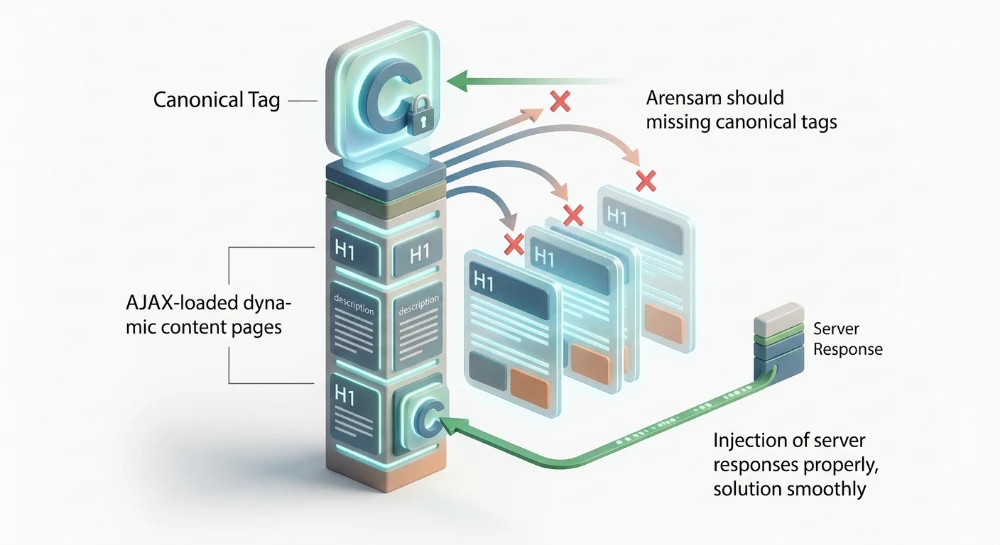
Search engine crawlers process the raw HTML first. If the canonical tag is missing from the initial server response and only injected via CSR, the crawler often drops the tag entirely. Rendering blocks or script timeouts leave the page without canonicalization directives.
Client-Side routing and the window location hazard
Developers frequently attempt to solve multi-environment routing by relying on the browser's native API. They inject host data directly from the client window object. This introduces a critical architectural flaw.
Scripts utilizing window.location.protocol and window.location.hostname force the canonical tag to mirror the exact environment where the JS executes. When a crawler accesses a testing environment, the DOM manipulation logic dynamically constructs a staging canonical. The tag references the testing environment instead of the production domain. If a user bypasses the CDN and accesses the origin server via a raw IP address, the client logic injects that IP directly into the canonical path.
Client-side canonical injection introduces specific rendering hazards.
- Race conditions between the HTML parser and JS execution causing delayed canonical discovery
- Dynamic hostname evaluation validating staging environments during automated crawls
- Protocol downgrades when reverse proxies strip HTTPS headers before JS evaluation
- Search engine indexing algorithms recording the pre-hydration state missing the CSR canonical entirely
Next.js architecture: Pages and app router vulnerabilities
Next.js lifecycle methods require strict environment variable binding. Absolute path enforcement frequently breaks down when routing logic shifts between server execution and client hydration.
Within the traditional Pages Router, data fetching methods like getServerSideProps and getStaticProps execute securely on the server. Developers bypass these methods, relying instead on router.asPath from the useRouter hook to patch canonicals directly inside client components. This creates a hydration mismatch. The server sends relative paths, and the client attempts to append absolute domains. The crawler receives conflicting signals between the static payload and the rendered DOM.
The App Router shifts this paradigm. The generateMetadata API replaces static head components and executes exclusively on the server. If this function relies on relative path parameters without a rigidly defined absolute URL base, it generates invalid SEO metadata or fails silently.
Compare the architectural differences between vulnerable client-side injection and secure server-side generation.
| Architecture Phase | Vulnerable Client Implementation | Secure Server Architecture |
|---|---|---|
| Initial HTML Payload | Missing or relative canonical tag | Strictly formatted absolute URL present |
| Host Resolution | Derived from window.location.hostname | Bound to environment variables |
| Hydration State | DOM injection overwrites previous tags | Static HTML matches rendered DOM state |
| Crawler Processing | Requires full JS execution and rendering | Processed immediately upon HTML fetch |
Enforcing absolute paths during hydration
Hardcoding domain variables at the server level eliminates CSR injection risks. The server must construct the full absolute URL before the hydration phase begins. This ensures the raw HTML matches the final rendered DOM perfectly.
Implement these code snippets for absolute path enforcement across Next.js rendering lifecycles.
// App Router: Secure generateMetadata implementation
export async function generateMetadata({ params }) {
  const baseUrl = process.env.NEXT_PUBLIC_PROD_URL;
  const canonicalPath = `/category/${params.slug}`;

  return {
    alternates: {
      canonical: new URL(canonicalPath, baseUrl).toString(),
    },
  };
}
Routing logic in the Pages router demands absolute resolution during the static generation phase. Do not pass relative paths to the client component.
// Pages Router: Absolute path enforcement via getStaticProps
export const getStaticProps = async ({ params }) => {
  const baseUrl = process.env.NEXT_PUBLIC_PROD_URL;
  const absoluteCanonical = `${baseUrl}/products/${params.id}`;

  return {
    props: {
      canonicalUrl: absoluteCanonical,
    },
  };
};
The client component only reads the absolute string provided by the server. It never evaluates the browser window object. The JS pipeline remains completely decoupled from the runtime hostname.
Systemic SEO impact: Duplicate clusters and indexing constraints
Googlebot treats structurally flawed canonical tags as absent directives. When encountering relative paths or hostname mismatches, the parser discards the tag and defaults to algorithmic deduplication. This forces search engines to expend computational resources crawling, rendering, and evaluating identical HTML payloads across multiple endpoints.
Server log analysis often reveals the immediate consequence: massive crawl budget waste. Indexing quotas are finite allocations derived from server capacity, historical crawl demand, and overall site quality signals. A site generating thousands of parameter-driven duplicate pages rapidly exhausts these quotas. Fresh, revenue-driving URLs remain undiscovered while bots repeatedly fetch redundant staging variations.
Cross-Domain URL selection and duplicate page errors
The indexing engine evaluates multiple signals to select a primary representative URL for a duplicate cluster. Invalid canonicals strip webmasters of control over this selection process. If a non-production environment leaks into the index with relative canonicals pointing to its own sub-domain, the algorithm processes both staging and production as distinct entities competing for the exact same semantic footprint.
This triggers systemic duplicate page errors. The algorithm groups identical content into a single duplicate cluster and attempts to select one URL to rank. Without a valid, absolute canonical directive establishing the production URL as the primary node, the system frequently misidentifies the canonical version.
Production pages lose their indexed status entirely.
Traffic funnels to non-transactional staging environments, API endpoints, or raw IP addresses, instantly destroying conversion metrics and ROI.
Keyword cannibalization triggers
Algorithmic URL selection instability directly causes keyword cannibalization. Search engine ranking systems struggle to assign query relevance and authority when multiple URLs serve identical intent. Instead of consolidating ranking signals into one strong page, the system splits impressions across several weak variations.
Monitor your environments for these specific algorithmic triggers:
- Dynamic tracking parameters appending to URLs without enforced absolute canonicalization overriding the query string.
- Protocol variations rendering simultaneously on HTTP and HTTPS due to incomplete server redirects.
- Sub-domain conflicts where CDN endpoints get crawled and indexed alongside the main application routing.
- Pagination sequences generating infinite loops when the canonical fails to point to the root category or explicit paginated state.
SERP volatility becomes erratic.
A core category page might rank in top positions on Monday, only to be replaced by a filtered query parameter variation on Tuesday. This URL rotation resets historical engagement signals and depresses overall CTR.
Link equity fragmentation mechanics
PageRank flows through canonical pathways to consolidate authority. Broken directives fragment this equity across disparate URL structures. External inbound links pointing to non-canonical versions fail to pass their full weight to the primary entity, diluting the domain's overall ranking capability.
The following structural anomalies fracture link equity when absolute paths are not strictly enforced.
| Anomaly Type | Structural Trigger | Algorithmic Consequence |
|---|---|---|
| Parameter-Based Canonical Issues |
Filtered navigation appending strings like
?sort=price
or
?color=red
without a self-referencing absolute tag on the root page.
|
Splits inbound link velocity. Search engines treat each applied filter as a unique document, dividing the cluster's authority by the number of active parameters. |
| Trailing Slash Mismatches |
Simultaneous 200 OK responses for
/product/
and
/product
endpoints.
|
Forces algorithm to maintain two distinct URI entities in the index. Internal link equity bleeds if CMS navigation modules link to both variations inconsistently. |
| Query Parameters Errors | Session IDs, affiliate IDs, or UTM tracking variables generating near-infinite URL permutations. | Severe equity dilution. Highly linked campaign URLs fail to transfer their PageRank back to the commercial landing page, stranding authority on transient URLs. |
Consolidating these variations requires strict architectural hygiene at the server level. Every permutation must resolve to a single, absolute canonical string. Allowing the client or the algorithm to infer the canonical relationship mathematically guarantees equity fragmentation.
Auditing canonical configuration status and URL indexing errors
Detecting canonical misfires requires isolating discrepancies between server intent, rendered output, and indexing status. Auditing demands a multi-tool approach to map raw code against search engine processing reality. The objective is to identify exactly where the architectural chain breaks across the deployment pipeline.
Screaming frog crawler configuration for DOM comparison
Crawler misconfiguration hides rendering logic failures. You must instruct the spider to process the payload exactly as a modern search engine would. Navigate to Configuration > Spider > Rendering and select JavaScript. This forces the headless browser to execute client-side scripts before evaluating the document.
Enable precise extraction parameters to monitor the hydration process.
- Go to Configuration > Spider > Extraction.
- Select Canonical Link Element.
- Enable the extraction of both raw HTML and rendered DOM targets.
The resulting crawl populates separate columns for the source code directives and the rendered directives. A mismatch between these columns indicates client-side manipulation overriding the server response. This immediately isolates rendering defects where the JavaScript framework injects an invalid relative path over a correct absolute HTML tag.
Status code verification for canonical targets
A self-referencing canonical tag represents the definitive version of a document. It must always resolve to a 200 OK status code. Extract all target URIs from the initial crawl and process them through list mode.
Tags pointing to a URL that returns a 301 Redirect or a 404 Not Found error create immediate processing stalls. Search engine bots drop the canonical signal if the target requires a redirect hop. The declared URL must always match the final destination exactly. Verify that no tag points to an intermediate redirect state. Fixing this requires updating the database or the CMS template logic to bypass the 301 Redirect entirely and output the final absolute path.
Google search console indexing reports
Server intent does not dictate algorithmic reality. Google Search Console exposes exactly how the search engine interprets your configuration. Access the Page Indexing coverage reports to identify consolidation failures.
Isolate these specific error states in the report dashboard.
- Duplicate without user-selected canonical: The algorithm found variations but no valid directive.
- Duplicate, Google chose different canonical than user: The algorithm actively rejected your directive.
Run problematic variations through the URL Inspection tool. The URL Inspection report maps out the precise evaluation state. Compare the User-declared canonical field against the Google-selected canonical field. When the system ignores the server declaration, it detects conflicting signals. This typically stems from contradictory internal links, sitemap mismatches, or a high volume of external links pointing to a non-canonical parameter variation.
Ahrefs site crawl diagnostics
Automated cloud crawling surfaces systemic routing flaws at scale. Ahrefs site crawl logs compartmentalize these errors into distinct severity tiers. Regular audits prevent undetected equity dilution across large clusters.
| Audit Metric | Detection Trigger | Diagnostic Action |
|---|---|---|
| Internal Canonical Issues | A document specifies an internal canonical URL, but that target URL returns a non-200 OK status or specifies a different canonical. | Audit the target HTTP response. Break the canonical chain by pointing the origin page directly to the final 200 OK destination. |
| External Canonical Issues | Cross-domain directives point to a broken, redirected, or unindexed external URL. | Verify the external host configuration. Ensure the target is accessible, returns a 200 OK, and allows indexing. |
| Unlinked Canonical Pages | A valid tag exists in the code but receives zero internal links from the CMS structure. | Update primary navigation nodes and pagination modules to link strictly to the absolute canonical paths. |
Rectifying these issues aligns your internal architecture with the explicit code-level directives. The crawler must encounter the exact same absolute path in the `href` attribute of a navigation link as it does in the canonical tag of the destination page.
Enforcing absolute paths across frameworks and CMS platforms
CMS environments dictate the baseline routing architecture for most web properties. Default configurations often fall back on relative paths or dynamically inject hostnames based on incoming server requests. This behavior triggers immediate cross-domain conflicts when a staging database pushes to production without strict environment variable updates. Application layers must output static, fully qualified URLs regardless of the host environment.
E-commerce ecosystems experience severe equity dilution due to faceted navigation and product variant routing. Filtered category pages append query parameters that generate near-infinite permutation states. A misconfigured CMS treats these dynamic routes as unique entities unless explicit absolute canonical overrides exist at the template level.
CMS configuration paths and filter hooks
Major platforms handle canonical assignment differently. Relying on default plugins without verifying their exact output leads to flawed indexation directives.
In Yoast SEO, manual overrides require accessing the Advanced tab at the bottom of the individual post or taxonomy editor. Locate the Canonical URL input field and insert the absolute URL containing the precise protocol and domain sequence. For programmatic enforcement across custom E-commerce product variations and filtered category pages, direct filter hooks bypass the default rendering engine.
add_filter( 'wpseo_canonical', function( $canonical ) {
    if ( is_product_category() ) {
        $term = get_queried_object();
        return get_term_link( $term );
    }
    return $canonical;
} );
Rank Math utilizes a parallel architecture via its Advanced meta box on the editor screen. Inputting the absolute URL in the Canonical URL field overrides dynamic generation for a specific document. Global control over filtered category pages in Rank Math demands modifying the active theme files using their specific filter hook.
add_filter( 'rank_math/frontend/canonical', function( $canonical ) {
    if ( is_product() ) {
        global $product;
        return $product->get_permalink();
    }
    return $canonical;
});
Shopify architectures notoriously generate duplicate paths for products nested under collections. A product accessed via a collection outputs a nested path (e.g., /collections/shirts/products/blue-shirt) which Search Engine Indexing processes as a distinct entity from the root product path (/products/blue-shirt). Standard Liquid objects dynamically append query parameters for product variations.
You must modify the primary theme rendering file. Locate the head section within the theme.liquid file. Replace default canonical logic with explicit URL filters that strip collection parameters and variant modifiers.
<link rel="canonical" href="{{ canonical_url | split: '?' | first }}">Server-Level enforcement via .htaccess
Application-level HTML tags fail if the server resolves multiple hostname variants. A valid canonical tag pointing to an HTTPS/www URL placed on an active HTTP/non-www page creates an indexing bottleneck. The crawler evaluates HTTP headers and connection protocols before parsing the DOM. Server-level redirects must force the exact protocol and subdomain structure matching your canonical architecture.
Apache servers require strict directives targeting the RewriteEngine module. The configuration below intercepts incoming requests, verifies the connection state, and permanently redirects traffic to the absolute HTTPS/www path before the CMS loads.
RewriteEngine On
RewriteCond %{HTTPS} off [OR]
RewriteCond %{HTTP_HOST} !^www\. [NC]
RewriteCond %{HTTP_HOST} ^(?:www\.)?(.+)$ [NC]
RewriteRule ^ https://www.%1%{REQUEST_URI} [L,NE,R=301]
Node.js and next.js environment binding
JavaScript frameworks require strict environment variable scoping to prevent relative path injection during hydration. If a Node.js or Next.js application derives its canonical path from incoming request headers, spoofed host headers manipulate the output. Bind an immutable production URL to a public environment variable.
Define the static absolute path in the production environment file.
NEXT_PUBLIC_SITE_URL=https://www.example.comExtract this variable inside the Next.js metadata export to construct an unbreakable absolute path for dynamic routes. This approach isolates the canonical tag from client-side URL manipulations and staging environment hostnames.
export async function generateMetadata({ params }) {
    const siteUrl = process.env.NEXT_PUBLIC_SITE_URL;
    return {
        alternates: {
            canonical: `${siteUrl}/products/${params.slug}`
        }
    }
}
Post-Deployment Re-Indexing procedures
Pushing structural canonical changes to production initiates a lengthy validation phase. Crawlers do not instantly trust modified code-level directives. They queue the updated URLs, fetch the raw HTML, compare it against the previous state, and compute the new cluster relationships.
Accelerate the discovery of corrected absolute paths by executing a sequential re-indexing protocol.
- Flush the application cache, server edge cache, and CDN layers to destroy stale relative path instances.
- Extract a fresh XML sitemap strictly containing the updated absolute canonical URLs.
- Submit the isolated sitemap directly via the search engine console interface.
- Ping the updated sitemap endpoint utilizing programmatic API request methods.
- Execute manual inspection requests on primary category nodes to force immediate recrawling of internal linking structures.
Monitor server log files immediately following the API submission. A successful deployment reflects an immediate spike in crawler activity targeting the explicit absolute paths defined in your revised architecture.