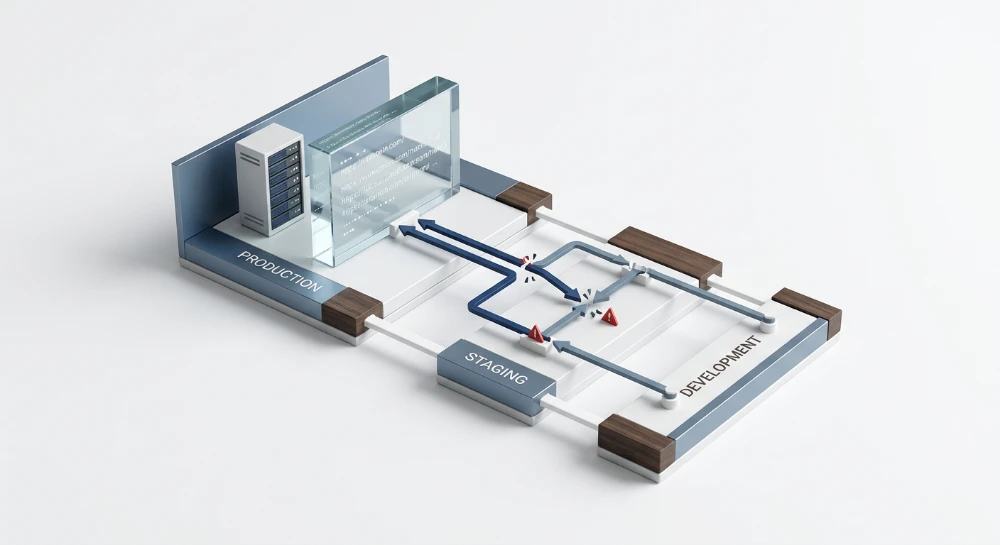
Handling canonical e-commerce conflicts during cross domain moves requires exact mapping of the rel="canonical" HTML element across multiple root domains. When an enterprise CMS pushes identical catalog architectures to new top-level domains, search engines fragment indexing signals across mirrored product pages. This fragmentation splits link equity directly. A standard 301 redirect protocol alone fails to consolidate ranking metrics when legacy infrastructure remains temporarily active for inventory or API integration processes.
Setting the master version prevents severe index cannibalization. Search bots freeze crawled URL variations and drop category pages from the SERP if canonical signals contradict header status codes.
Cross-domain canonicalization demands rigid architectural parameters to preserve authority and stabilize CTR data. Re-platforming sequences generate duplicate SKU pathways that degrade SEO performance if left untracked. Establishing strict rules for indexing bot behavior involves validating specific configurations:
- Absolute URL formatting within the canonical tag to force master version recognition
- Synchronized response headers aligning exactly with the destination architecture
- Temporary mapping logic separating live customer traffic from search engine crawl paths
Traffic drops during a migration often stem from canonical mismatches rather than lost backlinks. Rebuilding indexation trust takes an average of 12 weeks if the initial canonical architecture sends conflicting directives, directly delaying your projected ROI and missing critical KPI targets.
Architectural fundamentals of Cross-Domain canonicalization signals
Search bots parse document code sequentially. Syntax errors within the HTML Head section hierarchy immediately invalidate canonical directives. If a rel="canonical" HTML Element renders below bulky inline scripts or follows malformed meta tags, parsing stalls. The indexing signal drops. You must position canonical tags as high in the document head as technically feasible to guarantee extraction before rendering timeouts occur.
Standard HTML tags handle standard page requests. Non-HTML assets require server-side execution. The HTTP Link header serves the exact same indexing function but operates earlier in the network request cycle. PDF catalogs, raw data feeds, and dynamically generated media must leverage server-level configuration to pass equity.
<link rel="canonical" href="https://www.destination-domain.com/category/product/" />Link: <https://www.destination-domain.com/category/product/>; rel="canonical"Protocol and syntax standardization
Search engine databases process URLs as strict literal strings. One missing character creates an entirely new node in the index. You must enforce absolute URL configurations across all canonical tags. Relative paths trigger catastrophic crawl loops during architectural migrations.
Strict parameter handling prevents structural fractures across mirrored systems.
- Force HTTPS protocols universally across all tag outputs
- Hardcode WWW or non-WWW preference based strictly on the destination server configuration
- Standardize trailing slashes for directory paths and strip them for specific file extensions
Inconsistent trailing slashes create severe bottleneck conditions during crawl cycles. Bots hit the non-slash version, process a server redirect, and then evaluate the slash version before reading the canonical signal. This burns operational server capacity. Consolidate your URL syntax before deployment.
| URL Variable | Canonical Target Format | Index Processing Result |
|---|---|---|
| HTTP vs HTTPS | Strictly HTTPS | Consolidates authority to the secure protocol |
| WWW vs non-WWW | Match server default configuration | Prevents duplicate host architecture indexing |
| Trailing Slashes | Directory paths require a trailing slash | Standardizes log parsing signals |
| Relative Path | Absolute URL explicitly required | Prevents cross-domain extraction failures |
Cross-Domain application for mirrored and syndicated assets
Publishing mirrored content across secondary storefronts dilutes indexing metrics. You must route authority back to the Original domain. The cross-domain rel="canonical" application dictates which node in the multi-site network retains the Preferred URL status. Search engines consolidate ranking power to the specified target only when the source code matches the destination protocol exactly.
Syndicated content demands identical architectural rigor. When third-party platforms host your assets, their servers must output a canonical link element pointing directly to your primary architecture. Missing this implementation strips the Original domain of its accumulated indexing signals.
Cross-domain setups rely heavily on security handshakes. If the destination architecture presents an invalid or mismatched SSL Certificate during the crawl, search engines reject the cross-domain canonical directive outright. Protocol mismatch triggers an immediate fallback state. The unverified page indexes independently, causing duplicate entities to bleed into the SERP.
Overlapping HTML output and HTTP Link headers that point to contradictory URLs trigger immediate algorithmic distrust. Aligning the document source code with the server configuration guarantees seamless indexation flow across the new domain infrastructure.
Run a deep technical crawl to identify 4xx errors, missing meta tags, and indexation blockers.
Faceted navigation and parameterized URLs: E-commerce taxonomy conflicts
E-commerce product catalog structures inherently generate massive URL permutations. Faceted navigation creates a combinatorial explosion of filter pages and product variants. Every selected attribute appends a new query string to the base category path. Without strict URL parameters and query string handling, bots crawl thousands of near-identical product grids. This architectural bottleneck consumes server resources and fragments indexing signals across meaningless parameter combinations.
Primary category pages demand a hardcoded self-referencing canonical tag.
This baseline configuration establishes the clean URL path as the definitive node before user filters apply. If the base category lacks a self-referencing canonical tag, parameterized variants compete directly against the parent category in the SERP. The self-referencing tag anchors the base taxonomy URL. It signals the consolidation point for all subsequent single-facet filter variations.
Dynamic content generation complicates the parsing sequence. Client-side frameworks inject product grids into the rendered DOM based on active query strings. Search engines must execute rendering scripts to evaluate the final taxonomy state. This rendering overhead directly damages Crawl budget optimization. Bots waste allocated cycles evaluating dynamic filter states instead of discovering new core inventory. Consolidating the rendered DOM behavior via standardized canonical logic prevents crawl queue saturation.
Sorting parameters and product variant control
Product variants often share identical descriptions and media assets, differing only by minor attributes like stock dimension or color. Outputting separate indexable paths for each variant without strict canonical logic triggers immediate Internal duplicate content penalties. You must define a primary variant URL and point all secondary query string URLs to it.
Executing strict configurations for sorting parameters protects against Search engine ranking dilution across the product catalog.
- Parameter sequence enforcement requires standardizing query strings so alphabetical order dictates output. A path ending in sort=price&color=red must automatically rewrite server-side to color=red&sort=price before outputting the canonical link.
- Sorting parameter canonicalization forces all grid manipulations, including price low-to-high or newest arrivals, to canonicalize strictly back to the default, un-sorted category URL.
- Pagination parameter isolation keeps sequence identifiers completely distinct from facet parameters. Never canonicalize paginated series back to the first page.
- Multi-facet combination limits execute canonical mapping for complex arrays. Filter combinations exceeding two simultaneous parameters must canonicalize to the closest primary subcategory URL.
Deploying consistent parameter processing logic maintains taxonomy integrity during complex indexing operations.
| Parameter Type | Rendered DOM Behavior | Canonical Target Strategy |
|---|---|---|
| Product Variants | Updates primary product image and stock identifier | Points to primary variant URL |
| Sorting Variables | Reorders existing product grid layout | Points to base category URL |
| Session Trackers | Appends unique user session string | Points to clean base URL |
| Single Facet Filters | Narrows grid to specific sub-category | Self-referencing target execution |
Canonical tag chains, circular canonicalization, and Server-Side conflicts
Executing an SEO migration strategy frequently exposes architectural flaws where canonicalization logic conflicts with server-side routing. Misaligned directives force search bots into infinite loops. The result is total failure of ranking signal consolidation.
Canonical tag chains occur when sequential dependency is introduced into HTML routing. URL A points to URL B, which subsequently sets its canonical target to URL C. Search engines halt processing these soft hints after detecting multiple sequential hops. They evaluate the chain as an ambiguous signal. Circular canonicalization creates a more severe architectural deadlock. URL A specifies URL B as its preferred version, while URL B points back to URL A. The indexer registers a strict contradiction. It nullifies the directive entirely and defaults to algorithmic selection, often causing massive indexation cannibalization.
Consolidation mechanisms and crawl efficiency
Differentiating the consolidation behavior between server headers and HTML elements dictates the architecture of the Redirection plan. Both define URL handling protocol, but they operate at distinct network layers with varied impacts on network payload and crawl efficiency.
| Routing Directive | Execution Layer | Ranking Signal Consolidation | Client Accessibility |
|---|---|---|---|
| 301 Permanent Redirects | Server-side (HTTP Status) | Full equity transfer to terminal node | Original path inaccessible |
| 302 Moved Headers | Server-side (HTTP Status) | Zero initial consolidation | Original path temporarily routed |
| Canonical URLs | HTML / HTTP Link | Soft equity merge | Both paths return 200 OK |
Server-side redirects directly impact crawl efficiency by forcing additional network lookups. A single 301 Permanent Redirect is an optimal path correction. A sequence of redirects degrades server allocation exponentially.
Redirect chain errors inflate network latency. Search bots abandon the request path if the hop count exceeds internal network allowances. To restore crawl efficiency, intermediate hops must be systematically purged.
Resolving redirect chain errors requires mapping origin requests directly to terminal destinations.
- Extract the complete historical routing sequence from the server log files.
- Identify the exact origin path and the ultimate target path.
- Delete all intermediate routing rules from the server configuration file.
- Deploy a single-hop rule connecting the legacy origin directly to the current destination.
Status code correlation in redirection plans
The integrity of the Redirection plan depends strictly on the status code of the destination node. Pointing a 301 redirect or a canonical tag toward an unstable endpoint breaks the indexation process.
The target must always return a native 200 OK status. Redirecting a legacy path to a 404 page generates a structural dead end. The indexer processes the 404 and flags the original URL as functionally removed, destroying all accumulated link equity. Routing traffic toward a node experiencing 5XX server issues triggers a temporary crawl suspension for that cluster. Repeated server failures cause the indexer to downgrade the crawl priority of the entire origin domain.
Routine log analysis must correlate redirection rules with real-time response codes. If a destination node drops from 200 OK to a 404 status, the redirect rule itself becomes a liability. Orphaned redirect directives must be removed or repointed to active 200 OK category equivalents to maintain strict architectural integrity.
SEO structure and reciprocal link analyzer
Detect orphan pages, deep click depths, and toxic reciprocal links built by careless agencies.
Auditing indexing conflicts via Google search console
The Google Search Console Page Indexing report functions as the authoritative diagnostic ledger for URL evaluation. It directly exposes how the parser interprets structural directives across the domain. Relying on third-party crawlers without cross-referencing this native dataset creates massive blind spots during migration events. The report maps exact server responses to specific rendering states.
To isolate Indexation rate anomalies, engineers must implement strict diagnostic protocols.
Begin by filtering the interface to isolate non-indexed URL clusters. A sudden spike in De-indexed pages often signals a collapse in the site architecture. Execute Crawl report data exports via the native API or raw data download. Push this output into a relational database for log file cross-reference. You need to map the exact timestamp of the fetch request against server response logs. This correlation proves whether an anomaly stems from a temporary network timeout or a persistent configuration failure.
Analyzing canonical overrides
The status code 'Duplicate Google chose different canonical than user' highlights a critical breakdown in indexing signals interpretation. The indexer actively ignores the HTML directive. It has identified stronger, conflicting signals pointing to an alternative URL.
The parser evaluates the tag as a hint. It weighs internal link volume, sitemap file inclusion, URL structure, and legacy redirect patterns to determine the true primary entity. When the engine overrides the HTML directive, the origin page loses all ranking capacity.
Remediation requires auditing the full spectrum of indexing signals.
- Audit the internal linking structure pointing to the rejected URL.
- Verify the rejected URL exists in the active sitemap files.
- Identify legacy inbound links forcing authority toward an older node.
- Ensure the target URL functions correctly and loads without redirect loops.
Validating alternate page configurations
The 'Alternate page with proper canonical tag' status behaves differently. It confirms the parser read the tag, agreed with the directive, and correctly bypassed the URL. Taxonomy engines generate massive volumes of these URLs via filtering parameters.
Review this bucket manually.
The presence of product variants or tracking URLs in this list confirms the architecture is functioning correctly. A technical error occurs only when core, revenue-generating pages drop into this category. This indicates an accidental tag injection on primary templates. Extract the affected paths and trace the generation logic back to the CMS database.
Evaluating crawl failure mechanisms
Googlebot crawl error evaluation requires separating hard rejections from temporary bottlenecks. The data pipeline fractures when the parser hits infrastructure limits. Look directly at the failure codes mapped in the export.
| Status Code Classification | System Interpretation | Architectural Impact |
|---|---|---|
| Server error | The origin server timed out or refused the connection during the fetch request. | Immediate reduction in crawl frequency. Prolonged exposure causes mass de-indexation. |
| Not found | The requested node returned an empty state. | Permanent removal of the URL from the active index graph. Link equity is destroyed. |
| Crawled - currently not indexed | The parser retrieved the HTML but deferred processing. | Indicates low perceived content quality or severe crawl budget exhaustion across the domain. |
Monitor the error distribution across distinct directory paths. If the product directory maintains steady indexation while the category path shows rising crawl errors, the bottleneck is localized. Isolate the exact page templates generating the failure. Fix the underlying server load issues. Force a recrawl validation through the interface to confirm the resolution.
Staging environments: Pre-production tag management and crawl control
Pre-production environments exposed to search engine bots prior to DNS propagation trigger immediate cross-domain duplicate content leakage. Indexing an exact replica of the live production domain fractures ranking signals and triggers SEO penalties. The staging site must remain invisible to external parsers. Isolation protocols require server-side enforcement, not superficial front-end patches.
Development teams frequently misconfigure staging parameters by combining conflicting directives. A standard architectural flaw involves deploying both a strict Robots.txt Disallow rule and a Noindex robots meta tag simultaneously.
The parser hits the disallow directive and aborts the crawl. It never processes the HTML document. The Noindex tag remains undiscovered. If external paths point to the staging URL, search engines can still index the node based on anchor text alone. This yields a bare SERP listing with a notice that information is unavailable. You must choose a specific, non-conflicting path for pre-production isolation.
Evaluating isolation directives
Determine the optimal barrier based on server capabilities and pre-launch testing requirements. Each directive alters bot behavior at a different stage of the request cycle.
| Directive | Deployment Level | System Interpretation | Architectural Impact |
|---|---|---|---|
| Robots.txt Disallow | Root directory file | Blocks fetching of the URL path entirely. Does not prevent indexing via external link discovery. | High failure risk. Masks internal crawl bottlenecks during testing. Fails to drop already-indexed nodes from the database. |
| Noindex Meta Tag | HTML response | Permits crawling but explicitly blocks addition to the active index graph. | Medium risk. Relies on the parser actually reaching and rendering the DOM element. Ineffective for non-HTML assets. |
| Cross-Domain Canonical | HTTP Link header or HTML | Consolidates authority signals from the staging URL directly to the live production domain URL. | Low risk. Acts as the ultimate fail-safe. If the pre-production site is inadvertently crawled, equity routes back to the main domain. |
Authentication barriers and header controls
Network-level blockage guarantees isolation. Basic HTTP authentication creates an impenetrable wall for standard web crawlers. The origin server demands credentials before generating the DOM or executing database queries. The bot receives a 401 Unauthorized status code. Crawl attempts drop to zero immediately.
Implement HTTP header controls alongside authentication. The X-Robots-Tag injected directly into the server response acts as a secondary defense layer. It applies strict rules to non-HTML assets, securing PDF files, API endpoints, and raw image directories from indexation leakage.
Header set X-Robots-Tag "noindex, nofollow"This configuration processes at the server layer. It overrides CMS default outputs. It requires zero modifications to the application code.
Exact configuration for zero leakage
A robust staging environment utilizes a layered defense model. Execute the following configuration prior to migrating the database or routing internal domains.
- Lock the entire pre-production subdomain behind basic HTTP authentication to reject all unverified fetch requests instantly.
- Inject the X-Robots-Tag HTTP header globally across the staging server to apply strict noindex rules to all content types.
- Map cross-domain canonicals dynamically so every staging node references its exact counterpart on the live production domain.
- Configure the staging Robots.txt file to allow full crawling, ensuring any bot bypassing the authentication wall processes the canonical and noindex directives.
Relying solely on canonicalization without authentication risks crawl budget exhaustion on the live production domain. Bots mapping the staging site aggressively validate the canonical targets on the primary server. This creates artificial load. Seal the environment entirely. Expose the server exclusively to specific IP addresses if auditing tools require access prior to launch.
Bulk Google and Yandex index checker
Verify agency reports and track live SERP status in Google and Yandex to protect your SEO ROI.
Reconciling hreflang annotations with Cross-Domain canonicals
Hreflang annotations and cross-domain canonicalization frequently collide within multi-storefront architecture. A misaligned configuration forces search engine crawlers to choose between geographical targeting directives and duplicate content consolidation signals. This conflict creates a severe architectural flaw. When bots process an international commerce setup, the hreflang cluster must align flawlessly with the canonical state of every URL in that network. If a localized variant points a cross-domain canonical to a master domain, that localized variant must not exist in the hreflang cluster.
Only canonicalized pages belong in hreflang declarations. Non-canonical URLs included in regional mapping trigger system failures during indexation.
Syntax coordination for global storefronts
Deploying international routing requires explicit syntax mapping across localized subdirectories, subdomains, and separate root domains. The x-default attribute dictates the fallback destination for unmatched language or regional user agents. Every URL referenced in the HTML document must return a 200 OK status code and feature a self-referencing canonical tag.
<link rel="canonical" href="https://shop.example.com/en-us/product" />
<link rel="alternate" hreflang="en-US" href="https://shop.example.com/en-us/product" />
<link rel="alternate" hreflang="en-GB" href="https://shop.example.co.uk/product" />
<link rel="alternate" hreflang="fr-FR" href="https://fr.shop.example.com/produit" />
<link rel="alternate" hreflang="x-default" href="https://shop.example.com/en-us/product" />
This code establishes a valid cluster. The US version acts as the x-default baseline. The UK root domain and French subdomain participate as equal, canonicalized peers.
Analyze the distinct canonical behavior required across different architectural models.
| Architecture Model | Canonicalization Target | Hreflang Implementation Logic |
|---|---|---|
| Localized Subdirectories | Self-referencing within the subdirectory path | Absolute paths mapping sibling directories on the same host |
| Regional Subdomains | Self-referencing to the specific subdomain | Absolute paths mapping across related subdomain clusters |
| Separate Root Domains | Self-referencing to the exact root domain | Cross-domain absolute paths requiring bidirectional return tags |
Injecting a cross-domain canonical into this matrix breaks the bidirectional return-tag requirement. A page cannot simultaneously declare itself as a valid alternative version for French users while pointing its canonical state to a completely different domain.
Analyzing misconfigured hreflang errors
Architectural bottlenecks emerge when regional variants are deployed rapidly without distinct localization. A common technical error occurs when a translated page contains a hreflang tag pointing to sibling regional pages, but its canonical tag points back to the primary English root domain to consolidate ranking signals.
Bots drop contradictory directives instantly.
This invalidates canonical link elements entirely. The crawler rejects the cross-domain canonical mapping because the hreflang attributes assert that the page is a distinct, valid regional alternate. Indexing conflicts cascade across global search result indices. The localized URLs index independently, but without the intended canonical authority transfer.
Execute the following isolation protocols to stabilize regional indexing signals.
- Identify conflicting cross-domain canonicals embedded within x-default declarations.
- Purge non-canonical URLs from all regional XML sitemap clusters.
- Validate bidirectional return links via server log analysis to confirm crawl path completion.
- Strip hreflang tags from product variants that canonicalize to master category URLs.
Authority dilution follows this structural collapse. The primary root domain bleeds link equity to orphaned regional variants that fail to consolidate indexing signals. Bots waste resources verifying broken bidirectional links across separate domains. Secure the environment by treating canonical state as the absolute prerequisite for any URL participating in a regional translation cluster.
Executing bulk technical SEO audits using advanced crawl tools
Large-scale architecture demands rigorous crawl configurations to handle catalogs exceeding 100k SKU thresholds without crashing local environments. Standard settings fail at this volume. You must deploy specific operational parameters across Screaming Frog and OnCrawl to execute reliable indexability audits. Memory allocation dictates crawler stability.
Screaming Frog requires database storage mode rather than RAM allocation for environments processing vast product variants. Limit concurrent connections based on server capacity. Capping threads at 10 to 20 prevents triggering security blocks or artificial server latency during the extraction process. OnCrawl mandates custom crawl profiles that override default rendering behavior. Disable CSS, JavaScript, and image fetching entirely unless DOM rendering is strictly necessary to capture client-side injected directives. This preserves crawl budget and accelerates execution time.
Custom extraction via regex for directives
Standard extraction protocols routinely miss malformed directives injected via edge workers or custom server headers. Deploy custom extraction using regex to scrape the raw HTML document and HTTP Link headers directly.
Configure the crawler to target specific canonical markup variations within the HTML Head section.
<link[^>]*rel=["']canonical["'][^>]*href=["']([^"']+)["']HTTP Link header extraction demands strict regex parsing to isolate directives passed before the document renders.
Link: <([^>]+)>; rel="canonical"Map these extractions against standard crawl outputs. Discrepancies between the HTML Head and HTTP Link headers indicate a severe configuration failure at the server level. Bots prioritize HTTP headers. A conflict here invalidates the intended architecture instantly.
Validating URL mapping against sitemap inventories
Inject all regional XML files directly into the crawler in list mode. Enable the linked XML sitemaps directive. This initiates a comparative analysis between the declared inventory and the actual discoverable site architecture.
Isolate architectural bottlenecks using these sitemap crossover metrics:
- URLs present in sitemaps returning non-200 status codes.
- Orphaned URLs discovered in sitemaps lacking internal structural links.
- URLs discoverable via crawl but absent from the sitemap index.
- Non-canonical URLs polluting the sitemap nodes.
Detecting absolute and relative discrepancies
Cross-domain setups shatter when relative parameters populate canonical tags. A relative path resolves to the current host domain, nullifying any cross-domain mapping intended for regional consolidation. Set custom search filters to flag any href values lacking the http or https protocol prefix within canonical tags. Enforce strict absolute formatting across the CMS codebase.
Isolating broken links and tag conflicts
Massive product catalogs generate localized taxonomy variations that easily corrupt internal link graphs. Execute continuous log analysis alongside periodic web crawls to cross-reference server responses with crawled internal links.
Extracting conflict data requires targeted reporting parameters.
| Conflict Architecture | Diagnostic Parameter | Resolution Protocol |
|---|---|---|
| Canonical tag conflicts | Multiple identical rel attributes in HTML | Force single server-side header output |
| Broken internal links | Source pages linking to 404 targets | Update taxonomy templates replacing dead nodes |
| Relative URL discrepancies | href attributes omitting root domain protocol | Enforce absolute URL generation in CMS logic |
Audit completion relies on exporting these isolated data sets via API to data warehouses for engineering ticket creation. Granular isolation speeds up deployment fixes. Treat the crawler output as raw diagnostic logs. Filter aggressively.