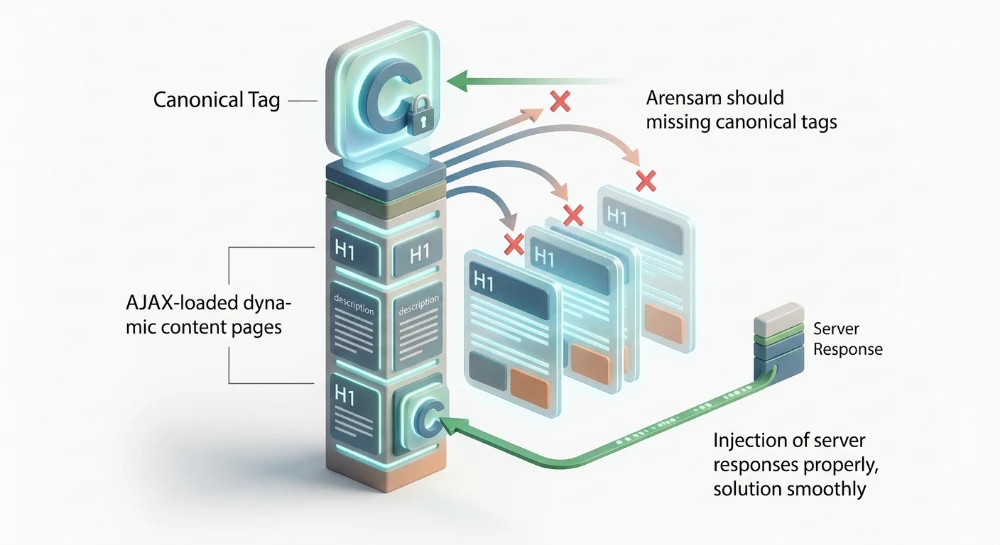
Understanding exactly why pages of dynamic content loaded via AJAX suffer from missing canonicals requires analyzing the rendering sequence of modern web application frameworks. Single-Page Applications delay DOM population. The browser must wait for JavaScript to execute and fetch external payload data before the page structure actually exists. This architectural delay leaves the initial HTML response entirely devoid of relational link directives. Googlebot processes this raw network response first. The crawler parses the source code and immediately notices the absence of instructions, placing the complex rendering tasks into a separate Web Rendering Service queue that can delay processing for days or weeks.
Client-side rendering shifts the computational burden of constructing the HTML entirely to the browser. This creates an immediate synchronization problem for indexation. When a user requests a URL, the server returns a barebones document containing little more than a script tag and an empty container `div`. The head section lacks critical meta information, including canonical directives meant to consolidate ranking signals. Search engine crawlers encountering this empty state often index duplicate variations of the same URL before the asynchronous scripts ever finish executing. The resulting duplicate content indexation dilutes PageRank across multiple parameterized endpoints. Index bloat follows rapidly as filtering and sorting parameters generate thousands of unique paths.
Injecting server responses directly into the initial document structure provides a definitive technical solution to this failure point. By populating the HTML head with the correct canonical tag before the response leaves the server, crawlers receive explicit instructions immediately upon connection. Consolidating authoritative URLs relies entirely on this synchronous availability. Establishing a clear primary structure blocks search engines from storing redundant permutations generated by session IDs or API tracking parameters.
The structural failure of asynchronous tag injection manifests through specific rendering behaviors:
- The server delivers an empty DOM state containing only the application root element without meta directives.
- Googlebot indexes the query string permutations before executing the associated JavaScript payload.
- Delayed DOM mutations fail to overwrite the indexing signals established by the raw HTML document due to rendering timeouts.
Architectural causes of missing canonicals in CSR environments
Client-side rendering fundamentally alters the sequence of document delivery and indexation. Traditional server architectures transmit a fully populated HTML payload directly to the client. CSR applications deploy an entirely different mechanism. The server delivers a bare skeletal framework, typically an index file containing a single empty root element and reference links to JavaScript bundles. This initial response constitutes the Raw HTML. The Rendered HTML only materializes after the browser downloads, parses, and executes these scripts to construct the Document Object Model dynamically.
This temporal gap between the initial network response and the finalized interface creates a severe structural vulnerability.
Formulating a precise canonical URL requires contextual application data. The client must determine the exact routing path, active product identifiers, or category hierarchies to construct the absolute URL required for the meta tag. In a standard CSR architecture, this data rarely exists within the static JavaScript bundles. The client must execute an asynchronous data fetch via AJAX to a backend API to retrieve the necessary payload.
Network latency immediately becomes a blocking factor in DOM population. While the client awaits the API JSON response, the HTML head remains structurally incomplete and completely devoid of the link rel="canonical" directive.
Search engine crawlers evaluate the Raw HTML immediately upon establishing the HTTP connection. When asynchronous data fetching delays the DOM population, the bot parses a head section lacking consolidation instructions. The delayed injection ensures the canonical tag arrives only after the initial evaluation phase has concluded, leaving the crawler to process the raw routing state.
SPA framework rendering mechanics
Default scaffolding utilities for modern single-page applications prioritize rapid interactive state over initial markup completeness. This engineering bias inherently strips SEO directives from the initial payload across major frameworks.
- ReactJS: Standard client-side implementations mount the application entirely within the browser. Component lifecycle methods responsible for fetching route context trigger only after the initial DOM paint, leaving the raw head block empty during the initial crawler connection.
- Angular: Base configurations rely on zone execution and asynchronous route guards before rendering view templates. The core application element remains unpopulated during the raw network transfer, physically delaying any dynamic meta tag injection until the framework fully initializes.
- Vue.js: Standard builds inject mounting scripts into a static template file. The internal router requires asynchronous component resolution to determine the active page context. This resolution latency blocks the generation of the canonical URL until the AJAX data payload successfully returns and binds to the view.
The architectural flow of CSR creates a measurable discrepancy between crawler expectations and application readiness.
| Rendering Phase | Application State | Canonical Presence |
|---|---|---|
| Initial Request | Server sends static index file with empty root node | Missing |
| Script Parsing | Browser downloads main JS bundles | Missing |
| Asynchronous Fetch | AJAX requests dispatch to backend API endpoints | Missing |
| DOM Population | Data binds to components and Rendered HTML finalizes | Injected |
Crawler interaction at any point prior to the final DOM population phase results in a missed directive. The reliance on client-side state resolution guarantees that the canonical URL depends entirely on the successful execution of asynchronous network requests, transforming a fundamental SEO requirement into a fragile, latency-dependent operation.
Parameter bloat and crawlability issues in faceted navigation
The absence of an immediate canonical directive in the initial HTML response exposes faceted navigation architectures to critical indexing failures. Dynamically filtered content relies on manipulating URL states to reflect user choices. Search engine crawlers interpret these distinct strings as unique endpoints. Without a static canonical tag in the raw HTML payload, the crawler registers every single state as an independent document.
Ajax Filtered Pages modify the interface without requesting a new static document from the server. The user selects a filter. The API returns the specific dataset. The client updates the routing string. Crawlers discover these new paths through sitemaps or internal links. The fundamental flaw occurs when the rendering logic assumes crawlers wait for the final DOM state before processing the URL. They do not.
Faceted navigation architectures utilize several distinct mechanisms to manage application state. Each component introduces specific crawlability hazards when canonicals remain absent during the initial fetch phase.
- URL parameters: Standard key-value pairs defining specific product attributes or sorting orders. A single category interface can generate thousands of mathematically valid combinations.
- query strings: The sequence following the question mark in the path. Uncontrolled query strings generate near-infinite crawl paths for identical datasets.
- URL Variables: Dynamic segments within the routing logic that change based on user interaction or API payloads.
- Session IDs: Tracking strings appended to maintain user state across the application. These create distinctly unique URLs for the exact same content on every single visit.
- URL fragment: Hash-based identifiers used for client-side routing logic. Modern routing configurations occasionally misconfigure hashbangs, leading to fragmented indexing when the crawler misinterprets the routing state.
The architectural breakdown happens during the delay between raw HTML extraction and JavaScript processing. Crawlers allocate finite crawl capacity to every host. When a crawler encounters an unprotected faceted navigation structure, it queues the massive matrix of parameter variations for extraction. The raw HTML contains no canonical consolidation signals. The crawler proceeds to download the exact same underlying content thousands of times.
The sequence of bandwidth exhaustion follows a predictable architectural failure pattern.
| Extraction Phase | Crawler Action | System Impact |
|---|---|---|
| Discovery | Crawler extracts internal links containing sorting and filtering strings | Crawl queue expands exponentially |
| Initial Fetch | Crawler requests the raw HTML for thousands of variations | Server load increases dramatically |
| HTML Parsing | Crawler finds missing canonical tags in the raw source code | Duplicate pages proceed directly to index processing |
| Rendering Queue | URLs wait for heavy JavaScript execution resources | Crawl bandwidth is completely exhausted |
Index bloat accelerates instantly. Crawl bandwidth plummets. The system forces the crawler to process thousands of identical application states. Googlebot utilizes a delayed processing model, separating the initial HTML fetch from the heavier JavaScript rendering queue. The sheer volume of duplicate parameter variations exhausts the server crawl allocation long before Googlebot JavaScript execution triggers.
The dynamic canonical injection never executes in time to prevent the duplication. The core application logic fails SEO requirements. Critical indexing equity fragments across thousands of meaningless parameter combinations, effectively removing the primary authoritative page from the active SERP.
Diagnostic workflows for DOM-Level canonical verification
Auditing dynamic canonicalization requires isolating the exact code payload search engine crawlers process. Standard browser verification methods fail in these environments. The DOM mutates rapidly after the initial load. Relying on visual checks or basic browser inspector tools creates false positives, masking underlying architectural flaws where scripts inject data too late for crawlers to see.
Engineers must execute a strict, multi-stage comparison to validate the rendering pipeline. You must identify exactly when and where the canonical directive enters the code structure.
Raw source code vs. rendered DOM analysis
Browser developer tools automatically execute client-side scripts. The default Elements panel presents a unified, fully processed state that hides initial payload deficiencies. To diagnose canonical latency, you must split the audit into two distinct verification phases.
- Right-click the page and select 'View page source' to access the unexecuted raw HTML response directly from the server.
- Search the ` ` section of this raw document for the canonical link element.
- Open Chrome DevTools and navigate to the Elements panel to inspect the active, fully executed DOM.
- Compare the presence, syntax, and target URL of the canonical tag across both environments.
A canonical tag that appears in the Elements panel but remains absent from the raw source code confirms client-side injection latency. Crawlers encounter a blank state during the critical initial fetch phase. The architecture forces search engines to rely on delayed rendering queues.
Validating injected state via Google tooling
Third-party crawlers handle script execution differently. You must utilize Google infrastructure to verify how Googlebot evaluates the DOM mutation. Google Search Console provides the exact interfaces required to bypass local browser discrepancies and validate the machine-readable state.
| Diagnostic Interface | Verification Objective | Execution Output |
|---|---|---|
| Rich Results Test | Real-time DOM evaluation | Exposes script timeouts and rendering blocks preventing tag injection |
| URL Inspection Tool | Historical crawl analysis | Displays the exact HTML payload captured during the last automated visit |
Submit the target URL to the Rich Results Test. This utility bypasses standard indexing queues to execute the page live. Open the 'View Tested Page' interface. Select the HTML tab. This code block represents the exact DOM Googlebot evaluates post-render. Search for the canonical directive.
If the tag remains missing in this output despite appearing in your local browser DevTools, the injection mechanism is failing at scale. The script either exceeds crawler rendering timeouts, relies on unsupported API calls, or throws silent execution errors.
Run the same URL through the URL Inspection Tool. Switch to the 'View Crawled Page' interface. This provides historical validation. A discrepancy between the live Rich Results Test and the historical URL Inspection output indicates intermittent rendering failures under server load.
Monitoring GSC indexing reports
Isolated manual checks cannot map domain-wide rendering failures. Systemic diagnostic workflows require continuous monitoring of the GSC Indexing report to track the exact scale of parameter bloat caused by rendering latency.
Navigate directly to the Pages interface within GSC. Filter the diagnostic data to isolate the 'Duplicate without user-selected canonical' status code. This specific classification triggers when the crawler processes identical content variants but encounters an empty directive state before making its indexing decision.
- Export the affected URL list directly from the GSC interface.
- Filter the dataset to isolate parameter-heavy structures generated by application sorting variables.
- Cross-reference URL discovery dates against recent application deployments or CMS updates.
A sudden spike in the 'Duplicate without user-selected canonical' report correlates directly with failed DOM injections. The crawler defaults to its own algorithmic deduction, ignoring the intended site architecture. Track this specific error cluster as the primary health indicator for dynamic canonicalization integrity.
Injecting server responses for dynamic canonical tags
Bypassing the crawler rendering queue requires shifting canonical tag population from the client to the server. The objective is to include the exact canonical directive within the initial HTML document payload. Crawler bots detect the authoritative URL immediately during the first HTTP request. This prevents duplicate clusters from entering the indexing pipeline while the application waits for asynchronous scripts to execute.
Server-side rendering resolves the latency gap inherent to client-side data fetching. When a request hits the server, the application environment evaluates the routing state, parses any active parameters, and injects the corresponding metadata directly into the head block before returning the response. Next.js handles this natively through server-side routing protocols. Engineers can leverage the App Router metadata object or legacy server-side functions to read the incoming request URL and map it to a predefined canonical state.
To implement this routing logic effectively, the server must execute specific sequential operations prior to client delivery:
- Intercept the incoming request object and parse the active query string.
- Filter out application-specific sorting variables to isolate the root path.
- Construct the authoritative URL string based on the clean path.
- Assign this string to the canonical property within the metadata API payload.
- Serialize the updated HTML response and dispatch it to the requesting agent.
Edge SSR configurations
Edge SSR configurations distribute metadata injection to the network perimeter. Instead of querying the origin server for every parameter combination, edge workers intercept the incoming request. They evaluate the query string, match it against a caching rule, and append the canonical tag to the HTML response directly at the edge node. This drastically reduces the time to first byte while maintaining strict architectural control over indexable URLs.
The edge layer acts as a middleware processor. It handles parameter stripping and tag injection without waking the main application backend. High-traffic faceted navigation systems rely on this pattern to scale metadata management without inflating server hosting costs.
Dynamic rendering fallbacks
Dynamic rendering remains a viable architectural bridge for legacy single-page applications that cannot undergo a full SSR rewrite. The origin server identifies incoming crawler requests via user-agent strings. Bots receive a fully serialized HTML payload containing the pre-rendered canonical tag. Human visitors continue receiving the standard client-side application.
Middleware services parse the executed DOM and snapshot the output. Maintain strict parity between the pre-rendered crawler metadata and the intended client state. Discrepancies here trigger cloaking flags within the SEO algorithm.
The architectural choice dictates the execution layer and resource overhead for injecting metadata.
| Implementation Pattern | Execution Layer | Crawler Discovery Speed | Engineering Overhead |
|---|---|---|---|
| Server-Side Rendering | Origin Server (Node.js/Application) | Instantaneous (Initial Payload) | High (Requires framework integration) |
| Edge SSR | Network Perimeter (Workers) | Instantaneous (Cached Node) | Medium (Requires routing logic at edge) |
| Dynamic Rendering | Middleware Server | Slight Delay (Pre-rendering generation) | Low (External service integration) |
Direct server injection guarantees the URL directive reaches the crawler before any JavaScript parsing occurs. Ensure the injected tag maps exclusively to the primary content node, regardless of which sorting parameters triggered the server request.
Implementing canonical directives via HTTP headers
Shifting the canonical directive from the document structure to the network layer provides a resilient alternative to HTML payload manipulation. The server transmits the authoritative signal before the client downloads the document body. Crawlers process network headers instantaneously. This prevents indexation dependency on DOM construction or rendering path execution.
The implementation requires configuring the server response to include a specific string alongside standard status codes and content type declarations.
Link: <https://www.example.com/authoritative-path/>; rel="canonical"Deploying this configuration requires direct access to server routing logic. The syntax demands an absolute URL enclosed in angle brackets, followed by the relational parameter separated by a semicolon. Improper formatting invalidates the directive entirely.
Canonicalizing raw API payloads
AJAX architectures frequently expose raw JSON endpoints to search engine crawlers. A bot discovering a standalone data endpoint lacks the context of the frontend application. HTML tags cannot exist within a JSON response. The HTTP header remains the sole mechanism to assign a canonical URL to an API data feed.
When a crawler requests the raw data endpoint, the server responds with the payload and the corresponding header directive mapping the data back to its parent view.
- Identify all exposed API endpoints queried during standard user navigation.
- Map each endpoint to the user-facing URL that consumes its payload.
- Configure the routing layer to append the Link header to all GET requests targeting the API directory.
Bypassing the rendering queue
Search engines separate the crawling phase from the rendering phase. Discovering a URL triggers an initial fetch. The crawler reads the HTTP headers and raw HTML immediately. Executing scripts to build the final DOM occurs later, subject to available computing resources.
Header directives process during the initial fetch. The server handshake confirms the canonical target before the rendering engine activates. This architectural pattern circumvents common points of failure.
| Failure Point | DOM Injection Vulnerability | HTTP Header Resolution |
|---|---|---|
| Rendering Timeouts | High risk during complex component mounting | Zero risk |
| Queue Latency | Deferred pending available crawl budget | Processed upon initial network request |
| Payload Size Limits | Truncated documents lose the markup | Headers process independently of body size |
Network-level implementation forces the search engine to acknowledge the canonical relationship immediately. The directive supersedes any conflicting signals potentially generated during subsequent client-side execution.
Limitations and risks of Client-Side JavaScript injection
Relying on client-side scripts to append canonical tags post-load introduces severe architectural vulnerabilities. Developers frequently deploy
document.querySelector('head').appendChild(canonicalLink)
as a quick patch for dynamic views. This assumes the crawler behaves exactly like a modern browser. It does not. The mechanism forces critical SEO signals to depend on asynchronous execution. This approach is inherently volatile in headless crawler environments.
The rendering queue latency trap
Search engine architecture processes pages in distinct stages. The initial fetch captures raw HTML. If the canonical tag is absent from this payload, the URL enters the rendering queue. The delay between discovery and rendering can span days or weeks. During this latency period, the crawler processes the page without a canonical directive.
Duplicate URLs get indexed. The index bloats.
When the rendering engine finally executes the JS, it is often too late to prevent initial duplicate indexation. The indexer has already assigned relevance and authority to the wrong URL parameter string. Relying on deferred execution for structural directives breaks authoritative consolidation logic entirely.
Execution vulnerabilities and timeouts
Client-side injection fails immediately if a script throws an unhandled exception before DOM manipulation occurs. A single syntax error in a third-party script can halt the entire execution thread. The canonical tag is never injected. The page remains orphaned from its canonical cluster.
Timeouts present a more insidious risk. Rendering engines allocate finite processing time per URL. If asynchronous data fetching takes too long, the service snapshots the DOM before the network call resolves.
The injected canonical misses the cutoff.
Compare these execution risks against server-level implementation to understand the necessity of robust architecture.
| Failure Mechanism | Client-Side JavaScript Injection | SSR Stability |
|---|---|---|
| Processing Latency | High risk. Dependent on render queue availability. | Zero risk. Processed immediately on initial fetch. |
| Resource Timeouts | Fails if data payload exceeds rendering time limits. | Immune. HTML contains directives before transmission. |
| Thread Blocking | Fails if prior JS throws unhandled exceptions. | Immune. No dependency on client processing. |
Asynchronous injection failure conditions
Client-side canonicals collapse under specific infrastructure stresses. Auditing log files frequently reveals strict conditions where asynchronous injection fails.
- Render thread timeouts caused by heavy synchronous main-thread tasks blocking DOM updates.
- Race conditions where the crawler snapshots the DOM before the asynchronous fetch promise resolves.
- Network latency delaying the API payloads required to build the target canonical URL.
- Memory allocation limits reached within the headless rendering container causing silent script termination.
SSR eliminates these variables. Pushing the canonical directive from the server ensures it exists in the raw HTML response. The crawler parses the consolidated URL immediately upon the initial network request. Critical meta directives must never rely on client-side compilation.
AJAX pagination handling and authoritative URL consolidation
AJAX pagination introduces extreme volatility into crawl paths. When users scroll or click pagination triggers, the browser updates asynchronously without a hard document reload. Search engines expect discrete, addressable HTML nodes. Leaving asynchronous fetches unmapped to static URL structures causes deep indexing failures. You must enforce strict URL parsing rules to synchronize the client state with the canonical directives.
Single-page applications often rely on relative paths for internal API routing. Migrating this logic into canonical tags creates recursive loop failures. Crawlers misinterpret relative paths when encountering appended query strings or altered base directories.
Require absolute URLs in all generated canonical tags. The output must contain the fully qualified protocol and hostname.
<link rel="canonical" href="https://www.example.com/category-name" />
Injecting a relative path during an AJAX request allows tracking parameters to bleed into the canonical evaluation. If a crawler requests a page with marketing variables attached, a relative canonical simply inherits the flawed state. Absolute URLs force the crawler to recognize the precise, unalterable target destination.
Root query state and Self-Referencing directives
The root query state serves as the master node for any faceted category or paginated sequence. This base URL represents the content without active filters or pagination variables. Securing this root state demands a self-referencing canonical tag.
When an AJAX request loads the first sequence of products, the routing logic must not append pagination parameters like a page one variable. The server response must output a canonical pointing directly to the clean root URL. As subsequent AJAX requests fetch deeper pages, the History API updates the address bar while the server returns a paginated canonical matching the new exact state.
Deploying strict URL parsing rules prevents infinite parameter generation during asynchronous pagination.
- Bind all asynchronous pagination states to the History API pushState method to generate distinct URLs.
- Strip all non-essential sorting or session parameters from the canonical output logic.
- Ensure the root category page canonicalizes to itself without appending an explicit page one parameter.
- Output paginated states sequentially using static path structures rather than dynamic query strings where possible.
Resolving legacy parameter structures
Architectural updates frequently shift pagination from query strings to path segments. Retaining backward compatibility in the AJAX interface allows old bookmarks to function but leaves the indexing signals fractured across multiple URL variants.
Utilize server-side 301 redirects for legacy parameter structures to consolidate the authoritative source. Intercept incoming requests containing deprecated parameters before they reach the AJAX rendering logic. Forcing a permanent redirect to the modern canonical structure passes historical indexing signals reliably to the new consolidated URL.
Relying on canonical tags alone to handle legacy parameters is insufficient. Crawlers waste bandwidth evaluating the legacy query string before reading the DOM payload. A server-level 301 terminates the crawl of the deprecated format immediately.
Mapping legacy parameter structures to modern routing requires specific server-level consolidation logic.
| Legacy Request URL | Modern Target URL | Required Server Action | Target Canonical Output |
|---|---|---|---|
| /category?p=1 | /category | 301 Redirect | https://www.example.com/category |
| /category?p=2 | /category/page-2 | 301 Redirect | https://www.example.com/category/page-2 |
| /category?sort=price&p=3 | /category/page-3 | 301 Redirect | https://www.example.com/category/page-3 |
| /category/page-4 | /category/page-4 | 200 OK | https://www.example.com/category/page-4 |
Consolidating these variants removes ambiguity from the crawl queue. The server dictates the authoritative URL structure before the asynchronous data fetch even begins, ensuring total alignment between the rendering logic and search engine indexes.