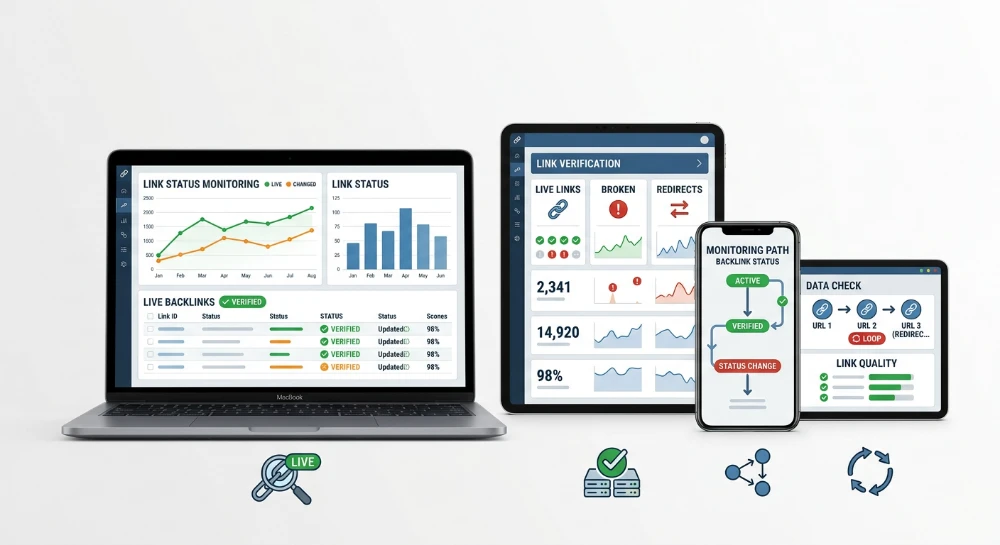
Monitor Backlinks rivals capable of live tracking of link profiles fall into a narrow category of tools built around one specific job: catching a change to a placed link the moment it happens, not weeks later during a routine audit. A dropped placement, a rel attribute quietly switched to nofollow or sponsored, an anchor text edited by a webmaster after the invoice was paid - these are status changes, not database entries. Most backlink tools are built to answer "who links to this domain". Far fewer are built to answer "did this exact link, on this exact page, change since last Tuesday".
That distinction matters for any team that pays for placements, negotiates guest posts, or runs a link-building campaign with contractual anchor text requirements. A general backlink index refreshes on its own schedule, often weekly or monthly, and shows a snapshot. Active monitoring works differently: it re-checks specific URLs on a set interval, logs the prior state against the current one, and pushes a notification through an alert channel when something moves. Without that logging layer, a lost link can sit undetected for a full billing cycle before anyone notices the referring domain no longer carries the client's URL.
Coverage gaps show up in predictable places. A webmaster removes a paid link after 90 days once the invoice clears. A rel attribute gets swapped from dofollow to nofollow during a site migration, cutting the equity transfer without removing the link itself. An anchor gets hijacked - the exact-match phrase quietly replaced with a generic "click here" or a competitor's brand term. None of these events show up in a standard database lookup unless the tool is explicitly re-checking that URL and comparing states over time.
Evaluating alternatives to Monitor Backlinks on this basis requires a fixed set of criteria rather than a feature-list comparison. Check frequency determines how quickly a change surfaces. Status-change granularity determines whether the tool distinguishes a full removal from an attribute edit from an anchor swap, or simply reports "link status: lost" with no detail. Alert delivery - email, Slack, Telegram, or Gmail-based notifications - determines how fast the finding reaches whoever owns the link relationship. Billing model, flat subscription versus usage-based pricing, determines whether the cost scales with the size of the monitored link list or stays fixed regardless of volume.
The sections that follow apply these four criteria to a set of tools with documented monitoring or alerting functionality: Ahrefs Alerts, Semrush Backlink Audit, Moz Pro Link Explorer and Campaigns, SE Ranking Backlink Monitor, Linkody, CognitiveSEO's Unnatural Link Detection module, and SeLinkPro's automated backlink monitor. Each gets assessed on what it actually logs and how it delivers that information, not on marketing copy. The closing section maps these findings against three practical variables - team size, budget structure, and required alert granularity - into a decision framework for choosing a monitoring setup that fits.
Why teams look past monitor backlinks for continuous link surveillance
A link that was live last month is not guaranteed to be live today. A webmaster edits a page, a CMS migration strips old markup, an agency swaps out a client's blogroll - and the link a buyer paid for either disappears, gets buried under a nofollow attribute, or has its anchor text rewritten to something that no longer matches the target keyword. None of this triggers a notification on its own. Somebody has to go check, and checking manually across dozens or hundreds of placements is not a workflow, it's a chore that gets skipped the moment the team gets busy.
This is the actual gap driving the search for alternatives. It's not that Monitor Backlinks fails to store a list of links. It's that a stored list is a static record, and link placements are not static. Three failure modes repeat constantly across real link portfolios, and each one needs a different kind of detection:
- The link is removed outright - the placement page is edited, the paragraph deleted, or the entire post taken down.
- The link survives but gets its attribute changed - dofollow quietly becomes nofollow, sponsored, or ugc, killing the equity pass without touching the visible page content.
- The anchor text is altered - a webmaster swaps the exact-match anchor for a generic one, or repurposes the link for a different page entirely.
A tool that only reports "backlink found" or "backlink not found" collapses all three into one bucket. That's not useful for a buyer trying to prove a vendor broke contract terms, and it's not useful for an in-house SEO trying to figure out why a page's rankings slipped without any obvious algorithm update. What's needed instead is an alert that fires automatically and describes what changed, delivered somewhere the team actually looks - not a dashboard nobody logs into until a client asks a hard question.
Framing the alternatives search this way sets up a fair way to judge the tools covered ahead. Rather than scoring each one on how big its backlink index is, the comparison needs to run on how well each tool catches change and how fast it tells someone. Six criteria carry that weight across the rest of this evaluation.
Check and alert frequency
How often does the tool actually re-visit a monitored link. Daily checks catch a removal fast; weekly or monthly cycles mean a dropped link can sit undetected for weeks, which matters a lot if the link was paid for under a guarantee period.
Granularity of Status-Change detection
Does the tool distinguish a full removal from an attribute edit from an anchor swap, or does it just report a binary lost/active status. This is the single biggest differentiator between a surface-level checker and a genuine monitoring tool, because the three failure modes above require completely different follow-up actions.
Alert delivery channels
Email digest is the baseline, but teams running link campaigns at volume need faster or more integrated routing - Slack, Telegram, or Gmail-based notification are the channels that matter here, since an alert sitting unread in an inbox for three days defeats the purpose of automated detection.
Integration with Google search console
Cross-verifying a monitoring tool's findings against Search Console data helps confirm whether a flagged loss is real or a false positive caused by a temporary crawl error on the donor page.
Billing structure
Flat subscription pricing charges the same regardless of how many links get checked or how often; usage-based pricing scales cost with actual monitoring volume. Which model fits depends entirely on portfolio size - a flat fee is wasteful for a small link list and a bargain for a large one, and the reverse is true for usage-based billing.
Disavow-File support
When a monitored link is flagged as toxic or spam-adjacent rather than simply lost, does the tool help generate a disavow file for submission, or does that step have to be done by hand outside the platform.
Ahrefs alerts: Tracking new and lost backlinks at scale
Ahrefs approaches backlink monitoring through its Alerts module, configured on a per-project basis. Set up an alert on a project and Ahrefs will notify when new backlinks appear or existing ones drop out of its index. The check frequency is selectable - daily, weekly, or monthly - and results arrive as an email digest rather than through any real-time push channel.
That scheduling choice matters for how teams plan follow-up. A daily cadence catches losses closer to when they happen, useful for campaigns where link velocity is high and a missing placement needs fast escalation to the outreach team. Weekly or monthly cadence works better for portfolios where checking every single day would just generate noise against a slower-moving link profile. Either way, the alert is a scheduled batch report, not a continuous poll - Ahrefs checks its own index at the interval selected, it does not sit there watching a donor page in real time.
All of this runs on data pulled from Ahrefs' own crawler-built Site Explorer database. That is an important distinction from tools that piggyback on third-party indexes: the backlinks surfaced in an Alert are backlinks that Ahrefs' crawler has itself discovered and stored, so the accuracy of any new/lost signal is bound to how frequently and how deeply that crawler has revisited the relevant pages. Alongside each monitored link, Ahrefs displays Domain Rating as the authority metric - a single number attached to the referring domain, giving a quick read on whether a lost link was sitting on a high-authority page worth chasing down or a low-value placement not worth the follow-up effort.
One thing that separates Ahrefs Alerts from a narrow backlink-only checker is the scope of the module itself. The same Alerts interface used for link tracking also runs brand-mention alerts and keyword alerts, which means a single dashboard covers three separate monitoring jobs at once: link status, unlinked brand mentions worth turning into links, and keyword movement. For a team already inside Ahrefs for other research work, that consolidation removes the need for a separate mention-tracking tool bolted on top of a link checker.
What the module does not document is any status-change granularity beyond new versus lost. There is no described breakdown distinguishing a link that went nofollow from one that vanished outright, and no anchor-text-change flag mentioned in how Alerts reports results. For teams whose core question is simply "did this link survive", a scheduled email digest built on Ahrefs' own crawl data covers the basic case well. For teams needing to know whether a surviving link quietly picked up a rel=sponsored tag or had its anchor swapped, that level of detail sits outside what this particular workflow reports.
Semrush backlink audit: Monitoring toxic and lost links
Semrush approaches link monitoring from a different angle than a pure alert feed. Backlink Audit is built around risk scoring first, status tracking second. The tool tracks new and lost referring domains over time, which covers the basic surveillance need, but the feature that defines the workflow is the Toxic Score attached to each domain in the profile.
That scoring matters for a specific reason. A link disappearing is one kind of problem. A link sitting on a domain that has quietly turned toxic is a different problem entirely, and it is one that a simple new-versus-lost check will not surface on its own. Semrush treats these as connected but distinct signals inside the same audit.
Where this becomes operational rather than just diagnostic is the disavow path. Domains flagged by the Toxic Score are not just listed for manual review - they feed directly into a disavow file formatted for submission through Google's Disavow Tool. That removes a manual export-and-reformat step that would otherwise sit between detection and action.
A few points define the boundary of what this workflow actually does:
- Tracking is domain-level for the new/lost comparison, covering referring domains rather than reporting anchor-text or rel-attribute changes on individual links.
- The Toxic Score is the mechanism used to separate links worth disavowing from links that are simply gone.
- Flagged domains route into a disavow file built for direct submission, not a generic export requiring reformatting.
Backlink Analytics, a separate module inside Semrush, supplies the trend view that pairs with the audit. It renders referring domain and referring page charts over time, which is the practical way a webmaster spots a drop before digging into which specific placements caused it. A sudden dip in the referring domains line is often the first signal that something in the link profile needs a closer look - before anyone opens the audit itself to find out why.
The distinction worth holding onto: Backlink Audit answers "is this domain a liability", while Backlink Analytics answers "is my link profile shrinking". Run together, they cover toxic-link identification and profile-level drop detection. Neither one, based on what is documented, reports rel-attribute swaps or anchor-text edits on a surviving link - that granularity sits outside this particular pairing of tools.
Moz pro link explorer: Alerting on link profile changes
Link Explorer runs new and lost link comparisons against Moz's own index, and that index refreshes on a periodic cycle rather than continuously. A webmaster pulling a report sees links that appeared or disappeared since the last refresh, not since the last minute. That timing detail matters for anyone expecting a live feed - the data is only as current as the most recent index update, and there is no documented mechanism for forcing an on-demand crawl of a single donor page.
Three metrics ride alongside every link in the report: Domain Authority, Page Authority, and Spam Score. DA and PA give a relative strength read on the linking domain and page. Spam Score flags the probability that a domain carries characteristics tied to link-farm or manipulative patterns. None of the three, based on documented functionality, report whether a specific link's rel attribute switched from dofollow to nofollow, sponsored, or ugc - the comparison operates at the link-presence level, not the attribute level.
Campaigns is the piece that turns Link Explorer from a lookup tool into something closer to a monitoring habit. A tracked profile inside a Campaign can trigger scheduled email alerts summarizing what changed in the link profile since the last check.
That's the whole mechanism: build a Campaign, attach the domain, let the schedule run.
What a webmaster gets from that email is a summary, not a line-item diff. It tells you the profile shifted. It does not tell you which anchor text got edited on a surviving placement, and it does not confirm whether a link that vanished from the report was removed outright or simply dropped from Moz's index on that refresh cycle. Anyone running vendor-placed links who needs proof of an attribute change or an anchor edit on a specific URL will need to cross-check the flagged domain manually - Campaigns alerts on the fact that the profile moved, leaving the diagnosis of why to a follow-up step outside the tool.
Framed against the workflow gap described earlier, Link Explorer and Campaigns cover two of the six criteria reasonably well: check frequency (scheduled, index-refresh dependent) and one alert channel (email). Status-change granularity stops at new/lost link presence. Spam Score gives a toxicity signal similar in spirit to what other platforms compute, but there is no documented disavow-file export tied to that score, and no Slack, Telegram, or Gmail delivery option beyond the scheduled email summary.
SE ranking backlink monitor: Dedicated Status-Change tracking
SE Ranking splits its backlink functionality into two distinct products, and that split matters for anyone evaluating monitoring workflows. The Backlink Checker is the lookup tool - point it at a domain, pull the referring-domain list, review the dataset. Backlink Monitor is a separate, dedicated feature built around a different question: not "what links exist right now" but "what happened to the links I already placed".
That distinction is the whole point of running a monitoring feature instead of a database query. A checker answers a snapshot question. A monitor answers a change question. SE Ranking's Backlink Monitor is built for the second case.
What backlink monitor actually tracks
The feature watches previously placed links for three specific status changes: removal, an attribute switch between dofollow and nofollow, and an anchor text edit. When any of those three events fires, SE Ranking sends an email alert flagging the change.
That is a meaningfully tighter granularity than a simple new/lost report. A link disappearing from a crawl index and a link getting physically deleted from a page look identical in a database-refresh model. Backlink Monitor's documented behavior separates removal from attribute change from anchor change - three named categories, not one collapsed "profile shifted" signal.
- Link removed - the placement is no longer present on the donor page.
- Attribute switched - a link that was dofollow becomes nofollow, or the reverse.
- Anchor text changed - the visible link text on a tracked placement has been edited.
Each of these maps directly onto the exact failure modes that make Monitor Backlinks users start looking elsewhere: a paid placement quietly downgraded to nofollow, a guest post anchor swapped out after publication, a link pulled entirely without notice. Catching any of the three requires status-change logging against a known baseline, not a fresh crawl compared to nothing.
Alert delivery and check mechanics
The alerting channel is email. When Backlink Monitor detects one of the three status changes on a tracked link, that triggers an email notification flagging the specific change. There's no documented Slack, Telegram, or Gmail-specific integration tied to this feature - email is the delivery mechanism as described.
Against the six-criteria framework used throughout this evaluation, Backlink Monitor scores well on granularity - arguably the strongest of the tools covered so far on that specific axis, since it names the change type rather than just flagging profile movement. Alert channel coverage stops at email, same limitation seen elsewhere in this comparison.
Backlink checker and the data API
Separate from the monitoring feature, SE Ranking maintains a Backlink Checker database for general lookup work, plus programmatic access through the SE Ranking Data API. The API lets a team pull backlink data directly into an internal system rather than working inside SE Ranking's interface - useful for agencies that want to feed link data into a custom dashboard or reporting pipeline.
That API access is a database-retrieval mechanism, not a monitoring or alerting layer in itself. Anyone building an automated status-change pipeline on top of the Data API would be constructing that logic outside SE Ranking's own documented Backlink Monitor workflow. The distinction matters for teams evaluating build-versus-buy: the Data API gives raw data access; Backlink Monitor gives the ready-made alert.
Weighed against the workflow gap defined earlier - removal, attribute change, anchor change, surfaced through an alert rather than a manual re-check - Backlink Monitor is the first tool in this comparison to name all three status categories explicitly and route each through an alert. What it doesn't document is a disavow-file export tied to flagged links, or a Google Search Console cross-check step, or any alert channel beyond email. Those gaps are the same shape as the ones found in the other platforms covered so far: strong on detection granularity, narrow on delivery flexibility and downstream remediation.
Linkody: A Purpose-Built monitor backlinks alternative
Of every platform covered so far, Linkody sits closest to Monitor Backlinks' original design brief. It was built around the same narrow job: keep a list of tracked backlinks, check them on a schedule, and fire an alert the moment one disappears. No adjacent audit suite bolted on, no broader marketing dashboard wrapped around it. Just the tracking loop teams were already trying to replace.
The core mechanic is a daily check against the backlink list a user has added to the platform. Each tracked link gets revisited once per day, and when a previously placed link is no longer detected, Linkody sends an email alert flagging the loss. That's the entire workflow gap from Section 2 addressed in its simplest form: removal detection, surfaced through an alert channel, without requiring anyone to manually re-open a spreadsheet and re-check placements by hand.
Filling gaps with search console data
Backlink lists built manually or pulled from a crawler database rarely capture every link pointing at a domain. Linkody addresses part of that blind spot through Google Search Console integration, pulling in links Search Console has discovered that weren't already part of the tracked list. That supplements coverage rather than replacing the core tracking mechanism - the daily-check loop still runs against whatever links end up on the list, whether added manually or surfaced through the Search Console connection.
This matters for teams worried about coverage gaps. A backlink acquired through a guest post or a mention nobody logged manually can still show up through Search Console and get folded into the monitored set, rather than sitting invisible until someone stumbles on it during a manual audit.
Disavow file generation and the chrome extension
For links flagged as toxic, Linkody generates a disavow file - the same downstream step Semrush's Backlink Audit documents, applied here inside Linkody's own tracking workflow. That closes a loop the SE Ranking section flagged as missing: a direct path from flagged link to a disavow-ready export, without needing a separate tool to build that file by hand.
Linkody also ships a Chrome extension for quick link lookups. It's a convenience layer on top of the core platform - useful for a spot-check while browsing a page, rather than part of the daily-check alerting mechanism itself.
Where linkody lands against the criteria
Measured against the six evaluation criteria from Section 2, the documented Linkody feature set breaks down as follows.
- Check frequency: daily checks against the tracked backlink list.
- Alert trigger: email alert sent when a monitored link is lost.
- Coverage supplement: Google Search Console integration adds discovered links to the tracked set.
- Remediation path: disavow file generation for links flagged as toxic.
- Lookup convenience: Chrome extension for quick link checks outside the main dashboard.
What isn't part of the documented workflow is any granularity beyond loss detection - there's no stated rel-attribute change tracking or anchor-text change alert comparable to what SE Ranking's Backlink Monitor names explicitly. Nor is there a documented alert channel beyond email; no Slack, Telegram, or Gmail routing appears in the described workflow. For a team whose entire pain point is "tell me when a link disappears", Linkody's daily-check-plus-email-alert loop is a direct functional match. For a team that also needs to know when a link silently flips to nofollow or gets its anchor swapped, that granularity sits outside what Linkody's documented feature set covers.
CognitiveSEO unnatural link detection for ongoing profile monitoring
CognitiveSEO takes a different angle on the same monitoring problem. Instead of building the workflow around "is this specific link still there", the Unnatural Link Detection module watches the shape of the entire backlink profile over time and flags patterns that look like spam. That's a pattern-recognition approach layered on top of profile history, not a per-link status check.
Two signal types drive the flagging logic. Links exhibiting spam patterns get marked directly. Separately, the module watches for unusual link-velocity spikes - a sudden jump in the rate at which new links appear, which is one of the classic footprints of a negative SEO attack or a botched link-building push that acquired too many links too fast. Neither signal requires a webmaster to touch an existing placement; the trigger is the aggregate trend, not a single URL going dark.
Flagged results surface inside the platform's Site Explorer, where they sit for ongoing review rather than firing off as a one-off notification. That's a meaningful distinction from an alert-first tool. The review happens in-platform: someone checks Site Explorer periodically, looks at what's been flagged since the last pass, and decides what to do with it.
From there, disposition is straightforward. Links flagged through this process can be routed into disavow file preparation, giving a direct path from detection to the same remediation step Semrush's Backlink Audit and Linkody also support - building a file for submission through Google's Disavow Tool.
What this workflow covers and what it doesn't
Set against the six criteria from Section 2, the documented CognitiveSEO workflow answers a narrower question than tools built around loss detection.
- Detection focus: spam-pattern flagging and link-velocity spike analysis across the full backlink profile, not single-link status polling.
- Review mechanism: flagged links accumulate in Site Explorer for manual, ongoing review rather than pushing an alert at the moment of detection.
- Remediation path: flagged links can be routed into disavow file preparation.
No check-frequency figure, no alert-channel detail, and no per-link status change tracking - removed, nofollow-flip, anchor edit - appears in the documented functionality. That puts Unnatural Link Detection in a different category than SE Ranking's Backlink Monitor or Linkody's daily-check loop: it's a profile-level spam and velocity screen, reviewed inside Site Explorer, not a link-by-link change log. Teams whose concern is a slow negative-SEO attack or a spike in spammy inbound links get a purpose-fit tool here. Teams needing confirmation that one specific placed link just lost its dofollow status will need to look elsewhere in this comparison.
SeLinkPro automated backlink monitor: Pay-As-You-Go continuous checks
Every tool covered so far treats a lost link as the worst-case scenario worth flagging. SeLinkPro's Automated backlink monitor tool starts from a different assumption: a link can stay technically live while quietly becoming worthless. The tracking engine polls vendor pages on a continuous basis, watching for link rot and backlink degradation that never triggers a simple removed/not-removed flag but still guts the placement's value.
Detecting stealth attribute injection
The most common way a paid or negotiated placement loses value without disappearing is a quiet rel attribute change. A vendor swaps a dofollow anchor to rel=nofollow, rel=sponsored, or rel=ugc weeks after publication, betting that nobody rechecks the page. SeLinkPro's engine polls specifically for this injection pattern and logs it the moment it appears, rather than waiting for a scheduled audit cycle to stumble across it. The same polling pass also catches altered or hijacked exact-match anchor text - a webmaster editing the anchor string itself, which quietly severs the topical and keyword association the link was built to carry.
Outbound link spikes as a toxic farm signal
A donor page that carried five outbound links at the time of placement and now carries eighty is showing a symptom, not a coincidence. SeLinkPro tracks total outbound links (OBL) on each donor page over time specifically to catch this pattern. A sudden spike in OBL count is treated as a flag for toxic link farm behavior - the donor page has likely been repurposed into a link-selling asset, diluting the equity every existing placement on that page was supposed to receive.
Stealthy crawler blocks
A link can remain visible in a browser and still be functionally worthless to search engines if the donor page has been quietly pulled out of the crawl graph. The monitor checks for exactly this category of manipulation:
- Injected noindex tags added to the donor page after the link was placed.
- Robots.txt exclusions that block crawler access to the page hosting the link.
- Hidden canonicals that point the donor page's authority signal somewhere else entirely.
None of these show up as a broken link or a 404. They show up as a page that looks fine to a human visitor while being invisible to the crawler that matters.
Semantic decay around the anchor
A link's contextual value depends on what surrounds it, not just whether it's still there. The monitor evaluates semantic decay by checking text proximity and entity co-occurrence around the anchor - measuring whether the surrounding paragraph still supports the topic the link was originally placed to reinforce. A donor page that gets rewritten around the anchor, or has unrelated content inserted nearby, can retain the exact same href and anchor text while losing the contextual relevance that justified the placement.
Full HTTP path verification
Following a link's destination address alone isn't sufficient - the monitor follows the full HTTP path to catch malicious 301 chains or 404 dead ends. A vendor can redirect a link through several intermediate hops before it lands on a page unrelated to the original target, or let the endpoint quietly decay into a dead-end 404. Tracing the entire path, not just the initial response code, is what surfaces this kind of manipulation.
Audit ledger for vendor disputes
Every detection event feeds into an audit ledger that maintains historical donor-page snapshots. When a vendor denies having altered a placement, the snapshot history provides a dated record of what the donor page looked like before and after the change - attribute status, anchor text, OBL count, and crawl-block state included. That ledger is the evidence base for disputing a degraded or sabotaged placement with the party who sold it.
Billing model
Every other tool in this comparison - Ahrefs, Semrush, Moz Pro, SE Ranking, Linkody, CognitiveSEO - runs on flat-fee subscription pricing: a recurring monthly or annual charge regardless of how many links get checked in a given cycle. SeLinkPro's Automated backlink monitor tool runs on a strict pay-as-you-go model instead. There is no monthly subscription; access starts with a minimum deposit of $5.00, and usage draws down against that balance. For a team that wants continuous polling on a specific set of vendor-placed links without committing to a recurring subscription tier, that billing structure is the practical differentiator, not just a pricing footnote.
Matching a monitoring tool to your alert needs, team size, and budget model
Seven tools, three axes, one decision. Alert channel, detection granularity, and billing structure do not move together - a tool can be strong on one axis and thin on another, and picking based on brand recognition alone tends to produce a mismatch between what a team actually needs to catch and what the subscription bill covers.
Alert channel reality check
Among the tools documented in this comparison, the alert channel picture is narrower than the general criteria framework might suggest. Ahrefs delivers through a scheduled email digest. Moz Pro Campaigns and SE Ranking's Backlink Monitor both push email alerts. Linkody sends email alerts when a monitored link is lost. Semrush's Backlink Audit and CognitiveSEO's Unnatural Link Detection, by contrast, surface findings inside the dashboard - trend charts and Site Explorer flags respectively - rather than through a documented push-alert mechanism, which means someone has to log in and look rather than wait for a notification. A team that specifically requires Slack, Telegram, or Gmail-native alerting should treat that requirement as a filter question to ask directly of a vendor, since none of the tools reviewed here were documented with those integrations.
Granularity: New/Lost versus attribute and Anchor-Level detection
Detection depth splits the group into two tiers. Ahrefs, Semrush, Moz Pro, and Linkody operate at the new-link/lost-link tier - useful for spotting a placement disappearing, less useful for catching a link that is still live but has been quietly switched to nofollow or had its anchor text swapped. CognitiveSEO adds a spam-pattern and link-velocity layer on top of that, which flags unnatural profile shifts rather than attribute-level tampering on a single URL. SE Ranking's Backlink Monitor and SeLinkPro sit in the second tier: SE Ranking tracks removal, the dofollow/nofollow switch, and anchor text changes as a dedicated function separate from its general Backlink Checker; SeLinkPro extends that granularity further, covering rel=nofollow/sponsored/ugc injection, anchor hijacking, OBL spikes tied to link farms, stealth crawl blocks, semantic decay around the anchor, and full HTTP path tracing through redirect chains.
| Tool | Alert Channel | Detection Granularity | Billing Structure |
|---|---|---|---|
| Ahrefs | Scheduled email digest | New/lost backlinks | Flat subscription |
| Semrush | Dashboard/trend-chart review | New/lost referring domains, Toxic Score flags | Flat subscription |
| Moz Pro | Scheduled email alerts | New/lost links, DA/PA/Spam Score context | Flat subscription |
| SE Ranking | Email alerts | Removal, dofollow/nofollow switch, anchor change | Flat subscription |
| Linkody | Email alerts | Lost-link detection | Flat subscription |
| CognitiveSEO | Dashboard/Site Explorer review | Spam pattern and velocity-spike flags | Flat subscription |
| SeLinkPro | Audit ledger and reports | rel-attribute injection, anchor hijack, OBL spikes, crawl-block detection, semantic decay, HTTP path tracing | Pay-as-you-go, $5 minimum deposit |
Billing structure as a decision variable
Six of the seven tools bill the same way: a flat monthly or annual charge that stays fixed whether ten links get checked that cycle or a thousand. That structure works cleanly when link volume is stable and predictable. SeLinkPro breaks that pattern with usage-based charges drawn against a deposit that starts at $5.00, with no recurring subscription attached. That distinction matters most when the monitored link count fluctuates or when checks are needed in bursts tied to specific vendor disputes rather than on a continuous monthly cadence.
Guidance by reader profile
Team size and the reason for monitoring shape which axis matters most. Three profiles come up repeatedly among teams evaluating Monitor Backlinks alternatives for live backlink tracking.
- In-house SEO managing a small owned link portfolio: A flat-subscription tool with email alerting and attribute-level granularity - SE Ranking's Backlink Monitor, or Linkody for a daily-check workflow with Google Search Console cross-verification - covers a stable, limited link set without the overhead of tracking a usage balance. Simple new/lost detection paired with occasional manual review is often sufficient when the portfolio is small and self-owned.
- Agency monitoring links across multiple client accounts: Volume and variability across accounts make a fixed subscription seat cost harder to justify uniformly. SE Ranking's Data API supports pulling backlink data programmatically for building client-facing reports at scale, while a pay-as-you-go model avoids paying full subscription pricing for client accounts with thin link profiles in a given month. Agencies juggling both heavy and light accounts benefit from mixing a subscription tool for baseline tracking with usage-based checks for accounts that need deeper attribute-level scrutiny.
- Link-building buyer needing audit-trail evidence for vendor disputes: The requirement here is not broad coverage but proof - a dated record of what a donor page looked like before and after a change. SeLinkPro's audit ledger with historical donor-page snapshots and its rel-attribute, anchor-hijack, and HTTP-path detection are documented specifically for this dispute-evidence use case, and the pay-as-you-go billing fits a workflow driven by sporadic, dispute-triggered checks rather than continuous monthly monitoring.