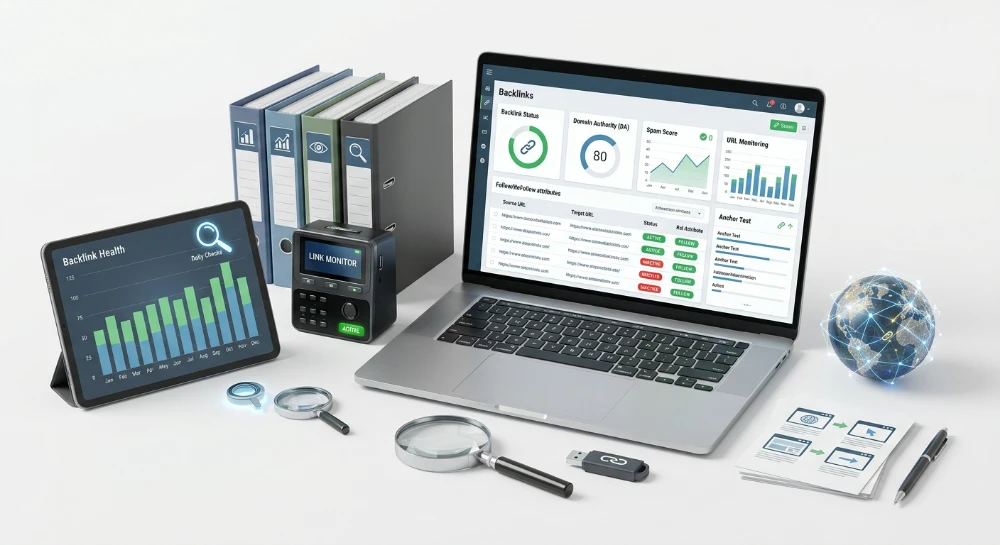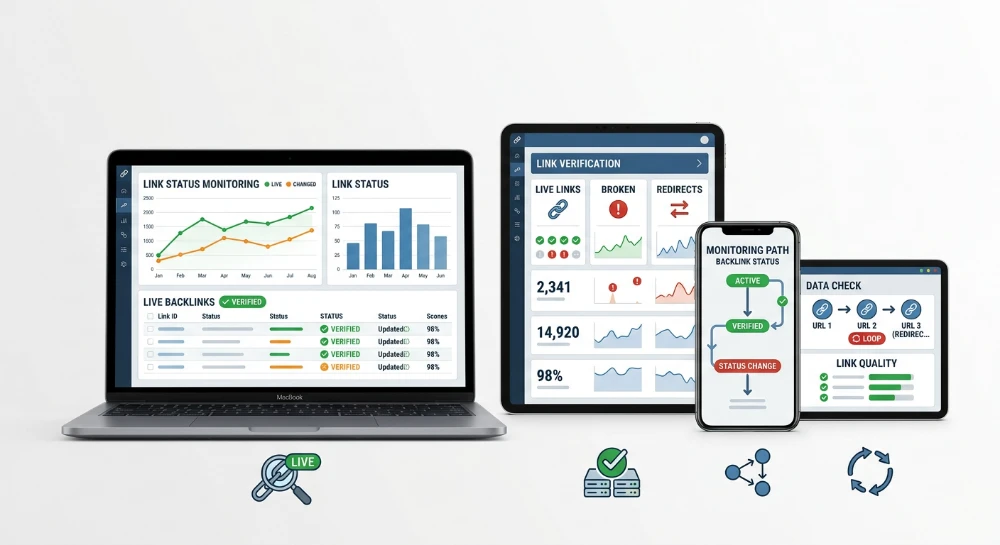
Ahrefs alternatives for live backlink verification exist because Site Explorer was never designed as a monitoring system. It works from a crawl-based index that refreshes on its own schedule, not on demand. A link recorded as dofollow during last week's crawl might carry rel=nofollow today, and Site Explorer will not flag that change until the bot revisits the donor page. For a single audit or a competitor snapshot, that lag is irrelevant. For a team running paid placements or managing a link-building campaign with active vendors, it creates a blind spot measured in days or weeks.
The technical gap shows up in specific ways. A backlink can return a 301 redirect to an unrelated page and stay listed as live in a static database. A link can get buried inside a redirect chain that loops through three or four hops before landing on a 404. Anchor text can be swapped after payment clears. None of these events trigger a notification in a tool built around periodic index refreshes rather than continuous polling.
The distinction that matters here is architectural, not just cosmetic. A backlink database answers the question: what links existed the last time we crawled the web. A monitoring system answers a different question: what is the current HTTP status, attribute set, and anchor text of this specific link, checked on a defined cadence, with an alert fired the moment something changes. One is a lookup tool. The other is a verification pipeline.
What follows sets out the verification criteria worth measuring against, status codes, redirect behavior, attribute drift, anchor changes, and alert delivery, before moving into tools built specifically around continuous checking rather than one-time reporting. The closing section ties those findings into a selection framework based on pricing structure, how often checks run, and how well each tool integrates into existing reporting workflows.
What live backlink verification actually requires
Before evaluating any tool, define what a verification system has to check, and how often it has to check it. Six categories separate a real monitoring workflow from a database lookup. Skip any one of them and the report will show links as healthy long after they have stopped delivering value.
Link status tracking: Found versus not found
A monitored link needs a binary status, Found or Not Found, tied to two timestamps: first seen and last seen. First seen confirms placement actually happened. Last seen confirms the link was still present at the most recent check. Without both timestamps, a report cannot distinguish between a link that was never placed and one that was placed and later removed. That distinction matters for vendor disputes, because payment terms usually hinge on placement being verified and maintained, not just placed once.
HTTP status code monitoring
Every backlink resolves to a status code, and that code has to be checked directly against the live page, not inferred from a crawl done weeks earlier. The categories worth tracking are straightforward.
- 2xx codes confirm the page loads normally and the link is technically reachable.
- 3xx codes signal a redirect, which is not automatically a problem but needs to be traced to its final destination.
- 4xx codes mean the page is gone, most commonly a 404, and the link equity tied to it is gone too.
- 5xx codes point to a server-side failure, which can be temporary or can indicate the donor site is failing entirely.
A tool that only logs "link found" without recording the actual status code is hiding information a webmaster needs. A 200 response and a 302 response are not the same outcome, even if both technically resolve.
Redirect chain and loop detection
Redirects compound. A single 301 is usually harmless. A chain of 301, 302, 307, and 308 responses stacked on top of each other is a different problem entirely, because each hop can dilute link equity and each hop adds a point of failure. Worse, some chains loop back on themselves, creating an infinite redirect that never resolves to a final page. A verification system has to follow the full chain, hop by hop, and flag both excessive length and circular loops. A static database that records only the first response in the chain will miss both conditions completely.
Link attribute changes
Attribute drift is one of the most common ways paid placements lose value without any visible change on the page. A link placed as dofollow can be quietly switched to nofollow after invoice payment clears. A rel=sponsored or rel=ugc tag can be injected into the anchor without altering the visible anchor text at all, which means a visual check of the page tells the webmaster nothing. Verification requires comparing the attribute set at the time of placement against the attribute set at each subsequent check, not just confirming the link is still on the page.
Anchor text shifts
Anchor text negotiated at the time of a placement is not guaranteed to stay fixed. Donor site owners sometimes edit the anchor after the fact, swapping an exact-match anchor for a generic one, or redirecting the anchor toward a different target page entirely. A verification workflow needs to log the original anchor string and flag any deviation on later checks. Anchor text shifts rarely trigger any visible alert on the donor site itself, so the only way to catch them is a direct text comparison against a stored baseline.
Alerting mechanisms for gains and losses
None of the checks above matter if the results sit unread in a dashboard nobody opens. Drop alerts, notifications fired the moment a tracked link disappears or its status degrades, are what convert a checking mechanism into an operational tool. The delivery channel matters as much as the check itself.
| Notification Type | Typical Use Case |
|---|---|
| Immediate flag for a single team member or client-facing report | |
| Dashboard | Ongoing visibility for a team reviewing multiple campaigns |
| API | Feeding link status directly into an internal reporting or automation system |
Check frequency determines how much decay accumulates before anyone finds out. A weekly crawl catches a lost link a week late. A tool polling on a defined, shorter cadence catches it within that shorter window. The gap between detection and reality is the entire cost of a slow-checking system, measured in wasted budget on links that stopped working days or weeks before anyone noticed.
Where Google search console and Google alerts fall short
Google Search Console shows external links Google has crawled and indexed, and Google Alerts can flag new mentions of a brand or URL across the web. Both are free and both have a place in a broader monitoring routine. Neither is built for this job. Search Console reporting lags behind real-time changes by days, sometimes longer, and it reports at the domain and page level rather than tracking individual attribute states like dofollow versus nofollow or rel=sponsored tags. Google Alerts flags mentions, not verified hyperlinks, and it has no concept of HTTP status, redirect chains, or anchor text drift at all. Both tools are useful supplements. Neither replaces a system built to check status codes, attributes, and anchors on a defined schedule with alerts tied to specific changes.
Linkody for continuous backlink tracking and loss alerts
Linkody is built around one core loop: add a backlink to a tracked list, and the system checks it on an automated periodic basis to confirm whether it is still live. That is the entire premise. It is not a discovery engine designed to surface thousands of unknown referring domains from a crawl index. It is a monitoring layer that sits on top of a link portfolio a team already knows about, and its job is to tell that team the moment something changes.
The notification mechanism is the part that matters most for day-to-day operations. When a tracked backlink disappears, whether the page was deleted, the link was stripped out, or the domain went dark, Linkody flags it as lost. When a new link shows up on a page that already contains a tracked link, or when tracked coverage expands, that gets flagged as gained. This gained/lost framing is deliberately simple. It does not require someone to manually diff a spreadsheet every week; the alert does that comparison automatically and reports the delta.
Dofollow and nofollow status on monitored links
Every tracked link carries a dofollow/nofollow state, and Linkody monitors that attribute over time rather than capturing it once at the point of link acquisition. This matters in a very practical way: a webmaster on the receiving end of a paid or earned placement can quietly add rel=nofollow weeks after the link went live, and without a monitoring layer checking that attribute repeatedly, nobody notices until a ranking report looks off. Because Linkody tracks this status on each monitored link, a shift from dofollow to nofollow shows up as a change worth investigating rather than a silent, invisible edit.
Disavow file management
Linkody includes a workflow for building and managing a disavow file directly from the tracked link data. Instead of exporting a spreadsheet, formatting it by hand, and uploading it separately, the disavow list is generated from within the same interface that already shows link status and history. For teams dealing with toxic or spammy links pointing at a domain, this keeps the disavow process tied to the same dataset used for ongoing tracking, rather than treating it as a disconnected, one-time cleanup task.
Google search console integration for import
Rather than requiring every backlink to be entered manually, Linkody connects to Google Search Console and imports the external links Search Console has already indexed. This is an import mechanism, not a live verification of Search Console data; it gives a starting point for a monitored list by pulling in links Google has already crawled, which then get added to Linkody's own periodic checking cycle going forward.
White-Label reporting for agencies
Agencies managing backlink portfolios for multiple clients need a way to hand off reporting without exposing the underlying tool's branding. Linkody supports white-label reporting, which lets an agency present gained/lost link data, dofollow/nofollow status, and disavow activity under its own name rather than Linkody's. This is a structural fit for agency operations specifically, where the deliverable to a client is a clean report, not a login to a shared dashboard.
Browser extension for quick checks
Linkody also offers a browser extension for checking link status without opening the full dashboard. This is suited to a fast, manual spot-check, confirming whether a specific link is still live and what attribute it currently carries, without running a full account-wide sync.
Put together, these pieces describe a tool aimed at ongoing alerting on a link portfolio someone already has, not at finding new links at scale. A team that already knows its backlink list and wants to know the moment something on that list breaks, changes status, or needs to be disavowed is the correct fit. A team trying to build a large-scale, previously unknown backlink map from scratch is asking Linkody to do a job it was not designed around.
Monitor backlinks (MonitorBacklinks.com) for daily link status checks
Monitor Backlinks runs on a daily check cycle: every tracked backlink gets re-verified once a day, and if a link that was there yesterday is gone today, the tool fires an email alert. That's the entire pitch, and it's a narrower one than Linkody's. No white-label layer, no agency branding controls. Just a fixed daily cadence and a notification when something drops off the list.
For a site owner who wants to know within a day, not a week, whether a placement disappeared, that cadence is the whole value proposition. Compare that against a static database lookup, where a link could vanish for months before a routine backlink pull happens to notice.
Daily checks and email alerts on link loss
The core mechanic is simple: add a URL to the tracked list, and Monitor Backlinks checks it daily going forward. When a backlink that was previously confirmed live returns a Not Found result on a subsequent daily pass, the system triggers an email notification. There's no need to log in and manually re-run a check to catch a dropped link; the alert lands in the inbox on its own schedule.
This matters most for anyone running outreach or paid placement campaigns where a vendor might quietly pull a link weeks after invoicing. A daily check closes that detection window considerably tighter than a monthly or quarterly crawl refresh would.
Google search console integration for discovery
Monitor Backlinks connects to Google Search Console to pull in backlinks Google has already crawled and indexed for a domain. This gives a starting point for populating the tracked list without manually entering every known URL by hand. Once imported, those links join the same daily verification cycle as any manually added backlink.
Tracking competitor backlinks alongside your own
Beyond monitoring a site's own link profile, Monitor Backlinks also supports tracking competitor backlinks in parallel. This means the same daily check-and-alert structure applies to links pointed at a rival domain, not just the user's own. For anyone trying to understand where a competitor is picking up placements, or whether those placements are stable over time, this sits inside the same dashboard rather than requiring a separate tool.
Bundled keyword rank tracking
Monitor Backlinks includes keyword rank tracking as part of the package. Backlink monitoring and keyword position tracking sit side by side, which matters for anyone trying to correlate a lost link with a ranking movement on a target keyword without switching between two disconnected platforms.
Disavow file builder
The tool also provides a disavow file builder, letting a user flag toxic or unwanted backlinks and compile them into a disavow file for submission to Google. This sits on top of the daily monitoring data rather than as a separate audit process, so links identified as harmful during routine checks can be routed directly into the disavow workflow.
Taken together, these functions describe a tool built around one clear rhythm: check daily, alert on loss, keep competitor and keyword data in the same view, and hand over a disavow file when needed. There's no agency-branding layer here, and no claim to redirect-chain-level or link-attribute-change detection beyond what's documented. What Monitor Backlinks offers instead is a minimal-setup path to a predictable daily verification habit, which is exactly the fit for a site owner or small in-house team that wants link-loss alerts without configuring a more elaborate agency reporting stack.
SE ranking's backlink monitor module for ongoing link tracking
SE Ranking approaches link tracking differently from a purpose-built monitoring tool: Backlink Monitor exists as one module inside a broader SEO platform rather than as a standalone product. That distinction shapes who should consider it. The module tracks new and lost referring domains and backlinks over time, giving a running record of what's been added to a link profile and what's dropped off since the last check. For a team already running keyword tracking, site audits, or competitor research inside SE Ranking, backlink monitoring becomes another tab in a workflow they've already committed to, not a separate login and a separate bill.
The alerting function centers on changes to a monitored link list. When a tracked link disappears or a new referring domain shows up, the platform surfaces that shift rather than requiring a manual re-check against a saved export. This mirrors the core loop covered earlier in this piece: don't wait for a full re-crawl to notice a link is gone.
Domain trust reporting on referring domains
Backlink Monitor pairs its new/lost tracking with reporting on domain trust metrics tied to each referring domain. Rather than treating every lost or gained link as equally significant, this lets a user weigh link churn against the authority of the domain behind it. A dropped link from a low-trust domain and a dropped link from a high-trust domain are not the same event, and having that trust data attached directly to the referring domain record removes a step that would otherwise require cross-referencing a separate metrics tool.
API access for custom reporting
SE Ranking exposes backlink monitoring data through the SE Ranking Data API. That matters for teams who don't want their reporting locked inside a vendor dashboard. Pulling backlink monitoring data via API lets a team feed link status changes, new/lost domain counts, and trust metrics into a custom dashboard or an existing agency reporting stack, rather than screenshotting a native report every reporting cycle.
Consider what this looks like for three different team types:
- An in-house marketer already using SE Ranking for rank tracking gets backlink alerting for free within a tool they're paying for anyway, with no separate monitoring subscription to justify.
- An agency building client dashboards in a third-party business intelligence tool can pull backlink monitor data via the SE Ranking Data API instead of manually compiling link-status updates each month.
- A team evaluating tools purely on link-monitoring depth needs to weigh whether bundled trust-metric reporting and API export outweigh the cost of paying for platform features they may not use elsewhere.
What isn't documented here matters as much as what is. There's no stated crawl frequency for how often the monitored list gets re-checked, and no published figure on the size of the underlying backlink database feeding these referring-domain counts. Teams evaluating SE Ranking against a dedicated monitoring tool should treat the module as a bundled feature of a full SEO suite, not as a specialist instrument built solely around link-loss detection, and factor that framing into any comparison against single-purpose alternatives.
SeLinkPro: Pay-As-You-Go monitoring for link status, redirects, and content hijacking
Where Linkody and Monitor Backlinks check whether a link still exists, and SE Ranking folds that same question into a broader suite, SeLinkPro's Automated Backlink Monitor tool asks a sharper question: has the link been quietly sabotaged without disappearing at all? That distinction matters most for teams buying placements from third-party vendors, guest post networks, or link resellers, where the risk isn't just link loss but link tampering after the invoice gets paid.
The tracking engine works by continuously polling the vendor or donor page where a purchased link lives, not by re-querying a static backlink index. That architectural choice is what allows it to catch several categories of degradation that a database lookup would never surface.
- Stealth attribute injection: a link placed as dofollow can be quietly switched to rel=nofollow, rel=sponsored, or rel=ugc weeks later. The monitor logs when that attribute change happens, giving a paper trail instead of a guess.
- Anchor text hijacking: a vendor can swap the agreed exact-match anchor for something unrelated, or redirect the anchor's link equity elsewhere. The tool logs the altered or hijacked anchor text against its original state.
- Redirect and dead-end tracking: the system follows the full HTTP path on every monitored link, flagging malicious 301 redirect chains and 404 dead ends rather than reporting a link as simply present or absent.
- Outbound link spike detection: donor pages get tracked for total outbound link counts, so a sudden jump in the number of links leaving that page, a common signal of the page being resold into a toxic link farm, gets flagged.
- Stealth crawler blocks: the monitor checks for injected noindex tags, robots.txt exclusions, and hidden canonicals added after the link went live, all of which quietly strip a placement's SEO value while leaving the link visually intact to a human checking the page manually.
Every check feeds a historical audit ledger. Donor-page snapshots get logged over time, which turns "the vendor changed the link" from an accusation into a documented sequence of before-and-after states. For anyone who has tried to get a refund or replacement placement from a link vendor, this ledger is the difference between a dispute that goes nowhere and one backed by dated evidence.
Indexation verification without a Third-Party database
A link that is live, dofollow, and correctly attributed still delivers nothing if the page hosting it was never indexed, or has since been de-indexed. The Bulk Google and Yandex backlink index checker handles that gap directly. Instead of pulling indexation status from a stored index snapshot, it performs a live SERP interrogation for each vendor-delivered URL, checking in real time whether Google and Yandex actually have the page indexed. This matters because a third-party database can report a URL as historically indexed while missing a recent de-indexing event, silently sending link-building budget toward pages that carry zero current search visibility.
Catching Bait-and-Switch link removal
The Semantic Backlink Analyzer, also framed as the Content Hijack Radar, addresses a different failure mode entirely: contextual hijacking. At the point a link is acquired, the module takes a content fingerprint of the donor page. On 7-day, 14-day, and 30-day scans, it re-compares that fingerprint against the current state of the page. A vendor who swaps out the surrounding article, strips the link, or buries it under unrelated content after the campaign is paid for gets caught by the mismatch between the original fingerprint and the re-scan.
This is the module built specifically for bait-and-switch tactics, where a webmaster accepts payment for a placement on a clean, relevant article, then later replaces or dilutes that content once the buyer stops checking. Fingerprint comparison at fixed intervals is what catches that pattern instead of a single point-in-time check.
Billing structure
SeLinkPro runs on a strict pay-as-you-go model with a $5.00 minimum deposit and no monthly subscription. The Bulk Google and Yandex backlink index checker is priced per unit at $0.004 per URL. The Automated Backlink Monitor tool and the Semantic Backlink Analyzer / Content Hijack Radar operate as usage-based modules within that same deposit structure, meaning cost scales with how many donor pages or link placements actually get monitored, rather than with a flat monthly seat price. For a team running a handful of link campaigns one month and a bulk vendor audit the next, that billing shape avoids paying for idle monitoring capacity during slow periods.
Matching the right alternative to your monitoring workload
Pricing structure alone eliminates half the decision tree before feature comparison even starts. Linkody, Monitor Backlinks, and SE Ranking all operate on fixed subscription or credit-based billing, which means the monthly cost stays flat whether the tracked link portfolio sits idle or gets hammered by a bulk vendor audit. SeLinkPro's per-unit model runs the opposite way: cost scales directly with volume, and there is no seat fee sitting on the books during a slow month.
That distinction matters most for teams whose verification load swings hard between periods. A subscription tool is cheaper per link when the portfolio size is stable and predictable month over month. A pay-as-you-go structure is cheaper when volume spikes unpredictably, or when a team runs a large one-off audit and then goes quiet for weeks.
| Tool | Pricing Structure | Alerting Depth | Best Fit |
|---|---|---|---|
| Linkody | Subscription | New/lost link notifications, dofollow/nofollow tracking | Agency reporting with white-label output |
| Monitor Backlinks | Subscription | Daily link-loss email alerts | Straightforward daily checks, minimal setup |
| SE Ranking | Subscription/credit-based | New/lost referring domain tracking, API export | Teams wanting monitoring bundled with a broader SEO suite |
| SeLinkPro | Pay-as-you-go, per-unit | Attribute-level, redirect-chain-level, audit-log evidence | Fraud and hijack verification on paid link placements |
Alerting depth separates these tools more sharply than pricing does. Linkody and Monitor Backlinks are both built around a fairly simple event: a link was there, now it is not, send a notification. That covers the most common failure mode, but it does not tell a buyer whether the link is still live yet quietly switched to rel=nofollow, or whether the anchor text got swapped out while the href stayed intact.
SE Ranking's Backlink Monitor sits a step above that in one specific way: the API access lets a team pull the underlying data into a custom dashboard or reporting pipeline instead of relying solely on the platform's own alert screen. That is valuable for teams already running internal reporting infrastructure, but it does not change what is actually being tracked, referring domain and backlink counts over time, not attribute-level or redirect-chain-level detail.
SeLinkPro's Automated Backlink Monitor and Semantic Backlink Analyzer / Content Hijack Radar operate at a different resolution entirely. Detecting a stealth rel=sponsored injection, logging a hijacked exact-match anchor, following a full HTTP path to catch a malicious 301 chain, and comparing a content fingerprint against a 30-day re-scan are all checks aimed at a link that is technically still present but has been quietly degraded. A basic new/lost notification would show that link as healthy the entire time.
Documentation needs split along a similar line. Linkody's white-label reporting is built for agencies that need to hand a clean, branded status report to a client, which is a presentation problem more than a verification problem. SeLinkPro's historical audit ledger of donor-page snapshots solves a different problem: proving to a link vendor, with dated evidence, that a paid placement was altered or removed after payment. One produces a report for a client relationship; the other produces evidence for a vendor dispute.
The practical selection question comes down to what kind of failure the team actually needs to catch. For basic link-loss alerting on an existing portfolio with minimal setup, Monitor Backlinks or Linkody cover that ground, with Linkody adding white-label output for agency-facing work. For platform-embedded tracking that needs to feed a larger reporting stack, SE Ranking's API access covers that requirement without needing a separate monitoring tool. For granular fraud and hijack verification on paid link placements, specifically stealth attribute changes, redirect manipulation, anchor hijacking, and bait-and-switch content swaps, SeLinkPro's usage-based modules are built for exactly that failure mode, with the audit ledger providing the documentation a vendor dispute requires.