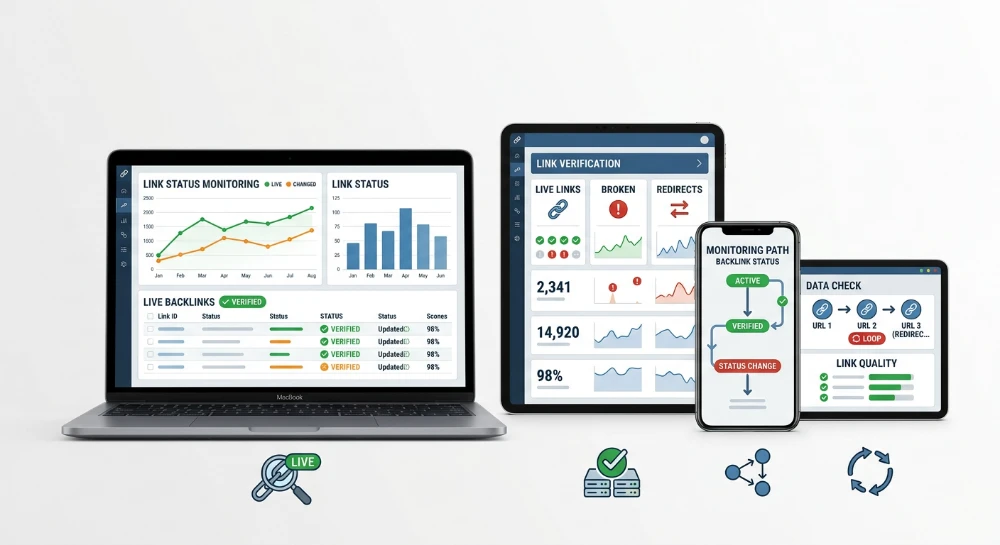
The best SEO tools for purchased backlinks share one job: proving that a link you paid for still exists, in the same form, on the same indexed page, months after the invoice was settled. A guest post, niche edit, or link insertion is a one-time transaction from the seller's side. What happens to that placement afterward is not. Vendors edit pages, recycle donor domains, and quietly adjust attributes long after the payment clears, and none of that activity shows up in a receipt or a screenshot taken on delivery day.
Four failure patterns account for most of the value lost on paid placements. A dofollow link gets switched to nofollow, sponsored, or UGC through a quick edit to the anchor's rel attribute, stripping the link of ranking weight while it stays visually intact. Anchor text gets rewritten or the link gets deleted outright once the seller reuses the slot for a newer buyer. The donor page itself drops out of Google's index, often through a noindex tag added later or a robots.txt change nobody flags. Or the surrounding content gets hijacked, with unrelated links inserted around the original placement until the page reads like a link farm.
A backlink checker built for research, not for surveillance, cannot catch any of this. Ahrefs, Semrush, and similar databases record a link's state at the moment their crawler last touched that URL. That snapshot answers whether a link existed at some point. It does not answer whether the specific link a buyer paid for on March 3rd is still dofollow, still indexed, still surrounded by the same content, on April 20th. Between those two dates, silence.
Closing that gap requires a different category of tool: one built to track individual URLs on a recurring schedule, log every attribute change, confirm indexing status, and keep a timestamped record usable as evidence in a vendor dispute. What follows lays out the specific risks and the evaluation criteria that separate a real monitoring tool from a database query, explains why Google Search Console and general-purpose backlink suites cannot substitute for dedicated tracking, reviews Monitor Backlinks, Linkody, and SeLinkPro against those criteria, and closes with the operational path from a monitoring alert to a refund request, a disavow file, or a written-off placement.
Why purchased backlinks need continuous monitoring, not just a backlink checker
Every paid placement dies in one of a handful of predictable ways. None of them announce themselves. A seller does not send an email confirming that a link's rel attribute just changed, or that the donor page got pulled from the index three weeks after invoice. The failure happens quietly, on someone else's server, and the buyer only finds out when a ranking drops or a client asks why the referring domains count went down.
Attribute swaps are the most common and the hardest to catch by eye. A link sold and delivered as dofollow can be edited weeks later to carry rel="nofollow", rel="sponsored", or rel="ugc" without any visible change on the page itself. The anchor text still reads the same, the link still points where it should, but the value passed to the target URL has been quietly stripped. Since the HTML markup, not the visible text, carries this signal, a buyer scanning the page in a browser will see nothing wrong at all.
Anchor text edits are almost as sneaky. A seller under pressure from a different client, or simply cleaning up a page months later, can rewrite the anchor from an exact-match commercial phrase to a generic "click here" or a branded term that carries none of the intended keyword weight. The link still resolves. The link is still live. It simply stopped doing the job it was purchased for.
Then there is outright removal. The slot gets reused, the article gets deleted, or a site redesign wipes the section that held the link. This is the cleanest failure to detect but only if someone is actually checking that specific URL on a schedule, rather than assuming a link purchased in January is still there in June.
Indexing failures sit one level deeper and are correspondingly harder to notice. A donor page can remain fully visible in a browser while quietly dropping out of Google's index, usually through one of three mechanisms:
- A noindex meta tag added to the page template after the link was already live, often as part of an unrelated site cleanup.
- A robots.txt rule that blocks the crawl path to that page, silently excluding it from future crawls without touching the page's own code.
- A canonical tag pointed at a different URL, effectively telling search engines to treat the donor page as a duplicate and ignore it.
A link on a de-indexed page passes nothing. It can still be clicked by a human visitor, which is exactly why it survives a casual visual check while providing zero ranking value.
Broken redirects are the technical failure mode buyers underestimate most. A donor page migrated to a new URL, a botched redirect, or an accumulated chain of 301s can turn a once-clean link into a dead end. A 404 error kills the link instantly. A long redirect chain degrades it gradually, since each additional hop adds friction and, in the worst cases, ends at an unrelated page or an error screen. Either way, the original placement stops functioning the way it did on delivery day.
Content hijacking is the failure mode most buyers never think to check for at all. The link itself may remain intact, dofollow, indexed, and correctly anchored, while the article around it gets rewritten or padded with unrelated outbound links until the donor page starts to resemble a link farm. Some sellers go further and swap the entire article for different content, keeping the URL alive purely to preserve its authority metrics while the context that justified the purchase disappears. A link surrounded by a wall of unrelated commercial anchors carries a different risk profile than the clean, topically relevant placement that was actually paid for.
A snapshot cannot prove a timeline
A one-time backlink audit answers a single question: does this link exist right now, at the moment of the check. That answer is useful the day the placement goes live, as confirmation that the seller delivered. It becomes far less useful three months later, because a single lookup carries no information about what happened in between. Did the attribute change in week two and get reverted in week six before the audit ran. Was the anchor edited twice. Did the donor page get de-indexed for ten days and then recovered. A snapshot has no memory. It cannot answer any of that.
An ongoing monitoring workflow solves a different problem entirely. Instead of asking whether a link exists at one point in time, it tracks the same target URL on a recurring basis and records every change in its history: status, attribute, anchor, indexing state, and surrounding content. The difference is structural, not just a matter of frequency. A historical database lookup tells a buyer what a crawler happened to see on its last pass through a domain. A monitoring workflow tells a buyer, with a timestamp attached, exactly when a specific paid link changed and what it changed into.
That distinction matters most in a vendor dispute. A seller who denies altering a placement is far harder to argue with when the only evidence is "the link looks different now" than when the buyer can produce a dated log showing the exact day the rel attribute changed from dofollow to nofollow.
What a Purchased-Link monitoring tool should actually do
Judging a monitoring tool against the failure modes above gives a buyer a concrete checklist, rather than a vague sense of "does this look thorough". The criteria that matter fall into a short list:
- Per-link status tracking that distinguishes live from lost on each individual monitored URL, not just an aggregate count for the whole domain.
- Attribute-change alerts that fire the moment a dofollow link is switched to nofollow, sponsored, or ugc, since this is the failure mode least likely to be noticed by manual review.
- Indexing verification of the donor page itself, confirming the page holding the link is still present in the search index rather than assuming visibility equals indexation.
- Historical snapshots or an audit log that timestamps every recorded state, so a change can be tied to a specific date for use as evidence in a dispute.
- New and lost link alerts that notify the buyer automatically, rather than requiring a manual re-check of every purchased URL on some arbitrary schedule.
- Export formats, typically CSV or PDF, that turn the monitoring log into a document a vendor or a client can actually review and act on.
A tool that satisfies most of this list functions as a surveillance system for a specific set of paid URLs. A tool that satisfies none of it, no matter how large its underlying link database, functions as a research instrument. Both have their place. Only one of them can prove what happened to a purchased placement between the day it was bought and the day someone decided to check on it again.
Where Ahrefs, Semrush, and Google search console fall short on Purchased-Link monitoring
Ahrefs, Semrush, Moz Pro, and Majestic were built to answer one question at scale: what does a domain's entire backlink profile look like right now. That is a discovery problem, not a verification problem. Their crawlers sweep billions of pages, index the links they find, and hand back a domain-level report of new and lost backlinks. Useful for competitive research. Weak for proving what happened to one specific paid placement between the invoice date and today.
The metrics these platforms surface reinforce that research orientation. Domain Rating, Authority Score, Trust Flow, Citation Flow, referring domain counts, these are aggregate scores describing a domain's overall link equity, not the condition of one URL. A domain can hold a strong Domain Rating while the exact page carrying a purchased link has quietly had its dofollow attribute stripped, its anchor text rewritten, or its content replaced with something unrelated. None of those domain-wide scores would move enough to flag it.
Crawl scheduling is the second structural gap. These databases refresh their index on their own internal schedule, driven by crawl budget and prioritization logic that has nothing to do with a buyer's need to check one placement on demand. A donor page might get re-crawled every few weeks, every few months, or not at all if the crawler deprioritizes it as low-value. That gap between purchase and re-crawl is exactly the window where a seller can swap an attribute or delete a link and have it sit unnoticed for a full reporting cycle.
The table below breaks down the mismatch between what these platforms are engineered to do and what a purchased-link audit actually requires.
| Capability | Ahrefs, Semrush, Moz Pro, Majestic | What a purchased-link audit needs |
|---|---|---|
| Scope of tracking | Domain-level new and lost backlink reports | Per-URL status on each individually purchased placement |
| Primary metric output | Domain Rating, Authority Score, Trust Flow | Live attribute state (dofollow, nofollow, sponsored, ugc) on one link |
| Update cadence | Platform's own crawl schedule | Verification on demand, tied to the buyer's own dispute timeline |
| Content awareness | Presence or absence of the link at crawl time | Whether surrounding content or the article itself has been replaced |
Google Search Console operates on a different mechanism but lands in the same functional gap. It shows which external pages link to a property, pulled from Google's own index of the web. That is a genuinely useful signal for confirming a link exists somewhere in Google's records. It stops there. Search Console does not alert when a donor page switches a link from dofollow to nofollow, does not flag an anchor text edit, and does not notice when the article around a purchased link gets hijacked with unrelated content. It was designed as a webmaster diagnostic tool for a site's own indexing and search performance, not as a system for tracking third-party pages a buyer has paid someone else to maintain. Nothing in its reporting produces a timestamped record suitable for handing to a vendor as proof of a broken agreement.
None of this makes these platforms worthless in a purchased-link workflow. Domain Rating, Authority Score, and Trust Flow are still the right reference points for judging whether a prospective donor domain is worth buying a placement on in the first place, and Search Console remains a legitimate cross-check for confirming a link is visible to Google at all. The distinction is between vetting a domain before purchase and auditing a specific placement after purchase. A backlink database can tell a buyer whether a domain looked authoritative last time it was crawled. It cannot tell a buyer, on the exact day a dispute is being filed, whether that one paid link is still dofollow, still pointed at the right anchor, and still sitting inside the same article it was placed in. That narrower, on-demand verification job requires a tool built specifically to poll individual purchased URLs rather than one built to map the web at large.
Monitor backlinks: Tracking link status and attribute changes for paid placements
Monitor Backlinks works on a simple premise: feed it a list of target URLs, and it checks that list on a recurring basis to confirm each link is still live. For a buyer running dozens of guest posts and niche edits across different vendors, that list becomes the master ledger of every paid placement in the campaign. Instead of re-running a fresh backlink audit every time a suspicion arises, the buyer adds each purchased URL once and lets the tool report back on it over time. The core value is the alert itself: a notification firing the moment a tracked link disappears from a donor page, rather than a buyer discovering the loss weeks later during an unrelated check.
Link status tracking is binary and that is exactly what makes it useful for dispute purposes. A monitored placement is reported as either live or lost. For a paid link, "lost" can mean the anchor was stripped out during a content refresh, the entire article was deleted, or the donor page returned an error on the last check. Whatever the underlying cause, the buyer gets a clear signal rather than having to manually revisit every invoice and re-crawl every donor page by hand.
Attribute tracking closes a gap that pure status checks cannot cover on their own. A link can remain physically present on the page while being quietly switched from dofollow to nofollow, which does nothing to the visible content but strips the placement of the link equity the buyer paid for. Monitor Backlinks tracks the follow and nofollow state of each monitored link, so a vendor who edits the rel attribute after invoicing does not get to hide behind the fact that the anchor text and URL are technically untouched.
Three additional features round out its role in a purchased-link workflow:
- White-label PDF reporting: useful for agencies managing paid placements on behalf of clients, letting the link-status and attribute data get packaged into a branded report rather than a raw export.
- Built-in disavow file generation: once a monitored link is confirmed toxic or effectively dead, the tool can generate a disavow file directly, cutting out the manual step of building that file by hand.
- Competitor backlink tracking: allows a buyer to track a competitor's link portfolio alongside their own, giving a comparative view of how one link-building effort stacks up against another over the same monitoring period.
None of these functions inspect the surrounding article for hijacked content, and none confirm whether the donor page itself is still indexed by Google. Those are separate questions the tool does not answer. What it does answer, reliably, is whether the specific link a buyer paid for is still there and still carrying the attribute it was sold with. For a purchased-link audit trail, that narrower answer is still the one most disputes hinge on.
Linkody: Automated alerts for lost and altered backlinks
Linkody's core function is straightforward: it automatically monitors a portfolio of backlinks and sends a notification the moment a tracked link is lost. For a buyer running multiple paid placements across different vendors, this turns manual re-checking into a passive watch list. Each purchased URL - guest post, niche edit, link insertion - gets added to the tracked portfolio, and Linkody polls that placement so a missing link surfaces as an alert rather than something discovered three months later during a routine audit.
Loss detection is only half the value. Linkody also tracks link attributes, specifically the follow and nofollow status of each monitored link. A vendor who quietly swaps a dofollow placement to nofollow after invoicing is not invisible to this kind of tracking - the attribute change gets logged against the same URL record the link was sold under. That distinction matters in a dispute: a link that is technically still on the page but stripped of its dofollow status delivered a different product than what was paid for, and the attribute log is the evidence that shows exactly when the swap happened.
Three functions round out how Linkody fits into a purchased-link workflow:
- Google Search Console integration: pulling additional link data in from Search Console gives the monitored portfolio a second data source alongside Linkody's own tracking, useful for cross-checking a placement's status.
- Disavow tool: for links that end up toxic - whether through vendor fraud or a donor site that degraded after the sale - Linkody includes a disavow tool for submitting the offending links directly to Google, skipping the step of manually assembling a disavow file.
- Export options in CSV and Excel: monitored link data, including status and attribute history, can be exported for reporting, which matters when a buyer needs to hand a vendor documented proof that a paid placement no longer matches what was invoiced.
None of this checks whether the donor page's surrounding content has been hijacked with unrelated links, and none of it confirms whether the donor page is still indexed by Google. Those checks sit outside what Linkody documents as its function. What the tool reliably answers is narrower and, for most vendor disputes, sufficient: is the link still live, and does it still carry the attribute it was sold under. A lost-link notification or an attribute-change flag is the trigger point - the signal that tells a buyer it is time to open a vendor follow-up before the placement's link equity quietly disappears.
SeLinkPro's automated backlink monitor: Detecting vendor fraud on purchased placements
Where Monitor Backlinks and Linkody answer the binary question - is the link live or dead - SeLinkPro's Automated backlink monitor tool is built as a continuously polling tracking engine aimed squarely at the subtler failure mode: vendor-side tampering that leaves a link technically alive while quietly gutting its value. That distinction matters for buyers of guest posts and niche edits, because the fraud that costs the most link equity is rarely a clean deletion. It is a slow, deniable edit.
Five detection points define what the module actually watches on each donor page tied to a purchased placement.
- Attribute injection: the engine flags stealthy insertion of rel="nofollow", rel="sponsored", or rel="ugc" on a link that was sold and delivered as a plain dofollow placement.
- Anchor tampering: it logs cases where the exact match anchor text has been altered or hijacked after the fact, a change that quietly detaches the link from the keyword it was purchased to support.
- Outbound link spikes: it tracks the donor page's total OBL count over time, so a sudden jump signals the page has been converted into a link farm - a strong indicator the placement now sits in bad neighborhood territory.
- Crawler-block detection: it catches injected noindex tags, new robots.txt exclusions, and hidden canonicals - blocks that a vendor can add without touching the visible page content, making them easy to miss on a manual check.
- Full HTTP-path tracking: it follows the entire redirect chain, catching malicious 301 chains or a 404 dead end where the donor URL used to resolve cleanly.
Every scan writes into an audit ledger of historical snapshots for each donor page. That ledger is not a cosmetic log - it is the evidentiary backbone for a vendor dispute. A buyer confronting a seller over a swapped attribute or a stripped anchor is in a much stronger position holding a timestamped record of what the page looked like at delivery versus what it looks like now, rather than a single current-state screenshot that a vendor can dismiss as a misunderstanding. Reports generated from that ledger are exportable, structured specifically to help reclaim wasted link-building budget rather than simply confirm that a problem exists.
Two complementary modules extend what the monitor alone can confirm. The Bulk Google and Yandex backlink index checker addresses a gap the monitor does not close by itself: a link can be live, correctly attributed, and still sit on a donor page that Google has quietly dropped from its index, which means the placement passes no visible authority regardless of how clean its HTML looks. Running purchased URLs through the dual-engine index checker confirms indexation status directly rather than assuming it from link presence. The Semantic backlink analyzer and content hijack radar handles a different problem - bait-and-switch content changes around the link itself. It takes a cryptographic content fingerprint of the donor page at the time of acquisition, then compares that fingerprint on repeat scans at 7, 14, or 30-day intervals, surfacing cases where a vendor has appended unrelated links - casino or pharma links being the classic example - around an otherwise untouched placement.
Billing runs on a strict pay-as-you-go model: a $5.00 minimum deposit, no monthly subscription. Bulk index checks are billed per URL, and domain metric checks are billed per domain, which lets a buyer scale monitoring spend directly to the size of a purchased-link portfolio rather than paying a flat fee regardless of how many placements need watching.
From alert to resolution: Disputing, refunding, and disavowing failed paid links
An alert by itself fixes nothing. It only starts a clock. What happens between the notification and the next invoice sent to that vendor determines whether the monitoring investment actually pays for itself or just becomes an expensive way to watch money disappear.
Building the evidence file before contacting the vendor
The first move after any alert - status code change, attribute swap, anchor edit, or outright removal - is to freeze the evidence, not to fire off an angry email. Vendors routinely deny that anything changed, and without a timestamped record the dispute turns into a word match nobody wins. A usable evidence file needs the exact date and time the change was detected, the prior state versus the current state, and a snapshot or export that a third party could verify independently.
Practically, this means capturing:
- The original HTTP status code at acquisition versus the current code (200, 301, 404, 5xx).
- The link attribute at delivery (dofollow) versus the attribute found at detection (nofollow, sponsored, ugc).
- The original anchor text and destination URL versus what currently renders on the donor page.
- A dated screenshot or HTML source excerpt showing the link present, altered, or gone entirely.
A dispute backed by a dated before/after record is difficult for a vendor to argue against. A dispute backed by "it looks different now" is not.
Deciding between a fix request, a refund demand, and a Write-Off
Not every flagged link deserves the same response. Three outcomes are realistic, and the right one depends on what broke and how the vendor responds.
A fix request makes sense when the underlying donor page is still healthy - same topic, same overall link count, no toxic pattern - and only a single attribute got altered, most commonly a dofollow silently switched to nofollow or sponsored. This is often an easy correction for a vendor who did not intend fraud, and requesting a fix preserves the placement's original value without wasting the sunk acquisition cost.
A refund demand is the correct move when the link was removed entirely, when the anchor text was rewritten to something the buyer never approved, or when a vendor stops responding to a fix request within a reasonable window. At this point the placement has stopped delivering what was paid for, and the vendor has had the chance to correct it.
A write-off - treating the placement as a lost cost rather than continuing to chase it - applies once the donor page itself has degraded past the point of being worth restoring. A page that has been repurposed into a link farm, dropped from Google's index long-term, or flooded with unrelated outbound links is not a placement worth fighting for a refund on case by case; it is a candidate for disavowal instead, covered next.
When a placement needs the disavow tool instead of a refund chase
Some failures are not billing disputes at all - they are technical liabilities. If a donor page has been converted into a link-farm outbound link, absorbed into a negative SEO campaign, or otherwise shifted into a pattern that could plausibly draw a manual action, chasing a refund is the wrong priority. The link itself needs to be neutralized in Google's eyes.
This is where Google's Disavow Tool comes in. The process requires compiling a .csv disavow file listing the toxic domains or specific URLs, uploaded through Search Console against the property in question. This step is not something to apply reflexively to every lost or altered link - dofollow-to-nofollow swaps or simple removals do not require disavowal, since a dead or nofollowed link carries no ongoing risk. Disavowal is reserved for placements that have turned actively harmful: pages absorbed into link farms, pages exhibiting sudden spikes in unrelated outbound links, or domains later associated with negative SEO patterns.
A Reconsideration Request only becomes relevant after Google has already issued a manual action tied to unnatural links pointing to the site. Disavowing toxic links proactively, before any manual action lands, is a preventive measure. Filing a Reconsideration Request is a reactive one, submitted after the disavow file has been in place long enough to demonstrate the toxic links have been addressed, and used specifically to request removal of an existing penalty rather than to pre-empt one.
Turning the dispute log into a budget decision
Every alert, dispute outcome, and disavowal decision is also a data point about vendor reliability. A single lost link is a minor cost. The same vendor triggering that pattern across five, ten, or twenty placements is a budget problem, and it only becomes visible if a record is kept.
A working record does not need to be complex, but it does need three fields tracked consistently over time.
| Field tracked | Why it matters for budget decisions |
|---|---|
| Purchased link URL and vendor of origin | Ties every placement back to a specific seller, making pattern recognition possible |
| Current status (live, altered, removed, disavowed) | Shows at a glance which placements still deliver value versus which have failed |
| Dispute outcome (fixed, refunded, written off) | Quantifies how much of the original spend was actually recovered |
Reviewed periodically, this record answers the question that matters most for future spend: which vendors deliver placements that hold up over months, and which vendors produce a recurring stream of attribute swaps, silent removals, or de-indexed donor pages. A vendor with a consistent pattern of failed placements is not a source of occasional bad luck - it is a source to be dropped from the budget, with future spend redirected toward sellers whose placements survive monitoring intact.