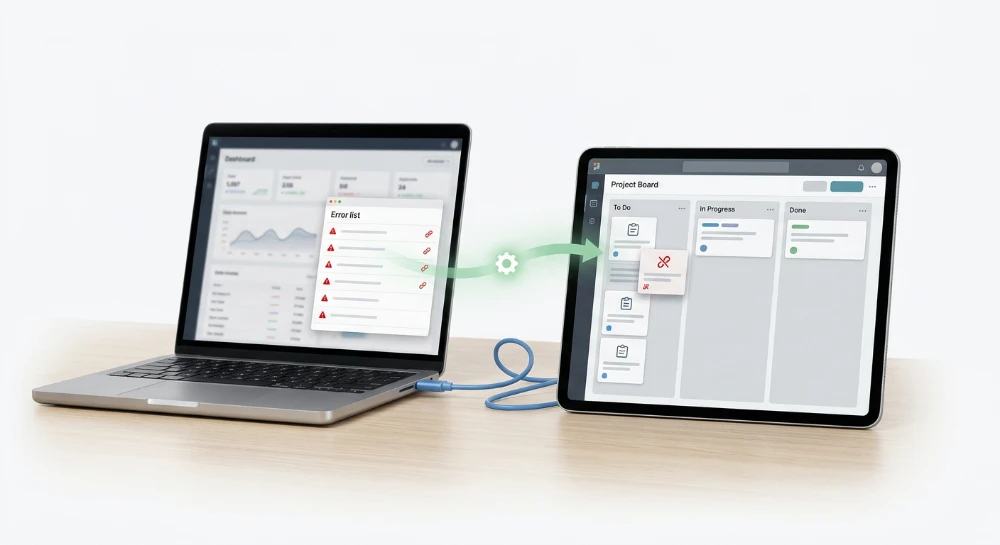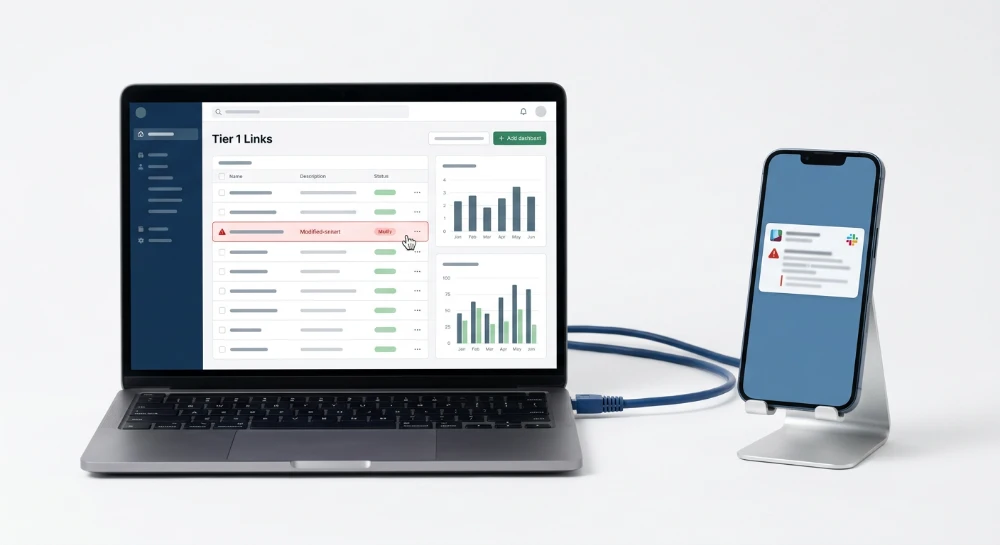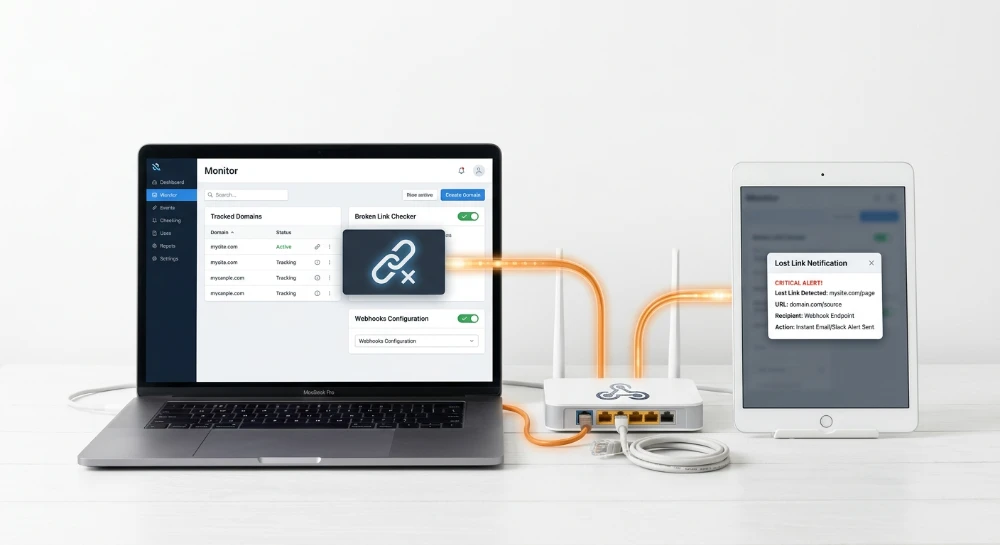
Establishing an event-driven data pipeline defines exactly how webhooks automate instant alerts for a lost link without relying on scheduled API polling intervals. Link reclamation campaigns experience a 45% drop in recovery success rates if outreach occurs later than 48 hours after a backlink is removed. Transitioning from batch processing to real-time event routing eliminates this latency entirely.
HTTP callbacks execute instantly across distributed server environments.
The moment a backlink crawler like Ahrefs Site Explorer detects a 404 Not Found status code or a modified anchor text on a source URL, the application pushes a JSON payload directly to a configured receiving endpoint. Traditional SEO platforms wait for automated weekly crawls to update their indexes. Pushing data immediately through an HTTP POST request triggers custom Node.js listener functions or middleware platforms like Make to process the event metadata milliseconds after the original database update.
A proactive reclamation protocol targets structural link losses before search engines recalculate PageRank variables.
Architectural foundations of Event-Driven SEO monitoring
Push versus pull data retrieval mechanisms
Traditional backlink tracking relies on pull-based data retrieval. An application runs scheduled cron jobs to request updates from an API at predetermined intervals. Polling cycles waste server resources.
If an API polling script executes every 24 hours, a removed backlink might remain undiscovered for up to 86,400 seconds. This pull methodology introduces unacceptable latency into the link discovery workflow. Push mechanisms reverse this communication model entirely. Instead of a client constantly interrogating a server for state changes, the target system actively pushes data outward the exact millisecond a modification occurs in the index.
The operational necessity of HTTP callbacks over API polling becomes evident when optimizing for minimal link discovery time. Every hour a lost link remains undetected increases the probability of a search engine crawler re-indexing the referring page without the target URL. Relying on continuous API polling risks rate limit exhaustion and generates empty responses when no index updates exist. Push architectures guarantee data transmission only when actionable events transpire.
Real time data transmission architecture
Event-driven architecture decouples the link crawling process from the notification pipeline. A web crawler identifies a missing URL. This structural modification registers in the core database and immediately broadcasts an event message across the network stack.
Real-time data transmission operates on this publisher-subscriber pattern. The monitoring application acts as the publisher, emitting the state change without requiring the subscriber to request the data. System latency drops from hours to milliseconds.
Webhook listener implementations function as the receiving nodes of this transmission flow. A listener operates as a persistent daemon running on a web server, explicitly bound to a network port to intercept incoming HTTP POST traffic.
Unlike dynamic web pages designed to serve HTML to browsers, listeners act as silent processing endpoints. They accept the inbound network connection, read the transmitted payload, and immediately terminate the connection. The primary architectural requirement for a listener is high availability; the service must remain online continuously to capture asynchronous event triggers fired by external crawling systems.
Monitoring platforms supporting outbound webhooks
Enterprise SEO suites are gradually replacing static email reports with direct webhook integrations. Identifying platforms with native outbound event routing is mandatory for establishing a functional real-time data pipeline.
| Platform | Data Retrieval Mechanism | Native Webhook Support | Primary Trigger Events |
|---|---|---|---|
| Ahrefs Alerts | Push | Yes | Lost backlinks, new backlinks, keyword movements |
| CognitiveSEO | Push | Yes | Unnatural link detection, link loss anomalies |
| Legacy API Trackers | Pull | No | Requires scheduled cron job execution |
Ahrefs Alerts pushes notifications natively when its crawler index updates, transmitting the exact state change directly to the configured listener daemon. CognitiveSEO provides similar outbound capabilities specifically tailored for backlink profile anomalies. Relying on monitoring tools equipped with native push capabilities entirely bypasses the need to build complex API polling infrastructure.
Technical specifications for the webhook endpoint
Provisioning a stable URL is the first operational requirement. This address acts as the sole entry point for inbound network traffic triggered by external indexers. The endpoint must be configured to exclusively accept HTTP POST requests. Dropping GET, PUT, or DELETE requests at the routing layer prevents unnecessary server load and mitigates basic network probing. Strict routing ensures the listener daemon only allocates compute resources to actual event payloads.
Enforce strict header validation. The application logic must verify the presence of the Content-Type: application/json request header before initiating any payload extraction. Requests transmitting form-encoded data or plain text must trigger an immediate drop command. Forcing strict JSON serialization guarantees programmatic predictability when mapping node values later in the pipeline.
Infrastructure selection for event routing
Deploying the listener requires choosing between dynamic execution environments and static servers. The volume of inbound requests from SEO crawlers fluctuates wildly. A massive core algorithm update might trigger thousands of lost link events within seconds, followed by days of absolute silence.
Serverless event routing platforms handle this variance natively. Frameworks like AWS Lambda and Google Cloud Run spin up compute instances on demand. They scale from zero to thousands of concurrent executions instantaneously. You pay exclusively for the microsecond duration of the payload processing window.
Maintaining dedicated Node.js/PHP listeners introduces significant infrastructure overhead. A dedicated environment running on a persistent virtual machine requires continuous process management. Sudden influxes of data easily create a system bottleneck if the dedicated listener lacks auto-scaling rules. Serverless architectures eliminate this specific system failure risk.
| Architecture Model | Primary Technologies | Scaling Mechanism | Cost Efficiency for Event Spikes |
|---|---|---|---|
| Serverless Event Routing | AWS Lambda, Google Cloud Run | On-demand, infinite concurrency | High (Pay-per-execution) |
| Dedicated Listener | Node.js, PHP on persistent VM | Manual or complex auto-scaling | Low (Idle compute costs) |
Acknowledge receipt and connection termination
The immediate network response dictates the stability of the entire pipeline. Upon receiving the POST request and validating the headers, the endpoint must instantly issue an HTTP 2xx status code back to the originating server. Standard implementations utilize HTTP 200 OK or HTTP 202 Accepted.
This acknowledgment must occur prior to any database write operations or complex internal routing. SEO platforms enforce rigid timeout windows for outbound webhooks. Failing to return a 200-level response within a few seconds forces the sending system to classify the delivery as a technical error. Send the HTTP 200 OK response immediately. Process the actual link data asynchronously.
Baseline endpoint validation protocols
Deploying endpoint logic directly to a live environment without validation guarantees dropped alerts. Controlled testing environments isolate request handling logic from downstream network variables.
- Deploy a temporary listener using RequestBin to capture the raw inbound requests.
- Inspect the exact header structures and JSON schemas transmitted by the monitoring platform during a live trigger.
- Import Postman Reference Collections to simulate these exact POST requests locally.
- Fire synthetic payloads against your staging URL via Postman to confirm the endpoint returns the mandatory HTTP 2xx status code under controlled parameters.
Testing with Postman Reference Collections isolates routing anomalies. If the synthetic POST request returns a 500 Internal Server Error during the local test, the structural flaw exists within your endpoint logic, not the external SEO crawler.
Implementing security protocols and payload authentication
Open endpoints invite abuse. Exposing an unauthenticated listener URL to the public web guarantees unwanted traffic. Automated scanners, rogue bots, and malicious actors will locate and hit that endpoint. If the listener blindly processes every incoming HTTP request, server resources drain rapidly and system failures follow. Payload forgery becomes a critical risk. Attackers can simulate fake link loss events, triggering arbitrary internal routines and disrupting actual SEO workflows. Secure the perimeter.
Cryptographic verification via HMAC signatures
The standard defense against Man-in-the-middle interception and payload forgery relies on HMAC verification. Both the originating server and the receiving endpoint share a secret key. When a link drop occurs, the sender hashes the JSON body using this secret key and the HMAC-SHA256 algorithm. The resulting cryptographic string attaches to the HTTP request within a custom header. Common implementations use headers like X-Hub-Signature-256.
The receiving listener must intercept the raw request body before applying any routing logic. Recalculate the hash locally using the exact same raw payload and the stored secret key. Compare the locally generated hash against the value transmitted in the custom header. A match confirms payload integrity. The request originated from the verified SEO crawler. A mismatch dictates immediate rejection.
Defending against timing attacks
Standard string comparison operators in Node.js or PHP fail security audits for cryptographic verification. Basic equality operators return false the moment a character mismatch occurs. This fractional variance in execution time allows attackers to guess the hash character by character through rapid requests. This architectural flaw is known as a timing attack.
In a Node.js Express environment, invoke the timingSafeEqual function. This forces the processor to compare the entire string buffer at a constant time. Execution speed remains identical regardless of where the mismatch exists. Attackers receive no temporal clues from the server response.
Configuring network level IP allowlisting
Application-layer security requires network-layer support. Relying purely on header verification leaves the server vulnerable to denial-of-service attempts. Lock down the listener at the firewall or reverse proxy level. Implement IP allowlisting.
Restrict inbound traffic to the specific subnet blocks owned by the monitoring platform. If an external IP attempts to push data to the webhook URL, the firewall drops the packet before it even reaches the application layer. This drastically reduces the CPU load required to process unauthorized traffic.
Deploying a multi-layered authentication matrix secures the event stream against distinct attack vectors.
| Security Layer | Verification Method | Rejection Protocol | Primary Threat Mitigated |
|---|---|---|---|
| Network | IP Allowlisting | Connection Drop | Denial-of-Service |
| Application | HMAC-SHA256 | HTTP 401 | Payload Forgery |
| Execution | timingSafeEqual | HTTP 401 | Timing Attacks |
Enforcing rejection protocols
Drop unauthenticated requests aggressively. Strict rejection logic preserves server capacity during unauthorized access attempts. Execute the following sequence when an inbound POST request fails authentication.
- Terminate the connection immediately upon detecting a signature mismatch.
- Issue an HTTP 401 Unauthorized status code back to the client.
- Suppress all verbose error messages that might expose architectural details.
- Record the source IP and timestamp in the server log for traffic analysis.
Prompt rejection minimizes bandwidth usage. Validating the origin ensures that only confirmed SEO link modification events pass through the gateway.
Structuring and parsing the event data payload
Enforce strict schema validation before allocating memory to parse inbound data. Reject any request lacking a Content-Type: application/json header immediately. Standardizing the serialization format prevents syntax parsing errors and protects the runtime environment from processing unexpectedly large plaintext or maliciously crafted XML streams. Drop non-conforming payloads. Only serialized JSON objects pass into the parsing logic.
The listener scripts must extract specific key-value pairs from the raw JSON to reconstruct the link modification event. Map the primary structural parameters into a flattened array.
- source_url defines the exact referring page where the backlink previously resided.
- target_url identifies the specific destination page on your domain.
- anchor_text captures the exact character string housing the hyperlink before the modification.
- link_attribute isolates the rel tag values, distinguishing between dofollow and nofollow directives.
Structural link loss triggers are defined by specific server responses recorded by the monitoring crawler during its most recent fetch cycle. The payload must specify the exact HTTP status code responsible for the dropped link event.
| HTTP Trigger Code | Detection Condition | Resulting Link State |
|---|---|---|
| 404 Not Found | Referring page deleted or URL path modified without server configuration | Severed |
| 410 Gone | Intentional permanent removal of the resource by the referring webmaster | Severed |
| 301/302 Redirect | Modifications to the target destination via server-side redirect rules | Altered |
Raw URL data lacks operational context for prioritization. Inject quality metrics metadata directly into the parsed array alongside the core structural parameters. Appending Domain Authority, Trust Flow, and Citation Flow values creates a unified, enriched object. This prevents the system from triggering high-resource reclamation workflows for scraped or zero-value domains.
{
  "event_type": "link_lost",
  "timestamp": "2023-10-27T08:14:02Z",
  "link_data": {
    "source_url": "https://industry-publication.com/seo-guide",
    "target_url": "https://yourdomain.com/technical-audit",
    "anchor_text": "site architecture",
    "link_attribute": "dofollow",
    "http_status": 404
  },
  "metrics": {
    "domain_authority": 68,
    "trust_flow": 45,
    "citation_flow": 50
  }
}
Parse the inbound JSON object natively and assign these nested values to local variables within the listener environment. Strip all trailing slashes and normalize the casing for the source_url and target_url fields during this parsing phase. Cleaning the strings immediately prevents mismatch errors during subsequent database query execution. This sanitized array serves as the definitive record of the link event, ready for conditional routing.
Configuring SEO tool triggers and registration workflows
The sanitized array relies on a validated origin source. You establish this origin by registering a Callback URL directly within the monitoring platform. Enterprise suites like Ahrefs Alerts, SE Ranking, and Monitor Backlinks provide UI-based webhook registration interfaces designed for continuous event broadcasting. Navigate to the developer or API integration settings within your dashboard.
Locate the outbound webhook configuration panel. Paste the provisioned listener endpoint into the target destination field. The platform will typically execute an immediate POST request to validate the connection.
Defining granular trigger parameters prevents log clutter and server resource exhaustion. Select specific event types to restrict the outbound payload transmission. Do not subscribe the endpoint to "all events" or new link discoveries unless the server architecture is explicitly provisioned for high-volume data ingestion. Restrict the scope entirely to negative profile shifts.
Event mapping and downstream logic initialization
Real-time change detection requires precise mapping between the platform's UI checkboxes and the expected payload output. Dropped link events represent total severances, while modifications represent partial equity loss. You must isolate exact-match anchor alterations.
A changed anchor text neutralizes contextual relevance just as effectively as a deleted HTML node. If the referring domain replaces a primary commercial term with a generic string, the system must recognize this as a critical structural failure. Map these distinct loss categories directly to the Downstream logic initialization phase to ensure the correct conditional routing rules apply.
| Platform Trigger Selection | Event Classification | Initialization Parameter mapped to Payload |
|---|---|---|
| Status Changed to 'Lost' | Dropped Link Event |
link_status: "severed"
|
| Anchor Text Modified | Exact-Match Anchor Alteration |
anchor_status: "altered"
|
| Attribute Changed to 'Nofollow' | Equity Depletion |
attribute_status: "downgraded"
|
| Page Status 404/410 | Target Node Failure |
target_status: "dead"
|
Configure the UI to batch these alerts immediately upon crawl completion. Ahrefs Alerts supports continuous backlink profile monitoring, triggering the event the moment their crawler registers the missing node. SE Ranking allows project-level isolation, ensuring your endpoint only receives alerts for specific client domains rather than the entire account portfolio. Monitor Backlinks provides dedicated status change toggles that instantly broadcast attribute downgrades.
Lock the configuration. The platform is now armed to detect structural failures and transmit the structured JSON payload to your listener endpoint. This completes the active monitoring registration, staging the sanitized data for the next phase of operational routing.
Middleware routing and data pipeline integration
Data sits idle until a routing layer dictates its path. Middleware orchestration platforms ingest raw payloads from the listener endpoint and distribute them across operational pipelines. Selecting the correct processing environment defines system latency and architectural flexibility. Zapier utilizes a Catch Hook module to initiate workflows. It operates reliably for linear data transfers but requires complex pathing rules to manage nested array iterations. Make provides a visual canvas equipped with native iterators that parse deep JSON structures efficiently. n8n offers self-hosted deployment architecture. This bypasses arbitrary cloud execution quotas while securing raw data behind corporate firewalls. Pipedream functions as a code-centric integration environment. It executes serverless Node.js scripts directly against incoming requests, providing absolute control over payload sanitization and routing logic.
Synchronous vs. asynchronous processing models
Automated link workflows require strict execution models based on incoming payload volume. Synchronous processing forces the middleware to complete all downstream routing before returning an HTTP response to the monitoring platform. This blocks the connection. It functions adequately for isolated alerts but causes critical bottlenecks during widespread target node failures. Mass drops trigger hundreds of concurrent webhooks, leading to connection timeouts and lost data packets.
Asynchronous processing decouples ingestion from task execution. The middleware instantly acknowledges the payload receipt and drops the data into an internal processing queue. The pipeline maps and routes the variables entirely independently of the source connection. High-volume SEO monitoring demands asynchronous routing. It prevents pipeline collapse during massive site-wide link purges or automated bot attacks.
JSON parsing and payload mapping nodes
Raw JSON requires structural flattening before triggering execution nodes. Middleware platforms utilize specialized mapping modules to extract key-value pairs and convert them into isolated, actionable variables. The data pipeline must isolate the core diagnostic tokens from the incoming multidimensional arrays.
- Configure the primary Catch Hook to accept incoming POST requests and validate the basic schema structure.
- Deploy an array iterator node immediately after ingestion to handle batched alert payloads. This splits bundled link loss events into distinct, individual execution sequences.
- Construct parsing functions to extract isolated variables directly from the payload arrays.
- Apply data sanitization filters to strip tracking parameters from the target URL strings prior to mapping.
Once parsed, mapping nodes bind the extracted strings to specific input fields required by subsequent modules. A rigid mapping structure prevents malformed data from crashing downstream API requests.
Defining downstream routing logic
Sanitized alert data requires precise conditional routing to reach the correct execution nodes. A single webhook endpoint receives highly variable event classifications. Middleware routing modules evaluate the parsed payload variables against predefined logical operators to split the pipeline directionally.
| Event Variable State | Routing Operator | Downstream Path Execution |
|---|---|---|
| link_status matches "severed" | String Exact Match | Route to Link Loss Node |
| attribute_status changes to "nofollow" | Value Exists | Route to Equity Audit Node |
| anchor_status matches "altered" | String Exact Match | Route to Anchor Review Node |
| target_status contains "404" | Regex Match | Route to Internal Correction Node |
Construct these paths utilizing switch nodes or conditional routers within the middleware interface. The orchestration engine evaluates the mapped payload against these rules sequentially. Data failing all programmed conditions drops into a terminal node. This gracefully closes the workflow without executing unnecessary API calls. Validated paths push the sanitized data payload forward, staging the variables for the final execution nodes.
Handling system failures: Retry logic and rate limiting
Network volatility guarantees payload delivery failures during automated link monitoring. Servers timeout. DNS resolutions stall. Infrastructure resilience plans prevent these transient errors from causing permanent data loss. You must architect the listener to handle redundant delivery attempts without corrupting the downstream database.
Mandating idempotent endpoints
Retrying failed POST requests creates duplicate data risks. An idempotent endpoint processes the same event payload multiple times while producing only a single state change. Enforce idempotency by extracting a unique identifier from the incoming payload.
Hash the source URL and target URL to generate a cryptographic execution key. Check this key against existing cache records before triggering downstream actions. If the key exists within the processing window, return a 200 OK without executing further logic. This absorbs duplicate webhooks safely and maintains database integrity.
Implementing exponential backoff algorithms
Continuous rapid-fire retries against an unresponsive server cause cascading failures. Implement exponential backoff algorithms to space out subsequent delivery attempts logically. A backoff delay timer multiplies the wait period after each consecutive failure.
- Attempt 1 executes immediately upon initial failure.
- Attempt 2 waits a baseline of 5 seconds.
- Attempt 3 pauses for 25 seconds.
- Attempt 4 delays for 125 seconds.
Cap the maximum delay interval to prevent infinitely hanging processes. Add a randomized jitter variable to the timer. This prevents thundering herd bottlenecks where multiple stalled workflows wake up and hammer the API simultaneously.
Preventing rate limit exhaustion
High-volume link loss events trigger aggressive payload bursts. Processing platforms enforce strict concurrency limits on incoming connections. Surpassing these thresholds triggers an HTTP 429 Too Many Requests response.
| HTTP Response Code | System Interpretation | Required Action |
|---|---|---|
| 200 OK | Payload processed successfully | Terminate sequence |
| 429 Too Many Requests | Rate limit exhaustion | Read Retry-After header and pause execution |
| 502 Bad Gateway | Upstream proxy failure | Initiate exponential backoff |
| 504 Gateway Timeout | Severe network latency | Initiate exponential backoff |
Hardcode the listener to inspect the headers of any 429 response. Extract the numerical value from the Retry-After header. Suspend the specific workflow thread until that exact timestamp passes. Ignoring this data results in temporary IP bans and permanently dropped events.
Configuring Dead-Letter queues
Infinite retry loops consume server memory and bloat error logs. Establish a hard cutoff for delivery attempts. Payloads experiencing multiple delivery failures exceeding the programmed threshold require offloading.
Route these terminal failures into dead-letter queues. Deploy AWS SQS or RabbitMQ as the isolation mechanism. The failed payload drops into this queue alongside its execution metadata.
- Original JSON payload structure
- Timestamp of initial failure
- HTTP status code of final attempt
- Diagnostic error string
Storing undeliverable events here keeps the primary pipeline clear. Server administrators can manually parse the queue to debug architectural flaws or replay the events once the target API regains stability.
Downstream incident response workflows and outreach activation
Once the payload clears the validation layer, route the sanitized data into operational notification channels. System administrators require immediate visibility into structural link loss. Map the extracted values to Slack Integration blocks or Microsoft Teams webhooks.
Construct the incoming webhook payload using the target platform's formatting framework. For Slack, utilize the Block Kit builder to arrange the alert data logically. Pass the source URL, target URL, and status code directly into designated layout blocks.
| Payload Variable | Slack Block Kit Element | Microsoft Teams Adaptive Card |
|---|---|---|
| source_url | Section Block | TextBlock |
| target_url | Context Block | FactSet |
| anchor_text | Section Block | TextBlock |
| status_code | Divider Block | ColumnSet |
Push this formatted data via HTTP POST to the unique channel endpoint URL. The execution node must transmit the request instantly. Any processing delay at this stage creates a bottleneck in the incident response timeline.
Automated tracking and log analysis
Alerts require a persistent historical log for structural auditing. Send automated tracking entries directly into Google Sheets via API. Configure a cloud project service account and authenticate the connection.
Define the precise cell ranges for the appending operation. Map the data arrays to specific spreadsheet columns.
- Column A: Timestamp of the link drop event
- Column B: Source domain triggering the technical error
- Column C: Target landing page URL
- Column D: Associated SEO metrics extracted from the middleware
- Column E: Current operational status of the outreach protocol
Appending rows through the API keeps the database updated without manual data entry. This creates a central repository for cross-referencing domain churn rates against overall SERP fluctuations. Deep log analysis of this dataset reveals patterns in link decay across specific industry niches.
Initiating link reclamation campaigns
Detection alone yields no ranking stability. You must initiate link reclamation campaigns immediately upon logging the event. Delaying outreach degrades the probability of successful restoration.
Pass the data pipeline output into a designated email outreach node. Configure dynamic variables within the email template. Populate the sender fields with the webmaster's contact information and insert the broken source URL into the message body. Trigger the dispatch sequence the moment the Google Sheets API logs the new row.
Target the specific site owner or server administrator. Request an immediate correction to the HTML structure or a restoration of the dropped page. Keep the automated messaging strictly factual and focused on resolving the broken user experience.
Measuring turnaround and retention metrics
System efficiency directly controls organic visibility. Measure the SEO recovery rate by tracking the percentage of successfully restored links within a defined recovery window. Compare this recovery percentage against the total volume of alerts processed through the listener.
Alert turnaround times dictate organic traffic protection thresholds. Rapid response protocols prevent search engine crawlers from registering the link loss during their next indexation pass. Calculate the exact duration between the initial webhook execution and the final email dispatch.
Analyze the subsequent link equity retention metrics. Monitor the targeted landing pages in your CMS. Evaluate their post-incident performance.
| Alert Turnaround Time | Projected SEO Recovery Rate | Impact on Organic Traffic Protection Thresholds |
|---|---|---|
| Under 24 hours | High retention | Minimal indexation drop; crawlers often miss the temporary outage. |
| 24 to 72 hours | Moderate retention | Noticeable ranking fluctuations; partial equity decay occurs. |
| Over 7 days | Severe equity loss | Crawler registers permanent structural link loss; rankings drop. |
Minimize the delta between detection and outreach. A streamlined architectural flow prevents bottlenecks in the reclamation process. Continuous log analysis isolates slow execution nodes. Adjust routing rules or upgrade server resources to maintain optimal operational latency.