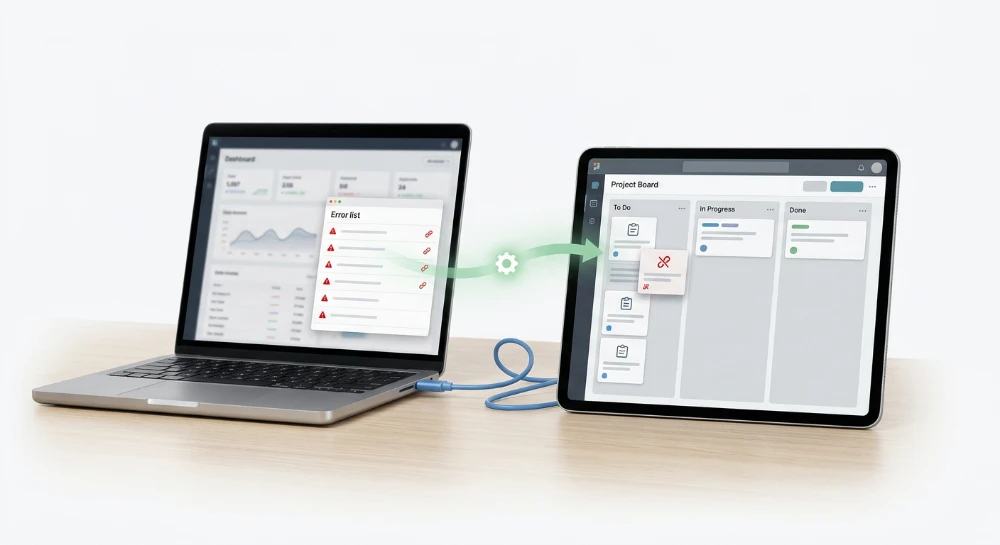
Understanding how automated workflows assure link quality for a large digital agency requires defining the specific structural requirements of enterprise-grade validation systems. Operations processing over 100,000 active URL paths daily fail when relying on manual crawling schedules. An architecture built on automated validation layers reduces technical debt by catching broken redirect chains and server errors before search engine bots encounter them.
The structural foundation divides into three distinct environments. The orchestration layer routes data via execution platforms like n8n or Zapier. Data extraction happens in the tool layer. Dedicated API gateways manage the exact data handoffs between crawling engines and reporting endpoints to prevent data loss during continuous transfer operations.
Technical KPI tracking dictates the system's viability. Time-to-detection for system failures must stay under five minutes to stop corrupted data sets from polluting the main database. System-wide API latency requires strict capping below 200 milliseconds during concurrent bulk requests. Validation checkpoint coverage needs at least 98% penetration across all active sitemaps to properly verify status codes and server configurations.
Integrating automated link status monitoring directly into a continuous delivery pipeline blocks poor code deployments at the staging environment. Pre-deployment scripts trigger site-wide crawls upon every code push to the staging server. The deployment halts automatically if the error rate for 404 and 500 status codes spikes above 2%. This technical blueprint forces development teams to resolve structural HTML issues prior to production releases, protecting the established SEO architecture.
Constructing the workflow orchestration layer
The orchestration environment binds disconnected tools into a unified execution pipeline. Configuring platforms like n8n, Make, and Zapier dictates the operational tempo of the entire SEO automation framework. n8n provides self-hosted deployment architecture, allowing precise control over server memory limits during massive data transfers. Make delivers advanced scenario routing, utilizing visual node connections for rapid prototyping of complex branching logic. Zapier handles standard webhook catch-and-push operations efficiently but lacks the deep array iteration capabilities required for granular dataset manipulation.
System configuration demands strict resource allocation. A single bulk export from a crawling engine can easily crash an under-provisioned worker node. Setting execution concurrency limits across automation platforms prevents memory faults during continuous polling sequences.
REST API and GraphQL API endpoint structures
End-to-End Connectivity requires robust endpoint mapping between the extraction layers and the central orchestration hub. REST API implementations follow rigid hierarchical paths for resource management. Workflow systems must constantly monitor authentication headers, pagination cursors, and rate-limit headers to maintain stable persistent connections. GraphQL API endpoints offer superior data density control. Instead of pulling massive default payloads from a standard endpoint, GraphQL allows the orchestration layer to request only the specific nested fields needed for the immediate execution step.
| API Architecture | Endpoint Structure Configuration | Workflow Application Focus |
|---|---|---|
| REST API | /api/v3/crawls/{crawl_id}/metrics | Triggering system functions and pushing bulk status updates. |
| GraphQL API | query { node(id: "x") { metrics { count } } } | Extracting highly specific data subsets to reduce memory load. |
Sequencing logic and conditional execution paths
Automation logic must account for unpredictable server responses. Relying on simple linear execution inevitably leads to corrupted datasets. Status-based triggers initiate downstream operations only when specific prerequisite conditions clear the queue. If a primary system reports an incomplete processing state, the trigger delays the next sequence automatically.
Sequencing logic dictates the exact chronological order of API calls. Conditional execution paths split the workflow dynamically based on real-time payload evaluation.
- Evaluate webhook headers to confirm origin authenticity before initializing any payload parsing sequences.
- Parse the initial status flags to determine if the crawler completed its scheduled run or aborted due to a timeout protocol.
- Route successful data runs immediately to the transformation module for processing.
- Divert aborted runs into an exponential backoff loop for retry scheduling to avoid hammering the endpoint.
This strict conditional routing ensures enterprise dashboards only ingest validated, complete datasets.
Automated data handoffs to enterprise platforms
Transforming raw extraction outputs into digestible formats bridges the critical gap between crawling tools and enterprise reporting interfaces. Automated data handoffs utilize standardized JSON payloads to transmit metrics from the orchestration layer directly to platforms like seoClarity and ClarityAutomate. Rigid schema compliance is non-negotiable in these environments.
Mismatched data types in the JSON structure will cause immediate ingestion failures at the destination endpoint. The workflow automation must execute mapping functions to convert flat arrays into the multidimensional JSON structures required by enterprise tools.
{
  "handoff_id": "req-992-alpha",
  "timestamp": "2023-11-14T08:30:00Z",
  "platform_destination": "seoClarity",
  "dataset": {
    "url_batch_size": 1000,
    "metrics_payload": [
      {
        "target_uri": "/products/industrial-components",
        "latency_ms": 112,
        "validation_state": "verified"
      }
    ]
  }
}
Pushing this JSON payload via a standard network request requires synchronized timing. The orchestration layer must await the confirmation response from ClarityAutomate before purging the temporary dataset from its own internal cache. This exact transactional logic guarantees zero data loss during high-frequency continuous crawling operations.
API-Driven backlink profile analysis and data enrichment
Raw extraction logs hold limited value without external context. Integrating third-party intelligence layers transforms flat URL lists into actionable datasets. Orchestration systems query external endpoints to append authority metrics, topology data, and risk scores to every discovered node.
Integrating Moz, Ahrefs, and Majestic endpoints
Enterprise environments require redundant data streams. Relying on a single provider introduces dangerous blind spots. Systems must query the Moz API, Ahrefs API, and Majestic Data APIs concurrently. Managing Ahrefs MCP allocations dictates that scripts batch requests efficiently. You cannot ping the endpoint for every individual URL without exhausting quota limits. The orchestration layer aggregates target arrays before issuing requests to the respective provider endpoints.
Payload parsing requires strict type enforcement. Each API returns unique JSON structures for link attributes. The parser normalizes these disparate schemas into a unified internal database format. Ahrefs delivers DR. Moz provides proprietary domain metrics. Majestic offers network flow calculations. The aggregation script maps these variables to a standardized internal weighting system.
Algorithmic filtering and referring domains extraction
Processing thousands of inbound connections requires aggressive algorithmic filtering. Extracting referring domains is the primary operation. The script isolates unique root domains linking to the target URL. Redundant links from the same domain are consolidated to prevent metric inflation. Filtering logic applies DR thresholds immediately upon extraction.
Setting minimum DR boundary conditions strips out irrelevant noise. The automation drops any referring domain below the baseline threshold from the primary analysis queue. This conserves processing power. Exact-match anchor text parsing executes next. The script tokenizes the anchor text strings returned by the API payloads. It compares these tokens against the target keyword list using programmatic distance calculations. High concentrations of exact-match strings trigger automatic over-optimization alerts.
- Extract primary domain from raw URL strings using regex parsing
- Execute deduplication scripts to isolate unique referring domains
- Apply conditional logic to drop domains failing the DR baseline
- Calculate exact-match anchor text ratios against total inbound links
Detecting link farms and negative SEO vectors
Identifying toxic backlinks relies on programmatic footprint analysis. Link farm patterns exhibit distinct structural signatures. The automation analyzes the neighborhood topology of referring domains. It looks for systemic anomalies.
A sudden velocity spike indicates a potential negative SEO vector. The system monitors the ingestion rate of new referring domains. If the volume of low-quality links breaches the historical standard deviation, the workflow raises a critical flag. Toxic links often share server infrastructure. The script cross-references the hosting data of the referring nodes to identify clustering.
| Toxicity Indicator | Detection Logic | System Action |
|---|---|---|
| Shared Server Infrastructure | High density of referring domains originating from identical subnets | Flag as potential link network cluster |
| CMS Footprint Duplication | Identical HTML structure and boilerplate CSS across multiple referring domains | Assign high risk score to the backlink cohort |
| Velocity Anomalies | Inbound link acquisition rate exceeds the established baseline deviation | Trigger negative SEO vector alert |
Algorithmic validation of outbound link patterns
Quality assurance extends beyond inbound links. Outbound link patterns require identical scrutiny. The crawler parses the HTML of proprietary digital assets to extract all outbound node destinations. Algorithmic validation checks the target attributes against Google Spam Policies.
Unregulated outbound link velocity degrades internal authority distribution. The script calculates the ratio of external links to internal links per page. It validates the presence and syntax of rel attributes. The system enforces strict compliance checks for sponsored and user-generated content.
function validateRelAttributes(linkNode) {
  const destination = linkNode.href;
  const relValue = linkNode.getAttribute("rel");
  if (destination.includes("affiliate-tracker") && relValue !== "sponsored") {
    return "compliance_failure";
  }
  if (linkNode.closest(".user-comments") && relValue !== "ugc") {
    return "compliance_failure";
  }
  return "verified";
}
Failing these compliance checks flags the specific HTML template for immediate remediation. The orchestration layer isolates the exact CMS block generating the non-compliant link. It logs the failure state and appends the specific rel attribute requirements needed to resolve the violation.
Automated technical validation for HTTP status and redirect protocols
Link equity dissipates instantly when routing protocols fail. Enterprise SEO architectures demand automated, high-frequency validation of HTTP response states across all internal and external link targets. Relying on manual crawler executions leaves critical infrastructure blind to sudden server-side routing failures.
Automated deployment of headless crawlers must explicitly log exact response headers. The orchestration layer evaluates these response codes against predefined compliance thresholds to trigger automated alerts. Core validation protocols assess the following HTTP status codes during every crawl sequence.
- 301 Permanent Redirects mandate a destination URL verification check to confirm equity transfer
- 302 Temporary Redirects trigger compliance warnings if persistence exceeds standard 14-day update cycles
- 404 Not Found and 410 Gone states log as direct link degradation endpoints requiring immediate replacement
- 500 Internal Server Error and 503 Service Unavailable codes halt further localized crawling to prevent false-positive deindexation flags
Algorithmic traversal of redirect paths prevents crawl budget waste and safeguards authority distribution. The automated script executes a network trace on the initial URL payload. It records each sequential server hop. If the hop count exceeds two, the system logs a redirect chain error. If any URL returns a target identical to a previously recorded node within the active trace, the algorithm registers a Redirect Loops failure. Dead links trigger when the final node resolution yields any 4xx or 5xx HTTP state.
The algorithmic routing evaluation matrix defines the exact failure thresholds and subsequent system actions.
| Routing Anomaly | Detection Logic | System Action |
|---|---|---|
| Redirect Chain | Node hops exceed strict limit of 2 | Flag architectural flaw for routing consolidation |
| Redirect Loops | Current node target matches prior trace node | Trigger critical alert for infinite loop resolution |
| Dead links | Final destination returns 404 or 410 | Queue target URL replacement task in CMS |
Integration with screaming frog CLI and botify APIs
Desktop crawlers operate efficiently at enterprise scale when deployed in headless environments. Executing Screaming Frog CLI through server cron jobs enables scheduled internal link topology mapping without manual interface interaction. The CLI configuration file instructs the system to export raw crawl logs directly into secured cloud storage bins. Botify APIs then ingest these structured data payloads to construct the final graph network.
Crawl depth analysis reveals architectural bottlenecks. The API response payloads define the exact click distance separating the root domain from deep landing pages. Internal link depth thresholds flag any URL requiring more than four clicks to access. Search engine crawlers rarely traverse beyond this depth limit. Orphan pages emerge when the orchestration layer cross-references server log files with the Botify URL database. URLs actively receiving organic traffic but possessing zero internal incoming links trigger an isolated Orphan pages alert for the technical team.
Validating link coding in JavaScript SEO architectures
Modern JavaScript frameworks obscure link distribution pathways. Standard HTTP GET requests often retrieve an empty HTML body shell. Automated systems must deploy headless browser rendering via Puppeteer or Playwright to evaluate the fully constructed Document Object Model.
Extraction logic specifically targets standard link coding execution. Developers frequently implement onclick JavaScript events and button-based routing to handle user navigation. Search engine crawlers cannot reliably execute these client-side events. The validation script parses the rendered DOM to confirm the presence of valid anchor tags containing explicit href attributes.
function validateAnchorTags(renderedDOM) {
  const anchorNodes = renderedDOM.querySelectorAll("a");
  const compliantLinks = [];
  anchorNodes.forEach(node => {
    const target = node.getAttribute("href");
    if (target && !target.startsWith("javascript:")) {
      compliantLinks.push(target);
    }
  });
  return compliantLinks;
}
This automated extraction sequence identifies malformed dynamic routing execution. Empty href attributes, fragment-only links, and client-side router redirects register as severe compliance failures. The workflow orchestration system processes these failures, isolates the specific JavaScript component generating the non-compliant link, and generates a prioritized engineering ticket containing the exact DOM selector required for remediation.
Crawler accessibility and indexation quality gates
Indexation gating mechanisms fail silently. A single malformed disallow directive strips link equity across entire site architectures. Automated validation protocols must parse Robots.txt rules and Meta Robots tags continuously. This prevents unapproved indexability state shifts from destroying organic visibility.
The crawler executes a dedicated script that intercepts HTTP response headers and the HTML meta nodes simultaneously. Trigger-based scans detect deviations between baseline indexability configurations and the live production state. If a URL previously marked for indexation suddenly returns a Noindex or Nofollow directive, the system halts downstream crawling.
Parsing logic for indexation states
Extraction routines look for conflicting instructions. Developers often leave X-Robots-Tag headers in the server configuration while altering page-level HTML tags. The validation protocol isolates these discrepancies.
function evaluateIndexability(headers, metaTags) {
  const headerRule = headers['x-robots-tag'] || null;
  const htmlRule = metaTags.find(tag => tag.name === 'robots')?.content || null;

  if (headerRule && headerRule.includes('noindex')) return 'BLOCKED_BY_HEADER';
  if (htmlRule && htmlRule.includes('noindex')) return 'BLOCKED_BY_HTML';

  return 'INDEXABLE';
}
This function runs against every URL evaluated in the workflow. State shifts trigger an immediate alert payload to the engineering queue.
Cross-Referencing logs with indexing APIs
Server logs map crawler behavior. Google Search Console Indexing APIs confirm the exact index status. Cross-referencing these data streams exposes systemic accessibility bottlenecks.
The workflow extracts raw server log entries, filters for Googlebot user agents, and matches those specific URLs against the API endpoints. This dual-verification isolates pages that search engine crawlers request but ultimately refuse to index due to hidden rendering failures.
| Server Log Status | API Indexing State | Diagnostic Meaning |
|---|---|---|
| HTTP 200 (High Frequency) | Crawled - currently not indexed | Content quality threshold failure or rendering timeout. |
| HTTP 200 (Low Frequency) | Discovered - currently not indexed | Crawl budget exhaustion or poor internal link architecture. |
| No crawl activity | Blocked by robots.txt | Upstream directive preventing URL discovery. |
Systemic checkpoints for rendering architectures
JavaScript environments mask link equity distribution pathways. If the client-side hydration process times out, search engine crawlers abandon the render queue. The raw HTML source code often lacks the navigational architecture required for crawling.
Engineering teams must establish systemic checkpoints to identify these rendering engine architectural flaws.
- Verify the initial HTML payload contains a fully populated navigation tree before client-side scripts execute.
- Measure hydration latency against standard crawler timeout thresholds.
- Detect empty DOM container nodes that require asynchronous API calls to load internal links.
- Audit dynamic routing components that inject hash fragments instead of standard URL paths.
Failing any of these checkpoints breaks the link graph. Crawlers cannot pass equity through pathways that do not exist during the exact moment of parsing. The automated workflow flags rendering timeouts as critical accessibility blocks, forcing immediate remediation of the client-side architecture.
Integrating SEO QA into CI/CD deployment pipelines
Post-release monitoring catches errors after the damage occurs. Revenue loss begins the second bad code hits production. Shift the validation process left. Pre-deployment automation frameworks intercept fatal architectural flaws in staging instances before they reach the main branch.
Continuous delivery pipelines require strict execution logic to function without manual bottlenecks. Agile environments push code daily. You cannot wait for a weekly crawl. Integrating Lumar Protect and ContentKing APIs directly into the deployment pipeline ensures every build passes technical validation automatically.
When a developer commits code to the staging repository, the continuous integration server fires a webhook to the validation layer. The Lumar Protect API initiates a scoped crawl against the staging subdomain. It compares the structural integrity of the new build against baseline production metrics. ContentKing APIs execute simultaneous real-time delta tracking. They detect unexpected shifts in internal linking structures or DOM hierarchy.
Code-Level quality gates
Passing unit tests does not guarantee crawler accessibility. The pipeline requires specific code-level quality gates configured to analyze technical execution and network response behavior.
- Parse HTML payloads for systemic link coding syntax errors such as empty href attributes or malformed URL structures.
- Identify missing absolute URL declarations within pagination or canonical components.
- Scan staging server logs for unapproved HTTP protocol shifts.
- Evaluate the delta of functional navigation elements compared to the production baseline.
A failure at any gate halts the build.
Automated pipeline rollbacks
Human approval slows down continuous delivery. The pipeline must self-regulate using predefined thresholds. If the automated audit detects critical violations, the system triggers an immediate deployment pipeline rollback.
The execution logic relies on strict boolean conditions based on the API response payloads.
| Pipeline Trigger | Validation Criteria | Rollback Condition |
|---|---|---|
| Staging Build Deployed | HTTP Status Distribution | Critical spikes in 4xx/5xx errors exceeding standard variance thresholds. |
| Lumar Protect Scan Complete | Link Coding Syntax | Detection of unparsable relative paths or broken anchor tags. |
| ContentKing API Callback | Indexability Directives | Unintentional injection of global blocked directives on core templates. |
Deployments proceed only when the validation layer returns a zero-error payload for critical severity issues. This closed-loop system isolates technical regressions within the staging environment. Production remains pristine. Server configuration faults or broken templating updates get rejected automatically. The build system logs the specific rejection criteria and pings the engineering team for immediate remediation.
Reporting automation and continuous audit trails
Orchestration layers generate massive volumes of payload data during scheduled crawls. This raw output requires structured storage for historical comparison. Centralized data warehouses serve as the foundation for workflow consistency across the enterprise architecture. Raw API response payloads from external validation tools route directly into data lakes via automated data pipelines. Storing immutable raw data prevents analytical distortion when diagnostic criteria evolve.
The architecture mandates separating raw ingestion tables from processed reporting views. Storing full payload schemas ensures every attribute remains available for retrospective log analysis if an undetected architectural flaw surfaces months later.
Logging protocols and audit trails
Strict audit trails for SEO automation workflows require immutable logging at every execution node. System failures often mask themselves as transient network timeouts. Identifying the root cause requires precise timestamping and payload preservation. Every trigger, condition evaluation, and API handoff must write an execution log to the warehouse.
Define standard logging schemas across all interconnected platforms.
- Execution ID mapping for tracking individual payloads across multiple API gateways
- Timestamp standardization utilizing universal time formats for cross-system correlation
- Endpoint response headers capturing API latency and rate limit thresholds
- Binary flags for immediate validation checkpoint coverage analysis
A failed webhook callback drops silently without persistent logging. Centralized logs expose these hidden failures immediately.
Query structures for issue remediation
Continuous auditing relies on delta extraction. Recurring automation query structures must isolate changes between sequential crawl logs. Remediation tracking demands comparing the active crawl state against the historical baseline to verify fixes.
Technical bottlenecks resolve only when engineering deployments push the correct structural updates. Delta queries validate these pushes autonomously.
| Query Objective | Execution Logic | Output Variable |
|---|---|---|
| Issue Resolution Verification | Compare current HTTP status against prior crawl log matching exact URL string | Remediation Confirmation Flag |
| Regression Detection | Identify missing schema payload keys in newly generated rendering output | Technical Alert Status |
| Link Equity Leakage | Count total outbound nodes per CMS template cross-referenced with internal link depth | Variance Percentage |
These recurring queries run daily against the updated warehouse partitions. Automated triggers fire alerts to the workflow orchestration system upon detecting unresolved critical issues.
Monitoring API uptime and technical bottlenecks
Dashboards translate raw output into actionable engineering metrics. The reporting layer connects directly to the processed data warehouse views. Monitoring API endpoint uptime ensures the validation pipeline itself remains operational. Dead orchestration nodes create a false sense of security. If the rank tracking automation layers fail to ping the validation endpoints, the system must log a critical alert.
- Monitor uptime compliance for third-party diagnostic endpoints
- Track average execution time for scheduled crawl clusters
- Map structural error density against specific CMS template deployments
Rank tracking automation layers overlay organic visibility data onto the technical audit trails. Correlating traffic drops directly with logged structural regressions removes diagnostic ambiguity. When an automated query detects an unapproved meta directive injection, the reporting system maps the exact hour of deployment to the corresponding SERP volatility. This closed-loop data architecture transforms reactive analysis into proactive system governance.