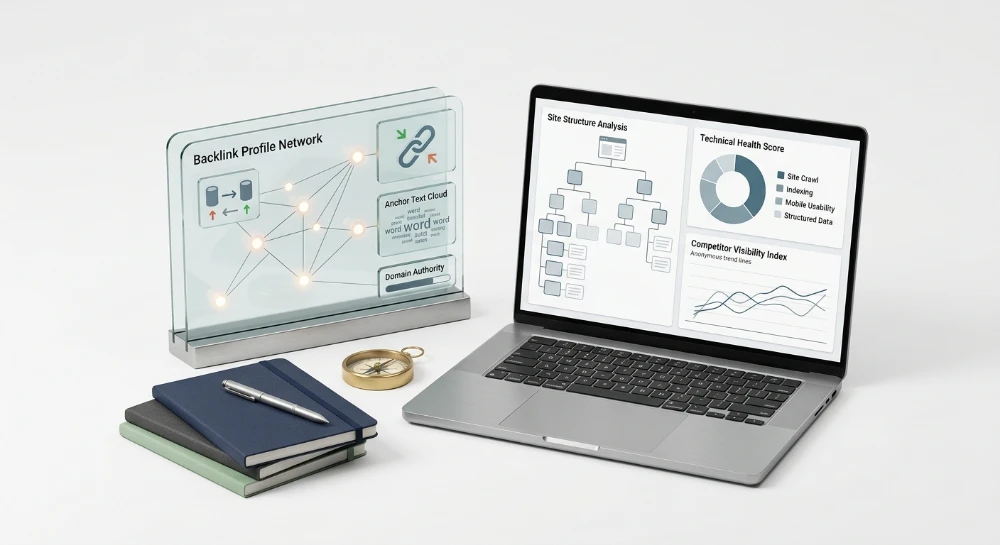
SE Ranking rivals split into three distinct groups once a team maps out how backlink analysis and technical SEO actually get handled inside each platform. SE Ranking itself ships a single package: a crawler for site audits and a module for backlink data, bundled under one login. That bundling works for teams running routine checks. It starts to break down once the work requires rendering diagnostics, log file parsing, or donor-page verification that goes beyond a static index snapshot.
The technical audit crawler inside SE Ranking flags standard issues: broken links, missing meta tags, duplicate content, basic crawl errors. What it does not do is render JavaScript-heavy pages the way a browser would, nor does it parse server log files to show which pages Googlebot actually visited versus which pages sit unvisited for months. Site speed reporting stays surface-level too, often missing the granularity needed to isolate render-blocking scripts or third-party script bloat on a page-by-page basis.
Backlink verification carries a parallel gap. SE Ranking's backlink module reports referring domains and anchor text at a point in time. It does not continuously re-crawl each donor page to confirm the link still exists, still carries the same attribute, or still points to the same target URL. A link marked dofollow today can turn nofollow next week with no alert. For agencies managing paid link placements or recovering from a manual action, that lag between index snapshot and live page state creates real risk.
Three categories of alternatives address these gaps differently. Full-suite SaaS platforms like Ahrefs and Semrush combine a crawler with a large backlink index inside one subscription, mirroring SE Ranking's structure but with deeper crawl diagnostics and more frequent index refreshes. Desktop and specialist tools, including Screaming Frog, Sitebulb, SEO PowerSuite, Moz Pro, Majestic, and LinkResearchTools, concentrate on one discipline at a time, either crawl depth and rendering accuracy or link-risk and attribute analysis, rather than trying to cover both. A third category, represented by SeLinkPro, drops the subscription model entirely in favor of pay-as-you-go pricing tied to live monitoring of donor pages and technical crawl output.
The sections that follow set out the specific criteria for judging crawl engines and backlink modules, then walk through what each platform actually documents regarding crawlability, site speed reporting, indexability checks, and link attribute verification.
Technical SEO and backlink analysis: Core evaluation criteria for SE ranking alternatives
Picking a replacement tool by feature-count alone is how most teams end up paying for a second subscription that solves the wrong problem. Before comparing any platform against SE Ranking, break the evaluation into six discrete dimensions. Each one maps to a different failure mode, and a tool can score well on one while doing almost nothing on another. Treat this as a checklist to run against your own workflow gaps, not a scoring rubric for ranking vendors against each other.
Crawl engine behavior
The crawler is the foundation layer. Everything downstream, indexability, speed diagnostics, internal link equity, depends on whether the crawl engine actually sees the site the way Googlebot does. Seven sub-checks matter here:
- Crawl budget handling: does the crawler respect crawl-delay directives and pagination limits, or does it choke on sites past a few thousand URLs, silently truncating the audit?
- JavaScript rendering support: can the engine execute client-side scripts to see content injected by React, Vue, or similar frameworks, or does it only read raw server-delivered HTML?
- Redirect chain detection: does it flag 301 hops that loop three or four times deep, a common cause of wasted crawl budget and diluted link equity?
- 4xx/5xx error classification: are broken links and server errors separated by cause, or dumped into one generic error bucket that forces manual triage?
- Orphan page discovery: can the tool find pages that exist on the server but carry zero internal links pointing to them?
- Canonical and noindex validation: does it confirm that canonical tags point to the intended URL and that noindex directives are not accidentally blocking pages meant to rank?
- Robots.txt and XML sitemap checks: does the crawler cross-reference disallow rules against the sitemap to catch pages that are submitted for indexing but simultaneously blocked from crawling?
A tool that fails even one of these checks consistently will produce audits that look complete but miss the actual root cause of a traffic drop.
Site speed and core web vitals reporting
Speed diagnostics split into two camps: tools that generate their own lab-based load-time metrics, and tools that pull field or lab data from Google's PageSpeed Insights and repackage it inside the dashboard. Neither approach is automatically better, but the distinction changes how you interpret the numbers. Confirm whether the platform surfaces Largest Contentful Paint and Cumulative Layout Shift as discrete metrics, or whether it only gives a bundled speed score with no breakdown. A bundled score is fine for a quick health check; it is useless when you need to isolate whether a slow LCP is caused by server response time, render-blocking JavaScript, or oversized image assets. If Core Web Vitals reporting is the weak point in your current stack, this is the dimension to weight heaviest.
Indexability verification
Indexability checks answer a narrower question than crawlability: not just whether a page can be crawled, but whether it is actually sitting in Google's index right now. This means verifying sitemap integrity, catching orphaned sitemap entries, broken sitemap XML, URLs listed that 404, and checking live indexing status rather than assuming a page is indexed because it was last month. A platform that validates sitemap structure but stops there is only doing half this job. The other half is confirming actual index presence, which requires either a live index check against the search engine or a documented method for pulling current indexing status.
Backlink data depth
Three separate questions get conflated under "backlink data" and they deserve to be pulled apart:
- How many referring domains does the index actually track, and does that number reflect unique domains or raw link count?
- How fresh is the index, meaning how much lag exists between a link going live or disappearing and that change showing up in the report?
- Are donor pages re-checked over time, or is each backlink analyzed once at discovery and never revisited?
That last point is the one most workflows underestimate. A backlink index built on one-time discovery crawls will tell you a link existed. It will not tell you whether that link still exists today, still carries the same target URL, or has been quietly altered since discovery. For anyone managing paid placements, guest posts, or link-building campaigns tied to vendor invoices, the gap between discovery-based indexing and ongoing re-verification is often the single biggest determinant of whether a tool is fit for purpose.
Link attribute verification
Attribute detection covers whether the tool distinguishes dofollow, nofollow, sponsored, and UGC links, plus how it reports anchor text distribution across the profile. This matters for two distinct reasons. First, an SEO paying for dofollow placements needs confirmation that the link was not silently switched to nofollow or sponsored after payment, a change that can happen without any notification from the donor site. Second, anchor text distribution, branded versus exact-match versus generic versus naked URL, is a direct input into over-optimization risk. A profile skewed too heavily toward exact-match commercial anchors is a red flag regardless of which tool reports it, but only a tool that breaks anchors into these categories will let you see the skew before it becomes a problem.
Link risk signals
The last dimension is risk scoring: does the platform assign a toxicity or spam score to referring domains, and does it support exporting a disavow file directly from that analysis? This matters most for sites recovering from a manual action or those that inherited a backlink profile from a previous agency or a expired-domain acquisition. Toxicity scoring is only useful if it is paired with an actionable export path; a spam score with no disavow file generation just tells you there is a problem without giving you a way to act on it.
Matching criteria to actual workflow gaps
The following table summarizes what each dimension protects against when it is missing.
| Evaluation dimension | What a weak tool misses | Business consequence |
|---|---|---|
| Crawl engine behavior | Rendering issues, redirect loops, orphan pages | Pages invisible to search engines despite existing on the server |
| Site speed and Core Web Vitals | LCP/CLS breakdown behind a bundled score | Cannot isolate root cause of a ranking or conversion drop tied to speed |
| Indexability verification | Live indexing status versus sitemap presence alone | Pages assumed indexed that have silently dropped out |
| Backlink data depth | One-time discovery instead of ongoing re-verification | Paid links that go dead or change attribute with no alert |
| Link attribute verification | No dofollow/nofollow/sponsored/UGC breakdown | Paying for dofollow value that has quietly disappeared |
| Link risk signals | No toxicity score or disavow export | Slower manual-action recovery, wasted disavow effort |
No single metric decides which alternative is correct. A crawl-heavy agency auditing large ecommerce catalogs will weight crawl budget handling and JavaScript rendering far above anchor text distribution. A link-building team managing paid placements across dozens of vendors will care almost exclusively about backlink re-verification and attribute change detection, and treat Core Web Vitals reporting as a secondary concern handled by a different tool entirely. Identify which one or two of these six dimensions represents the actual bottleneck in the current workflow, then use that as the filter for everything that follows.
Ahrefs: Site audit crawler and backlink index as an SE ranking alternative
Ahrefs approaches the same problem SE Ranking does - combining a crawler with a backlink database under one login - but pushes deeper on both sides. The Site Audit module runs a crawl against a domain and returns a Site Health score, a single number meant to summarize the overall technical condition of a site. Underneath that score sits a categorized breakdown of issues: broken links, redirect problems, HTML tag errors, content flaws, and performance bottlenecks are each grouped separately rather than dumped into one undifferentiated list. That categorization matters for triage. A webmaster staring at a health score of 78 learns nothing actionable; a webmaster looking at a category labeled redirects with a specific count of affected URLs knows exactly where to send the dev team.
Core Web Vitals reporting sits inside the same module, giving LCP and CLS visibility tied directly to the crawled pages rather than a separate bolt-on report. That pairing lets a technical lead correlate a specific template or page group with a specific vitals problem instead of guessing which section of the site is dragging the aggregate score down. Site Audit also supports JavaScript rendering, which means pages built on client-side frameworks get evaluated after script execution rather than against a bare, pre-render HTML shell. Sites that lean on React, Vue, or similar frameworks for content delivery depend on this distinction - a crawler that only reads raw HTML will misreport indexability and content visibility on those templates, flagging pages as thin or broken when the rendered version is neither.
Site explorer and the backlink layer
On the link side, Ahrefs runs Site Explorer, built around Domain Rating as its headline authority metric. Domain Rating gives a single comparative figure for link strength, similar in function to the authority scores found in other suites, but the value of Site Explorer comes less from that one number and more from what sits behind it. The backlink index itself is continuously updated, meaning previously discovered links get re-crawled and re-verified over time rather than logged once and left static. That continuous refresh is the direct answer to a problem raised earlier in this comparison: a one-time backlink discovery process cannot tell a webmaster when a paid placement goes dead or when a donor page swaps a dofollow link for a nofollow one weeks after the invoice clears.
Referring domain counts are reported alongside the raw backlink totals, which separates genuine link diversity from simple link volume - a site with five hundred links from six domains looks very different from a site with five hundred links from five hundred domains, and Site Explorer keeps that distinction visible rather than collapsing it into one figure.
Anchor text reporting rounds out the backlink layer, surfacing the exact anchor strings pointing at a domain so a link-building team can spot over-reliance on exact-match anchors before it becomes a pattern worth flagging. Paired with that is a dofollow/nofollow breakdown of external links, which tells a team whether the attribute value they paid for is actually the attribute value currently live on the donor page.
The following list summarizes how the two modules divide responsibility inside the platform:
- Site Audit handles crawl-based technical diagnostics: Site Health score, categorized issue reporting, Core Web Vitals, and JavaScript rendering support.
- Site Explorer handles link-based diagnostics: Domain Rating, a continuously updated backlink index, referring domain counts, anchor text reports, and dofollow/nofollow attribute breakdowns.
Positioned against SE Ranking, Ahrefs makes the most sense for teams that specifically want one vendor, one login, and one billing relationship covering both disciplines - crawl-based technical audits on one side, a large and frequently refreshed backlink index on the other - without needing to stitch together a separate crawler and a separate link-verification tool. That single-vendor convenience is the trade-off worth weighing: it consolidates workflow, but it also means the depth of any one feature is bounded by what a general-purpose suite chooses to prioritize, rather than built by a specialist focused on that single discipline alone.
Semrush: Site audit and backlink analytics for technical SEO teams
Semrush splits its diagnostic work into the same two-discipline structure found in Ahrefs and SE Ranking, but under different module names. Site Audit handles crawl-based technical checks. Backlink Analytics and Backlink Audit handle link verification and risk scoring. The split is functional rather than cosmetic: crawlability problems get flagged in one place, link-profile problems in another, and a team pulls from whichever module matches the symptom they're chasing.
Site Audit runs crawlability checks against the domain and rolls the findings into a Site Health score, which gives a team a single number to track over time rather than forcing them to re-read the full issue list on every check-in. Below that score, issues get categorized by severity - errors, warnings, notices - so a technical lead can triage broken redirects or blocked resources before spending time on lower-priority notices. Core Web Vitals integration sits inside the same module, giving the crawl output a speed-and-stability layer instead of leaving that data isolated in a separate report.
Backlink Analytics is the discovery layer: it reports Authority Score, referring domain metrics, and a breakdown of backlink types across the domain's link profile. Backlink Audit is the risk layer built on top of that data - it flags toxic links and supports disavow file export, which matters for any team that has already identified a problem link cluster and needs to hand Google a formatted disavow list rather than assembling one by hand.
The functional split between the two backlink modules is worth laying out plainly, since it mirrors how the platform expects a team to work:
- Backlink Analytics answers "what does the link profile look like" - Authority Score, referring domain counts, and backlink-type breakdown.
- Backlink Audit answers "which of these links are a liability" - toxic-link flagging and disavow file export for cleanup.
Structurally, this puts Semrush in the same category as SE Ranking rather than in a separate tier: both platforms bundle a crawl-based audit tool and a backlink-risk tool under one subscription, aimed at teams that want technical diagnostics and link-profile monitoring without switching vendors. The comparison worth making isn't over whose Authority Score or Site Health formula is more precise - those scoring models aren't fully disclosed by either vendor, and chasing exact formula parity is a dead end. The comparison that actually matters is breadth of the combined module set: does the audit-plus-backlink pairing cover crawlability, Core Web Vitals, referring domain depth, backlink-type classification, toxic-link detection, and disavow export all under one login. On that count, Semrush and SE Ranking occupy similar ground, which means the decision between them tends to come down to reporting workflow and existing team familiarity rather than a missing capability on either side.
Moz pro: Link explorer and site crawl for Authority-Centered backlink analysis
Moz Pro splits into the same two-module pattern seen elsewhere in this comparison - a crawler for technical issues and a backlink tool for link-profile analysis - but the weighting between the two modules is different. Site Crawl handles the technical side, flagging issues like broken links, duplicate content, and missing metadata across the site. On-Page Grader works at the individual page level, scoring a given URL against a target keyword and surfacing on-page factors that need fixing. Neither tool is positioned as the platform's centerpiece. That role belongs to Link Explorer.
Site Crawl and On-Page Grader cover the baseline technical checks a team expects from any audit tool: locating broken links, catching duplicate content, and identifying missing or malformed metadata. It's a standard crawler, built to flag what's broken rather than to dig into rendering behavior or granular performance diagnostics. For teams whose main gap versus SE Ranking is deep crawl logic - JavaScript rendering nuances, log-level diagnostics - Site Crawl won't be the differentiator that pulls them toward Moz. What pulls them toward Moz is the backlink layer.
Link explorer and the authority-first backlink model
Link Explorer is built around Moz's own authority metrics rather than around raw link-count or crawl-depth reporting. Three scores anchor the module:
- Domain Authority - a score representing the overall strength of a domain's backlink profile.
- Page Authority - the same logic applied at the individual page level rather than the domain level.
- Spam Score - a metric flagging how likely a domain is to be penalized or ignored by search engines based on link-profile characteristics.
Beyond the scores, Link Explorer produces a Linking Domains report, giving a view of which domains link to a target site and how that referring-domain set breaks down. That's the raw inventory layer sitting underneath the authority scores - useful for confirming which domains are actually driving the Domain Authority number, not just trusting the headline figure.
The feature that separates Moz's approach from a straightforward backlink index is Link Intersect. It's built specifically for competitor gap analysis: identify which domains link to one or more competitors but not to the target site. That's a distinct workflow from simply pulling a backlink list. It's a targeting tool for link-building teams trying to find realistic outreach opportunities - sites already vouching for competitors in the same space.
Where Moz pro fits versus crawl-depth-first platforms
The positioning question comes down to what a team is actually optimizing for. Platforms that prioritize crawl depth build their value proposition around catching every technical fault a bot can find - rendering edge cases, exhaustive error classification, granular site-speed diagnostics. Moz Pro isn't competing on that axis. Site Crawl does the standard job: broken links, duplicate content, metadata gaps. Nothing more elaborate is claimed here, and nothing more elaborate should be expected.
Where Moz earns its place in this comparison is the authority-metric layer. Domain Authority and Page Authority give teams a shorthand for comparing link-profile strength across sites, Spam Score adds a risk lens on top of that, and Link Intersect turns the whole analysis into an actionable competitor-gap workflow rather than a static report. For a business owner or SEO specialist whose actual bottleneck is deciding which link-building targets are worth pursuing - not whether their crawler catches one more class of redirect chain - Moz Pro's authority-first framing is the more direct fit.
SEO PowerSuite: Desktop-Based technical audits and backlink analysis with WebSite auditor and SEO SpyGlass
SEO PowerSuite breaks from every platform covered so far in one structural way: it runs on a local machine, not in a browser tab connected to a vendor's cloud crawler. The suite splits technical and backlink work into two separate modules - WebSite Auditor and SEO SpyGlass - each installed and executed on the user's own hardware. That distinction matters more than it sounds. It changes what "crawl limit" even means for the reader evaluating this as an SE Ranking alternative.
WebSite auditor: A desktop crawler built around structure visualization
WebSite Auditor functions as a technical crawler that maps a site's architecture and renders it as a visual structure diagram. Rather than reading a flat list of URLs, teams can see how pages connect, where click-depth gets excessive, and which sections of the site sprawl without a clear hierarchy. That visualization layer is the module's defining trait - it turns crawl output into something a webmaster can inspect visually instead of scrolling through rows of a spreadsheet.
Beyond the structure map, WebSite Auditor runs on-page factor checks: the standard set of technical and content-level signals a crawler flags on a per-page basis. This covers the kind of detail work that catches metadata issues, content-level factor gaps, and structural inconsistencies across a site's page inventory.
None of that requires a live cloud connection to a vendor's index. The crawl happens locally, which is precisely the appeal for a team that wants a technical audit without depending on server-side crawl scheduling.
SEO SpyGlass: Backlink checking with a penalty-risk lens
SEO SpyGlass handles the backlink side of the suite, and its core differentiator is a Penalty Risk indicator attached to a site's link profile. Instead of just listing referring domains, the module scores the profile for exposure to manual action or algorithmic penalty risk - a framing aimed squarely at teams doing link audits ahead of a disavow submission or a recovery effort after a ranking drop.
That risk score feeds directly into a link detox workflow: a process built around identifying which links in the profile are dragging penalty risk upward, so the reader can isolate candidates for removal or disavowal rather than treating the entire backlink list as a single undifferentiated block. Anchor text distribution analysis rounds out the module, giving teams visibility into whether a site's anchor profile leans too heavily on exact-match or money terms - a pattern that historically correlates with over-optimization risk.
- WebSite Auditor: desktop crawl engine, site structure visualization, on-page factor checks.
- SEO SpyGlass: backlink checker, Penalty Risk indicator, link detox workflow, anchor text distribution analysis.
Licensed software versus cloud subscription: What actually changes
SEO PowerSuite is sold as licensed desktop software. There is no monthly cloud subscription model behind it, and that single fact reshapes how crawl volume and backlink checks behave compared to browser-based platforms like the ones discussed earlier in this comparison.
Cloud SaaS competitors meter usage through account-level caps - pages crawled per month, backlink lookups per project, refresh cycles tied to a subscription tier. A desktop license doesn't work that way. Crawl volume and backlink-check capacity are governed by the local machine's processing power and by whatever constraints the license itself imposes, not by a server-side quota reset on a monthly billing cycle. For a team running audits on an irregular schedule - quarterly technical reviews, one-off penalty investigations - that can mean paying once for a license rather than carrying an ongoing subscription cost tied to usage the team doesn't need every month.
The trade-off runs the other direction too. A browser-based SaaS tool updates its backlink index and crawl engine on the vendor's schedule, with no local install to maintain. Desktop software puts that maintenance burden - updates, local storage of crawl data, hardware-dependent processing speed - on the user. For a solo consultant or a small in-house team running audits from a single workstation, that's a manageable trade. For a distributed agency team needing simultaneous cloud access across multiple analysts, it's a real limitation worth weighing before committing to a license.
Screaming frog and sitebulb: Dedicated crawlers for crawlability and site speed audits
Screaming Frog SEO Spider runs as a desktop crawler focused entirely on crawl mechanics. It checks HTTP status codes across the full URL set, maps redirect chains hop by hop, validates hreflang attributes for multi-region or multi-language sites, and reads structured data markup to flag malformed or missing schema. JavaScript rendering is supported, so pages built on client-side frameworks get crawled the way a modern browser would render them, not just the raw HTML response.
Speed diagnostics come through a PageSpeed Insights API integration rather than a built-in speed engine. That's a meaningful distinction. The crawler itself doesn't calculate page-speed metrics from scratch - it pulls them from Google's API on a per-URL basis during the crawl, which means speed data for a site audit is only as current and as rate-limited as the API connection allows.
Licensing follows a two-tier structure. A free version caps the number of URLs crawled per session, enough for spot-checking a small site or sampling a subset of pages on a larger one. The paid license removes that cap, opening up unlimited crawling and unlocking configuration options - custom extraction, scheduling, API integrations - that the free tier doesn't expose. For a site running into the tens of thousands of URLs, the free cap makes the paid license the only practical option.
Sitebulb takes a different presentation approach to a similar core job. It's also a desktop crawler with JavaScript rendering support, but its output is built around visualized crawl reports rather than raw data tables. Issues get surfaced with prioritized recommendations attached, which shifts some of the interpretation work - deciding what to fix first - from the analyst to the tool itself.
Neither tool ships a native backlink index. That's the line that separates them from the full-suite platforms discussed earlier in this comparison.
Running an audit in Screaming Frog or Sitebulb tells a site owner exactly which pages are throwing 5xx errors, where redirect chains are burning crawl budget, and how hreflang or structured data is holding up. It says nothing about who links to the site, how those links are attributed, or whether a donor page still carries the link a month later. For a team whose SE Ranking workflow is already covering backlinks adequately but keeps missing rendering issues, log-driven crawl gaps, or granular speed diagnostics, that trade-off is the whole point - depth on the crawl side, a blank spot on the link side.
Majestic and LinkResearchTools: Specialized platforms for link attribute and link risk analysis
Majestic built its reputation on a metric pair that most SE Ranking users have seen referenced elsewhere but rarely get to inspect at this resolution: Trust Flow and Citation Flow. Citation Flow measures raw link quantity weighted by how many links point at a domain, while Trust Flow weights those same links by proximity to a curated set of trusted seed sites. The gap between the two numbers is diagnostic on its own - a domain with high Citation Flow and low Trust Flow is usually sitting on a pile of low-quality or spammy links, which is exactly the kind of profile a manual link-quality review needs to catch before it becomes a ranking liability.
Topical Trust Flow extends that scoring one layer further by attaching subject-matter categories to the trust calculation. A backlink from a finance site pointing into a finance-focused page scores differently than the same link profile built around unrelated topical categories. For anchor text and referring domain analysis, that topical breakdown matters because it separates links that reinforce a site's subject authority from links that are topically disconnected - a pattern that's easy to miss when a tool only reports raw referring domain counts without any topical context.
Majestic splits its data into two distinct index views rather than presenting one blended dataset:
- Fresh Index - reflects recently discovered and recrawled links, useful for tracking the current state of a link profile and catching newly acquired or newly lost links.
- Historic Index - holds a longer-running record of links Majestic has crawled over time, which supports referring domain analysis that needs historical depth rather than a snapshot.
Toggling between Fresh and Historic changes what an anchor text report actually shows. A site owner checking whether an exact-match anchor spike is a recent event or a years-old pattern gets a different answer depending on which index is active - that distinction alone is something SE Ranking's backlink module doesn't expose.
LinkResearchTools takes a narrower, risk-first angle. Its core workflows are built around disavow file management and forensic link-risk audits, both aimed squarely at manual action investigation and penalty recovery. Where Majestic's strength is quantifying trust and topical relevance across a link graph, LinkResearchTools is structured around the question a site owner asks after a ranking drop: which links caused this, and what needs to go into the disavow file to fix it.
That forensic orientation shows up in how the workflow is organized - building a defensible link-risk case, documenting which links are suspect, and assembling a disavow submission that a webmaster can act on. For a site that's already received a manual action notice, or one that suspects a negative-link attack is behind a sudden traffic drop, that's a materially different task than a routine backlink health check. It's investigation work, not monitoring work.
Neither Majestic nor LinkResearchTools ships an integrated technical site crawler. There's no crawl budget analysis, no 4xx/5xx classification, no rendering engine checking JavaScript-dependent content, and no site speed reporting sitting alongside the link data. Both platforms are backlink-only specialists in the strictest sense - everything they do lives on the link side of the audit.
That positioning makes the decision fairly mechanical. A team whose SE Ranking crawl reports are already solid but whose link attribute analysis feels shallow - no topical trust scoring, no separated fresh-versus-historic view, no structured path into disavow and penalty forensics - has a real gap that Majestic or LinkResearchTools fills directly. A team struggling with crawl depth, rendering issues, or site speed diagnostics won't find any relief here; that gap sits entirely outside what either platform is built to do.
SeLinkPro: Pay-As-You-Go Real-Time backlink monitoring and technical audit platform
Every platform covered so far runs on a flat monthly subscription, whether that team crawls 500 pages or 500,000. SeLinkPro breaks from that model entirely. Billing runs on a strict pay-as-you-go economy: a $5.00 minimum deposit gets an account started, and there's no recurring subscription fee sitting on the books whether the tool gets used that week or not. Costs scale directly with volume - $0.005 per page crawled for a technical audit, $0.004 per URL for a bulk indexation check, $0.04 per domain for bulk domain metrics. A small affiliate site running a quarterly audit pays for a few thousand crawled pages and nothing else. An agency auditing forty client domains a week pays proportionally more, but never for idle capacity.
That shift matters for budget-conscious teams and for anyone auditing link vendors rather than running an internal marketing department. Flat-fee tools charge the same whether an account is dormant for three weeks or crawling nonstop. Usage-based billing removes that dead weight.
Technical SEO audit module
The crawling and rendering engine targets indexing blockers directly. It flags server 5xx errors, broken 4xx internal and external links, redirect chains, and orphan pages - the standard set of crawl-blocking faults that quietly bleed crawl budget. Validation extends to robots.txt, XML sitemap integrity, canonical tags, and noindex directives, catching the kind of silent misconfiguration that keeps whole sections of a site out of the index without anyone noticing until traffic drops.
Heading structure gets a dedicated check: missing H1s, duplicate H1s, skipped heading levels, and H1-H6 hierarchy problems all surface in the report. Performance diagnostics cover TTFB, total load time, and render-blocking JavaScript - the kind of front-end bottleneck that tanks Core Web Vitals scores without an obvious cause in the HTML source. On the content side, near-duplicate detection runs on text embeddings rather than simple string matching, which catches semantic duplication - pages that reuse the same structure and phrasing with minor wording swaps - that a basic diff-based checker would miss entirely.
Output comes as an exportable HTML or PDF report, structured around a prioritized issue list and an overall health score. That format gives a webmaster a single number to track over time and a ranked list of what to fix first, rather than a raw dump of every flagged URL with no sense of severity.
Automated backlink monitor
This module addresses a problem none of the subscription-based backlink tools solve directly: what happens to a link after it's placed. Continuous polling of donor and vendor pages checks for link rot - pages going 404, getting deleted, or disappearing behind a redirect chain months after the placement was paid for.
The monitor also watches for attribute manipulation. A vendor can quietly inject rel="nofollow", rel="sponsored", or rel="ugc" onto a link that was sold and delivered as a clean dofollow placement, and without ongoing checks, that change goes unnoticed indefinitely. The same logic applies to anchor text - the monitor logs when anchor text gets altered after the fact, which is a common tactic for devaluing or redirecting link equity without informing the buyer. Outbound link spikes on a donor page get tracked too; a sudden jump in outbound links dilutes the equity passed through any single link, including one already paid for.
All of this feeds a historical audit ledger of donor-page snapshots. That ledger is the difference between suspecting a vendor cut corners and proving it - a snapshot taken at placement time versus one taken six months later gives a documented, comparable record for a dispute or a refund request.
Bulk Google and Yandex backlink index checker
A backlink that exists on a page but never gets indexed by the search engine passes no equity at all. The Bulk Google and Yandex Backlink Index Checker verifies live indexation status for vendor-delivered URLs across both engines, which matters directly for anyone running or auditing outreach and guest-post campaigns where indexation was part of the deal. Checking this in bulk, rather than one URL at a time, is what makes it usable at the scale a link-building campaign actually operates at.
SEO anchor cloud analyzer
Anchor text distribution is a well-known risk lever - overconcentration on exact-match commercial anchors is a pattern that draws unwanted algorithmic attention. The SEO Anchor Cloud Analyzer breaks a backlink profile into branded, naked-URL, generic, and exact-match categories, and lays each one against its dofollow versus nofollow ratio. That gives a clear read on whether a link profile leans too heavily on money anchors before it becomes a problem, rather than after.
Put together, the combination is distinct from every other platform in this comparison. Where Ahrefs, Semrush, Moz Pro, and SE Ranking check a backlink once and refresh it on their own index schedule, SeLinkPro's monitor keeps polling the actual donor page. Where Screaming Frog and Sitebulb handle crawl diagnostics with no backlink layer at all, SeLinkPro pairs its crawler directly with live link verification. And where every other tool locks a team into a flat monthly rate regardless of actual usage, SeLinkPro charges per page, per URL, per domain - a structure that fits a team auditing a finite batch of vendor links or running an occasional technical crawl far more efficiently than a subscription built for constant, high-volume use.
Matching technical SEO and backlink analysis needs to the right SE ranking alternative
None of the platforms covered so far are interchangeable. Each one was built around a different assumption about what a team actually spends time doing - crawling thousands of pages, chasing referring-domain counts, or investigating why a link that cost real money quietly turned into a nofollow. Matching the tool to the workflow gap, rather than to a feature checklist, is what keeps a technical SEO stack from becoming shelfware.
Start with the agency case. A shop managing multiple client accounts, presenting monthly reports under its own branding, needs one dashboard that produces both a Site Health-style crawl summary and a backlink layer with referring domain counts and toxic-link flags in the same export. Semrush and Ahrefs fit that pattern directly - both combine a crawler that classifies technical issues with a backlink index deep enough to support authority scoring and disavow workflows, and both are built as SaaS suites suited to white-label client deliverables rather than internal engineering-only use.
Authority-driven link building is a narrower problem. A team whose main job is deciding which sites are worth pursuing for outreach, and which competitor backlinks represent a realistic gap to close, is optimizing for a different variable than crawl depth. Moz Pro's Link Explorer - Domain Authority, Page Authority, Spam Score, and Link Intersect for competitor gap analysis - is built around that exact judgment call. Its Site Crawl module exists, but it plays a supporting role next to the authority metrics, not the reverse.
Crawl volume itself creates a separate constraint. Cloud crawlers price and throttle by pages scanned, and a site with hundreds of thousands of URLs, or an agency running audits across many domains in parallel, can hit that ceiling fast. Desktop and local processing routes around it entirely.
- SEO PowerSuite's WebSite Auditor runs as licensed desktop software, giving structure visualization and on-page checks without a browser-based crawl cap tied to the license.
- Screaming Frog SEO Spider handles HTTP status codes, redirect chains, hreflang, structured data, and JavaScript rendering locally, with a capped free tier and an unlimited paid license for larger crawls.
- Sitebulb produces visualized, prioritized crawl reports with JavaScript rendering support, aimed at the same local-processing use case.
None of these three carry a native backlink index. That is the trade-off: local processing solves the crawl-volume bottleneck, but a team relying on them still needs a separate source for referring domains and link attributes.
Penalty recovery and link-risk investigation sit in a different category again. When the question is not "how healthy is my crawl" but "which links are putting the domain at risk, and how do I build a defensible disavow case", a technical crawler adds little value. Majestic's Trust Flow, Citation Flow, and Topical Trust Flow, split across Fresh Index and Historic Index views, give the anchor-text and referring-domain granularity a forensic review needs. LinkResearchTools goes further into the workflow itself, with disavow file management and forensic link-risk audits built specifically for manual-action investigation. Neither includes an integrated site crawler - both are backlink-only specialists, and that narrowness is precisely what makes them suited to a penalty-recovery engagement rather than a general audit.
Budget-conscious workflows and vendor auditing form the last scenario, and it is structurally different from the previous four. A team that occasionally audits a finite batch of purchased links, or runs a technical crawl only when a site redesign or migration demands it, is paying a flat monthly rate for capacity it uses in short bursts under a standard SaaS subscription. SeLinkPro's usage-based structure - combining a Technical SEO Audit module, an Automated Backlink Monitor that keeps polling donor pages rather than checking once, a Bulk Google and Yandex Backlink Index Checker, and the SEO Anchor Cloud Analyzer - fits that intermittent, campaign-driven usage pattern rather than a team running continuous, high-volume monitoring every day.
Laid side by side, the scenario mapping looks like this:
| Reader scenario | Best-fit platform(s) | Primary evaluation criterion satisfied |
|---|---|---|
| Agency needing combined crawl and backlink dashboard with white-label reports | Semrush, Ahrefs | Backlink data depth plus crawl engine behavior, in one suite |
| Authority-metric-driven link building and competitor gap analysis | Moz Pro | Backlink data depth, authority scoring |
| Large or frequent crawls outside cloud page limits | SEO PowerSuite, Screaming Frog, Sitebulb | Crawl engine behavior, site speed diagnostics |
| Link-risk and penalty-recovery investigation | Majestic, LinkResearchTools | Link attribute verification, link risk signals |
| Budget-conscious or vendor-link auditing with live attribute monitoring | SeLinkPro | Link attribute verification, usage-based cost control |
Every row in that table traces back to the same six-part framework laid out earlier: crawl engine behavior, site speed and Core Web Vitals reporting, indexability verification, backlink data depth, link attribute verification, and link risk signals. No platform in this comparison scores well on all six simultaneously - that is not a flaw in any single tool, it is a structural reality of how these products were designed and priced.
The decision, in the end, is not about which platform has the longest feature list. It is about identifying which single dimension is actually broken in the current workflow - a crawl that misses orphan pages and redirect chains, or a backlink check that never notices when a paid link quietly picks up a nofollow attribute six weeks after publication - and picking the tool built to close that specific gap.