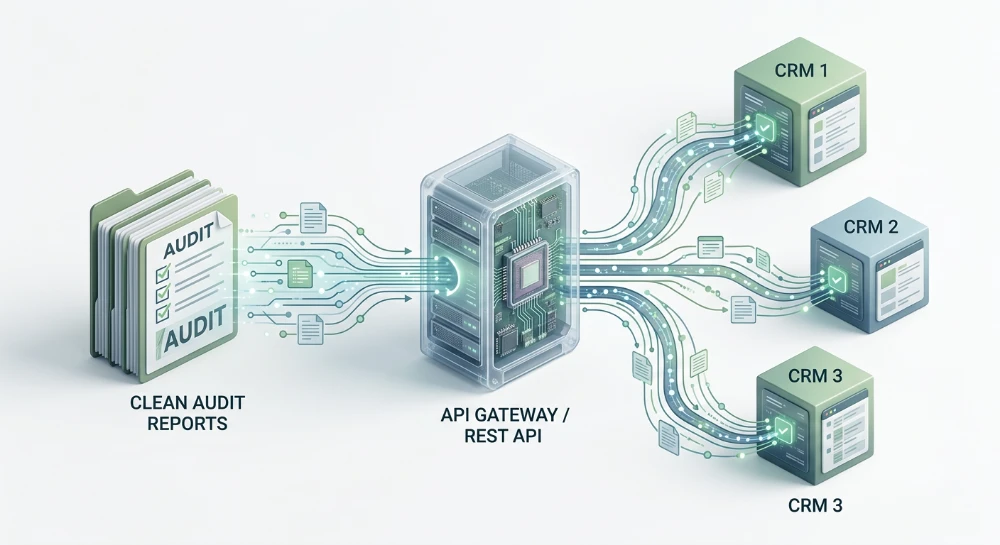
Integrating crawl data directly into sales environments demands an infrastructure where a REST API exports clean reports of an audit to client CRM systems. Manual data extraction from crawler interfaces introduces delays in prospect engagement workflows. Routing raw technical SEO metrics via HTTP endpoints directly into platforms like Salesforce triggers immediate lead scoring algorithms.
The underlying extraction mechanism relies on a strictly defined ETL pipeline. This architecture requests server response codes and indexing directives via an API GET request. Middleware scripts intercept and parse the resulting raw data array. The system structures the output into a normalized JSON payload mapping strictly to custom object identifiers.
A standard HTTP POST request executes the payload injection into the receiving endpoint.
Specific data mapping parameters connect site speed metrics and crawl errors to prospect qualification models. A URL returning 500-level HTTP status codes or missing HTML schema triggers an automated negative score adjustment. Account executives view this parsed technical context natively within the lead record. Automating the API fetch sequence completely removes manual CSV file processing from the operational pipeline. Each successful data injection immediately updates the primary ROI dashboard.
REST API architecture for bulk audit data extraction
The extraction layer of any automated diagnostic system depends on a rigid REST API architecture. Endpoint definition dictates how the system addresses specific crawl datasets. A standard setup isolates structural diagnostic data from performance tracking by separating the SEO Audit API from the SEO Metrics API. You query the audit endpoint for crawl depth anomalies and the metrics endpoint for visibility indexes. Separation of concerns prevents massive payload bloat.
Executing an API Call requires explicit header configuration to dictate the response format. An HTTP GET request initiates the transfer. Setting the Accept header to application/json returns a deeply nested JSON payload ideal for programmatic parsing. Legacy systems often require text/csv for flat-file processing operations. Passing application/zip compresses the transit payload when extracting raw server log arrays or heavy asset dependencies. Bandwidth consumption drops significantly.
Scaling workflows with batch auditing
Scaling the infrastructure requires shifting from single-domain queries to Batch API Requests. A Bulk-audit operation consolidates multiple target URL arrays into a single execution command. This Batch Auditing approach reduces the total number of network trips. Instead of keeping a connection open while the crawler analyzes ten thousand pages, the server responds instantly with a temporary job identifier.
This triggers Queue-And-Wait processing. The client dispatches the initial command. The server drops the task into a background worker queue and immediately terminates the active connection. Client-side threads remain completely unblocked.
State resolution and data retrieval
Retrieving the finalized extraction requires a mechanism to track the asynchronous background job. Systems deploy one of three architectural patterns to resolve the queue state and fetch the final payload.
| Retrieval Mechanism | Architectural Logic | System Resource Impact |
|---|---|---|
| Polling loops | Client sends continuous state-check requests at fixed intervals until the job returns a completion status. | High network overhead. Highly inefficient for prolonged crawl durations. |
| Callback mechanisms | Client provides a destination endpoint in the initial request. Server pushes the parsed data to this location upon completion. | Low overhead. Requires a publicly exposed listener endpoint on the receiving server. |
| Webhooks | Event-driven architecture where the API broadcasts state changes to subscribed external listeners natively. | Optimal for system orchestration. Zero wasted idle queries. |
Security protocols: Authentication and request authorization
Securing the transport layer constitutes the foundational baseline. Raw data traversing external networks demands continuous Encryption. Enforce strict HTTPS across all remote endpoints. Implement automated SSL Certificate Tracking within the server infrastructure. An expired certificate instantly severs the connection, dropping inbound payloads and halting backend validation processes.
Authentication verifies client identity. Authorization defines execution boundaries.
Both validation parameters operate directly through HTTP request headers. Passing tokens within query strings exposes raw credentials to network sniffing and server log extraction.
Credential standards and access control
System endpoints require structured identity verification before returning server responses. Implementing a strict Data Security Policy dictates the precise method of credential deployment and lifecycle management.
- API keys: Static alphanumeric tokens passed via custom headers. Generate least-privilege keys locked exclusively to designated server IP ranges.
- OAuth 2.0: Dynamic token exchange protocols. Deploy this standard when orchestrating multi-tenant environments requiring delegated application access.
- Single Sign-On: Centralized identity provider routing. Restricts endpoint interaction strictly to authenticated enterprise directory users.
Limit the blast radius of compromised credentials through granular role-based access models. A service account tasked with reading crawl metrics must never possess write or delete permissions. Segregating system privileges guarantees Data integrity across the entire server environment.
Secure credential storage architecture
Embedding plaintext tokens within application source code introduces critical architectural flaws. Server administrators isolate access credentials from the execution logic entirely.
| Storage Architecture | Security Configuration | Deployment Suitability |
|---|---|---|
| Environment variables | Key-value pairs injected directly into the server operating system configuration during runtime initialization. | Standard server setups running standalone monolithic applications. |
| Hardware or Cloud secrets manager | External cryptographic vaults that dynamically fetch, inject, and rotate credentials without local file storage. | Distributed microservices demanding strict compliance and access audit trailing. |
ETL pipeline configuration and middleware integration
Raw extraction payloads from a White-label SEO API rarely match target data models natively. Nesting structures differ. Key names clash. An ETL pipeline serves as the mandatory translation layer between the source crawler and the final database. You extract the raw metrics, transform the nested key/value pairs into flat objects, and load them into the destination framework.
Skipping this transformation phase introduces immediate data corruption.
Engineers typically route these payloads through integration middleware or custom execution environments. Custom execution relies on server-side environments operating Node.js, Python, or PHP. You build rigid, highly optimized parsers handling raw cURL requests directly. This approach minimizes latency. It eliminates third-party platform dependencies and provides absolute control over the API behavior.
No-code infrastructure abstracts the underlying transport logic entirely. Platforms like Zapier, Make, and n8n utilize visual nodes to construct workflow automation routing.
Middleware architecture selection
Evaluate your data throughput requirements before provisioning infrastructure. Custom scripts handle immense concurrent loads but require dedicated maintenance. Middleware visual builders accelerate deployment speeds.
| Execution Layer | Implementation Stack | Operational Strengths |
|---|---|---|
| Custom Scripting | Node.js, Python, PHP, cURL | Zero platform lock-in. Complete execution control. Handles complex multi-threaded parsing logic efficiently. |
| Self-Hosted Middleware | n8n | Retains data within the internal network. Bypasses external platform volume limits while offering visual workflow automation. |
| Cloud No-code | Zapier, Make | Rapid deployment. Pre-built authentication modules. Ideal for standard integrations and simple linear ETL pipelines. |
Data mapping requires strict JSON schema validation. An unvalidated payload hitting a downstream endpoint often triggers system failure. When processing crawler output, the integration middleware must inspect specific key/value pairs against predefined data models. A missing page speed integer causes cascading bottlenecks if the downstream logic expects a numerical value for automated ticketing.
Implement a robust validation node early in the processing sequence.
- Define the expected schema explicitly within the parsing script or middleware node configuration.
- Isolate rogue data structures. Route unrecognized key/value pairs to a secondary dead-letter queue for manual log analysis.
- Enforce strict data typing. Convert string-based numerical metrics into pure integers before passing them forward.
- Strip redundant objects from the JSON payload to reduce overall transport weight.
Validating data structures early prevents malformed records from triggering false automated ticketing events. Solid data mapping acts as an aggressive filtering mechanism. Only pristine, correctly typed objects clear the validation threshold to reach the next phase of the integration.
Mapping technical health scores to CRM data models
Validated payloads hold raw metrics. These numerical values and arrays mean nothing without structural alignment inside Client CRM systems. Data mapping bridges the gap between an isolated Website audit and active database intelligence. You must bind the extracted keys from the parsing node directly to corresponding CRM entity properties.
Standard platforms lack native fields for search engine parameters. Engineers must execute explicit custom fields configuration before routing any payload. A standard Site audit generates hundreds of distinct Data points. Funneling this structured data into a generic text or notes field destroys query capability. It breaks automated Lead scoring algorithms.
Map critical SEO parameters to strict data types within the database schema.
| Audit Parameter | Database Field Type | System Logic Mapping |
|---|---|---|
| Technical health scores | Integer (0-100) | Values below 40 trigger high-priority status for aggressive outreach. |
| Mobile Usability Errors | Boolean (True/False) | True state increments overall prospect value by defined routing weights. |
| Total Broken Links | Numeric | Isolates domains requiring immediate structural repair pitches. |
| Indexation Blockers | String (Multi-select) | Categorizes the exact technical failure for personalized email templates. |
Prospect list enrichment requires granular field isolation. Injecting raw JSON into Salesforce or Hubspot CRM demands mapping core variables into native numeric fields. This unlocks native dashboard filtering and automated list segmentation. Platform architectures vary significantly in how they handle entity updates. Pipedrive and Zoho enforce different numeric limits and API interaction patterns. Verify specific property creation constraints within your CRM integration settings before committing the final schema.
Data integrity hinges on overwrite controls.
Pushing metrics without a primary key creates redundant company entities. You must define an immutable object identifier to anchor incoming payloads to existing records. The root domain URL or a system-generated cryptographic hash serves as the most reliable key. Deduplication rules execute against this key prior to database insertion. When the identifier matches an existing record, the system updates the designated custom fields instead of spawning a duplicate lead.
Bypassing Deduplication logic guarantees database pollution. Unstructured overwrites destroy historical prospect data and corrupt the sales pipeline.
Executing CRM injection workflows via HTTP methods
Routing normalized audit data into a target infrastructure requires strict adherence to RESTful conventions. You must configure the HTTP request to match the exact schema expected by the receiving server. The integration layer handles endpoint mapping, dictating whether the payload initiates record creation APIs or triggers update operations on existing entities. Misconfigured methods cause silent failures.
HTTP POST forces the generation of a net-new entity. When a prospect does not exist in the database, the pipeline executes a POST request containing the initial audit metrics. HTTP PUT replaces the target resource entirely. For incremental adjustments during Automated SEO reporting cycles, sending a PUT request without the full dataset nullifies any omitted fields. Engineers design updating sequences around PATCH requests if the target infrastructure supports partial data modification. Legacy systems often mandate PUT for comprehensive profile synchronizations.
Payload structuring and data freshness
Every outgoing payload structuring process must explicitly declare the data format. Servers reject malformed requests immediately. Custom domain associations bind the technical metrics to specific account IDs within the CRM. This binding ensures that crawl data routes to the exact domain profile rather than an orphaned node.
Configure the request parameters according to the following baseline standards:
- Set the Content-Type header strictly to application/json.
- Define the Accept header as application/json to enforce structured response formatting.
- Embed a crawl_timestamp field within the JSON body to establish exact audit chronologies.
- Map custom fields using the target platform's internal alphanumeric keys rather than human-readable labels.
Injecting stale metrics corrupts the pipeline. You must implement data freshness parameters within the logic. Compare the timestamp of the incoming audit against the last modified date of the target record. If the CRM entity holds a newer timestamp, the update operation must abort. This prevents historical crawl files from overriding recent audits. Server architectures demand this chronological validation to maintain database integrity.
{
  "object_id": "8a7b6c5d",
  "audit_timestamp": "2023-10-15T08:30:00Z",
  "technical_metrics": {
    "core_web_vitals_fail": true,
    "broken_links_count": 42
  }
}
Endpoint mapping configuration
Constructing the target routing requires dynamic endpoint mapping. The base path remains static. The execution path must append the unique object identifier when running an update. A static path handles record generation. A dynamic path handles entity modification.
Endpoint routing requires distinct logic depending on the target action state.
| HTTP Method | Integration Action | Payload Scope | Execution Context |
|---|---|---|---|
| HTTP POST | record creation APIs | Complete Initial Schema | Spawns a net-new lead and populates all initial technical audit fields. |
| HTTP PUT | Entity Overwrite | Full Schema Required | Replaces entire entity data. Mandates sending all existing values alongside new metrics. |
| PATCH | update operations | Delta Payload | Modifies only explicitly defined keys. Preserves existing custom fields. |
Mapping variables directly to endpoints controls the structural flow of SEO data. Hardcoding dynamic IDs into the request path string ensures the CRM engine locks onto the precise database row before executing the injection. Operations run sequentially. Bulk update endpoints accept arrays of JSON objects, reducing the total connection overhead and streamlining the extraction cycle.
System scalability: Rate limits, error handling, and logging
High-volume data synchronization stresses network infrastructure. Continuous extraction of technical health metrics requires robust traffic control mechanisms to prevent connection termination. System scalability dictates how efficiently the integration layer handles load spikes during bulk extraction. You must implement defensive engineering patterns. Dropped payloads compromise data integrity.
Managing throttle constraints and retry logic
Endpoints impose strict API Rate limits to protect server resources. Hitting these ceilings triggers automatic connection rejection. Implementing an exponential backoff algorithm resolves this bottleneck. The script pauses execution upon encountering a throttle event. It calculates a progressively longer wait time before reattempting the injection.
This pattern prevents aggressive polling from permanently locking the connection account. Graceful degradation ensures partial payloads process successfully even if secondary enrichment endpoints fail. The primary pipeline stays functional.
HTTP status code resolution and state reconciliation
Network communication relies on absolute predictability. Every server response outputs an HTTP status code defining the precise outcome of the payload transmission. Your middleware must parse these integers instantly. Routing logic depends on it. Error state reconciliation demands strict parsing rules to route failed records into an isolated dead-letter queue for manual intervention.
Standardized response protocols govern automated retry conditions and failure routing.
| HTTP status code | Resolution State | Pipeline Action |
|---|---|---|
| 200 OK | Successful transaction | Proceed to the next object in the execution array. |
| 400 Bad Request | Malformed payload syntax | Halt process. Reject injection. Flag JSON schema for developer review. |
| 401 Unauthorized | Missing or invalid token | Suspend pipeline. Rotate secret keys and re-authenticate. |
| 403 Forbidden | Insufficient permissions | Verify role-based access rules. Target endpoint restricted. |
| 404 | Endpoint not found | Verify target base path and object ID syntax. |
| 500 | Internal server error | Engage exponential backoff sequence. Reattempt after delay. |
Asynchronous polling and Long-Running tasks
Deep crawl extractions exceed standard timeout thresholds. Synchronous connections will drop before the server finishes compiling the Export Audit. Transitioning to long-running task management solves this architectural flaw.
The initial request triggers the audit compilation. The server responds with a temporary tracking token. The middleware initiates queue ID tracking.
Asynchronous workflow execution strictly follows a three-phase polling cycle.
- Dispatch extraction request and capture the response token from the initial header.
- Ping the status endpoint at interval delays until the job registers as complete.
- Download the finalized payload from the temporary storage URL upon success signal.
API operations telemetry and audit trails
Silent failures corrupt database synchronicity. You must write every transaction event to internal server logs. An Audit log tracks exact timestamp variables against modified record IDs. If a sync fails, API operations telemetry provides the forensic data required to rebuild the injection parameters.
Log retention policies dictate debugging capacity. Store raw request headers, payload bodies, and server responses systematically. This metadata accelerates error state reconciliation when mapping rules break.