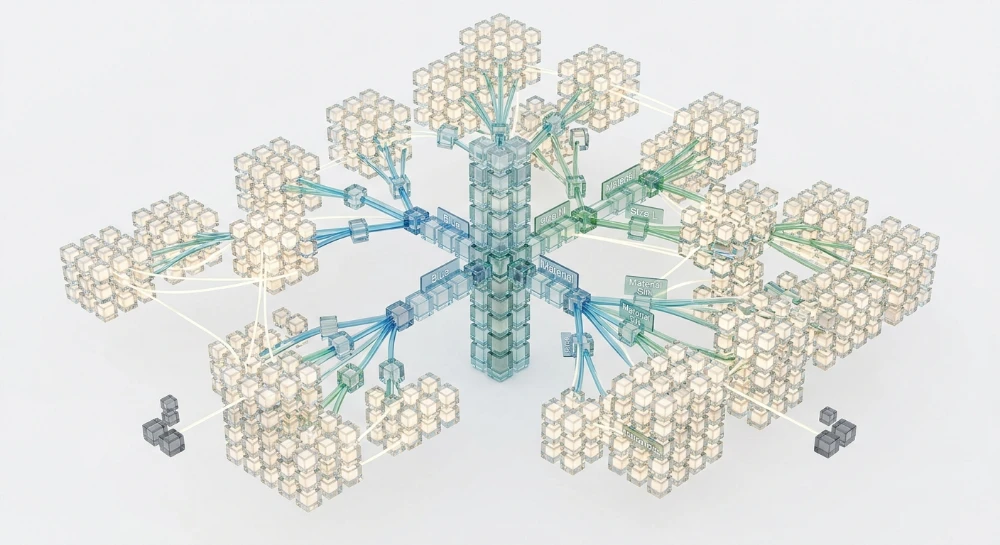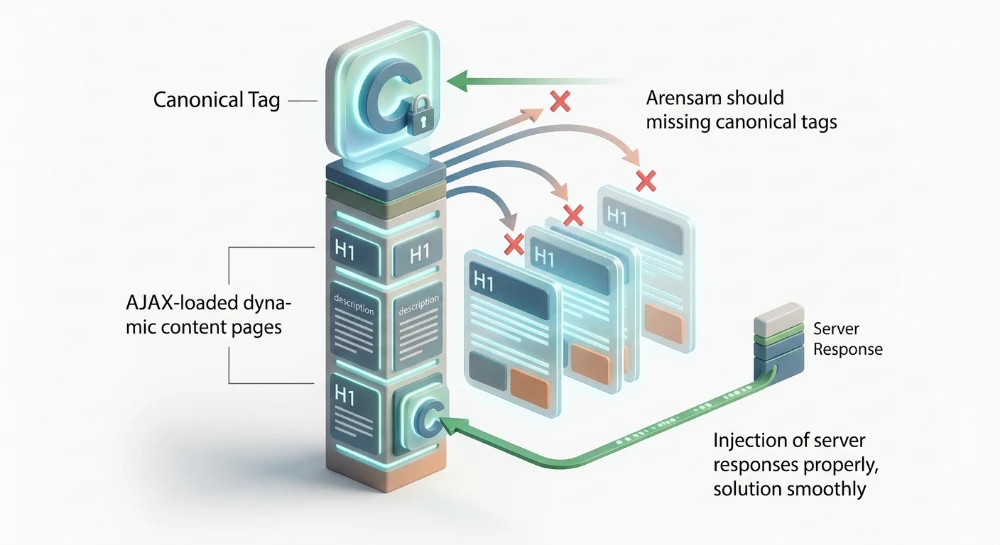
Engineers analyzing why fragments of URL identifiers trigger generation of duplicate pages must first isolate the functional divide between server-side resolution and browser-side state management. A standard base URL maps to a definitive server endpoint and returns an HTTP 200 OK status code upon a successful GET request. The fragment identifier acts strictly locally within the client viewport to anchor navigation to specific HTML elements. Search engine crawlers equipped with JavaScript rendering capabilities process these localized viewport shifts as entirely new document discoveries.
Client-side rendering frameworks manipulate these hash states to load new data payloads via an API without initiating a full document refresh. Googlebot executes this routing logic during its rendering phase and systematically extracts every hash variation injected into the user interface.
The queueing of thousands of faceted URL parameters inflates the site architecture exponentially. Identical core content propagates across multiple generated endpoints. The Google Search Console Page Indexing report immediately registers this server load spike under the 'Discovered - currently not indexed' classification.
This structural vulnerability directly degrades technical SEO metrics and indexation efficiency.
- Crawl budget depletion occurs when Googlebot wastes finite processing allocations rendering non-canonical hash paths instead of discovering new core content.
- Internal competition forces identical client-rendered variations to split ranking signals within the SERP.
- Fragmented link equity prevents inbound connections pointing at hashed addresses from consolidating PageRank at the definitive root endpoint.
Architectural distinction between base URLs and document fragment identifiers
RFC 3986 defines the uniform resource identifier syntax as a strict sequence of hierarchical components. The specification fundamentally isolates the base URL from the document fragment identifier. Base URLs consist of the scheme, authority, path, and query parameters. These specific components dictate server-side routing logic. When a client initiates a network request, the transmission stack passes these elements to the server to locate, execute, and compile the requested document.
The fragment identifier operates under entirely different architectural rules.
Demarcated by the hash mark symbol, the fragment is explicitly excluded from HTTP request headers. Web servers never process, read, or log fragment strings. Evaluation remains entirely restricted to the local client environment. While the standard hash mark targets specific element nodes for static viewport positioning, the hash bang sequence introduces a programmatic routing trigger. Developers originally adopted the hash bang syntax to force a structural state change marker within client-rendered applications. Browsers isolate hash bangs with the same network-level blocking as standard hash marks, yet client-side routing logic interprets the exclamation point sequence as a distinct directive to mount application states rather than execute a localized scroll event.
Protocol transmission rules per RFC 3986
| URL Component | Delimiting Character | Processing Environment | Network Request Transmission |
|---|---|---|---|
| Base Path | Forward Slash | Server | Fully Transmitted |
| Query String | Question Mark | Server | Fully Transmitted |
| Standard Fragment | Hash Mark | Client | Strictly Blocked |
| Hash Bang State | Hash Bang Sequence | Client | Strictly Blocked |
The structural divergence between traditional deep linking and application routing determines how crawler infrastructure interprets the page state.
Standard HTML named anchors exist strictly for viewport manipulation. A user interacts with an anchor link targeting a specific ID attribute within the active document. The browser instantly adjusts the viewport axis to align with that localized node. The document structure remains entirely static. Network activity remains at zero.
Programmatic hash states deployed in client-side rendering environments hijack this native browser behavior to emulate multi-page navigation. Client-side frameworks attach continuous event listeners to the window interface to monitor fragment mutations. When the fragment string updates, the application intercepts the event before the default scroll execution can occur. The routing protocol parses the new fragment value and triggers asynchronous API calls to request new data payloads. Upon receiving the API response, the framework dynamically strips existing elements and injects new components directly into the DOM.
Functional execution discrepancies
- Execution Layer: Standard HTML anchors rely exclusively on native browser scroll mechanics. Programmatic states depend on the continuous execution of the JavaScript event loop to intercept and parse URL mutations.
- DOM Manipulation: Deep linking requires a fully parsed, static layout architecture. Hash routing actively destroys and rebuilds element nodes based on dynamic API responses.
- Network Footprint: Standard anchor links generate zero external network calls. Programmatic hash shifts trigger continuous data fetching routines to populate injected rendering templates.
This operational shift transforms a simple localized bookmark mechanism into a complex application state generator. The distinction marks the boundary between static document navigation and dynamic content generation via client logic.
Client-Side rendering and the AJAX crawling pattern vulnerability
Early SPA architectures required a mechanism to reflect application state changes in the browser address bar without forcing a server-side page reload. Modifying the base URL path triggered a hard refresh, resetting the application state. Engineers adopted hash routing to bypass this limitation. The client-side router maps specific DOM component injections to distinct fragment values. A user clicking a navigation link modifies the hash, firing a
hashchange
event. The JS runtime intercepts this event, destroys the current component tree, and mounts the new view. The physical file remains static.
Search engine crawlers originally lacked the rendering engines required to execute this client-side logic. Content mapped to hash states remained invisible to the index. An AJAX crawling protocol emerged relying on a specific syntax modification to bridge this gap. Developers appended an exclamation mark to the hash, creating a hashbang. When a crawler encountered a hashbang URL, it mutated the request by converting the fragment into a distinct URL parameter.
The crawler translated
domain.com/page#!state
into
domain.com/page?_escaped_fragment_=state
. The origin server recognized this query parameter and bypassed the standard SPA delivery. It served a pre-rendered, static HTML snapshot of the requested state. The protocol functioned as a temporary bridge between dynamic client-side applications and static indexing infrastructure.
Rendering capabilities evolved rapidly. The protocol was officially deprecated, shifting the burden of JS execution from server-side snapshot generation back to the crawler's native rendering engine. Legacy applications maintaining
_escaped_fragment_
configurations now face severe duplication vulnerabilities. Crawlers evaluate the standard JS-rendered application state while simultaneously discovering legacy parameterized paths embedded in historical internal links or external references.
Routing architecture comparison
Modern client-side applications replace hash-based state management with the History API. This architectural shift fundamentally alters how states map to URLs.
| Routing Protocol | State Management Mechanism | URL Structure | Crawler Processing |
|---|---|---|---|
| Legacy Hash Routing |
Relies on
hashchange
events to trigger component mounting.
|
Appends fragment identifiers (
domain.com/#/products
)
|
Triggers single-page evaluation; ignores fragments natively. |
| History API | Updates the browser session history stack without network requests. |
Modifies the raw path natively (
domain.com/products
)
|
Evaluates unique paths as distinct documents. |
The History API method
history.pushState
allows developers to push a new state into the session history stack. The address bar updates to reflect a clean path without appending fragments. The browser suppresses the default HTTP request to the server. The JS framework handles the DOM update synchronously. The crawler processes each distinct path as an independent node.
Dynamic generation of AJAX duplicates
Deploying hash routing without server-side mitigation generates exponential URL variations. The client-side router acts as an internal engine generating unique DOM outputs for identical base URLs. Search engines process the base document and execute the initial JS payload. The framework renders internal navigation links containing varied fragment states. Crawlers extract these links and attempt to resolve them.
The vulnerability occurs at the intersection of rendering execution and URL normalization. A crawler discovers hundreds of internal links pointing to varying hash states.
- The framework intercepts the navigation events mapped to the fragment links.
- The JS engine executes API calls to retrieve distinct JSON data payloads.
- The DOM is rebuilt with the new data, presenting entirely different content arrays under the exact same base path.
- The crawler evaluates varying DOM outputs mapped against identical root documents.
This interaction forces the indexing pipeline to process conflicting signals. A single physical HTML file acts as a container for hundreds of logical application states. The client-side logic dynamically alters the title tags, meta descriptions, and core body content based on the active fragment. The crawler evaluates highly divergent content payloads served through a unified entry point. This architectural flaw degrades the structural integrity of the application, transforming necessary JS functionality into a compounding duplicate content generator.
Googlebot crawl infrastructure and crawl budget depletion via hash queues
The crawler scheduling pipeline receives a constant influx of extracted internal links from rendered DOM outputs. When client-side routing overrides standard document fragment behavior, the crawler stops treating the hash as a simple scroll position marker. It registers each unique state as a distinct URL string requiring evaluation. This triggers a catastrophic expansion of the crawl queue.
Crawl depth inflation occurs immediately. A flat category architecture becomes deeply nested as JS generates sequential faceted states. An initial request to a base path yields links to single-filter states. Rendering those states exposes multi-filter combinations.
The crawler traverses these layers sequentially. Instead of discovering new root documents, crawler resources are expended resolving infinite permutations of existing datasets. Crawl budget is consumed by mathematical combinations rather than distinct inventory.
Triggering discovered - currently not indexed thresholds
Google Search Console reports accurately reflect this architectural failure. The "Discovered - currently not indexed" status indicates the crawler successfully extracted the URL from a referring page but actively deferred the HTTP request.
This specific indexing status is triggered by precise crawl queue mechanics:
- Host load protection activation due to sudden spikes in scheduled request volume.
- Queue saturation where the volume of extracted faceted paths exceeds the site allocation.
- Algorithmic deprioritization of deep crawl paths exhibiting parameter-like infinite loop characteristics.
The crawler knows the logical paths exist. It refuses to fetch them. The scheduling system assesses that executing the required requests would overload the target server without yielding proportionally valuable HTML content.
Server payload scaling from faceted states
When the crawler does execute a subset of these queued URLs, the infrastructure impact compounds. Client-side rendering shifts the structural assembly to the browser, but the data must still be sourced. Each crawler execution of a faceted hash state forces the JS payload to fire distinct requests back to the server.
Processing 50,000 generated hash URLs is not 50,000 static file retrievals. It is 50,000 headless browser instances executing JS, which in turn query the backend API, triggering database lookups for specific filter combinations.
Server payload increases directly correlate with crawler evaluation volume. This continuous database querying degrades server response times across the entire host architecture.
| Infrastructure Metric | Static Base URL Evaluation | Faceted Hash State Evaluation |
|---|---|---|
| Crawl Depth Progression | Shallow, deterministic | Infinite, exponential nesting |
| Backend API Request Volume | Single request per document | Multiplied by filter permutations |
| Host Latency Profile | Stable | High volatility, rendering blocks |
Increased latency forces the crawler to reduce its crawl rate to protect the host infrastructure. A self-reinforcing cycle begins. The client-side architecture generates millions of paths. The crawler attempts to evaluate them, spiking server latency. The scheduler detects the latency, throttles the crawl rate, and dumps the remaining paths into the deferred queue. Core pages are neglected while the infrastructure chokes on phantom duplicates.
Algorithmic evaluation of exact and Near-Duplicate content profiles
Once the rendering engine extracts content from faceted hash states, the indexing algorithms must classify the resulting payloads. The system applies distinct evaluation protocols for exact duplicates and near-duplicates. The distinction dictates exactly how ranking signals are processed, stored, and ultimately applied to the domain.
Sorting parameters predictably generate exact duplicate profiles. A URL appending a hash modifier to sort inventory by price reorganizes the visual layout but retains the identical item count and surrounding HTML text nodes. The indexer calculates a near-perfect similarity threshold. The evaluation engine flags the variation and merges the ranking signals with the base URL. The algorithmic consolidation works, but the initial crawl processing power is already lost.
Faceted filters behave entirely differently. Selecting a specific attribute isolates a narrower subset of the inventory grid. The boilerplate navigation, footer architecture, and primary category descriptions remain static, but the core content payload changes slightly. This generates near-duplicate content.
The indexing logic struggles heavily with this specific replication state. High overlap in HTML structure forces the algorithm to weigh the unique localized differences against primary search intent. The system must determine if this specific filter permutation justifies a distinct entity in the database.
| Parameter Trigger | HTML Overlap Profile | Indexation Action | Ranking Signal Impact |
|---|---|---|---|
| Sorting (Price, Date) | 100% (Reordered elements) | Usually collapsed into base | Consolidated (if recognized) |
| Filtering (Single attribute) | High (70-90% match) | Often indexed as unique | Cannibalized relevance |
| Deep Filtering (3+ attributes) | Variable (Often empty) | Indexed as thin content | Domain quality devaluation |
Link equity fragmentation across hash states
Inbound link equity flows exclusively to the precise URL path requested by the client. When users, affiliates, or internal marketing campaigns link directly to faceted hash URLs, PageRank splinters. The equity intended to bolster the main category page gets trapped within isolated parameter variations.
A base category page requires maximum link authority to rank for highly competitive head terms. The math is brutal. If twenty percent of inbound links point to the base URL, thirty percent point to a size filter hash, and fifty percent point to various color permutations, the authority fractures. The ranking algorithm evaluates the base URL utilizing only the fraction of signals it directly received. Authority dilutes across hundreds of phantom duplicates instead of consolidating on the primary cluster target. The domain loses the SERP visibility it technically earned.
Analyzing internal competition signals
Indexed near-duplicates actively sabotage the base URL. The ranking engine processes a search query and scans the index for the most relevant document. If the crawler has indexed the base URL alongside twelve faceted variations, all thirteen pages compete in the exact same relevance auction.
Algorithmic cannibalization manifests through specific indexing symptoms:
- Constant URL swapping within the SERP for the identical target keyword
- Stagnant ranking positions locked in the lower half of the first page due to split authority
- Aggregated impression data distributed evenly across five or more hash variations instead of one base page
- Diluted CTR metrics triggered by irrelevant filter pages surfacing for broad search queries
Signals fracture. The algorithm detects multiple documents from the same host attempting to satisfy the identical query intent shift. Rather than returning the strongest page, the system suppresses the entire cluster. Click data spreads thin. The SERP algorithm interprets this dispersed engagement as a negative user experience signal, further demoting the primary URL.
SERP visibility devaluation via indexed thin content
Deeply nested faceted navigation frequently generates thin content at an exponential scale. Applying multiple filters simultaneously often reduces the product grid to one or two items. Frequently, the grid returns entirely empty.
The algorithm evaluates site quality holistically. When the index contains 500 robust, unique category pages and 50,000 indexed hash variations displaying empty grids or repetitive boilerplate text, the domain profile skews overwhelmingly negative.
The indexing engine calculates a massive ratio of low-value, thin pages against the core HTML documents. This triggers algorithmic demotion across the host. It is a mathematical adjustment based on the aggregate quality of the indexed footprint. As the volume of indexed thin content grows, the search engine devalues the overall domain authority. High-performing core pages lose SERP visibility entirely because the surrounding index architecture is saturated with algorithmic junk.
Diagnostic framework: Auditing URL variations and faceted states
Standard crawler configurations mask the severity of client-side duplicate generation. Default crawl behaviors ignore fragment identifiers entirely. Running an audit without modifying crawler parameters yields a false positive representation of site health. You miss thousands of dynamic states bleeding server resources.
Isolating these phantom variants requires forcing crawlers to evaluate the rendering logic exactly as a modern search engine does. You must extract the exact scale of faceted URLs polluting the architecture.
Configuring screaming frog SEO spider for Client-Side rendering
You must adjust the fundamental crawling parameters to capture AJAX-driven state changes. Standard HTTP requests return only the base HTML document.
- Navigate to Configuration > Spider > Crawl and check the Crawl Fragments box
- Navigate to Configuration > Spider > Rendering and switch the mode from Text Only to JavaScript
- Adjust the AJAX Timeout settings to at least 5 seconds to allow faceted product grids to fully render
- Enable Window Size configuration to Mobile or Desktop equivalents to trigger responsive JavaScript payloads
Initiate the crawl. The software will now capture and list every unique hash state generated by the faceted navigation logic. Sort the final crawl data by URL to cluster the fragment identifiers. This exposes the sheer volume of duplicate pages stemming from a single root document.
Chrome DevTools analysis for dynamic DOM elements
Visual inspection of the source code fails in client-rendered environments. The raw HTML response rarely contains the faceted anchor tags. They exist solely within the rendered DOM.
Open Chrome DevTools and navigate to the Elements panel. Inspect the faceted navigation links, specifically the filter checkboxes or sort dropdowns. You are looking for client-rendered anchor tags masking dynamic scripts. Evaluate the href attribute. If the href explicitly contains a relative hash path rather than an absolute URL, the architecture actively generates fragment variations.
Switch to the Network panel.
Clear the network log and click a facet filter. Filter the network requests by Fetch/XHR. Observe the data exchange. You will see a lightweight JSON payload requested from the server to populate the new product grid, while the browser URL simultaneously updates with a new fragment identifier. This confirms the AJAX crawling pattern vulnerability is active. The interface relies on hash state updates rather than unique document retrieval.
Isolating phantom duplicates via Google search console
Search engines attempt to consolidate fragment URLs, but misconfigurations and legacy protocols force them into the indexing pipeline. The Page Indexing report provides the forensic data required to quantify the damage.
Access the Page Indexing interface. You must aggressively filter the data pool to separate legitimate document exclusions from generated variants.
| Report Classification | Filter Parameters | Diagnostic Value |
|---|---|---|
| Crawled - currently not indexed |
Regex filter:
.*#.*
|
Identifies raw fragment identifiers the bot discovered via client-rendered anchor tags but refused to index due to quality thresholds. |
| Alternate page with proper canonical tag |
URL contains:
utm_
or
_ga
|
Isolates GA Tracking Parameters appended to hash states or base URLs, revealing how tracking strings inflate the overall crawl queue. |
| Duplicate without user-selected canonical |
Regex filter:
.*#!.*
|
Highlights legacy AJAX states the crawler processed as unique documents but collapsed algorithmically. |
Applying these specific regex and string filters isolates the phantom pages from routine site architecture errors. The data reveals the exact pathways the crawler utilizes to access the faceted states. Review the referring pages for each isolated URL. This pinpoints the exact internal links or JavaScript events responsible for distributing crawl allocation toward the fragment variations.
Executing strict canonicalization protocols for fragment URLs
The canonical tag instructs crawling engines on the definitive version of a document. When processing JS environments that generate thousands of fragment states, strict canonicalization is the primary defense against index fragmentation. The objective is to force all URL variations containing hash fragments to consolidate ranking signals into the clean, base endpoint.
The logic must be absolute.
Ambiguity in canonical implementation causes crawling engines to ignore the directive entirely. You must configure the server or client-rendered DOM to output a precise mapping.
Defining syntax mapping to the definitive base URL
The link element must reside within the document head. If a crawler accesses a generated fragment state, the rendering engine must output a canonical tag pointing strictly to the URL without the fragment identifier. The output must utilize the exact absolute URL of the base document.
<link rel="canonical" href="https://example.com/category-page/" />This exact markup must persist regardless of what parameters or fragments are appended to the address bar. Self-referential canonicals on root endpoints form the foundation of this protocol. The base URL must declare itself as the definitive version. If the clean endpoint lacks a self-referential tag, algorithmic deduplication might arbitrarily select a fragmented URL as the canonical version based on external linking signals or internal navigation weight.
Preventing Non-Indexable canonical errors
Implementing dynamic canonical tags across faceted navigation often triggers fatal logic loops. A Non-Indexable Canonical error populates in GSC when a canonical tag points to a URL that cannot be indexed due to conflicting server responses or recursive directives.
Enforce the following logic parameters to prevent execution failures:
- Target endpoints must return a 200 HTTP status code without exception.
- Target endpoints must not redirect to secondary locations.
- The href attribute must enforce strict protocol and trailing slash consistency matching the primary server configuration.
- Injected canonical tags via JS must match the server-side HTML response to prevent rendering conflicts.
Internal link architecture: Overwriting relative hash paths
Deploying the canonical tag handles index consolidation, but internal linking architecture dictates how the crawler evaluates the URL pathways. Relying on relative paths in JS code blocks or navigation elements frequently results in appended hash paths.
Crawlers append relative paths to the current working URL.
If the crawler evaluates a fragmented state and encounters a relative link, it constructs a combined URL string. This recursive appendage inflates the crawl queue exponentially. You must map absolute paths within all internal linking code blocks to overwrite relative hash path generation.
| Implementation Type | Code Block Syntax | Crawler Execution Result |
|---|---|---|
| Relative Hash (Vulnerable) |
<a href="#filter=price">
|
Appends the fragment to the existing URL state, creating endless crawl loops. |
| Absolute Path (Strict) |
<a href="https://example.com/category-page/">
|
Forces the crawler to evaluate the definitive base URL, abandoning the hash path. |
Replacing relative hash links with absolute paths ensures that any crawler discovery event initiated from a faceted state points back to the canonical endpoint. This starves the generated fragments of internal link equity and stops the crawler from chaining multiple hash parameters together into deep, crawlable directories.
Migrating to history API routing to eliminate hash state indexing
Legacy routing configurations rely heavily on client-side fragments to manage application state. This architectural flaw forces search bots to navigate messy hash paths. You must rip out window.location.hash dependencies and deploy the History API.
The history.pushState method enables developers to modify the browser active URL string and push a new state to the session stack without triggering a full HTTP request. By replacing hash-based navigation with this method, the application generates clean, hierarchical paths. Crawlers evaluate these paths as standard documents rather than fractured state variables.
Executing the history API transition
Migrating requires strict synchronization between the routing script and DOM mutations. When a user interacts with a facet or trigger, the JS must execute the state change alongside the content swap.
history.pushState({ category: "electronics" }, "", "/category/electronics/");This specific command rewrites the address bar to a clean URL. The hash is entirely eliminated.
Client-side routing execution shifts the burden of URL generation away from the anchor tag and into the application logic. The JS intercepts the click event, prevents the default browser navigation, fetches the required data payload, and fires pushState to update the URL interface.
Server-Side routing fallbacks
Deploying client-side pushState routing introduces a critical server-side vulnerability. Hash URLs inherently resolve to the root directory because the server ignores everything after the fragment identifier. If a crawler directly requests a newly formatted pushState URL, the server attempts to locate a physical directory matching that exact path.
Without a routing fallback, the server returns a 404 error.
This immediately drops the URL from the index and causes severe crawl latency. You must map server configurations to intercept these direct HTTP requests. The server must route all requests for dynamic pathways back to the root application shell, ensuring a 200 OK status code. The client-side JS then takes over, reading the requested URL and rendering the correct state.
| Server Environment | Catch-All Routing Logic | Target HTTP Status |
|---|---|---|
| Nginx |
try_files $uri $uri/ /index.html;
|
200 OK |
| Apache |
RewriteRule ^ index.html [L]
|
200 OK |
| Node (Express) |
app.get('*', (req, res) => { res.sendFile('index.html'); });
|
200 OK |
Routing all unknown paths to the root entry point guarantees that search engines receive a valid 200 OK response on initial discovery. The crawler engine downloads the JS bundle, executes it against the clean URL path provided by the server, and renders the specific view.
DOM rendering updates and canonical synchronization
URL mutations executed via the History API require precise DOM management. Updating the address bar is only half the execution. The JS payload must simultaneously update the application view and the metadata mapping to the canonical target URL.
Crawler rendering engines evaluate the DOM exactly as it appears after the initial JS execution phase completes. If the routing updates the URL to the new state but fails to update the canonical node, the page signals conflicting instructions. You must script exact DOM mutations to accompany every pushState event.
- Modify the title node to reflect the newly requested state.
- Overwrite the href attribute within the canonical tag to match the exact pushState URL.
- Inject or replace primary heading nodes to match the updated UI layout.
- Destroy stale DOM nodes from the previous state to prevent content bloat.
Synchronous execution of these rendering updates ensures that when the crawler parses the final DOM tree, the visual content, the URL structure, and the canonical directives align perfectly. This alignment validates the clean URLs generated by the History API, overriding any legacy signals left behind by outdated hash configurations.
Crawl directives and XML sitemap architecture normalization
Network-level access control dictates crawler efficiency following a routing architecture update. Client-side URL mutations leave residual tracking parameters and faceted combinations exposed to automated indexing systems. Suppressing these phantom variations requires precise server directives and ruthless sitemap hygiene.
Standard fragment identifiers execute entirely within the browser. Server log analysis reveals that raw hash values never append to the request URI. Consequently, applying exclusion rules directly to hash strings in the robots configuration fails natively. You must target the tracking query strings and legacy protocol translations that developers map to these faceted states.
Deploy exact parameter blocking to drop crawler requests for faceted tracking permutations.
User-agent: Googlebot
Disallow: /inventory?filter=
Disallow: /catalog?sort=
Disallow: /app?_escaped_fragment_=
Disallow: /landing?utm_source=
These directives intercept the request before the server allocates resources to execute the JS payload. Terminating the crawl path at the network edge halts crawl budget depletion instantly.
XML sitemap inclusion parameters
Sitemap files serve as the absolute baseline for indexing prioritization. Submitting dynamic URL variations generated by client-side routing severely pollutes this signal. The indexer demands a static, definitive map of core endpoints, not an exhaustive log of transient application states.
Enforce strict automated validation rules for sitemap generation scripts.
- Include exclusively clean base paths returning a direct 200 OK HTTP response.
- Exclude all requested URLs containing fragment identifiers, query parameters, or temporary session IDs.
- Verify every submitted path executes a self-referencing canonical node within its initial HTML payload.
- Purge endpoints dynamically if they trigger 3xx redirects or 4xx client errors.
A pristine sitemap infrastructure reinforces the clean URLs established during the History API migration. Discrepancies between XML sitemap entries and on-page canonical tags trigger algorithmic hesitation. This misalignment forces search engines to guess the authoritative version, heavily delaying the indexation of new product or content layouts.
The canonical and noindex protocol conflict
Engineers frequently attempt to resolve faceted URL bloat by injecting a noindex meta tag while leaving the canonical tag pointing to the clean base URL. This configuration executes a critical protocol conflict. The directives issue mutually exclusive commands to the crawler.
A canonical tag commands the engine to map duplicate properties and transfer link equity to a primary target. A noindex directive mandates the complete and immediate removal of the document from the indexing pipeline. When forced to process conflicting instructions, engines prioritize the restrictive command. The page drops from the index completely. The crawler halts evaluation of its outgoing canonical signals. Link equity trapped within the faceted state evaporates.
| Directive Configuration | Crawler Processing Logic | Indexing Outcome |
|---|---|---|
| Canonical Tag Only | Evaluates duplicate profile; transfers ranking signals to target URL. | Consolidated equity; clean SERP representation. |
| Noindex Tag Only | Drops URL from pipeline; halts signal extraction immediately. | URL excluded; zero equity transfer. |
| Canonical + Noindex | Prioritizes restriction; canonical consolidation instruction ignored. | URL excluded; historical equity completely destroyed. |
Consolidation requires indexability. If a faceted state exists in the crawl queue, it must remain eligible for indexing long enough for the engine to read the canonical tag and process the duplicate relationship. Never combine these tags on the same route. Deploy canonicalization to merge duplicate UI states, reserving noindex strictly for unique utility pages requiring absolute removal from the SERP.