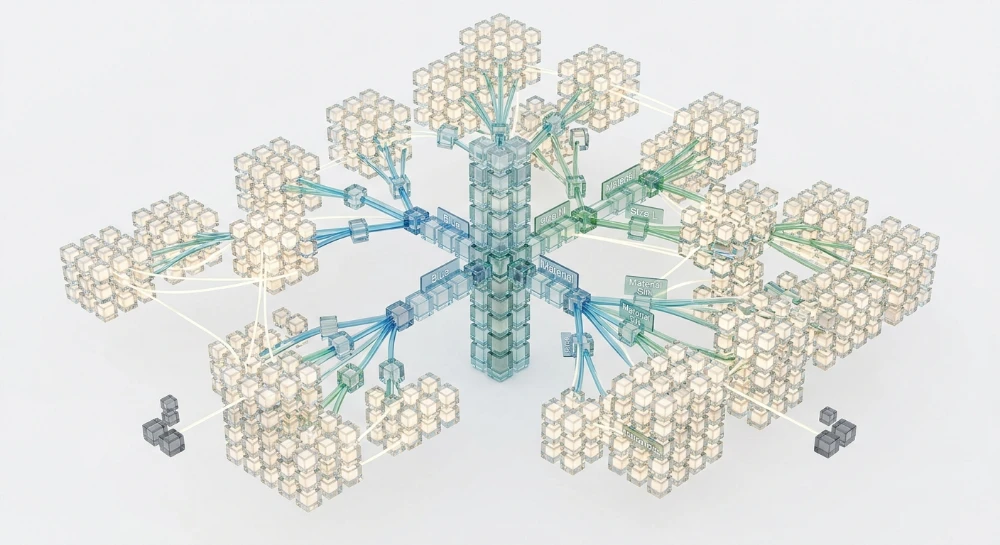
Understanding why matrices of duplicate content grow exponential in faceted navigation requires mapping the exact behavior of Googlebot against URL parameter permutations. Retail platforms generate product filters for attributes like dimensions, materials, and pricing tiers using standard query strings appended to base paths. A single category page featuring just five filter blocks with ten options each mathematically yields 100,000 potential combinations. Search engine crawlers parse every unique string configuration as a distinct HTML document containing nearly identical product grids.
This structural explosion instantly builds an exponential duplicate content matrix. Thousands of technically distinct paths split internal link equity and rapidly deplete the allocated crawl budget.
Technical SEO infrastructure demands strict parameter handling to prevent system-wide crawling blocks and indexation failures. Engineers must deploy hardcoded canonicalization rules via the rel=canonical link element to consolidate ranking signals toward the primary category. Without precise URL boundary control, the Google Search Console Page Indexing report rapidly populates with Crawled currently not indexed status flags. Unregulated facet generation forces indexing algorithms into infinite request loops, triggering server-side timeouts and suppressing the SERP visibility of core commercial assets.
Architectural mechanics of URL parameter combinations
Site architecture relies on a strict hierarchy of category pages and subcategory pages to establish a logical taxonomy. These form the static backbone of a routing system. A standard directory tree assigns definitive paths to core product hubs. The infrastructure maps distinct inventory clusters to fixed addresses.
Faceted navigation shatters this fixed architecture.
When interface filters are engaged, the CMS dynamically modifies the active request by appending query parameters to the base category path. Interacting with brand, price, and material toggles instantly transforms a static directory into a parameterized query string. The server interprets the root path, processes the appended key-value pairs, and queries the database to render the filtered product grid.
Static paths versus dynamic fragments
Distinguishing between hardcoded directory paths and generated parameter handles is critical for structural control. Static URLs define permanent nodes within the taxonomy. Dynamic URL fragments create temporary states of those nodes.
| Architectural Element | Routing Behavior | Query Structure | Output Generation |
|---|---|---|---|
| Static Category Page | Physical or virtual directory resolution | /hardware/monitors | Primary curated taxonomy node |
| Static Subcategory Page | Hierarchical child node resolution | /hardware/monitors/4k-displays | Narrowed taxonomy node |
| Dynamic Facet (Single) | Parameter appended to base path | /hardware/monitors?resolution=4k | Variant attribute state |
| Dynamic Matrix (Multiple) | Concatenated key-value pairs | /hardware/monitors?resolution=4k&panel=ips | Complex intersecting variant state |
Mathematical permutations and infinite URL spaces
The core engineering failure in unfiltered facet deployment is combinatorial explosion. Every filter dimension added to a category multiplies the total potential query paths.
Consider a subcategory page equipped with four filter dimensions. The logic requires multiplying the available options within each facet block.
- Size facet: 6 distinct options
- Color facet: 12 distinct options
- Material facet: 5 distinct options
- Brand facet: 15 distinct options
Selecting one option from each block generates 5,400 distinct combinations. The reality of system architecture is far more volatile. Interfaces permit multi-select filtering within the same block. A user selecting three colors and two brands creates a massive compounding effect on the query generation.
The CMS often appends these parameters in the chronological order of interaction. This mechanical behavior creates structural duplicates based purely on click sequencing.
Path A: /apparel/jackets?color=black&size=large
Path B: /apparel/jackets?size=large&color=black
These two strings generate the exact same HTML payload. They constitute two entirely unique addresses within the routing infrastructure. When systems allow empty parameters, trailing delimiters, or reverse-ordered query strings, the permutation count escapes finite bounds. The architecture shifts from a managed taxonomy into an infinite URL space. Every new attribute assigned to the database exponentially increases the matrix depth.
Unrestricted dynamic generation breaks structural boundaries. The routing logic infinitely spawns distinct paths for identical inventory configurations.
Crawl budget depletion and overcrawling mechanics
Search engines allocate finite resources to every host infrastructure. Googlebot operates on automated extraction paths, parsing the code for href attributes and queuing those values for future server requests. When a spider encounters an unrestricted faceted matrix, the site architecture transforms into a hostile environment. Every applied filter injects new links into the document. The bot follows them mechanically. This creates an endless feedback loop of URL generation and extraction.
We must define the operational constraints governing crawler interaction.
- Crawl volume: The absolute number of server requests executed by search engine bots over a given timeframe.
- Crawl Budget: The hard limit of concurrent connections and total request volume assigned to a specific server, calculated via response latency and domain crawl demand.
- Crawl Efficiency: The exact ratio of server requests yielding unique HTML payloads versus total requests made.
Faceted navigation severely degrades Crawl Efficiency. It forces a state of Overcrawling. Automated spiders aggressively request mechanically generated query strings that offer zero unique value. This mass execution consumes server bandwidth, overloads database queries, and monopolizes processor cycles. The immediate architectural result is immense crawl waste.
Discovery crawls versus refresh crawls
Search engine queuing systems categorize processing tasks into two primary operations. Spiders execute these distinct crawl types based on historical site data and perceived structural value.
Discovery crawls hunt for completely new URL structures. Refresh crawls systematically poll previously stored addresses to identify modified code or updated inventory.
Unfiltered matrices hijack the Discovery crawl queue. The spider detects thousands of new parameter permutations and prioritizes them as undiscovered architecture. Googlebot expends its allocated bandwidth processing
?brand=alpha&sort=price_asc
instead of extracting newly published primary category pages. Once these thousands of permutations enter the system, they poison the Refresh crawl queue. The spider wastes daily computing cycles verifying if a mathematically useless five-parameter URL combination has updated its inventory.
HTTP status codes and signal failure
The root cause of ineffective crawling lies in server header responses. Crawlers rely on standard protocol signals to dictate path termination and resource allocation.
| HTTP Status Code | Server Condition | Search Engine Bot Behavior |
|---|---|---|
| 404 | Resource unavailable or path invalid | Registers a dead end. Terminates path execution and drops the specific address from the active crawl queue. |
| 200 OK | Successful query string execution | Validates the path. Processes the HTML payload and queues all newly discovered parameter links for future extraction. |
Faceted environments weaponize the 200 OK status code. Requesting a non-existent static directory rightly throws a 404. The spider learns the boundary. Requesting a combination of overlapping filters triggers a database query that successfully returns a dynamically rendered layout. The server issues a 200 OK.
This validates the spider's action. Continuous 200 OK responses on infinite query permutations signal to the crawler that the architecture is endlessly deep. The bot assumes every query string represents a critical site component. Search engine bots lack the semantic reasoning to understand that sorting identical inventory by price rather than alphabetical order does not warrant a distinct crawl path. Without hard boundaries, the infrastructure feeds its entire Crawl Budget into a structural void.
Index bloat and the page indexing report
When crawl paths fail to terminate, the secondary failure state is index bloat. This occurs when the search engine index retains thousands of low-value, duplicate, or irrelevant parameter permutations. The Google Index is not an infinite storage drive. Forcing the algorithmic infrastructure to process marginal utility pages degrades the evaluation quality of the entire domain. An unchecked faceted matrix forces algorithms to parse near-identical product sets, stalling indexation for critical category updates.
The first structural symptom of index bloat is title tag duplication. When filters append dynamic strings to the root category, the CMS often fails to dynamically rewrite the HTML title element. The search engine processes thousands of distinct URLs returning the exact same head data. Data saturation of this type triggers immediate algorithmic suppression across the affected directory.
Diagnostic extraction via the page indexing report
Webmasters extract diagnostic signals directly from the Google Search Console Page indexing report to evaluate structural health. The primary metric to monitor is the ratio of indexed to non-indexed pages within specific directory paths. A sudden spike in non-indexed URLs featuring query strings indicates a faceted matrix leak.
| Page Indexing Status | Legacy Index Coverage Report Equivalent | Diagnostic Interpretation |
|---|---|---|
| Crawled - currently not indexed | Crawled - currently not indexed | The bot accessed the parameter combination but deferred indexation due to low perceived uniqueness or processing limits. This is the primary indicator of an active duplicate content matrix. |
| Discovered - currently not indexed | Discovered - currently not indexed | The URL was parsed from a facet link, but the active crawl queue is choked. High volume here confirms systemic depletion caused by the matrix geometry. |
| Duplicate without user-selected canonical | Duplicate, Google chose different canonical than user | The system recognized the parameter URL as an exact duplicate of a root page and bypassed indexation automatically. |
High volumes in the Crawled - currently not indexed bucket act as a forensic footprint. It confirms the server is wasting resources rendering 200 OK responses for pages the search engine has already deemed structurally redundant.
Keyword cannibalization in duplicate matrices
Duplicate content matrices fracture query relevance. When multiple parameterized URLs enter the search engine index for a single commercial term, keyword cannibalization occurs. The algorithm cannot isolate a primary ranking signal.
Instead of one authoritative category page consolidating query relevance, five parameterized variants compete in the SERP. This internal competition degrades the semantic authority of the primary page.
- Rapid SERP ranking fluctuations for target head terms
- Dynamic swapping of ranking URLs between the root category and filtered variants
- Suppressed organic CTR due to mismatched user intent on obscure parameter pages
- Diluted algorithmic evaluation of the core page content
The duplicate content matrix acts as a relevance vacuum. Every indexed facet URL fragments the indexing profile. This structural defect guarantees that the domain underperforms in the SERP regardless of off-page metrics or raw content quality.
Internal PageRank dilution across parameter handles
Link Equity follows the mathematical pathways of your internal architecture. Every link embedded in a category page sidebar extracts a fraction of the total available authority. Unrestricted faceted navigation systems inject hundreds of dynamic parameter links into the document structure. This configuration guarantees severe link juice dispersion.
Calculate the Internal PageRank distribution. A primary category page aggregates ranking authority from external backlinks and site-wide navigation. If this page contains 50 links to vital subcategories and 250 links to dynamic parameter combinations, over 83 percent of its passing authority flows directly into the duplicate content matrix. The math is absolute. You are heavily funding URLs that offer zero organic search value.
The authority bleeds out.
The mechanics of link juice dispersion
PageRank Distribution inefficiencies occur when architecture prioritizes filtering utility over equity consolidation without structural safeguards. Unfiltered crawl paths force the search engine to divide the primary page's weight across thousands of useless nodes.
| Architecture Type | Average Outlink Count | Equity per Internal Link | Destination URL Value |
|---|---|---|---|
| Strict Hub | 40 | High Concentration | Core Subcategories |
| Unfiltered Matrix | 300+ | Microscopic | Parameterized Duplicates |
This structural defect actively devalues primary category pages. Instead of acting as a consolidated hub that pushes ranking signals down to specific product target pages, the root category operates as a sieve. The algorithmic weight meant to stabilize SERP performance leaks into endless parameter handles.
Fracturing the semantic core
Unfiltered crawl paths do more than drain numerical authority. They fracture the semantic core of the entity.
Search algorithms evaluate internal linking structures to map the topical relationship between interconnected pages. A dense, focused internal linking graph signals high semantic relevance for the target entity. When a faceted menu generates hard HTML links for every possible permutation of size, color, and price, it destroys this topical focus.
The relevance signals degrade rapidly.
- Core category authority drops as equity flows outward to parameter combinations
- Semantic relevance shifts from a defined product cluster to a chaotic URL matrix
- Subcategory pages suffer algorithmic demotion due to starved Internal PageRank input
- Deep product nodes lose evaluation priority as crawl paths detour through facet links
Equity dilution at this scale is catastrophic for competitive commercial terms. A domain cannot achieve cluster relevance when its primary category pages distribute their ranking power into an infinite loop of query strings. The architecture must channel Internal PageRank strictly toward pages built for organic acquisition.
Diagnostic workflows: Log file analysis and SEO crawlers
Executing a technical SEO audit on a faceted matrix requires raw data. Front-end audits miss the invisible network of requests hitting the server architecture. Server access logs provide the absolute ground truth of bot behavior.
Every request from a search engine leaves a footprint. Extracting these footprints reveals exactly how algorithmic equity is wasted on dead-end parameter combinations.
Raw server logs export as immense, unstructured text files. Processing this data requires a dedicated SEO log analyzer to parse the millions of lines into actionable crawl trajectories. The objective is to identify the precise query strings consuming the most server resources. Look for URL parameter patterns generating the highest volume of HTTP requests. You will often find that a specific facet combination drives thousands of daily hits without ever triggering a user session.
Server hit data must be cross-referenced against the GSC Crawl Stats report. The interface provides aggregate data. Server access logs provide granular URL execution details. Merging these two datasets exposes latency metrics and hidden crawl loops that the standard reporting interface obscures.
| Diagnostic Metric | GSC Crawl Stats Report | Server Access Logs |
|---|---|---|
| Bot Identification | Aggregated by bot type | Verified via reverse DNS lookup and exact user agent string |
| Crawl Frequency | Daily totals and averages | Exact timestamps to the millisecond per URL request |
| Parameter Impact | Sample URLs under categorized file types | Complete inventory of all requested parameter combinations |
| Latency Metrics | Average response time across the property | Individual time-to-first-byte for specific query strings |
Enterprise SEO crawler configuration
Standard crawler configurations fail on faceted matrices. They either crash from memory exhaustion or truncate the crawl before reaching the critical depth where the architectural flaw exists. You must force the crawler to mimic a completely unfiltered bot.
Different tools require specific parameter configurations to expose the full scale of the matrix.
Screaming frog setup
Adjusting the spider configuration is mandatory to capture the infinite URL space. The default settings hit limits too quickly when encountering multi-select filters.
- Configure the URL Behavior settings to treat all parameters as unique nodes to expose the raw HTML links generated by the DOM
- Set the spider to ignore pre-existing rules that might prematurely truncate the crawl path
- Enable extraction of latency metrics to correlate deep facet combinations with database query execution delays
- Remove any depth limits strictly for the parameter-handling phase of the audit
Monitor the response times. Latency metrics often degrade exponentially as parameter complexity increases. A category page filtered by brand, color, size, and price simultaneously requires massive backend computation, resulting in severe rendering blocks.
SiteBulb application
SiteBulb excels at visualizing architectural sprawl. Utilize the built-in parameter handling reports to identify which specific query keys generate the largest volume of unique values.
The visual crawl map demonstrates the exact nodes where the structure fractures into unmanageable clusters. You can pinpoint the exact subcategory where a poorly configured price slider generates thousands of useless query permutations.
Botify and oncrawl integration
Enterprise platforms handle massive scale by design. Botify and Oncrawl natively integrate server hit data directly with their crawl data.
Push your server access logs directly into the crawler prior to execution. This overlays the actual bot behavior on top of the site architecture map. The resulting report highlights orphan parameter URLs. These are combinations that bots find through legacy internal links or external signals that are no longer accessible via the active faceted navigation.
Configure these platforms to flag structural depth. Any parameter combination sitting beyond click depth five must be scrutinized. Deep, unoptimized facet combinations starve the upper architecture of ranking power.
Canonical tag deployment in faceted matrices
A faceted matrix demands precise signal consolidation. You implement canonicalization using the rel="canonical" link element to force crawling infrastructure to collapse duplicate query strings into a single authoritative node. Every parameter attached to a base category must have a defined canonical path. Leaving parameter combinations without explicit directives forces crawlers to guess the primary version.
They usually guess wrong.
The core mechanism relies on differentiating a self-referencing canonical tag from non-canonical directives. A primary category page must serve a self-referencing tag to lock its status as the indexing target. When a filter generates a parameter string, the server must dynamically swap that self-referencing tag to a non-canonical directive pointing directly back to the clean baseline URL.
Establishing the canonical version
You need a strict logic gate for parameter handling. Not all parameters serve the same function. Sort modifiers, tracking strings, and session variables never alter the core content payload. They must always canonicalize to the base URL.
Attribute filters require distinct architectural rules.
Define exact conditions in your CMS for establishing the Canonical version across different parameter combinations. A single filter applied to a category often points back to the root node. Multiple filters applied simultaneously dictate a mandatory non-canonical state back to that same root. The system must process the parameter array and output the correct canonical destination dynamically.
| Parameter Execution | URL Structure Example | Canonical Directive Target |
|---|---|---|
| Sort / Order Modifier | ?sort=price_asc | Base Category URL |
| Session / Campaign Tracking | ?utm_source=email | Base Category URL |
| Multi-Facet Selection | ?color=blue&size=10 | Base Category URL |
| Single High-Demand Facet | ?brand=specificbrand | Self-Referencing URL |
Edge cases for Long-Tail keywords
Blanket canonicalization destroys organic reach. If you blindly point every facet back to the root category, you eliminate the ability to capture specific SERP demand. You must address canonicalization edge cases for long-tail keywords by deliberately breaking the consolidation rule.
Identify parameter combinations that align with validated search intent. If query data proves demand for a specific sub-segment, that exact facet combination must be elevated. The server must inject a self-referencing canonical tag on that specific parameterized URL. It transitions from a redundant duplicate into an independent entity.
- Extract search volume data for combined item attributes.
- Map high-value combinations against existing facet parameters.
- Configure the routing logic to isolate these specific query strings from the default canonical fallback.
- Inject unique semantic data to support the newly established node.
Verification via HTTP response header
HTML document canonicals often fail under extreme architectural scale. Heavy DOM layouts or conflicting rendering executions can obscure the rel="canonical" link element from parsers. You eliminate rendering dependencies by moving the directive upstream.
Verify Canonical Tags via HTTP response header. Injecting the directive directly into the header ensures parsing engines process the consolidation signal before requesting the document body. This intercepts the crawl path early.
Open your network analysis tooling and inspect the raw server response. The header output must contain the explicit Link attribute formatted for canonicalization. If your caching layers strip this header during edge delivery, reconfigure the environment to persist the Link directive across all parameterized requests.
Crawl path control: Robots.txt vs. meta directives
Canonical tags consolidate duplicate signals, but they do not stop server hits. You must control the crawl path at the protocol level to protect your infrastructure. Relying solely on canonicalization leaves your server vulnerable to millions of automated requests across faceted matrices.
Robots txt disallow rules against noindex directives
Engineers frequently confuse crawl directives with index directives. They are not interchangeable. A robots exclusion rule prevents a bot from requesting the URL. The noindex directive prevents the search engine from storing the URL in its active index.
Applying both simultaneously creates a strict directive conflict. If you block a path at the network level, the crawler cannot read the HTML document or the HTTP headers. It never sees the noindex instruction. A URL previously indexed remains trapped in the search engine index as a blocked resource.
Follow this exact sequence to remove and block parameter URLs:
- Inject the noindex directive into the HTTP response header of the target parameter.
- Monitor server access logs to verify bots are crawling the URL and processing the removal tag.
- Confirm the URL has dropped from the active index via the coverage reports.
- Deploy the exclusion rule to sever the request path permanently.
Syntax for query string disallow rules
Standard directory blocks fail on dynamic parameter handles. You need specific path prefix matching to neutralize faceted query strings.
The placement of the question mark and ampersand dictates the exact scope of the block. Apply these exact prefix matches to your crawler configuration file.
User-agent: Googlebot
Disallow: /shop/?price=
Disallow: /products?category=shoes&sort=
Disallow: /catalog/?filter=
The first rule blocks the price parameter when it initiates the query string directly after the shop directory. The second rule isolates the sort parameter when it is appended as a secondary facet behind a static category string. Verify these paths against your active server access logs to ensure you do not block critical rendering assets.
Evaluating noindex and header execution
Document-level instructions carry a strict latency cost. The standard robots meta tag requires the bot to download and parse the entire HTML payload. For massive facet matrices, this exacts a heavy toll on rendering capabilities.
Move the directive upstream. The header-level tag operates before the document body loads, bypassing the parser entirely.
Compare directive execution layers to determine the optimal deployment strategy:
| Directive Method | Execution Layer | Rendering Dependency | Optimal Use Case |
|---|---|---|---|
| Robots Meta Tag | HTML Document HEAD | High | Static content and standard CMS templates |
| X-Robots-Tag | HTTP Response Header | None | Faceted matrices and non-HTML files |
Configure your routing logic to inject the header tag with a strict noindex instruction for all URLs containing dynamic facet patterns. This cuts the evaluation time to milliseconds and forces immediate index removal.
Evaluating nofollow on facet links
Internal link architecture dictates bot behavior before the request executes. The rel="nofollow" attribute applied to specific facet links acts as a localized crawl inhibitor.
Inject this attribute directly into the markup of your filtering sidebar. This cuts off the discovery path at the source. While parsers treat internal nofollow as a hint rather than a strict directive, it heavily deprecates the priority of the destination URL. It stops link equity from bleeding into infinite parameter variations.
Apply this attribute selectively. Never restrict primary category links or top-level subcategories. Target the multi-select checkboxes and secondary sorting dropdowns that generate exponential parameter combinations.
Sitemap exclusion protocols
Contradictory signals destroy crawl efficiency. You cannot feed a URL to a bot via a sitemap while blocking it via protocol directives. The sitemap is an explicit inclusion signal.
Faceted URLs blocked by any control mechanism must be aggressively purged from your sitemap files. Leaving them active forces the engine to process conflicting instructions. This wastes allocation limits and triggers coverage errors.
Audit your dynamic sitemap generation scripts. Ensure the logic explicitly filters out URLs containing blocked query parameters. The sitemap must contain a pristine list of canonical and indexable URLs returning a clear 200 OK status.
Client-Side filtering: AJAX, fetch API, and history API
Structural markup dictates crawl architecture. Constructing filter interfaces with standard HTML anchor tags actively feeds parameter combinations into the crawling queue. Parsers systematically extract href attributes from the DOM. Every checked color box or adjusted price slider generates a distinct URL discovery event. You must sever this mechanism at the node level.
Replace anchor tags with HTML button elements for facet execution. This architectural shift alters indexation mechanics immediately.
Bots do not simulate user interactions on UI components. They do not trigger click events or execute generic event listeners attached to buttons. Binding facet logic strictly to button tags removes the discovery vector entirely. The parameter matrix becomes invisible to the crawler. Functionality remains intact for the user.
Dynamic content rendering workflows
Server-side URL parameter generation forces the infrastructure to build and return a complete HTML document for every filter permutation. This wastes processing overhead and creates redundant crawl paths. You must intercept the request and shift the rendering payload to the client.
Implement the Fetch API or legacy AJAX protocols to handle UI interactions asynchronously. When a user engages a facet button, the client-side script prevents the default browser routing. It dispatches a silent request to an internal API endpoint. The server returns only the specific data required to populate the active product grid.
This architectural pattern eliminates server-side query strings. The crawler downloads the static primary category page once. All subsequent sorting, filtering, and pagination execute client-side without altering the document location via hard server requests.
Evaluate the structural differences between traditional and client-side execution models.
| Architectural Component | HTML Anchor Execution | Fetch API with Button Element |
|---|---|---|
| Crawl Path Generation | Infinite URL matrices discovered via href parsing | Zero discovery paths generated |
| Server Load | Full HTML document rendering per interaction | Targeted data object retrieval |
| Bot Interaction | Follows links indiscriminately | Ignores unlinked button elements |
| Latency Profile | High TTFB due to full page reload | Millisecond DOM updates via asynchronous fetch |
State management via history API
Client-side filtering introduces a UX vulnerability. Bypassing server requests breaks native browser navigation. Users expect the back button to function sequentially. They expect to copy a heavily filtered URL and share it. You resolve this exact conflict using the History API.
Deploy the pushState and replaceState methods simultaneously with your asynchronous data requests.
These methods dynamically update the browser address bar to reflect the current filter state without initiating an HTTP request. The user receives a clean, parameterized URL containing their specific facet combinations. They can bookmark the page or share the link. Because the bot executes a stateless crawl of the initial category hub, it never triggers the client-side JavaScript required to append these parameters to the URL string. You achieve total UX compliance without opening the parameter matrix to indexation.
DOM rendering payload optimization
Client-side routing creates rendering bottlenecks if payload management fails. You must strictly control the data traversing the network during facet execution. Returning pre-rendered HTML chunks from your API bloats the transfer size and blocks the main thread.
Structure your internal endpoints to return lean arrays. Isolate DOM updates to the exact nodes requiring modification.
Execute the following payload management protocols to ensure rapid client-side rendering:
- Format API responses to include only critical product identifiers, pricing integers, and image pathways.
- Target isolated DOM nodes for partial replacement rather than tearing down the parent container framework.
- Cache initial API responses locally using sessionStorage to eliminate redundant network round trips on back-button navigation.
- Throttle user inputs on continuous range sliders to prevent asynchronous requests from stacking in the browser execution queue.
- Maintain static placeholders for UI layout shifts while the asynchronous request processes to stabilize the visual viewport.