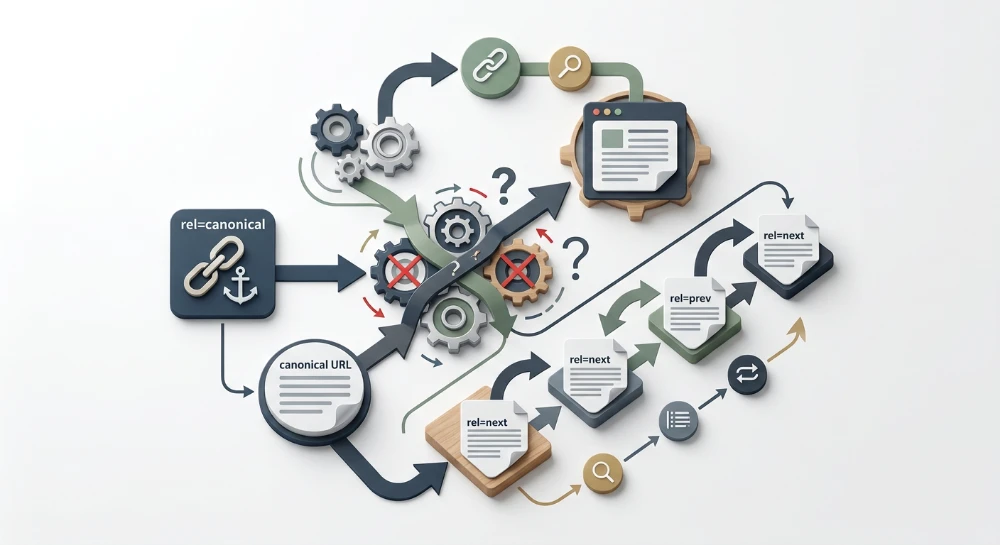
Understanding exactly how rel next pagination triggers conflicts of canonicalization with canonical URL configurations dictates the indexation success of multi-page inventory structures. The technical architecture of HTML head directives requires absolute precision. Crawlers parse these tags line by line. When pagination attributes map a sequential series but the canonical tag forces consolidation to page one, Googlebot receives mutually exclusive instructions. The crawl path breaks.
Deploying identical canonical attributes across a paginated series halts link equity distribution.
An e-commerce CMS generating a 200 HTTP status code for a sequential parameter like ?page=3 while simultaneously declaring the root category as the master version creates an immediate indexing block. Google Search Console processes this contradiction by dropping the deep paginated URLs from the active index. The Pages report populates with 'Duplicate without user-selected canonical' warnings. Wasted crawl budget scales linearly with the total volume of paginated assets.
Establishing accurate baselines for indexation analysis means cross-referencing server log data against Google Search Console coverage reports. Auditing duplicate pages requires comparing the raw HTML source code against the final DOM rendering to detect any JavaScript-injected directive overrides. Improper consolidation occurs the moment a sequential component loses its self-referencing canonical tag. Technical SEO protocols mandate configuring extraction tools like Screaming Frog SEO Spider to simultaneously pull both pagination sequences and canonical attributes to expose these directive loops. Validating the API payload ensures external auditing software reads the exact same header responses as the primary search engine crawler.
Architectural directives: Rel=canonical and pagination tags in the HTML <head>
Consolidation and sequential relationship mapping serve opposing architectural functions. A canonical element exists exclusively to merge duplicate or near-duplicate assets into a single authoritative URL. Pagination attributes dictate a linear sequence across a divided set of unique assets. Combining them improperly fractures crawler understanding.
The syntax for these directives dictates strict structural compliance within the document. The canonical tag syntax requires an absolute URL.
<link rel="canonical" href="https://example.com/category/page-2/" />Sequential attributes require identical precision to map the adjacent URL states.
<link rel="prev" href="https://example.com/category/" />
<link rel="next" href="https://example.com/category/page-3/" />
Differentiation between these elements lies in indexation handling. The canonical element instructs the algorithm to drop the subordinate URL from the index and forward ranking signals to the master version. Pagination elements instruct the crawler to treat the URL as an independent indexable component within a larger series. Forcing a sequential component to canonicalize to a master version overriding its sequence creates a dead end. Link flow terminates. Deeply nested product URLs lose their discovery pathways.
Googlebot processes these directives through a rigid parsing sequence. Upon receiving a 200 HTTP status, the crawler immediately scans the raw HTML document top-down. The initial parsing pass ignores linked JavaScript files and CSS. The crawler extracts directives directly from the raw source code. Conflicting instructions in the raw HTML force the parser to default to the most restrictive directive or abandon consolidation entirely. Relying on client-side rendering to inject canonical or sequential attributes introduces rendering latency. The crawler processes the default server-side response before the script executes.
Search engine indexing protocols for component structure
Protocols governing URL structure rely on explicit architectural cues to process clustered data.
- Self-referencing canonical attributes must exist on every individual URL within a sequential series to validate independence.
- Adjacent sequential attributes must point to valid endpoints returning a 200 HTTP status code.
- Root category URLs must not appear in sequential tags of deep paginated assets unless strictly serving as the preceding URL.
- Parameter ordering within the URL structure must remain static across both sequential and consolidation directives to prevent infinite crawl spaces.
Comparative structural roles highlight the necessary separation of duties within the HTML.
| Directive Attribute | Primary Architectural Function | Crawler Processing Behavior | Indexation Outcome |
|---|---|---|---|
| rel canonical | Master version consolidation | Transfers ranking signals and drops duplicate | Single authoritative URL retained |
| rel next | Forward sequence mapping | Discovers subsequent content nodes | Sequential URLs indexed independently |
| rel prev | Backward sequence mapping | Validates preceding content nodes | Sequential URLs indexed independently |
Improper consolidation: When paginated archives canonicalize to page one
Routing canonical tags from paginated endpoints back to the root category page represents a critical architectural flaw. A CMS configured with this anti-pattern generates HTML where sequential assets like ?page=2 explicitly declare the root URL as their master version. Web crawlers interpret this directive literally. They classify the deep paginated URL as a duplicate of page one.
<!-- Flawed directive on https://example.com/category/?page=2 -->
<link rel="canonical" href="https://example.com/category/" />
Validating a sequence requires distinct nodes. Pointing paginated assets to the root category violates the requirement for self-referential canonicals on sequential pages. Without a self-referencing attribute, the independence of the paginated URL fails validation. The search engine consolidation algorithm merges the ranking signals into the root category and discards the paginated URL entirely.
Discarding paginated URLs severs the internal crawl paths to deep inventory items. When page two drops from the index due to improper consolidation, the products or articles listed exclusively on that page lose their primary discovery mechanism. Crawlers stop following outgoing links from non-indexed duplicate pages.
Deep inventory becomes digitally orphaned.
Organic visibility for older content or deeper product catalogs plummets because the crawler cannot reach the internal links. Crawl architecture degradation manifests through specific routing failures.
- Internal links housed on consolidated paginated nodes receive zero crawl priority.
- Deep inventory items fail to achieve initial indexation due to isolated crawl paths.
- Crawl frequency drops for historical assets pushed past the first page of the archive.
- Link equity fails to flow downward from the root category to individual item pages.
Diagnostic warnings and duplicate meta tags errors
This improper consolidation setup forces the CMS to render identical HTML payloads across multiple distinct URLs. Crawlers detect exact matches in title elements, meta descriptions, and canonical targets across the entire paginated series. Site audit tools and diagnostic platforms flag these clusters as duplicate content.
Resolving these diagnostic warnings requires severing the false equivalence between the root category and its paginated children. The crawler needs absolute certainty that sequential URLs hold unique, indexable links distinct from the root.
Systematic errors emerge across three specific dimensions during crawling.
| Diagnostic Warning | Trigger Condition | Architectural Impact |
|---|---|---|
| Identical canonical URLs | Multiple ?page= parameters point to the exact same href value | Engine ignores the pagination sequence and consolidates variables |
| Duplicate meta tags | CMS replicates title and description on all paginated nodes | Lowers cluster quality score and triggers canonical evaluation |
| Orphaned deep URLs | Inventory lacks inbound links from indexed category pages | Items drop from SERP due to zero internal link discovery |
Forcing a blanket canonical directive across a dynamic parameter string destroys the structural integrity of the URL cluster. The crawler registers a direct contradiction between the explicit consolidation command and the unique product links populated on the paginated nodes.
Indexation and crawl budget implications of conflicting directives
Conflicting directives in the HTML head force search engine crawlers into a loop of continuous re-evaluation. The engine hits a paginated node, reads a canonical attribute pointing to the root category, but parses unique product links within the DOM. This contradiction breaks the indexing pipeline. Resources burn. The crawler spends processing time rendering URLs that yield no net positive indexation.
Analyze the Google Search Console Pages report to diagnose the exact fallout. Navigate directly to the Indexing section. The data surface here reveals how the indexing engine handles mixed technical signals across your pagination clusters.
Isolate these two specific status codes within the Pages report to confirm canonicalization conflicts.
- Discovered - currently not indexed: The engine found the paginated URL but delayed crawling due to perceived low cluster quality or domain crawl capacity limits.
- Duplicate without user-selected canonical: The algorithm grouped the paginated pages as duplicates, completely ignoring your explicit, conflicting markup.
Crawl rate anomalies and server log analysis
Cross-reference Google Search Console data with raw server log analysis. Logs tell the unfiltered truth about wasted crawl budget. Filter your server requests specifically for Googlebot user agents hitting URLs containing pagination parameters.
A healthy site architecture yields a descending crawl frequency as pagination deepens. Page two gets crawled less than page one. Page ten gets crawled less than page two. When canonical directives conflict with pagination sequences, this standard distribution shatters. Wasted crawl budget occurs when the bot repeatedly fetches deep parameter URLs, processes the conflicting canonical tag, and discards the HTML payload without transferring discovery signals to the nested inventory.
Server log anomalies reveal exactly how conflicting directives manipulate crawling behavior.
| Log Pattern | Crawl Behavior | Indexation Outcome |
|---|---|---|
| Flat Crawl Distribution | Bot hits all pagination parameters with equal frequency | Wasted budget, delayed indexing of high-priority core pages |
| Spike and Drop | High hit volume on page two, zero hits beyond | Deep inventory permanently orphaned from the index |
| Cyclical Re-crawling | Bot revisits identical parameter strings daily without indexing | Domain stuck in an algorithmic canonical evaluation loop |
Link equity dilution and drop-offs
Structural failure manifests next through link equity dilution. Paginated URLs naturally accumulate internal link equity through navigation menus and breadcrumbs. When pagination tags and canonical attributes align logically, this equity distributes efficiently to the deep inventory URLs. Conflicting directives trap this equity. The engine refuses to consolidate the signals. The link juice fragments across dozens of pagination URLs that hold no distinct ranking power on the SERP.
Track indexation drop-offs closely for category pages and tag pages. Monitor the exact number of indexed URLs within these specific directory paths over a rolling 90-day window.
A sharp decline in indexed category pages often correlates directly with a recent push of conflicting canonical code. The engine views the root category and its paginated children as a fundamentally broken cluster. It drops the entire branch from the index. Deep inventory items lose their sole internal referral path. Organic traffic decay follows immediately.
Auditing canonical chains and pagination directives
Open Screaming Frog SEO Spider. Before launching the crawl, modify the default configuration to capture the precise directives governing multi-page inventory. Navigate to Configuration > Spider > Extraction. Verify that both 'Canonicals' and 'Pagination' are actively selected. This ensures the crawler parses the link elements specifically designed for version consolidation and sequential progression.
Start the crawl across the category paths identified during the log analysis phase.
Isolating pagination status errors
Raw extraction data requires immediate filtering. Head directly to the right-hand window pane and select the Pagination tab. The initial check focuses on HTTP status codes returned by URLs listed within the pagination sequence.
- Navigate to Reports > Pagination > Non-200 Pagination URLs. This export reveals instances where sequential markup points to dead endpoints, redirects, or server error pages. Search engine crawlers abandon sequential discovery when hitting a status code outside the 200 OK range within a pagination chain.
- Generate the Reports > Pagination > Unlinked Pagination export. Orphaned paginated URLs exist in the index or sitemap but lack internal linking structures connecting them to the primary sequential path.
Detecting canonical chains and loops
Directives must resolve in a single step. Chained canonicals force the crawler to process multiple network hops before reaching the authoritative version. This latency destroys crawl efficiency.
Inspect the Canonicals tab. Filter the view for 'Canonical Chains'. A chained setup often manifests as an architectural flaw where page three canonicalizes to page two, which subsequently canonicalizes to page one. The engine stops following the chain, leaving the deep inventory undiscovered.
Circular canonicals present a more destructive scenario. URL A canonicalizes to URL B, while URL B canonicalizes back to URL A. The crawler hits an endless evaluation loop. The engine resolves the conflict by ignoring the directives entirely or dropping both URLs from the index.
Evaluate directive setups by checking specific crawler reports against known architectural flaws.
| Anomaly Type | Detection Path | Impact on Crawling |
|---|---|---|
| Canonical Chain | Canonicals > Canonical Chains | Forces multi-step resolution, risks crawl drop-off |
| Circular Canonical | Canonicals > Report > Circular Canonicals | Triggers algorithmic evaluation loop, URLs de-indexed |
| Non-200 Pagination | Pagination > Non-200 Pagination URLs | Severs sequential discovery path for deep URLs |
| Unlinked Pagination | Pagination > Unlinked Pagination | Isolates URLs from internal link equity distribution |
DOM rendering vs. raw source code
Static source code parsing tells only half the story. Client-side routing and JavaScript execution frequently manipulate HTML elements post-load. Relying strictly on raw HTML extraction generates false negatives during an audit.
Reconfigure the crawler for client-side rendering. Navigate to Configuration > Spider > Rendering. Switch the setting from 'Text Only' to 'JavaScript'. Execute a secondary crawl against a targeted sample set of paginated URLs.
Compare the raw HTML source code against the rendered DOM. You are looking for dynamically injected link tags that overwrite the static directives. A server might deliver a valid self-referencing canonical in the raw HTML payload. Upon execution, a client-side script injects a canonical pointing back to page one. A hard conflict exists.
The web crawler prioritizes the rendered DOM. The dynamic injection overrides the static code, triggering the improper consolidation loop and immediately suppressing deep inventory discovery on the SERP.
Sequential pagination vs. View-All page canonicalization strategies
Routing canonical attributes of individual paginated components to a single master version URL consolidates indexing signals into one destination. Link equity directed at fragmented sequence URLs aggregates entirely within the view-all variant. The configuration dictates that query parameters like ?page=2 and ?page=3 contain a canonical attribute strictly pointing to the ?view=all destination.
Server architecture dictates the viability of this method.
Strict pagination markup operates on the opposite logic. This setup requires self-referencing canonicals on sequential URLs combined with accurate relationship attributes. Page two canonicalizes to page two. Independent crawlable status remains intact for every segment. The crawler discovers deep inventory items directly through the sequence without encountering massive consolidated payloads.
Evaluating payload and load time metrics
Pushing thousands of product nodes into a single master version URL alters server response dynamics drastically. You must evaluate exact payload and load time metrics before deploying a view-all canonicalization strategy.
Massive item arrays trigger severe database query strain. TTFB degrades exponentially as the server struggles to compile the complete inventory list into a single HTML document. Network latency increases.
Client-side rendering of comprehensive view-all pages introduces main thread bottlenecks. The browser chokes while painting hundreds of DOM elements simultaneously. INP scores spike well beyond acceptable thresholds. Search algorithms frequently reject the view-all URL as the authoritative version if performance deficits reach critical limits. The system ignores the canonical directive and indexes the fragmented sequence instead to protect the SERP user experience.
Rules for authoritative version selection
Deciding between a consolidated view-all page and strict sequential pagination requires a rigid evaluation protocol based on infrastructure limits.
- Calculate total category node volume. Categories holding fewer than 150 items usually tolerate view-all consolidation without triggering payload failures or exceeding render quotas.
- Monitor server response baselines. Abandon the view-all strategy if TTFB exceeds 800ms during headless load testing of the consolidated URL.
- Assess client-side interaction delays. An INP exceeding 200ms on the view-all variant mandates a fallback to strict pagination markup to preserve technical SEO stability.
- Analyze deep link equity distribution. High-value category hierarchies with heavy internal linking benefit from strict sequential pagination to distribute crawler focus evenly across deep inventory paths.
Implement the strategy that aligns with your resource ceiling. Forcing a view-all canonical architecture on an underpowered CMS guarantees crawling anomalies.
| Strategy Configuration | Inventory Threshold | Maximum TTFB | INP Limit | Crawler Processing Behavior |
|---|---|---|---|---|
| View-All Master Version | Under 150 items | 800ms | 200ms | Consolidates equity into a single canonical URL |
| Strict Sequential Markup | Unlimited scale | Flexible baseline | Flexible baseline | Parses individual self-referencing parameter segments |
Handling infinite scroll and Load-More pagination structures
Web crawlers do not execute scrolling behaviors. They do not trigger asynchronous click events. They parse static document nodes. An infinite scroll interface built entirely on client-side event listeners creates a rendering block for deep link extraction. The infrastructure requires a hybrid rendering model. The visual layer delivers dynamic continuity, while the underlying HTML maintains discrete paginated segments.
Mapping the API to document directives
Segmenting a continuous product feed requires defining exact boundary points. As the viewport crosses these thresholds, the application must update the browser state. The History API handles this transition.
Triggering history manipulation methods alters the visible URL string. This execution must concurrently manipulate the HTML head structure. A state change from the root category to the second segment demands an immediate rewrite of the canonical directive within the document. The target element requires a real-time update to reflect the newly active parameter string.
Desynchronization occurs when the visual state advances but the head directives remain static. The crawler captures the updated URL but processes the original canonical instruction. This generates duplicate metadata errors mapping back to the root category. You must engineer the event listener to target and overwrite the canonical link node exactly when the URL shifts.
Implement these state management rules for infinite scroll architectures:
- Calculate component boundaries based on fixed item counts matching the static server response.
- Execute a canonical node replacement via JavaScript simultaneously with the URL state shift.
- Provide hardcoded anchor elements pointing to sequential parameters to support crawler pathing without JavaScript execution.
- Configure routing to load the precise parameter state upon direct server request.
Preventing indexation pruning anomalies
Engineers often misconfigure paginated scroll components by appending a noindex directive to dynamically generated states. This tactic attempts to consolidate indexation metrics into the root URL. It fails fundamentally.
Applying noindex to sequential parameter strings severs crawler access to the localized item nodes. Search engines drop the paginated URL from the processing queue. Link discovery for deep inventory nested exclusively within those states halts entirely. Retain the default index directive across all valid URL variations.
Index pruning on paginated components applies only during intentional inventory suppression. Limit this destructive action to low-value, isolated paths where crawl budget optimization supersedes deep link extraction.
State synchronization mapping
Validating the synchronization between the interface event and the document state ensures clean indexation routing. The interaction triggers must align perfectly with the directive outputs.
| User Interaction | API Execution | URL Output | Canonical Directive State |
|---|---|---|---|
| Initial load execution | None required | /category/ | /category/ |
| Scroll past item boundary | pushState rewrites path | /category/?page=2 | /category/?page=2 |
| Click load-more trigger | pushState rewrites path | /category/?page=3 | /category/?page=3 |
Every unique URL generated by the API must feature a self-referencing canonical structure. This explicit mapping neutralizes identical canonical warnings and stabilizes crawler processing behavior. Standard sequential logic applies regardless of the client-side rendering methodology.
Implementing strict pagination markup for clean indexation
Validating sequential state requires explicit HTML directives mapped directly to the server response. You need a self-referencing canonical paired with exact pagination attributes to maintain index integrity. The markup block must unambiguously declare its specific position within the series.
Below is the precise implementation for a standard series component residing at the second sequence index.
<link rel="canonical" href="https://example.com/category/?page=2" />
<link rel="prev" href="https://example.com/category/" />
<link rel="next" href="https://example.com/category/?page=3" />
Backend CMS routing frequently overrides dynamic parameters during template compilation. Core logic often hardcodes the canonical element to the root category path, stripping query strings entirely before document generation completes. This configuration forces identical directives across all sequential states. Engineering teams must implement programmatic logic checks at the template level to intercept and rewrite the canonical output dynamically based on the active URL parameter.
Backend CMS logic checks
Preventing improper consolidation requires strict validation rules on the server before generating the document layout.
- Query String Whitelisting: Intercept the active URL parameter state and map the exact key-value pair directly to the canonical output function.
- Out-of-Bounds Sequence Handling: Terminate the rendering process for non-existent sequences and return a 404 status code rather than executing a fallback redirect to the root index.
- Protocol and Hostname Locking: Force absolute URL construction via environment variables to prevent relative path generation during proxy layer caching.
- Empty Parameter Suppression: Strip the pagination parameter entirely from the first sequence output to prevent duplicative root paths.
Verifying directive execution demands direct feedback from the crawling engine. Manual source code inspection only confirms the payload structure, not the indexing outcome. Submit specific sequential paths through the GSC URL Inspection API. The response payload confirms whether the indexer respects the self-referencing markup or overrides the configuration due to conflicting signals.
| Requested URL | Declared Canonical | Google-Selected Canonical | Indexation Status |
|---|---|---|---|
| /category/?page=2 | /category/?page=2 | /category/?page=2 | Indexed, not submitted in sitemap |
| /category/?page=3 | /category/ | /category/ | Duplicate without user-selected canonical |
| /category/?page=4 | /category/?page=4 | /category/ | Duplicate, Google chose different canonical |
A mismatch between the declared and selected authoritative version fields indicates systemic logic failure in the markup structure. The API output exposes exact node conflicts.
Continuous monitoring protocol for duplicate meta tags
Static validation misses regressions deployed during routine code updates. A continuous monitoring protocol ensures long-term stability across deep inventory paths.
Configure automated scheduled crawls targeted exclusively at the pagination parameter paths. The extraction parameters must parse the raw source code and validate the node arrays.
- Configure the extraction crawler to scrape the exact string value of the canonical element across all discovered sequential paths.
- Run a deduplication script against the extracted canonical string array. Any sequence state returning a duplicate value triggers a configuration alert.
- Set exact match conditions verifying the requested path precisely matches the declared canonical string.
- Extract multi-node occurrences to catch duplicate meta tags injected by third-party plugins operating outside the core template logic.
Automated validation logic isolates rendering blocks before they impact indexation rates. Identifying duplicate meta tags at the staging phase prevents equity dilution on the live server environment.