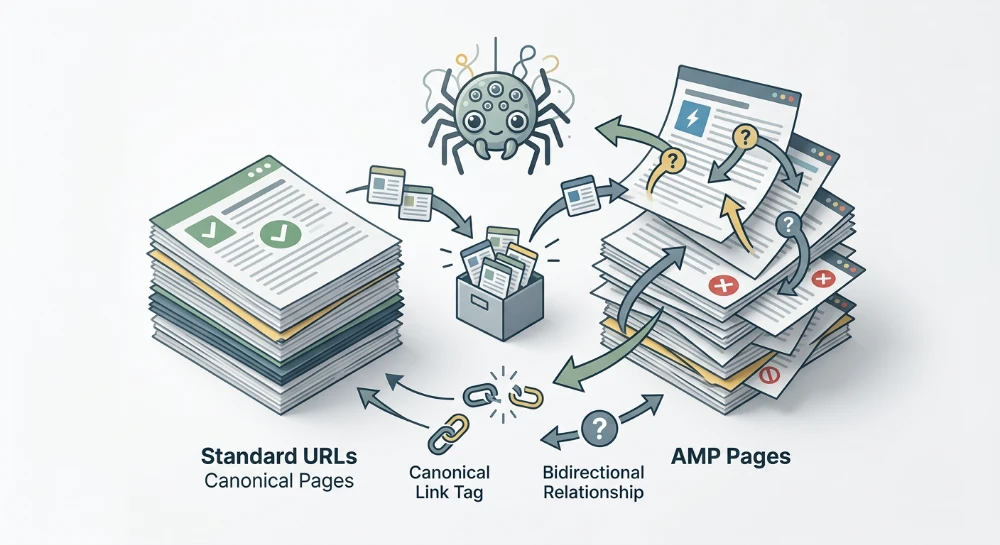
Understanding exactly why duplicate events of indexation stem from errors in AMP canonical page tags requires analyzing the bidirectional relationship between document versions. Search engine crawlers depend on precise relational syntax to merge ranking signals across multiple endpoints. When developers misconfigure these tags, Googlebot processes the mobile and desktop variants as entirely separate entities. This creates an immediate duplicate cluster within the main search index. Traffic cannibalization follows.
The technical architecture demands strict bidirectional links between AMP and non-AMP equivalents. The standard HTML document must serve a <link rel="amphtml"> tag specifying the exact location of the mobile variant. The mobile page must point back to the desktop original using a strict <link rel="canonical"> declaration. Google algorithms evaluate this reciprocal structure to pass PageRank and consolidate SERP visibility into a single representative URL. Broken links destroy this algorithmic bridge. One missing tag shifts the entire indexing logic.
Severed bidirectional connections directly impact crawl budget allocation. Unresolved duplicate content clusters force search bots to fetch and render identical assets repeatedly. Server logs will show Googlebot wasting requested bandwidth on both the standard CMS output and the orphaned mobile endpoints.
- Wasted crawl bandwidth delays the discovery of newly published URLs across the domain.
- Duplicate clusters split CTR metrics across multiple indexed versions.
- Misaligned canonical directives trigger the duplicate without user-selected canonical status in Google Search Console.
Sites managing extensive inventories face rapid indexation blockages when validation fails. Identifying the exact point of tag failure halts redundant server crawling.
Architecture of bidirectional relational links for accelerated mobile pages
The precise syntax of relational directives dictates how search engine parsers map alternate document versions. A standard HTML document mandates a specific node pointing to its mobile counterpart.
<link rel="amphtml" href="https://example.com/amp/page-name/">The corresponding mobile variant must return the signal to the standard document. This establishes the required reciprocal connection.
<link rel="canonical" href="https://example.com/page-name/">Without this exact absolute string match returning to the source, the relationship fails entirely, forcing the indexing algorithm to evaluate the two endpoints as completely isolated nodes competing for identical query sets.
Document head placement specifications
Crawler efficiency relies on strict document object model positioning specifications to prevent rendering latency.
| Document Type | Required Tag Syntax | Optimal Placement Node |
|---|---|---|
| Standard HTML | <link rel="amphtml" href="[AMP_URL]"> | Directly below the charset declaration |
| AMP HTML | <link rel="canonical" href="[STANDARD_URL]"> | Preceding any external resource calls |
The rendering engine parses the document head sequentially. Relational directives positioned below heavy inline scripts or complex meta blocks delay extraction. Relative paths trigger parsing failures during dynamic routing. Absolute paths are mandatory. Protocol mismatches between secure and non-secure schemes sever the algorithmic connection instantly.
Algorithmic signal consolidation logic
The indexing engine processes reciprocal directives through a strict validation sequence. Discovery initiates at the standard document.
When the crawler extracts the amphtml pointer, it queues the mobile variant for immediate fetching. The parser processes the mobile payload specifically searching for the returning canonical tag. The algorithm executes a binary string comparison between the declared canonical target and the originating standard URL.
A validated match triggers the consolidation sequence.
Google merges the two distinct documents into a single entity within the primary index. The standard URL absorbs all query relevance, PageRank, and historical authority. The mobile asset ceases to exist as an independent SERP candidate.
The successful execution of this algorithmic merge yields three specific architectural behaviors:
- Link equity directed at the mobile endpoint transfers seamlessly to the primary document.
- The index treats the mobile version strictly as an alternative serving mechanism invoked solely by mobile user agents.
- Signal dilution drops to zero.
Any disruption in this loop isolates the ranking signals. The engine defaults to indexing both versions independently, splitting visibility metrics and heavily fragmenting overall SEO performance.
Algorithmic triggers for duplicate indexation events in AMP environments
Asymmetric signal configurations sever the bidirectional loop required for document consolidation. The indexing engine treats conflicting directives as a definitive break in the relationship. When the standard URL points to a mobile variant that fails to return a matching canonical pointer, the algorithmic merge aborts instantly.
Crawlers process these disjointed bidirectional relationships by isolating both documents.
Self-Referencing canonical directives
Deploying a self-referencing canonical tag on the AMP document represents a fatal architectural flaw. The parser expects the mobile payload to declare the standard document as its primary entity. A self-referencing tag overrides this hierarchy.
The parser registers the mobile variant as an independent, standalone URL.
This conflict forces the engine into a specific processing sequence:
- The standard document initiates the crawler sequence via the amphtml directive.
- The fetching mechanism queues and retrieves the mobile payload.
- The HTML parser extracts the canonical tag from the mobile variant.
- A string mismatch between the extracted canonical URL and the originating standard URL forces a hard validation failure.
- The relational link breaks, instructing the indexer to treat both URLs as distinct entities.
Link equity dilutes immediately. External signals pointing to the mobile variant remain trapped at that endpoint instead of flowing to the primary document.
Formation of duplicate document clusters
Once the bidirectional loop fails, the content evaluation algorithm takes over. The parser analyzes the HTML structure and text payload of both the standard and mobile documents. Discovering near-identical content across two distinct URLs triggers duplicate cluster formation within the primary index.
The engine groups the URLs into a single competitive cluster. Neither document maintains absolute dominance.
| Directive Configuration | Algorithmic Evaluation | Indexation Status | Ranking Impact |
|---|---|---|---|
| Matched Reciprocal | Valid bidirectional loop | Single primary entity | Consolidated equity |
| Self-Referencing Target | Disjointed relationship | Distinct competing entities | Severe signal dilution |
| Asymmetric Output | Conflicting hierarchy | Duplicate cluster | Unpredictable URL swapping |
This cluster introduces aggressive algorithmic filtering. The ranking algorithm attempts to determine which version serves the query intent better, often swapping the standard and mobile URLs unpredictably within the SERP. The continuous re-evaluation of which URL should represent the cluster degrades overall visibility.
Missing directives and simultaneous indexing
The complete absence of a canonical tag on the mobile payload forces a different crawling behavior. Without explicit directives, the engine relies entirely on automated content extraction and heuristic evaluation to determine the relationship between the URLs.
Simultaneous indexing occurs.
The crawler ingests the standard URL and the mobile URL concurrently. Lacking a canonical directive to force consolidation, the indexing pipeline processes both payloads as primary documents. This specific failure state forces the crawler to allocate resources to fetch, parse, and index identical content multiple times.
Crawl bandwidth drops sharply in efficiency. The system wastes execution cycles re-evaluating the duplicate mobile payload during every standard URL refresh.
This simultaneous indexation state fractures SEO performance across two separate endpoints. Algorithms designed to reward deep, authoritative content split their scoring models. The standard document loses the specific behavioral and equity signals generated by mobile users, artificially suppressing the core entity's total ranking capability and fragmenting KPI tracking across systems.
Diagnosing AMP canonical errors via Google search console
Engine evaluation failures surface directly within the GSC interface. Identifying structural canonical breakdown requires parsing specific index statuses rather than relying on surface-level traffic metrics. The platform exposes exactly how the indexing pipeline processes the relationship between standard and mobile endpoints.
Aggregate data highlights macro-level architecture flaws. Endpoint-level data proves algorithmic interpretation.
Page indexing report statuses
The core diagnostic data resides in the Page Indexing report. Engineers must filter this system data for two specific classification statuses that dictate how the crawler processes the bidirectional link architecture.
| GSC Indexing Status | Technical Diagnostic Meaning | Infrastructure Condition |
|---|---|---|
| Duplicate, Google chose different canonical than user | The crawler rejected the explicitly provided directive on the fetched document. The indexing engine algorithmically selected a different primary URL for the cluster. | Critical failure. The AMP endpoint likely contains a self-referencing canonical, or the standard URL lacks the proper amphtml link, forcing a heuristic override. |
| Alternate page with proper canonical tag | The system successfully recognized the document as a secondary representation. The crawler read the directive and correctly folded the document into the primary URL cluster. | Expected behavior for AMP URLs. If standard non-mobile URLs populate this report, the bidirectional relationship is inverted at the routing level. |
High URL volumes dropping into the duplicate status category signal immediate systemic failure. The crawler is actively rejecting the provided code architecture.
URL inspection tool workflow
Aggregate status reports lack endpoint-specific granularity. Isolating the exact point of failure requires executing a targeted check against the isolated mobile URL.
The URL Inspection tool forces a real-time database lookup of the exact parameters Google Search holds for a specific asset.
- Input the isolated AMP URL directly into the inspection field at the top of the GSC interface.
- Expand the Page Indexing accordion block to reveal backend processing metrics.
- Locate the Indexing state parameters block at the bottom of the expanded section.
- Cross-reference the User-declared canonical value against the Google-selected canonical value.
This comparison is the definitive test for directive integrity.
If the user-declared canonical field reads 'None' or outputs the mobile URL, while the system-selected canonical outputs the standard URL, the infrastructure has failed. The crawler recognized the content parity but had to discard the invalid explicit tags to consolidate the index. The exact string output here dictates the necessary source code modifications.
Crawl stats and bandwidth allocation
Indexing errors generate secondary infrastructural strain. Fetching redundant payloads consumes strict crawl bandwidth.
Isolated AMP endpoints with broken canonicals force the crawler into endless fetch loops. The system hits the endpoint, parses the payload, hits a dead end due to canonical conflicts, drops the asset from the primary index, and then schedules another fetch based on internal refresh cycles.
Navigate to Settings, then access the Crawl stats report. The host-level data provides a direct view into fetch efficiency.
- Filter the crawl requests report by file type, isolating HTML document fetches.
- Sort the URL paths to identify directories, subdomains, or query parameters explicitly dedicated to AMP endpoints.
- Calculate the percentage of total crawl requests dedicated to these isolated mobile paths over a 90-day window.
Wasted crawl bandwidth becomes immediately visible. If the mobile endpoints register high daily crawl volume but simultaneously carry the 'Duplicate' index status in the Page Indexing report, the system is burning execution cycles. This continuous re-evaluation cycle steals critical bandwidth from core HTML document discovery, suppressing the indexation rate of new standard URLs.
CMS infrastructure and Plugin-Induced canonicalization failures
Modern CMS environments rely heavily on external modules to compile alternative mobile templates. This segmented architecture introduces a highly volatile layer into the page generation lifecycle. The core CMS kernel processes standard document routing while a standalone plugin intercepts the request to strip payloads and assemble the accelerated layout. Disconnects between these two distinct routing engines frequently corrupt link relational tags.
Misconfigurations in compilation plugins represent a primary point of failure. Out-of-the-box default settings often authorize the extension to seize total control of the document head during server-side rendering. Instead of inheriting canonical directives from the primary SEO module, the mobile extension generates an autonomous, self-referencing canonical tag. The crawler parses an endpoint declaring itself as the primary entity, instantly dismantling index consolidation.
Dynamic routing constraints
Routing pathways require absolute synchronization across both template architectures. The core system usually assigns a dedicated path by appending a specific slug or URL query string to the base request. The non-equivalent endpoints will output invalid reference tags if this routing logic breaks.
Strict dynamic routing rules demand exact parameter enforcement at the application level:
- The primary routing controller must inject the amphtml tag exclusively on standard endpoints, strictly appending the mobile path suffix without modification.
- Protocol mapping must enforce absolute HTTPS parity. Any forced HTTP protocol downgrades at the server block level will immediately invalidate the outputted relational links.
- Query parameter logic requires rigid exclusion filters. The routing engine must strip session identifiers, sorting parameters, and affiliate variables before compiling the final href target string.
Rendered DOM vs. raw HTTP source logic
Infrastructure complexity dictates that what the server transmits does not always match what the browser eventually constructs. Caching layers, asynchronous scripts, and late-firing CMS hooks modify the document structure post-initialization. Validating this infrastructure requires a strict logical separation of the raw HTTP response from the final rendered DOM.
A fatal injection error happens when the raw server output delivers the accurate canonical target, but a subsequent client-side script overwrites that specific node within the DOM tree. Bots extract the raw source data upon initial fetch. Misaligned directives between the initial response payload and the fully rendered tree trigger validation loops and indexing halts.
Executing the necessary logical check requires analyzing both delivery phases independently.
| Evaluation Phase | Extraction State | Target Output Validation |
|---|---|---|
| Raw HTTP Response | Source code prior to script execution | Verify backend compilation outputs exactly one canonical node pointing directly to the standard URL. |
| Rendered DOM | Elements tree post-initialization | Confirm late-firing scripts or secondary plugins do not duplicate, alter, or remove the primary canonical directive. |
Compare the extracted strings character by character. A single trailing slash discrepancy between the raw HTTP output and the DOM representation signifies a severe conflict within the CMS routing engine. Identifying this specific delta isolates the exact plugin or script responsible for the tag manipulation.
Execution of AMP validator and syntax debugging protocols
Validating the syntactic integrity of relational links prevents catastrophic indexing halts. Search engine parsers evaluate code with strict tolerance limits. A single malformed attribute or hidden HTTP header overrides the entire canonicalization logic. Specialized diagnostic environments must be deployed to expose structural failures.
UI and CLI debugging environments
Surface-level source code checks often miss dynamic injection flaws. Rely on diagnostic tools that interact directly with the server response and the proprietary validation framework.
- Official AMP Validator: Run via the web UI interface for single-page spot checks or deploy the CLI package via Node.js for batch validation. It parses the document against the strict specification and flags invalid canonical tag placements outside the designated document head block.
- Chrome DevTools Network Tab: Capture the raw response payload. Navigate to the Doc filter, select the primary HTML file, and analyze the raw output before the browser initiates DOM construction. This exposes the unmodified server configuration.
HTML snippet comparison: Valid vs. invalid canonical directives
Algorithmic processing requires absolute URL targets. Relative paths or dynamically appended query strings within the relational tag corrupt the indexing cluster.
Valid canonicalization strictly uses the absolute standard URL:
<link rel="canonical" href="https://example.com/category/product-name/">Invalid canonicalization introduces relative paths or self-referencing mobile query strings:
<link rel="canonical" href="/category/product-name/">
<link rel="canonical" href="https://example.com/category/product-name/?amp=1">
Isolating HTTP header conflicts
Server-level configurations occasionally inject relational directives into the HTTP response header, entirely bypassing the HTML document. Conflicting signals occur when the server header dictates one target while the document head specifies another.
Inspect the Response Headers within the Chrome DevTools Network tab. Look for the following precise syntax:
Link: <https://example.com/category/product-name/>; rel="canonical"If this HTTP header exists, it must perfectly match the HTML tag output. A discrepancy here forces search bots to discard both directives. Server administrators must strip the HTTP header injection if the CMS already handles canonicalization, ensuring only a single source of truth exists.
String matching protocol for relational links
Crawlers process target URLs as raw character strings. They do not infer intended routing rules. The href attribute in the amphtml link on the standard page and the canonical link on the accelerated page must align flawlessly. A one-character deviation breaks the bidirectional relationship.
| String Discrepancy Type | Standard Page Output (amphtml) | Accelerated Page Output (canonical) | Diagnostic Result |
|---|---|---|---|
| Trailing Slash Mismatch | https://example.com/amp-page | https://example.com/standard-page/ | Validation fails. Standard page expects non-slash target, triggering a broken loop if server routing forces a trailing slash redirect. |
| Protocol Mismatch | https://example.com/amp/ | http://example.com/standard/ | Validation fails. Mixed security protocols sever the bidirectional link, typically caused by forced HTTPS redirects ignoring the canonical output generation. |
| Subdomain Variance | https://amp.example.com/page/ | https://www.example.com/page/ | Validation passes only if exact string match is maintained across both specific subdomains consistently. |
Extract the target strings from both page versions. Run a direct Boolean string comparison. If the targets deviate by protocol, subdomain, or trailing slash, the routing configuration requires immediate patching at the server block level.
Infrastructure remediation and re-indexing procedures
Pushing corrected tag syntax to the production environment triggers the algorithmic recovery process. The deployment must execute sequentially to clear stale data from intermediate layers. A flawless code update fails if caching tiers serve outdated HTTP responses to the crawler.
Deploy the corrected <link rel="canonical"> tag to the standard URL infrastructure. The standard URL must output a self-referencing canonical tag. The accelerated template must output a canonical tag pointing directly back to that standard URL. Confirm the rendered HTML strictly matches the raw HTTP response code.
Purge the entire caching stack immediately after deployment. Stale cache creates a split-brain scenario where crawlers receive valid DOM signals from one endpoint but invalid HTTP headers from another. Invalidate cache across three specific tiers.
- CDN edge nodes require a hard purge of all cached HTML assets, bypassing static-only flush rules.
- Server-side caching mechanisms such as Varnish or Nginx microcaching must drop the stored payload for the affected paths.
- Application-level cache generated by the CMS database must rebuild the routing tables to reflect the updated relational links.
Isolate the XML sitemap generation logic. The sitemap.xml file dictates primary indexation targets to the crawler. Accelerated pages must never exist in this file. Search engines discover them exclusively through the amphtml relational link embedded in the standard page HTML. Including them in the sitemap sends conflicting signals and wastes crawl capacity.
Update the dynamic sitemap rules to explicitly exclude any path matching the accelerated routing format. Validate that the sitemap strictly contains standard URLs.
| Configuration Component | Required Action |
|---|---|
| Sitemap Generation Query | Apply regex or conditional logic to filter out /amp/ directories or ?amp=1 query parameters during generation. |
| XML Output Validation | Parse the generated sitemap.xml to ensure zero instances of accelerated URLs exist within the <loc> nodes. |
| Search Engine Ping | Submit the sanitized sitemap URL directly to search engine endpoints to force a re-read of the architecture. |
Execute manual intervention for critical URLs. The standard crawl queue processes natural discovery slowly. Accelerate this by feeding the corrected standard URLs directly into the GSC URL Inspection tool.
Run the live test. Verify the fetched DOM contains the updated relational tags. Execute the 'Request Indexing' command. This action bypasses the standard scheduling algorithm and inserts the URL into the priority crawl queue. The crawler fetches the standard page, reads the amphtml link, crawls the accelerated page, and processes the corrected canonical tag pointing back to the standard URL.
Track the queue resolution through GSC Page Indexing reports. The data takes several days to reflect the updated cluster status.
Monitoring indexing queue resolution
Filter the Page Indexing report by the specific directory paths affected by the misconfiguration. Observe the trend lines for indexing status codes. You are looking for a definitive volume shift between two specific reporting buckets.
The chart must display a sharp decline in URLs flagged under 'Duplicate, Google chose different canonical than user'. Simultaneously, the 'Alternate page with proper canonical tag' bucket must show an equivalent volume increase. This inverse correlation confirms the algorithm successfully consolidated the duplicate cluster into a single ranking entity.