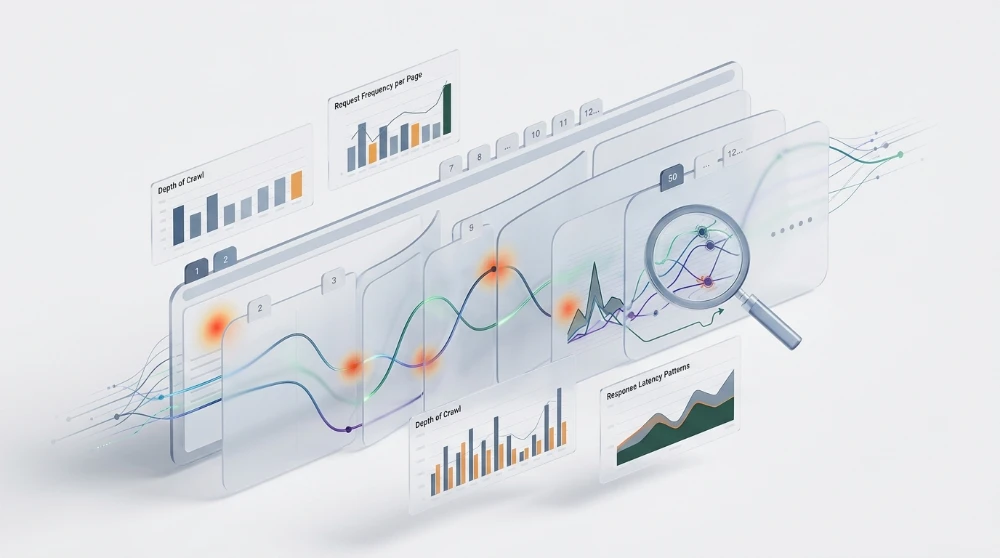
Resolving site structures causing nested indexation bottlenecks requires a strict evaluation of how Googlebot allocates crawl capacity across deeply tiered architecture. Websites exceeding a Site Depth of four clicks from the root domain regularly drop from the crawl queue. A standard e-commerce platform with layered category filters can generate thousands of parameter strings. These paths consume server resources and force search engine bots to abandon the crawl before reaching the actual product pages.
Crawl-budget waste occurs when a search engine spends its allocated time fetching low-value or infinitely looping URL paths instead of indexing primary content. Deeply nested folders create a hierarchical trap. Search engine crawlers operate on an allocated time limit per domain based on server response times and historical limits. Every additional subdirectory in a URL string forces the bot to process another layer of relative links. This architectural flaw directly degrades performance. High priority pages remain undiscovered while bots crawl empty category pagination.
Identifying these architectural constraints requires tracking specific performance indicators within the CMS and search console data. Track these specific metrics to evaluate crawlability limits:
- Crawl Efficiency: The ratio of priority pages crawled compared to total server requests generated by bots.
- Site Depth: The exact number of clicks required to reach a specific URL from the homepage.
- Index Rate: The percentage of submitted pages that successfully appear in the SERP.
Flattening hierarchical structures reduces the physical click distance between the root domain and bottom-tier content. This required technical intervention strips unnecessary subfolders from the URL and consolidates internal link equity mapping.
Removing excessive HTML elements that generate redundant navigational links immediately tightens the site architecture. Optimized crawlability forces search engine bots to process target pages faster, directly impacting the final SEO outcome and securing a higher ROI.
Diagnosing crawlability failures in deeply nested architectures
Extracting the Page Indexing report from Google Search Console exposes exact crawl execution limits. Navigate to the Indexing section and export the primary status table. Deeply nested directory trees manifest specifically within two distinct failure categories. The data points directly to structural degradation.
'Discovered - currently not indexed' signals a severe architectural flaw. The bot parsed an inbound link and queued the URL. The system then abandoned the request to prevent server overload. Deep folder constructs inflate the crawl queue exponentially. Search engine bots hit their processing limits before reaching target pages deep in the hierarchy. 'Crawled - currently not indexed' dictates a different system failure. The bot successfully requested and rendered the HTML document. The algorithm then declined SERP inclusion. Extensive folder nesting often dilutes perceived page value. The engine algorithms discard the URL entirely.
Executing a technical audit requires Screaming Frog SEO Spider to map the physical architecture. Configure the crawler configuration to strictly follow internal pathways and mimic bot behavior. Process the entire domain structure.
- Extract the Site Architecture report to isolate the distribution of URLs across all directory levels.
- Measure Click Depth to determine the exact number of hops required from the start page.
- Measure Page Depth to count the absolute number of subdirectories rendering in the URL string.
- Cross-reference high depth metrics against search console status codes to pinpoint drop-off zones.
Discrepancies between physical clicks and directory levels highlight internal routing failures. A specific product page might sit seven folders deep. It registers a massive Page Depth. It remains undiscovered unless structural elements artificially pull it closer to the root domain.
Relying solely on frontend crawlers leaves vast data gaps. Server log analysis maps absolute Googlebot crawl attention. Extract raw access logs directly from the hosting environment. Filter these server requests specifically for search engine user agents. Map the resulting requested paths against the known CMS database.
| Diagnostic Metric | Optimal State | Failure Indicator |
|---|---|---|
| Log Hit Frequency | Daily bot requests logged on target pages | Zero requests logged over a 30-day period |
| Directory Penetration | Consistent hits registered at level 4+ folders | Crawl activity concentrated solely on the root domain |
| Status Code Distribution | Heavy concentration of 200 OK responses | Frequent 3xx chains or 4xx drop-offs mid-crawl |
This raw log data identifies massive crawl-budget waste bottlenecks. Bots frequently become trapped in infinite parameter combinations or process empty category pages within deep folder constructs. Every wasted request subtracts from the available processing quota. High-priority pages starve for crawl attention.
Comparing the server log extraction against the crawl software database isolates Orphan pages. These assets exist on the server but lack inbound structural pathways. They float entirely disconnected from the primary hierarchy. Deeply nested architectures breed Orphan pages rapidly. Legacy categories are deprecated or subfolders are renamed without proper architectural consolidation. Search engine algorithms eventually abandon these disconnected URLs.
Server-Side constraints and crawl demand optimization
Search engine crawlers do not operate with infinite resources. Every domain receives a strict crawl capacity limit derived from the historical stability of the hosting infrastructure. Hostload metrics dictate this threshold. When server response times degrade under heavy bot traffic, algorithms automatically throttle the crawl rate to prevent infrastructure exhaustion.
This automated throttling severely restricts deep site architectures.
Server load spikes during aggressive bot parallel connections. Crawlers attempt to fetch multiple assets simultaneously. Inadequate server bandwidth bottlenecks these requests. The resulting queue creates artificial delays, forcing bots to abandon deep directory traversal before reaching critical assets.
TTFB impact on crawl rate
TTFB acts as the primary governor of crawl speed. High TTFB directly shrinks the total volume of processed pages per daily allocation. Every millisecond the crawler waits for the initial byte is subtracted from the total session allowance.
TTFB latency enforces strict limits on bot behavior:
- Fast TTFB allows maximum utilization of the allocated crawl budget
- Degraded TTFB forces algorithms to terminate concurrent connections early
- Variable TTFB triggers dynamic throttling protocols
Monitor specific hostload metrics via server log analysis. Consistent response delays signal the server is struggling to compute complex CMS database queries required to render nested hierarchies.
Server-Side response protocols
HTTP status codes communicate server status directly to crawling algorithms. Frequent error responses destroy crawl demand.
| Status Code | Server Event | Crawl Impact |
|---|---|---|
| 5xx Server Errors | Server timeout or processing failure under heavy concurrent load | Immediate reduction in daily crawl capacity limit |
| HTTP 429 | Aggressive rate-limiting by security modules | Algorithms misinterpret valid restrictions as permanent server instability |
| 4XX Client Errors | Dead endpoints draining available server bandwidth | Permanent removal from the active crawl queue |
Misconfigured security modules frequently trigger HTTP 429 rate-limiting during legitimate crawl spikes. Network administrators configure firewalls to block parallel connections exceeding arbitrary thresholds. Search engine user agents hitting these rate limits register a catastrophic host failure. Crawl demand plummets instantly.
5xx Server Errors represent systemic infrastructure failure. They occur when dynamic database queries strain CPU resources during simultaneous crawler requests.
Implementing HTTP caching protocols
Processing static pages repeatedly wastes computing overhead. Implement strict HTTP caching to manage crawl demand efficiently.
Configure the server to evaluate conditional fetch requests. When a crawler requests an unchanged URL, the server must return a 304 Not Modified status code. This response contains empty body data. It confirms the asset remains identical to the cached version stored in the search engine index.
Validating caching protocols yields immediate infrastructure benefits:
- Bypasses full HTML payload generation
- Eliminates redundant database queries
- Preserves server bandwidth for discovering new assets
- Accelerates bot traversal through deep folder constructs
Leveraging 304 Not Modified responses drastically alters indexation efficiency. A single bot session processes exponentially more assets when bypassing repetitive HTML downloads. The saved bandwidth is immediately reallocated to penetrating deeper architectural levels.
URL restructuring and flattening site depth
Every additional forward slash in a URL string acts as a structural demotion. Deep hierarchy fractures crawl priority. Search engine bots allocate compute resources based on perceived asset importance. Distance from the root domain dictates that importance mathematically.
Path segments generate friction. A nested structure forcing a crawler through five distinct directory layers guarantees severe crawl drop-off. You must formulate flat URL structures to collapse this physical distance. Aggressive pruning of path segments eliminates redundant structural nodes. This accelerates bot traversal efficiency across the entire domain.
Contrast deep hierarchy directly with flat site architecture. Deep architecture relies on strict physical folder nesting. It stacks categories, subcategories, and sub-themes into agonizingly long strings. Flat site architecture decouples physical CMS folder structures from the final URL presentation. It flattens the logical path while retaining organizational sanity.
| Architectural Element | Deep Hierarchy Model | Flat Site Architecture Model |
|---|---|---|
| Path Segments | 4 to 8+ directories deep | 1 to 2 directories deep |
| Crawl Priority | Exponential decay per segment | Consolidated at root level |
| Keyword Dilution | High dilution across multiple folders | High concentration in terminal slug |
| System Overhead | Heavy path resolution requirements | Minimal string parsing |
Root domain relational logic
Top level directory mapping determines core asset visibility. Core category hubs must sit exactly one path segment away from the root domain. This asserts maximum relational priority. Eliminate intermediary taxonomy folders that provide zero search value.
Examine the URL slug construction. A deeply nested slug relies heavily on its parent directories for semantic context. When you flatten the architecture, that structural context vanishes. You must consciously preserve it. Combine critical semantic identifiers directly into a single, concise URL slug instead of spreading them across multiple folders.
Deep Structure: domain.com/products/electronics/audio/headphones/wireless-model-x
Flat Structure: domain.com/audio/wireless-headphones-model-x
The revised structure removes useless taxonomy layers. It maintains the primary category relationship while injecting the required keyword context directly into the terminal slug.
Subdirectories logic for topic clusters
Flattening does not mean dumping thousands of pages directly into the root directory. That creates chaos. Implement precise subdirectories logic for topic clusters.
Maintain a parent-child URL relationship specifically for semantic grouping. Limit this depth constraint. A topic cluster requires isolation to build thematic relevance, but it does not require endless nesting.
- Assign a single hub page to the first path segment following the root
- Place all supporting cluster pages exactly one segment beneath the hub
- Strip out date-based folder structures completely
- Remove author or contributor taxonomy directories from the path
This configuration signals clear topical boundaries to search engine bots. It achieves thematic clustering without sacrificing crawl efficiency.
In-Site migration parameters
Reducing nested URL structures fundamentally alters site topology. You must define strict in-site migration parameters before pushing changes to the production environment. Keyword targeting must survive the transition intact.
Condense the semantic value of removed folders. If a product or service page previously relied on its parent category folder to rank for a primary keyword, append that keyword to the new root-level slug. Never strip folders blindly without auditing the SERP intent attached to those removed words.
Execute the path consolidation according to these operational parameters:
- Extract all URL strings exceeding three path segments
- Identify keyword cannibalization occurring between parent folders and child slugs
- Formulate a revised slug mapping document targeting zero taxonomy redundancy
- Retain exact-match primary keywords within the final 60 characters of the URL string
- Verify the target CMS supports custom permalink structures decoupled from physical category trees
The restructuring phase redefines the operational footprint of the site. URL strings transform into highly concentrated semantic signals. Bots stop parsing meaningless navigational folders. Crawl compute applies directly to processing unique content payloads.
Consolidating link equity flow via internal navigation
Flattening the URL structure solves crawl access, but it temporarily disrupts thematic grouping. You must re-establish topical boundaries using a strict internal linking strategy. The HTML elements and their precise href attributes become the primary conductive paths for Link Equity Flow. Search engines evaluate the contextual relevance of these paths to map hierarchy without relying on deep physical directory paths.
Architecting content silos for authority distribution
Link Equity Flow naturally pools at the root domain and high-traffic entry points. Moving that authority to deeper pages demands rigid content silos. Hub pages act as the central distribution nodes. Cluster pages orbit these hubs, linked together via highly specific anchor text.
Execute silo architecture by enforcing these technical routing rules:
- Restrict outbound internal links on cluster pages to either their parent hub page or laterally related cluster pages within the exact same silo
- Strip global navigation menus of deep cluster links to prevent equity dilution across the entire site footprint
- Force top-down equity distribution by linking from the hub page directly to all child cluster pages using contextually rich anchor text
- Audit navigational links sitting in sidebars and footers to ensure they do not bleed equity into unrelated content categories
Cross-linking architectural flaws destroy the isolation required for effective siloing. When a cluster page in a server hardware silo links directly to a cluster page in a database management silo, semantic signals degrade rapidly. Bots fail to categorize the cluster. Isolate the silos. If cross-silo reference is strictly necessary, route the link through the target's hub page rather than pointing directly to the deep cluster page.
Deploying structured navigation data
Visual breadcrumbs orient the human user. Structured Navigation Data orients the bot. Injecting BreadcrumbList schema markup into the page code explicitly declares the hierarchical position of the page, completely independent of the flat URL string.
A flat site architecture relies on this markup to simulate depth synthetically. When a bot parses the BreadcrumbList JSON-LD payload, it reconstructs the parent-child relationship that was removed from the URL slug.
| Navigation Component | Implementation Method | Bot Processing Outcome |
|---|---|---|
| Primary Hub Link | In-content HTML tag with keyword anchor | Passes maximum Link Equity Flow; establishes primary semantic relationship. |
| Lateral Cluster Link | Contextual paragraph link to sibling page | Reinforces silo relevance; distributes authority horizontally within the cluster. |
| Breadcrumb Trail | BreadcrumbList schema markup | Defines precise hierarchical position; generates rich snippets in the SERP. |
| Global Header Menu | Structural href attributes targeting Hub pages only | Channels root authority to category nodes; prevents indexation bottlenecks. |
Auditing contextual relevance in navigational constructs
Site-wide links carry minimal contextual weight. Megamenus and heavy footer blocks generate massive volumes of internal links with zero contextual relevance to the source page. This floods the DOM with structural noise. Consolidate authority by pruning non-essential site-wide links.
Mitigating parameter variants and faceted navigation Index-Bloat
Faceted navigation dynamically generates infinite endpoint variations via query strings. Every applied filter multiplies the URL matrix. Search engine crawlers process these raw parameter permutations without recognizing them as identical semantic entities. This structural flaw forces the crawler into an infinite loop of duplicate content ingestion. System architecture collapses under index-bloat. Crawl capacity diverts away from revenue-generating nodes toward valueless filter combinations.
| Parameter Type | Query String Example | Architectural Impact | Resolution Protocol |
|---|---|---|---|
| Sort Options | ?sort=price_desc | Reorders identical DOM nodes; offers zero unique semantic value. | Robots.txt Disallow |
| View States | ?view=list | Modifies CSS layout payload; duplicates entire source code content. | URL Canonicalization |
| Multi-Select Filters | ?color=red&size=large | Generates thin content instances; isolates sparse product grids. | X-Robots-Tag NOINDEX |
| Session Tracking | ?sessionid=8473 | Creates infinite unique strings for identical page renders. | Parameter stripping via CMS |
Deploying URL canonicalization protocols
Engineers default to URL canonicalization to manage facet duplication. The HTML rel=canonical element maps parameter-heavy URLs back to a clean primary node. Search algorithms consolidate ranking equity to this defined master source. This mechanism handles basic parameter appending cleanly.
This protocol fails when parameter variants render fundamentally different source code arrays. If a filter combination drastically reduces the product grid count, search engines perceive a content mismatch. They ignore the canonical hint. The system registers the variant as an independent entity, causing soft-error duplicates in the SERP. Canonical tags only work reliably when the dynamic output remains substantially similar to the master template. Extreme filter permutations demand more aggressive crawl directives.
Forcing directives with robots txt and x robots tag
Blocking crawl access prevents query string duplication from exhausting crawl bandwidth. Configure Disallow directives in the robots.txt file for non-essential parameter keys. This syntax stops crawler paths at the edge of the server.
User-agent: *
Disallow: /*?sort=
Disallow: /*&price=
Disallow: /*?view=
Crawl blocks do not erase existing index-bloat. URLs already stored in the index database remain locked as anomalous search results because the crawler cannot access them to see a removal directive. External links pointing to blocked parameters force indexation regardless of the Disallow rule.
Deploy the X-Robots-Tag NOINDEX parameter directly via HTTP response headers to forcefully extract URLs from the SERP. This method bypasses the HTML payload entirely. When a bot hits a filtered URL, the server response header dictates indexation rules before the DOM renders. Configure server blocks to inject this header based on Regex matches for specific query string patterns. This guarantees immediate deindexation of chaotic facet variants.
Managing pagination constraints
Deep paginated series dilute crawl focus. Paginated URL structures require distinct handling protocols to avoid being flagged as thin content instances. Do not canonicalize paginated URLs back to the root category page. This severs the crawl path to deep inventory items and orphans the products housed on subsequent pages.
- Maintain self-referencing canonical tags on every unique paginated endpoint.
- Treat pagination parameters as unique structural nodes in the site architecture.
- Inject exact match query logic into the meta title of the paginated sequence to differentiate DOM states.
- Ensure product grids on paginated nodes maintain distinct item populations.
Resolving keyword cannibalization within faceted frameworks
Faceted navigation systems inadvertently generate landing pages targeting primary search queries. A generic category page filtering for a specific brand actively competes against the dedicated brand node. This triggers severe keyword cannibalization. Ranking models fail to identify the authoritative destination, resulting in volatile SERP placement.
Analyze query logs to identify overlapping semantic targets. Map high-demand filter permutations to static URL structures. Strip query strings from these targets and reconstruct them as discrete subdirectories within the CMS. Apply strict NOINDEX parameters to the remaining dynamic facet combinations. This forces algorithmic scoring models to evaluate only the static architectural node. Link equity consolidates immediately. Organic ranking signals stabilize.
Technical implementation of redirection protocols during flattening
Deploying HTTP 301 Permanent redirects executes the physical URL paths transition. Every legacy nested node requires a strict one-to-one mapping rule to its corresponding root-level counterpart. Failing to enforce server-level routing fragments link equity and severs established crawl paths. Algorithmic scoring models demand definitive directives to transfer historical authority signals from the deprecated URL to the new flat target.
Execute these routing rules directly within the web server configuration for maximum processing efficiency. Application-layer redirects generated by CMS plugins introduce database query latency and slow down overall response times.
Nginx and Apache configuration logic
Construct regex-based pattern matching to strip redundant subdirectories dynamically. This prevents bloated configuration files and reduces server processing load.
For Nginx server blocks, apply the rewrite directive mapped directly to the new root path.
server {
    server_name domain;
    rewrite ^/category/subcategory/product/(.*)$ /product/$1 permanent;
}
For Apache environments, modify the .htaccess file utilizing mod_rewrite syntax.
RewriteEngine On
RewriteRule ^category/subcategory/product/(.*)$ /product/$1 [R=301,L]
Preventing algorithmic routing failures
Map out redirection algorithms meticulously prior to deployment in a staging environment. Overlapping regex rules frequently trigger Redirect loops. The server repeatedly routes a request between conflicting directives until the client terminates the connection with an error state.
Redirect chains occur when legacy routing tables are not audited against the newly flattened logic. A request hits an old redirect, which points to another legacy node, before finally reaching the current destination. Each intermediary hop degrades crawl efficiency.
- Extract all existing rewrite directives from current configuration files.
- Cross-reference historical HTTP 301 routes against the new flat URL map.
- Update legacy source nodes to point directly to the final destination URL.
- Strip intermediate hops from the server logic entirely.
Managing deprecated nested URL structures
Not all deeply nested structures map cleanly to a flat equivalent. Discarding irrelevant parameter combinations or obsolete category tiers requires explicit server status codes. Redirecting dead nodes to the homepage is a critical architectural flaw. It generates Soft 404 errors. Search engines misinterpret these localized soft-error duplicates, forcing crawlers to evaluate irrelevant content.
Eliminate Soft 404 errors by configuring the server response headers accurately. Returning a 200 OK status on a customized error page wastes crawl capacity. Ensure the CMS framework is not overriding server blocks with application-level success responses on empty category grids.
| Status Code | Server Directive Context | Crawl Behavior Impact |
|---|---|---|
| HTTP 301 Permanent | One-to-one URL migration | Transfers equity and updates index target immediately. |
| HTTP 410 Gone | Resource permanently deleted | Immediate deindexation and precise crawl path termination. |
| HTTP 404 Not Found | Resource not found | Gradual deindexation over multiple subsequent crawl passes. |
Handle HTTP 410 Gone statuses for deprecated Nested URL structures when the content holds zero semantic value in the new architecture. The HTTP 410 directive actively instructs the crawler to drop the resource from the index immediately. Rely on HTTP 404 Not Found only for transient errors or resources that might theoretically be reinstated. Verify the exact status code transmitted to the bot by inspecting server headers directly.
Post-Restructure validation and indexation monitoring
Force crawler focus onto the newly flattened architecture immediately by deploying XML sitemaps with dynamic
<lastmod>
tags. Hardcoding modification dates generates false signals, prompting bots to fetch stale resources and waste crawl capacity. Tie the
<lastmod>
node directly to the CMS database update timestamp. When a restructured category grid receives new items, the sitemap must instantly reflect the precise second of that change. This granular accuracy commands priority within the crawl queue.
Query the Search Console API to extract bulk indexation statuses. Standard interface reports often lag and limit data export during massive structural changes. Automating data extraction allows for precise tracking of Index rate recovery across the new URL paths. Isolate the exact timestamp the crawler processes the new routing directives.
- Run API batch requests to map the transition status of deprecated structural nodes.
- Validate crawl queue processing speeds by measuring the time delta between sitemap ping and the initial server hit.
- Monitor Unique pages indexed against the predefined target volume of the flat architecture.
Divergence between the expected flat URL count and the active index signals lingering parameter bloat or failed redirection logic. Single path anomalies require immediate inspection. Deploy the URL Inspection Tool to execute spot checks on critical hubs. Identify render-blocking scripts or canonicalization conflicts preventing the target node from entering the index.
| Validation Method | Primary Diagnostic Tool | Target Metric | Execution Frequency |
|---|---|---|---|
| Bulk Status Extraction | Search Console API | Index rate recovery | Daily |
| Single Path Verification | URL Inspection Tool | Rendering and canonical status | On-demand |
| Crawl Trajectory Mapping | Server Log Analysis | Search engine crawlers penetration depth | Weekly |
Do not guess bot behavior based on front-end metrics. Conduct follow-up Server log analysis. Parse the raw access logs to verify Search engine crawlers penetration depth. If the crawler consistently terminates sessions before hitting the newly nested target nodes, the flattening implementation holds residual friction. Look for consecutive HTTP 200 OK responses on the new URL patterns paired with absolute zero requests to the legacy paths. A persistent crawl request to a deprecated path indicates external backlinks or lingering internal links pointing to the old structure.
Track Organic ranking signals closely during the initial stabilization phase post-migration. Fluctuation is expected as equity transfers between old and new paths. Severe ranking drops point directly to broken canonical chains or missing internal equity links within the restructured silos.
Monitor Core Web Vitals stability post-migration. Structural DOM modifications applied during the flattening process frequently introduce hidden performance bottlenecks. Track field data to ensure performance metrics remain within required thresholds on the updated templates. A perfectly indexed flat architecture fails if the updated layout degrades the underlying user experience signals.