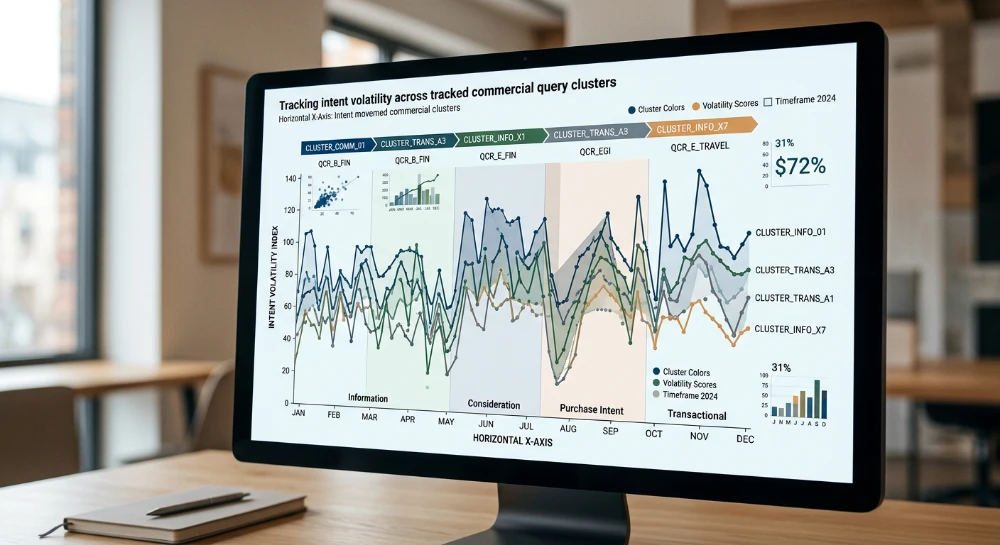
Accurate observation of commercial volatility within tracked intent clusters requires precise measurement of algorithm shifts affecting transactional queries. Search engines frequently adjust the semantic weighting of ranking factors, causing immediate displacement of previously stable positions. A sudden drop in CTR on high-converting pages often signals a change in how algorithms interpret the exact same query, replacing product grids with text-heavy guides. Traffic drops occur not because the underlying HTML degraded, but because the core classification engine shifted its preference.
Intent volatility measures the frequency and magnitude of changes in the dominant user intention rewarded by search algorithms. The calculation relies on continuous SERP monitoring. When an algorithm update recalibrates token attention scores, queries previously classified with commercial intent may suddenly favor a highly specific informational vector. This semantic recalibration directly alters the structural differential of the search results. Measuring the exact URL ranking history against these layout changes isolates intent shifts from standard SEO turbulence.
Protecting project ROI dictates establishing a rigid system architecture for anomaly detection. Pulling localized, high-frequency ranking data requires configuring the DataForSEO API to extract live metrics without geographic caching delays. Combining this live stream with historical volume datasets from the Semrush API and backlink velocity metrics from the Ahrefs API creates a unified monitoring warehouse. Engineers feed this telemetry directly into the active CMS to trigger automated layout recalibrations based on real-time ranking data.
An effective anomaly detection setup establishes specific KPI thresholds across the semantic core to flag classification changes. Core tracking vectors mapped during the ingestion phase calculate the exact scope of algorithm displacement:
- Commercial intent probability metrics showing the percentage of transactional features currently active.
- Informational vector dominance highlighting the integration of knowledge panels and definition blocks.
- Structural differential values measuring the physical pixel displacement of standard organic links.
- SERP similarity score variance indicating a complete algorithmic swap of the historical top-ranking domains.
Architectural foundations of algorithmic query interpretation and intent volatility
Modern NLP search systems process queries as mathematical coordinates rather than string literals. The transition to transformer-based natural language understanding dismantled legacy exact-match paradigms. Search engines now parse syntax through multiple layers of neural networks to extract contextual meaning. This architectural shift relies heavily on mapping terms into a rigid mathematical structure.
Lexical density no longer dictates relevance.
Every submitted query undergoes immediate tokenization. Text is fragmented into distinct tokens before passing through the encoding layers of models like BERT. Bidirectional evaluation allows the system to process surrounding context simultaneously. The engine assigns attention scores to these tokens. High attention scores indicate strong contextual dependencies between specific words regardless of their physical proximity within the query string. These scores dynamically adjust transformer model weights during the evaluation phase.
Mapping semantic embeddings in High-Dimensional space
Generative interpretation models convert query tokens into semantic embeddings. These embeddings exist as floating-point arrays within a high-dimensional space. The exact spatial location of an embedding represents its semantic footprint. Distance calculations between points in this vector space determine topical proximity and query relevance.
Large Language Models plot these coordinates to cluster conceptually similar queries.
Relying on LLM architecture allows search systems to continuously recalculate distances based on real-time data ingestion. When systemic weights shift during algorithm updates, the spatial coordinates of specific query embeddings move. This movement directly alters the SERP layout.
| System Architecture | Processing Mechanism | Intent Calculation Method |
|---|---|---|
| Legacy NLP search systems | String matching and entity extraction | Static keyword databases |
| Transformer architecture | Tokens and attention scores | Vector space proximity |
| Generative interpretation models | Semantic embeddings mapping | Dynamic probability scoring |
Defining user intent probability thresholds
Intent classification operates on fluid probabilities rather than rigid categories. Search engines calculate user intent probability thresholds for every processed query. A single query might register a 65% commercial intent probability and a 35% informational intent probability. If the commercial probability drops below a system-defined threshold during a core update, the engine automatically purges transactional URLs from the SERP.
- Calculated distance between query semantic embeddings and known commercial document clusters dictates the baseline probability.
- Attention scores applied to specific modifier tokens force threshold recalibration across the entire results page.
- Transformer model weights update continuously based on aggregated click telemetry and session success rates.
Volatility occurs when algorithmic thresholds adjust. A previously stable SERP fractures because the underlying classification engine shifts its weight distribution. System engineers must monitor these probability fluctuations directly. Tracking token displacement and vector space shifts provides the necessary diagnostic data for diagnosing intent-based ranking drops before deploying layout modifications.
Structuring commercial query clusters via High-Dimensional intent classification
Query grouping requires strict mathematical boundaries. Relying on lexical similarity fails. Keyword Clustering routines must process query sets through multidimensional vector space analysis rather than simple string matching. We map search terms to specific coordinate points. This spatial distribution exposes the true intent distribution of a target keyword list.
System architecture demands precise Document cluster parameterization. Parameters dictate spatial thresholds. If the coordinate radius is too loose, transactional pages compete directly with educational resources in the index. Setting tight radius parameters ensures URL grouping aligns exclusively with highly specific coordinate clusters. Intent classification algorithms evaluate these plotted coordinates to enforce boundaries and route the user to the correct landing page template.
Segregating mixed user intent
Most high-volume queries trigger Mixed User Intent. The classification engine detects competing signals within the identical token sequence. A user querying server deployment might require installation documentation or enterprise licensing pricing. The search system must resolve this ambiguity.
| Classification Node | Vector Trajectory | System Architecture Target |
|---|---|---|
| Commercial intent | High proximity to vendor datasets | Pricing matrices and procurement portals |
| Action-driven intent | Alignment with execution endpoints | Checkout gateways and configuration engines |
| Informational intent | Proximity to technical documentation | Knowledge bases and specification sheets |
Separating these clusters requires isolating the Informational vector from the Commercial vector. The informational vector directs query weight toward educational datasets. The commercial vector pulls the query toward transactional processing systems. Algorithms detect competing vectors with near-equal magnitude and split the SERP layout accordingly.
Processing fragmented user intent
Fragmented user intent occurs when vector magnitudes fail to establish a dominant classification. The search system defaults to a highly unstable mixed output state. URL targeting breaks down entirely if internal site architecture ignores this fragmentation. Attempting to force a strict commercial page into a highly fragmented cluster results in rapid position decay.
- Query nodes mapping heavily to the informational vector require dedicated glossary or guide configurations.
- Nodes aligned with the commercial vector demand immediate pricing or conversion gateways.
- Intersecting nodes necessitate hybrid page structures featuring both transactional elements and dense technical documentation.
Engineers must integrate an Identify Intents tool within their processing pipeline to scan the entire semantic core. This utility extracts probability distributions for every tracked query. Scheduled scans capture spatial shifts before they destabilize established rankings. Output logs from the Identify Intents tool provide the raw coordinate data needed to adjust Document cluster parameterization dynamically.
Cluster mapping is never static. Processing pipelines must continuously recalibrate as algorithms assign new weights to historical tokens. Tracking the divergence between the informational vector and the commercial vector dictates when a specific URL must transition from an educational format to an action-driven layout.
Configuring API pipelines for continuous SERP monitoring and volatility tracking
Relying on manual UI exports constitutes a severe architectural flaw. Manual extraction introduces latency. Engineers must deploy robust data ingestion pipelines to process raw JSON payloads directly into centralized data warehouses. Polling search engines at high frequency captures micro-fluctuations before they cascade into widespread system failures.
Integration routes require strict mapping across the DataForSEO API, the Semrush API, and the Ahrefs API. Each system handles specific telemetry vectors necessary for building a three-dimensional model of ranking stability.
Data ingestion and endpoint routing
Cron jobs must trigger specific endpoints to maintain an accurate spatial model of the search results. The DataForSEO API delivers real-time payload data directly from the SERP Volatility Tracker. Configure this endpoint to pull hourly logs. Daily batch processing masks the exact timestamps of positional decay.
The Semrush API drives the Position Tracking modules. Push requests to its batch endpoints to extract cluster-level movement and isolate unstable query nodes. The Ahrefs API supplies the Rank Tracker data necessary for cross-referencing domain visibility metrics against individual URL performance.
Routing architecture must isolate these incoming streams to prevent bottleneck issues during data transformation. The following table outlines standard endpoint configuration patterns for continuous extraction.
| System Provider | Target Endpoint | Primary Telemetry | Extraction Protocol |
|---|---|---|---|
| DataForSEO API | SERP Volatility Tracker | Global landscape turbulence | High-frequency polling |
| Semrush API | Position Tracking | URL coordinate shifts | Scheduled batch processing |
| Ahrefs API | Rank Tracker | Historical visibility indices | Delta-based extraction |
Aggregating algorithm weather telemetry
Internal tracking data requires environmental context. Without external benchmarks, a local traffic drop mimics a global algorithm update. Aggregating telemetry from established algorithm weather tools provides the critical baseline for comparison.
Ingest normalized indices from Semrush Sensor, MozCast, AccuRanker, and Algoroo. These platforms quantify broader SERP fluctuations across thousands of untracked queries. Funnel these external metrics into the same database housing the Google Search Console log exports.
Engineers must configure the ingestion pipeline to parse the distinct data structures of each weather tool.
- Semrush Sensor requires parsing categorical volatility scores to isolate shifts within the specific commercial niche.
- MozCast outputs a single temperature metric serving as a macro algorithmic turbulence indicator.
- AccuRanker and Algoroo provide granular delta metrics indicating exactly how much of the index reorganized within a rolling window.
- Google Search Console query logs validate whether external turbulence physically impacted actual click yields.
Calibrating alert thresholds for SEO volatility
Raw data accumulation without automated alerting leads to analytical paralysis. System administrators must set strict thresholds for SEO volatility to filter out standard background noise. Alert fatigue occurs rapidly when pipelines trigger warnings for minor positional swaps.
Metrics require distinct triggering mechanisms based on cluster density. Single keyword flux operates on a tight threshold model. If a high-volume anchor query drops significantly within a single crawl interval, the system dispatches an immediate alert. This localized system failure typically indicates a technical error, a broken internal link structure, or an aggressive competitor deployment.
Multi-keyword flux demands a wider standard deviation trigger. Entire semantic clusters rarely move in unison unless the search engine reweights core ranking factors. Thresholds for Multi-keyword flux must calculate the aggregate coordinate shift of all associated targets. Set algorithms to compute the median displacement across the entire tracked cohort.
Configure the alerting logic to assess the intersection of internal and external data flows. When internal Multi-keyword flux aligns perfectly with a massive spike in MozCast or Algoroo telemetry, the system logs a confirmed algorithmic update and suppresses localized panic. When internal flux occurs during periods of low external SERP fluctuations, engineers must initiate immediate technical audits to locate the internal bottleneck causing the decay.
Diagnostic analytics for detecting commercial semantic shifts and SERP layout changes
Search algorithms routinely manipulate visual hierarchies before altering underlying organic rankings. When search engines inject heavy multimedia modules above the traditional organic stack, standard positional tracking becomes functionally obsolete. You must systematically monitor SERP Layout Shifts to understand actual market visibility. A URL maintaining the number one numerical position holds zero commercial value if pushed below the fold by aggressively expanded elements.
Visual displacement dictates commercial viability.
Engineers must execute Visual displacement audits at scale. This requires parsing the raw HTML of the results page and measuring the absolute pixel depth of the first true organic link. Track the Active layout configuration for all primary revenue-driving clusters daily. Search engines dynamically adjust these grids based on real-time query categorization. If a query suddenly triggers a Transactional SERP layout featuring dense product carousels and local inventory feeds, the organic click yield will plummet instantly.
Algorithms frequently deploy a Split layout to resolve ambiguous queries. This configuration divides visual real estate between direct e-commerce category pages and informational buying guides. When a keyword moves into a Split layout, exact-match commercial URLs often bleed traffic to long-form editorial content positioned adjacent to them.
Execution of differential diagnostics
Standard rank tracking provides incomplete telemetry. System administrators must execute Structural differential calculations to quantify the gap between the historical visual baseline and the live rendering. This mathematical model evaluates the presence, absence, and coordinate positioning of all injected modules.
| Layout Metric | Diagnostic Purpose | System Impact |
|---|---|---|
| SERP Features | Identifies newly injected grid components | Pushes organic results downward increasing pixel depth |
| Rich Snippets | Measures markup extraction success | Directly alters visual footprint and CTR density |
| Position zero rendering | Tracks featured extraction blocks | Bypasses standard ranking mechanics entirely |
Quantify Position flipping within the tracked cluster. Two internal URLs constantly trading places for the same query signals a severe canonicalization failure or an intent cannibalization issue. The search engine cannot determine which page satisfies the commercial vector. Left unresolved, continuous Position flipping usually precedes a total algorithmic demotion of both assets.
Monitor Position zero rendering relentlessly. Earning or losing a featured extraction block causes immediate traffic whiplash. System pipelines must flag any disappearance of these elements as a critical incident requiring immediate on-page technical review.
Lexical syntax and token alignment
Search engines rewrite display titles and description blocks based on their interpretation of the query vector. You can reverse-engineer semantic shifts by analyzing what text the engine chooses to display.
- Extract all rendered text strings from the live search results via API.
- Calculate Lexical syntax extraction rates by matching the rendered text against your raw source code.
- Isolate which specific paragraphs or headers the algorithm prioritizes for display.
If the engine suddenly stops extracting product specifications and begins pulling generic definitional text from your page, the core algorithmic intent has shifted away from a commercial transaction. Compare these live extraction patterns against Historical token alignment scores. A massive deviation from historical token patterns indicates the engine now views the query through a different semantic lens.
Cross-reference these layout anomalies using the SERP similarity score. High layout volatility combined with a high similarity score across core URLs suggests a visual interface test rather than a foundational algorithm update. The search engine is merely testing new pixel arrangements on the same set of recognized entities. If the similarity score drops simultaneously with massive structural changes, a fundamental algorithmic shift in query processing has occurred.
Analyzing user behavior signals and traffic anomalies during algorithm updates
Core Update deployments routinely trigger massive traffic anomalies before position tracking tools register any keyword drops. You must monitor User Behavior Signals immediately during the initial rollout phase. The ranking holds. The traffic tanks. The interface changed.
Analyze the Transactional click behavior across your most profitable clusters. Users alter their click patterns the moment new query interpretations surface different visual elements on the page. Calculate the exact Organic CTR delta. Pull the percentage shift between a 14-day pre-update window and a 14-day post-update baseline via API. A severe negative Organic CTR delta on completely static rankings dictates immediate structural displacement. The engine pushed your result below the fold.
Cross-Referencing Post-Click telemetry
Engagement Metrics provide the raw data required to diagnose semantic mismatch. When a search engine alters its intent threshold for a query, the demographic profile of the incoming user changes. This manifests instantly in post-click server logs.
- Extract Pogo-Sticking rates by matching entry timestamps against rapid exit return events. High Pogo-Sticking confirms the user hit your page, found a semantic mismatch, and immediately bounced back to the search results.
- Audit Dwell Time drop-offs across affected URL clusters. Calculate the exact second mark where user exit rates accelerate disproportionately compared to historical baselines.
- Monitor the absolute Conversion Rate delta. A steady flow of Organic clicks paired with a cratering Conversion Rate indicates a systemic algorithmic shift from transactional intent to informational intent.
If the Organic CTR delta remains flat but the Bounce Rate spikes overnight, the landing page architecture no longer satisfies the algorithmic intent of the routed user. The search system is sending top-of-funnel informational traffic to a bottom-of-funnel transactional endpoint. The user abandons the session.
Mapping behavioral variables to diagnostic overlays
Do not view behavioral data in a vacuum. You must overlay engagement anomalies directly onto Position History Charts to identify the exact inflection point of a rollout. Map these variables to isolate the technical failure point.
| Behavioral Metric Node | Correlated Ranking Variable | Diagnostic Outcome |
|---|---|---|
| Organic CTR delta | Visibility Score | Interface displacement or snippet extraction failure |
| Conversion Rate | Core Keyword Performance | Shift in query categorization away from commercial intent |
| Engagement Metrics | ROI | Degradation of incoming traffic quality despite stable positions |
A high Visibility Score means nothing if the underlying ROI collapses due to poor traffic alignment. Evaluate Core Keyword Performance strictly alongside revenue telemetry. When the algorithm alters the semantic weighting of a query, the quality of the Organic clicks changes instantly.
Isolating telemetry via server logs
Look at the raw request data. Traffic anomalies manifest in server access logs hours before third-party analytics dashboards process the sessions. Isolate the exact request paths driven by organic referrers. Parse Dwell Time and Bounce Rate at the log level to bypass client-side script blockers and track the exact request sequence. Systemic drops in authenticated user sessions post-click validate a fundamental algorithmic disruption in how the engine perceives your commercial utility.
Impact of search generative experience and AI overviews on intent probability thresholds
Raw request data reveals the silent displacement of organic sessions. Search Generative Experience fundamentally rewires query parsing logic. Standard intent probability thresholds collapse when AI Overviews intercept the user journey before a client-side click even registers on the server log. The engine resolves the query directly within the interface.
AI Search Volatility requires completely new diagnostic frameworks. Traditional flux metrics fail here. You must track exact instances where generative modules inject themselves into the layout, displacing standard extraction targets. The algorithm overrides historical intent mappings. It forces an immediate recalculation of probability matrices based on synthesized answers rather than direct index retrieval. Your architectural focus must pivot from traditional indexing parameters to generative extraction compliance.
Configuring integration logic for answer engine optimization
Answer Engine Optimization abandons traditional keyword density models. AI Search Optimization demands explicit data structures built for immediate parsing. Generative models construct responses based on node proximity within established data sets rather than string matching. Extracting value requires feeding precise logic sequences directly into the parsing engine.
Implement strict architectural controls for generative compliance.
- Map schema properties to enforce strict parent-child node relationships.
- Deploy critical data arrays in raw HTML tables for direct parser extraction.
- Align heading syntax precisely with target query semantic structures.
- Inject primary entity markers within the initial text nodes of the document.
Entity co-occurrence density and knowledge graph mapping
Entity Clarity determines inclusion in the synthesized response. Ambiguity triggers instant module exclusion. Calculate Entity Co-occurrence Density by parsing the frequency of relational nodes within the local semantic neighborhood. A high density configuration signals extreme relevance to the generative parser. The system requires zero inference.
Entity Recognition must map flawlessly against established Knowledge Graph structures. The algorithmic engine attempts to link the specified on-page entity to a verified Knowledge Graph identifier during crawl time. Failure to resolve this link causes the module to drop the domain from the reference array entirely. AEO depends entirely on this exact resolution step.
Diagnostic parameters for entity validation dictate structural priorities.
| Diagnostic Metric | Measurement Parameter | Optimization Target |
|---|---|---|
| Entity Co-occurrence Density | Target node frequency versus contextual noise | High proximity to secondary validation nodes |
| Entity Clarity | Disambiguation confidence score | Exact match to established system identifiers |
| Entity Recognition | Extraction latency during crawl operations | Instant algorithmic validation without fallback |
Continuous monitoring of these specific structural vectors isolates extraction failures. Generative engines demand absolute semantic precision. Systemic ambiguity causes immediate domain exclusion from the reference pool. Optimize the data framework to feed the algorithm exactly what it requires for zero-latency entity resolution.
Engineering content infrastructure to mitigate fragmented user intent and intent gaps
Intent gaps expose critical architectural flaws within the semantic core. When a target page fails to satisfy secondary query variations, the routing engine drops the URL from active rotation. System failure occurs instantly. You lose the session. Mitigating this requires an infrastructure designed to capture and process fragmented intent strings before they trigger a session termination.
Deploy aggressive Content refreshing protocols to prevent node decay. Stale URLs degrade the entire cluster configuration. Set automated triggers based on specific degradation thresholds within your analytics dashboard. When a URL drops below the baseline retention limit, initiate Landing Page Optimization routines immediately. Restructuring the HTML syntax to match shifting user demands prevents indexation drops.
| System Trigger | Degradation Metric | Execution Protocol |
|---|---|---|
| Intent Score Decline | Negative delta exceeding 15 percent over 30 days | Inject missing Long-tail Keywords into subheading structures |
| Topic Consumption Drop | Fewer than 1.2 pages per session within the silo | Realign internal linking pathways and modular navigation arrays |
| Signal Fragmentation | Multiple competing intents detected on a single URL | Deploy segmented UI blocks to isolate specific Intent Signals |
Topical authority models and cluster architecture
Topical Authority models dictate the cluster hierarchy. You cannot bypass semantic depth requirements. Group interconnected queries through precise Topic clustering methodologies. Map every URL within the CMS to a specific functional node. The crawler demands a logical path.
Evaluate Topic consumption intensity continuously. This metric determines how deeply users interact with interconnected pages within a specific cluster. High intensity validates the silo architecture. Low intensity indicates a disconnected semantic flow. Assign a strict Intent Score to every document to quantify its relevance against the primary query vector.
Auditing external vectors and E-E-A-T framework compliance standards
Trust operates as a hard algorithmic filter. E-E-A-T framework compliance standards require explicit data verification. If the crawler cannot validate the entity behind the content, the domain faces suppression. Verifying this requires auditing specific off-page data pipelines.
- Extract Competitor Analysis vectors to identify semantic gaps in rival architectures.
- Audit Backlinks for exact semantic relevance rather than raw domain metrics.
- Cross-reference Citations against established industry databases to confirm entity data consistency.
- Monitor Brand authority by parsing the ratio of exact-match brand queries to generic category searches.
Integrate Long-tail Keywords aggressively into the supporting cluster nodes. These specific strings capture isolated user demands that the primary hub page cannot process. Structuring the content hierarchy to address every fragmented query ensures total topical coverage. The system demands absolute completeness. Optimize the architecture to leave zero dead ends.