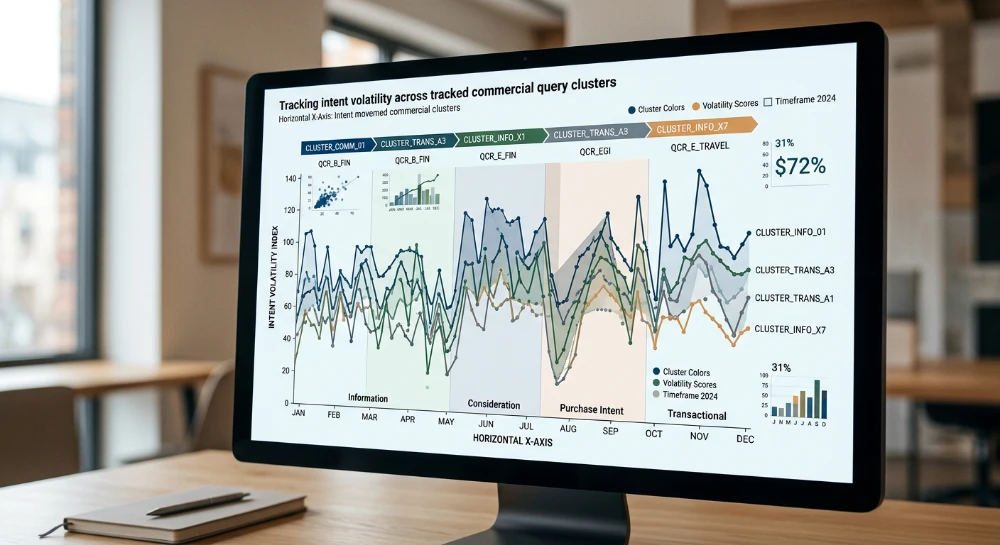
Search engine algorithms frequently reclassify query interpretation models, resulting in commercial semantic shifts changing informational intent across localized search results. A query previously triggering Wikipedia and blog posts will pivot to display Shopping Boxes and product grids when the Google RankBrain algorithm detects a 15-20% increase in transactional click behavior. This volatility requires an analytical framework relying on DataForSEO API endpoints to isolate the exact moment an informational vector converts into a transactional SERP layout.
Detecting these transitions requires configuring daily rank tracking combined with entity recognition parameters. Google Knowledge Graph connects entities through vectors of meaning rather than exact keyword matches. When search algorithms process high CTR on product-focused markup within an informational SERP, they rapidly inject commercial features. Webmasters must implement Product Schema.org and Article Schema.org side-by-side to maintain visibility during these algorithmic transitions. Automated alerts triggered through the Semrush API flag layout volatility the moment Sponsored Listings replace Featured Snippets.
Organic CTR drops sharply when intent mismatch occurs. Positions in the top-3 of Google organic search capture over 50% of all clicks for an informational query, but this metric collapses to under 10% if a Free Product Listing carousel pushes organic text links down the page. Tracking these semantic shifts demands continuous structured data validation against the active layout configuration.
Algorithmic query interpretation: Modeling intent transitions in search engines
Search engines do not read text. They calculate the distance between mathematical vectors. Transformer-based natural language understanding converts search queries into a high-dimensional space where words function as coordinates. RankBrain adjusts the weights of these vectors based on macro-level query log data. BERT processes the bidirectional context of the string, assigning attention scores to individual tokens. Meaning matching occurs when the user query vector aligns with the vector of a specific document cluster. If the query vector drifts toward a cluster dense with transactional entities, the algorithmic intent classification flips.
LLMs fundamentally altered this classification pipeline. Early systems relied on static entity recognition dictionaries. Generative interpretation models now dynamically predict user intent probability thresholds in real time. Take an ambiguous query. The system calculates fragmented user intent. The algorithmic response forces a split layout. Half the page satisfies the informational vector. The remaining nodes test the commercial vector.
Mapping algorithm updates to semantic intent shifts
Core updates continuously recalibrate the threshold for semantic intent shifts. Algorithm updates modify the underlying transformer model weights, forcing a recalculation of historical relevance scoring metrics. A query holding an 80% informational probability threshold can drop to 30% overnight when new neural network parameters deploy. The interpretation model determines that the user intent has transitioned, triggering an immediate layout reconfiguration.
Differentiating these intents requires the search engine to process specific machine-readable signals embedded within the query syntax and the candidate documents.
| Signal Parameter | Informational Intent Vector | Commercial Intent Vector |
|---|---|---|
| Entity Co-occurrence Density | High density of abstract conceptual entities and historical nodes | High density of product-specific entities, brands, and monetary nodes |
| Transformer Attention Weights | Heavy weighting on interrogative tokens and knowledge-seeking modifiers | Heavy weighting on transactional verbs and comparative adjectives |
| Document Structure Recognition | Preference for deep text nodes and hierarchical heading structures | Preference for grid arrays, tabular data structures, and pricing tables |
| Knowledge Graph Proximity | Close proximity to academic nodes and reference repositories | Close proximity to merchant entities and manufacturer databases |
Evaluating vectors of meaning
Meaning matching transcends simple lexical similarity. Search algorithms utilize vectors of meaning to group semantically identical concepts regardless of the actual string characters submitted by the user. If a commercial node gains prominence in the knowledge graph for a specific entity, the interpretation model shifts the entire query cluster toward a transactional classification. The natural language processing parameters adapt to the evolving relationship between the entity and its real-world application.
Engineers configure relevance scoring metrics to differentiate informational intent from commercial intent based on the following algorithmic signals.
- Attention mechanism weighting on specific syntax modifiers within the query string.
- Knowledge graph entity proximity scores calculating the distance between the query and known merchant nodes.
- Lexical syntax extraction rates evaluating the ratio of transactional verbs to informational nouns.
- Dynamic intent probability thresholds generated by real-time LLMs evaluating query ambiguity.
- Historical token alignment scores matching the current query against previously classified intent vectors.
Fragmented user intent requires continuous algorithmic adjustment. When BERT or newer LLMs detect multiple conflicting vectors within a single query, the relevance scoring metrics divide the probability. This division creates hybrid interpretation models where the search engine simultaneously attempts to satisfy research, comparison, and purchasing behaviors within a single loaded interface. The dominant vector dictates the primary layout configuration, while secondary vectors populate localized features.
Configuring telemetry for SERP layout volatility and feature tracking
Static rank tracking fails when search engines output dynamic, intent-driven layouts. Engineers must deploy telemetry systems capable of capturing the precise moment an algorithm injects a commercial module into an informational query space. This requires capturing the entire DOM tree at regular intervals. Telemetry pipelines log these structural rendering shifts to measure semantic intent recalibration in real time.
Deploying High-Frequency data pipelines
Monitoring rendering shifts demands programmatic access to raw output data. Relying on cached reporting masks the intra-day volatility characteristic of algorithmic intent testing. You configure hourly and daily data ingestion pipelines using DataForSEO, the Ahrefs API, or the Semrush API. These pipelines parse the precise structural composition of the loaded page.
Daily rank tracking establishes the baseline. Hourly rank tracking acts as the diagnostic layer when commercial layout insertions spike.
You must configure webhook endpoints to trigger automated alerts when the data pipeline detects specific structural anomalies. Automated alerts isolate algorithmic testing phases before they stabilize.
- Sudden displacement of the top organic text node by Shopping Boxes.
- Injection of Free Product Listings above the algorithmic fold.
- Disappearance of a stable Featured Snippet in favor of Sponsored Listings.
- Expansion of related query clusters containing highly commercial syntax modifiers.
360-Degree SERP analysis and big SERP data aggregation
Tracking traditional organic positions provides incomplete telemetry. 360-Degree SERP Analysis demands logging every visual node and DOM element returned for a monitored query. You execute big SERP data aggregation to parse the JSON responses from tracking APIs and map the exact coordinate position of layout insertions.
Query interpretation changes leave structural footprints in the HTML response. When a query shifts toward a transactional classification, the engine suppresses text-heavy nodes. It elevates modular commerce elements.
| Layout Feature | API Detection Logic | Algorithmic Implication |
|---|---|---|
| Shopping Boxes | Parsing product grid arrays in the API response payload | Direct product comparison intent overriding informational research intent |
| Sponsored Listings | Counting ad slots preceding organic HTML nodes | High commercial value and competitive bidding volume dominating the query space |
| Free Product Listings | Extracting merchant feeds embedded in the organic stack | Algorithmic transition toward hybrid organic commerce layouts |
| Featured Snippets | Detecting paragraph or list extraction at position zero | Informational vector dominance maintaining priority over transactional nodes |
Executing universal ranking analysis
Isolating interpretation changes requires Universal Ranking analysis. You extract the aggregated layout data to map the lifecycle of a query cluster. If a query historically returned ten organic articles and suddenly renders three Sponsored Listings and a Shopping Box array, the interpretation model has flipped.
SERP Volatility Tracking isolates the blast radius of these rendering flips. Tracking platforms report high SERP Volatility Tracking metrics localized to specific topical clusters. This signals a systemic algorithmic recalibration of intent weights rather than individual domain ranking fluctuations. Engineers pipe this volatility data into centralized data warehouses to cross-reference commercial layout insertions against URL visibility drop-offs.
Continuous SERP Monitoring catches the exact timestamp of the layout shift. You parse the structural differences between the pre-shift and post-shift rendering outputs. The resulting structural differential exposes the updated relevance thresholds dictated by the search engine.
Analyzing user interaction metrics to detect intent mismatch
When ranking models alter layout composition, historical traffic baselines degrade. Users land on a URL expecting a transactional interface but encounter a purely informational guide. This friction generates negative behavioral logs. Search engines ingest these specific interaction metrics to downgrade URL relevance against the newly updated query interpretation.
Isolating intent mismatch requires strict KPIs for user behavior signals. Relying on raw traffic aggregates masks the underlying interaction failure. You must track distinct granular metrics at the URL level to diagnose the exact point of user abandonment.
- Organic CTR: A sharp drop without ranking degradation indicates visual displacement by new layout elements.
- Dwell Time: Shortened session duration on comprehensive guides suggests users demand rapid transactional endpoints rather than deep reading.
- Pogo-sticking: Users click the URL, immediately return to the search engine, and click a competing commercial node.
- bounce rate: High single-page abandonment without triggering secondary navigational events.
- Conversions: Direct monitoring of primary event triggers failing disproportionately compared to the baseline traffic drop.
- ROI: Downstream financial impact tracking mapped against ongoing content acquisition and maintenance costs.
Deploying session recording analysis
Quantitative data highlights the drop-off point. Qualitative data explains the interaction failure. You deploy session recording analysis via Microsoft Clarity to observe actual user navigation patterns during an intent shift. Engineers embed the tracking snippet directly into the CMS header to capture raw interaction logs.
Watch for rage clicks on non-clickable informational elements. A user furiously clicking a static product image within a blog post indicates they expect a direct add-to-cart function. Evaluate scroll depth metrics. If users hit the 15 percent scroll threshold, trigger a bounce, and exit, the page copy fails the immediate intent check. Microsoft Clarity exposes these specific failure points across desktop and mobile device configurations.
Correlating traffic anomalies with layout variations
Traffic decay misleads analysts into diagnosing algorithmic penalties. The actual root cause is structural displacement. You must correlate click-through rate anomalies with SERP Layout Shifts.
Extract URL performance data via API. Map the daily Organic CTR delta against layout rendering timelines captured by tracking systems. A sudden drop in clicks without a corresponding drop in ranking position signals visual displacement. A newly inserted commercial widget pushes the organic URL below the fold. The result is a broken interaction chain.
| Telemetry Source | Interaction Signal | Architectural Flaw Diagnosis |
|---|---|---|
| Search Analytics | Organic CTR delta exceeding historical variance | Snippet visually outclassed by adjacent commercial nodes |
| Web Analytics | High Pogo-sticking volume | Content format fails immediate semantic relevance check |
| Microsoft Clarity | Aborted Dwell Time | Text density obstructs rapid transactional pathways |
Executing intent mismatch resolution
Fixing the interaction failure requires restructuring the analytics pipeline. You execute intent mismatch resolution by cross-referencing search analytics, customer journey mapping, and sales funnel progression data.
A query historically positioned at the top of the funnel might transition to a bottom-of-funnel conversion driver. If your URL still serves top-of-funnel informational copy, the conversion pipeline breaks. You overlay the updated search engine interpretation against your existing user flow maps. This exposes dead ends where the landing page structure no longer matches the user's progression velocity.
To sustain visibility over this process, formulate performance reporting structures. Build automated dashboards that fuse Organic CTR anomalies, layout volatility logs, and ROI metrics into a single viewport. Set hard conditional formatting alerts. A dashboard must trigger a critical notification when Dwell Time drops below baseline concurrently with a steep decline in Organic CTR on a high-value URL. This telemetry forces immediate engineering review.
Executing structural page redesigns for commercial layout alignment
When telemetry triggers a critical intent mismatch alert, the existing page architecture becomes an active architectural flaw. A structural page redesign is mandatory. You must refactor the DOM hierarchy to shift pixel space from dense informational paragraphs to transactional UI components. The parsing engines expect grids, pricing tables, and localized conversion pathways. Retaining an informational layout when the algorithm demands a commercial interface guarantees immediate traffic drop.
Define requirements for structural page redesign based on the specific layout components injected into the new SERP. If competitor URLs are triggering product carousels and shopping boxes, your target URL must structurally support identical data extraction. Push long-form text below the primary viewport. Elevate transactional modules to the top of the DOM. This ensures immediate parsing of commercial entities during the initial HTML rendering pass.
Deploying commercial structured data markup
Data extraction engines rely on Structured Data Markup to validate the transactional nature of a node. You must overhaul the Schema.org implementation. An obsolete schema deployment contradicts the updated visual layout and forces the crawler to resolve conflicting signals.
Strip or demote existing Article Schema. If the page was originally an overarching guide, the primary JSON-LD payload must transition to Product schema or a CollectionPage configuration. Integrate Product Feeds directly into the markup pipeline to stream real-time pricing and availability data directly to the crawler. This synchronization prevents the URL from being filtered out of commercial layout insertions.
- Change the primary entity declaration from Article to Product or ItemPage.
- Inject AggregateRating and Offers arrays to validate the transactional capability of the node.
- Deploy FAQPage Schema at the bottom of the DOM hierarchy.
- Map the FAQ schema strictly to secondary informational long-tail queries.
The FAQPage Schema catches residual informational search volume without diluting the primary commercial signal. Do not place FAQ schema above the Product schema in the raw HTML. Order dictates priority.
Refactoring the internal link graph
The internal linking structure dictates how a crawler classifies a node within the broader site architecture. An isolated commercial page mapped inside an informational silo creates a bottleneck in crawler logic. Reconfigure the internal link graph to flow from established transactional hubs.
You must manipulate entity relationships. Entity-based linking requires mapping the updated commercial URL to related product categories, checkout protocols, and warranty nodes. Sever internal links originating from top-of-funnel blog posts that use purely informational anchor text. Replace them with inbound links from high-authority product grids.
Anchor text optimization protocol
Internal anchor text optimization requires a hard pivot. The contextual surrounding text must reflect immediate acquisition rather than passive discovery. Update the text surrounding the inbound links to validate the commercial entity transition.
| Architectural Component | Legacy Informational State | Target Commercial State |
|---|---|---|
| Contextual Surrounding Text | Learn about the specifications of this system in our guide. | Check current inventory and pricing for this system. |
| Internal Anchor Text | how system works | buy system license |
| Entity Linking Hub | Glossary and Documentation | Pricing and Product Categories |
| Link Position in DOM | Footer reference or inline paragraph | Primary navigation or related product carousel |
Shift the internal anchor text profile from interrogative phrases to exact-match product modifiers. This forces the PageRank distribution algorithm to recalculate the node's position within the commercial semantic cluster.
Aligning indexable elements and mitigating spam signals
Redesigning a page for transactional intent carries high technical risk. Injecting high-density commercial keywords and restructuring indexable elements often triggers over-optimization filters. A sudden influx of exact-match commercial terms in the H1, title tags, and localized navigation menus looks like manipulation to the spam detection algorithms.
To avoid triggering spam signals, maintain strict text-to-code ratios. Ensure indexable elements align with new commercial layouts by utilizing clean, sparse HTML. Do not duplicate the primary product keyword in every table header or grid item.
Use relational entity modifiers in the headers instead of repeating the root commercial query. The algorithm extracts the commercial context from the Product Feeds and the surrounding schema framework. Overloading the visible text with transactional commands degrades the semantic integrity of the page and risks a manual action or algorithmic suppression. Balance the injection of commercial UI elements with tight, highly relevant contextual surrounding text that supports the primary entity without keyword stuffing.
Tracking SKU-Level visibility and generative engine optimization signals
Search engines now construct dynamic interfaces rather than retrieving static documents. This requires deploying AI Search Intelligence to monitor real-time rendering of hybrid SERPs. You must adapt telemetry systems to capture LLM-generated layout components.
Standard URL ranking metrics fail when the search engine generates a custom answer grid. Implement Generative Engine Optimisation.
Shift focus from document-level ranking to entity-level inclusion. Answer Engine Optimisation demands parsing conversational search queries that bypass traditional index retrieval and instead trigger direct LLM synthesis. When users submit multi-variable query strings, the system aggregates data fragments from multiple nodes into a single, cohesive interface.
Configuring AI overviews tracking
Establish strict parameters for AI Search Visibility Tracking. You must detect exactly when an AI-generated layout pushes standard organic listings below the initial viewport. This requires configuring rank tracking APIs to flag dynamic container rendering.
Extract parsing data from the DOM.
- Identify the presence of generative text containers in the initial HTML response.
- Log the citation links embedded within the LLM text output.
- Measure the pixel depth of the AI overview to calculate exact viewport displacement.
- Monitor the specific conversational search queries triggering these dynamic insertions.
Relying on standard position metrics corrupts your performance data. Position three below a generative overview yields vastly different CTR than position three on a legacy SERP layout.
Executing SKU level results tracking
Commercial queries now frequently generate dynamic organic product listings within hybrid SERPs. The algorithms construct visual product grids directly from inventory data feeds. Tracking standard page URLs is insufficient.
You must configure SKU Level Results Tracking.
Map individual product variants to specific generative output grids. When search engines compile these dynamic carousels, they pull granular attributes directly from Google Merchant Center integrations. The LLM evaluates inventory status, pricing data, and user review aggregates in real time.
To effectively Track AI Shopping features, isolate the telemetry for product grid insertions.
| Tracking Parameter | Data Source Integration | Detection Methodology |
|---|---|---|
| Product Carousel Rendering | Google Merchant Center integrations | API detection of grid-based layout components injected below the search bar |
| Citation Visibility | AI Search Intelligence | HTML parsing of source attribution links within the generated text node |
| Variant Surfacing | SKU Level Results Tracking | Matching specific product ID strings returned in dynamic organic product listings within hybrid SERPs |
Generative layouts segment commercial intent into highly specific shopping parameters. If a user inputs a complex conversational query defining size, material, and shipping requirements, the engine filters the product feed immediately.
Ensure your inventory data structure supports this rapid filtering.
Synchronize feed updates with your primary CMS to prevent data mismatches. Discrepancies between the rendered page HTML and the API feed trigger algorithmic distrust. The system will drop the product from the generative grid if it detects pricing or availability conflicts. Maintain strict data parity across all endpoints to sustain visibility in AI-generated shopping modules.
Re-mapping entity clusters and semantic cores for transactional queries
When search engines adjust layout logic to favor commercial assets, legacy informational keyword lists become obsolete. You must deprecate string-based targeting. Transition your database to an entity-first optimisation model.
This restructuring requires mapping core product keywords directly to recognized entities. Do not rely on loose semantic association. Pinpoint exact node relationships within the search engine architecture. Flat query lists fail when dynamic layouts replace standard blue links.
Executing Entity-First optimisation
Restructure the semantic core by discarding single-keyword density metrics. Build robust topic clusters grounded in strict entity coverage. Topical depth is no longer measured by raw word count. Search algorithms evaluate depth by calculating the extraction and validation of distinct, relevant entities mapped within the cluster.
Analyze the current database structure.
- Identify primary entities representing your inventory or services
- Map secondary entities that define attributes, features, or technical specifications
- Group these entities into hierarchical keyword clustering arrays
- Assign intent values to each cluster based on current SERP layout outputs
Switching from string-matching to entity mapping prevents relevance drops when algorithms modify query interpretation. If the engine shifts a query from informational to transactional, your page must already contain the structured entity data to match the new commercial filters.
Deploying intent modifiers for transactional architecture
Commercial queries utilize strict intent modifiers appended to core product keywords. Identify intent-based keywords driving layout shifts. Sort your server query logs. Look for modifier patterns indicating transaction readiness.
| Modifier Category | Data Function | Target Layout Component |
|---|---|---|
| Transactional Modifiers | Signal direct purchase readiness | Shopping grids, product carousels, dynamic checkout links |
| Navigational Modifiers | Specify exact brands or localized inventory | Local packs, brand-specific knowledge panels, direct site links |
| Investigational Modifiers | Trigger specification comparisons | Comparison tables, feature snippets, related product feeds |
Apply these modifiers to filter your dataset. Isolate queries transitioning into commercial layouts. Reassign these targeted intent-based keywords to product pages and transactional category templates. Remove them from long-form educational articles.
Content gap identification protocols
You need external data validation to verify entity completeness. Execute content gap identification via SurferSEO or MarketMuse. These platforms parse top-ranking commercial pages to generate missing entity sets.
Run your existing target URLs through these analytical processors.
Extract the output lists of missing entities. Cross-reference these gaps against your current page architecture. If the analysis demands pricing arrays or technical specifications and your page outputs an educational text block, you have a structural deficit. This is an architectural flaw, not merely a missing string of text.
Do not inject isolated terms into existing paragraphs to close the gap. This directly triggers keyword stuffing filters. Restructure the page node entirely. Add a specification table, a modular feature list, or a distinct HTML block to accommodate the entity naturally and systematically.
Validating search behavior shifts
Monitor the dataset transition continuously. Validate target audience search behavior shifts from informational queries to commercial keywords through your raw analytics logs. Track the conversion of traffic sources as the algorithm updates.
Correlate traffic patterns with indexation data.
If informational pages drop in traffic while commercial category pages rise for the identical query set, the engine has reclassified the intent. Re-align your internal architecture immediately. Adjust navigation menus and cross-linking scripts to push crawl priority to the commercial nodes. Deprioritize the legacy informational assets in the site hierarchy to match the new algorithmic baseline.