Understanding exactly why rule stacking in .htaccess triggers conflicting redirect storms requires examining the ERR_TOO_MANY_REDIRECTS architecture. Browsers automatically terminate a TCP connection after encountering 20 consecutive HTTP 301 or 302 response codes. This hard limit prevents network exhaustion. Server misconfigurations instantly degrade SEO performance by forcing search engine crawlers into endless execution loops. The bot simply drops the connection and discards the target URL.
Routing conflicts frequently originate within Apache HTTP Server v2.4 environments. The primary failure point involves mixing core dependencies within a single .htaccess configuration file. Server administrators routinely place pattern-matching directives from mod_rewrite directly alongside static structural mapping commands from mod_alias. This creates a hidden race condition.
These two modules run on fundamentally incompatible execution timelines. Apache processes mod_alias instructions before evaluating mod_rewrite conditions. The physical top-to-bottom order of the code blocks inside the text document does not override this internal processing hierarchy. A basic folder alias will intercept a request before a complex rewriting condition can append a trailing slash, immediately pushing the server into an infinite recursion state.
Architecture of a redirect storm in Apache environments
An infinite redirect occurs when a server configuration continuously routes a requested path back into its own evaluation logic without reaching a terminal endpoint. This structural failure manifests in two distinct variants that dictate how the server and client interact across the network. An external redirect loop forces the client to actively participate in the cycle. The server issues a 3xx HTTP status code, instructing the client to request a new target URI. That new target then triggers another 3xx response pointing back to the original origin. The client executes these requests sequentially until hitting the browser execution limit.
An internal redirect loop operates entirely out of sight from the client.
During an internal cycle, Apache rewrites the requested path and silently pushes the modified path back to the top of its internal processing stack. No network traffic occurs between iterations. The server rapidly executes these subrequests in a closed execution thread until it triggers its internal recursion limit, bypassing the client-side TCP termination completely.
The mod_rewrite execution pipeline
Apache evaluates HTTP requests through a strict state machine of processing phases. Translating a requested URI to a physical filesystem path happens during the translation hook. Module execution depends entirely on which specific processing phase the module attaches to during the request lifecycle.
The architectural conflict between routing modules stems from this hook sequence. The mod_alias module hooks directly into the initial URI-to-filename translation phase. It executes early in the request lifecycle. In stark contrast, mod_rewrite operating within a directory context executes during the later fixup phase. When a mod_rewrite rule triggers inside a local file, it modifies the path and issues an internal redirect. This action forces Apache to restart the entire phase sequence from the beginning with the newly rewritten path.
Because mod_alias runs earlier in the cycle, it catches the rewritten subrequest before mod_rewrite can evaluate it again. If the alias rule alters the path back to a state that triggers the rewrite rule, the two modules trap the server in an endless volley. The execution priority hardcoded into the Apache core dictates this behavior, rendering the physical line order of directives in the configuration file irrelevant.
| Failure Architecture | Processing Layer | Client-Side Visibility | Termination Trigger |
|---|---|---|---|
| External Redirect Loop | Client and Server Network | High (Visible in Network tab) | Browser TCP termination limit |
| Internal Redirect Loop | Server Application Thread | Zero (Client awaits response) | Server internal recursion limit |
Configuration hierarchy in httpd.conf
To control routing safely, administrators must manage the directive hierarchy established at the server root. The execution context dictates exactly how rule chains perform and whether they trigger internal recursion.
Before any directory-level routing functions execute, the main server configuration must authorize the overrides. This requires specific declarations within the core Directory block structure.
- The AllowOverride directive dictates the scope of permissible configuration changes. Setting AllowOverride FileInfo enables mod_rewrite processing in local directory environments.
- The Options +FollowSymLinks directive acts as a mandatory security prerequisite. Apache refuses to execute rewrite rules without it, preventing requests from symlinking outside of their designated web root hierarchy.
Moving routing logic up the configuration hierarchy eliminates many recursive vulnerabilities by altering the phase hook.
Rules defined explicitly inside the main httpd.conf or VirtualHost blocks operate in a server context rather than a directory context. In a server context, mod_rewrite hooks into the URI-to-filename translation phase directly alongside mod_alias, executing at the same priority level. Furthermore, server context rewrite rules process exactly once per request. They do not trigger the internal subrequests that cause infinite loops in directory contexts. Consolidating complex routing logic directly into the server configuration block bypasses the internal loop architecture entirely.
Syntax conflicts: Trailing slashes, protocols, and subdomains
Syntax collisions occur when overlapping canonicalization rules execute without strict termination parameters. The server processes routing directives linearly. A poorly structured sequence of conditions creates a cycle of competing instructions where the output of one rule triggers the condition of another. Server execution loops emerge directly from logical oversights in path evaluation.
Conflicting pairs: Protocol and hostname forcing
Enforcing a secure protocol alongside a canonical hostname is the most frequent trigger for configuration loops. The server must evaluate both the encryption state and the domain string simultaneously. Executing HTTP to HTTPS routing independently from non-WWW to WWW mappings fragments the validation process.
When these directives operate as separate sequential blocks, they form conflicting pairs. A request entering the server undergoes multiple incomplete mutations. The following exact conflicting pairs demonstrate standard routing traps:
- HTTP non-WWW forced to HTTPS non-WWW, immediately followed by HTTPS non-WWW forced to HTTPS WWW. This requires two distinct server responses, doubling latency.
- HTTP to HTTPS routing executed blindly on all hostnames vs non-WWW to WWW mappings executed only on port 80. The rules ignore the port 443 environment, causing secure requests to bypass canonicalization entirely.
- Global HTTPS enforcement competing with subdomain-specific HTTP exclusions. The primary rule encrypts the payload while the subdomain rule attempts to force a downgrade, bouncing the request infinitely.
Combining the protocol and hostname checks into a single compound condition block neutralizes these pairs. The engine evaluates the full desired state and executes exactly one routing action to achieve the target URL.
The DirectorySlash directive and mod_dir collision
Apache relies on the mod_dir module to handle physical directory requests. The DirectorySlash directive is enabled by default in the core server configuration. When a client requests a valid directory without a trailing slash, mod_dir automatically issues a redirect to append it. This mechanism prevents directory listing vulnerabilities and standardizes resource paths.
SEO requirements often dictate stripping trailing slashes to consolidate duplicate content metrics. Implementing a global trailing slash removal rule in the rewrite engine creates a direct architectural conflict with mod_dir.
The execution loop follows a strict pattern:
- The client requests a physical directory path without a trailing slash.
- mod_dir intercepts the request, appending the slash and issuing a response to the client.
- The client requests the new URL containing the appended slash.
- The global SEO rewrite rule detects the trailing slash, strips it, and issues another response.
- The client requests the slash-free URL again, restarting the cycle.
Disabling DirectorySlash halts the loop but exposes the server file system if directory indexing remains active. Standard engineering practice requires explicitly excluding physical directories from global slash-stripping rules. You must verify that the requested path is not a directory before executing the removal syntax.
Root-Relative URL-Path mapping errors
Translating physical file structures into clean URLs introduces distinct mapping challenges. Extensionless URLs require precise internal rewriting to resolve the underlying HTML or application scripts. Routing an extensionless request to its physical counterpart relies heavily on root-relative URL-path declarations.
A root-relative path explicitly defines the target starting from the server document root. Errors cascade when the rewrite target unintentionally matches an existing directory name instead of a file name.
| Mapping Strategy | Execution Result | Architectural Risk |
|---|---|---|
| Relative Pathing | Appends rewritten target to the current directory context. | Fails on nested directories, creating duplicate path segments. |
| Root-Relative Pathing | Maps target directly from the server root via a leading slash. | Triggers internal subrequests. Misconfigured targets restart the entire rule chain. |
| Absolute Pathing | Bypasses relative mapping by defining the full server file system path. | Requires hardcoded server paths, breaking portability across staging environments. |
If an extensionless clean URL request maps to a directory name instead of a file, the server appends a trailing slash, altering the URL structure mid-execution. The rewrite engine processes the mutated URL again. It attempts to append the hidden extension to what it now evaluates as a directory path. The file resolution fails entirely, resulting in broken application states or endless internal routing.
Condition variable failures: REQUEST_URI, SERVER_NAME, and HTTP_HOST
Rewrite execution hinges on environment variables. Misunderstanding the data structures within these specific variables guarantees condition failures. Variables evaluate differently depending on server configuration and client inputs.
SERVER_NAME
represents the configured hostname of the server environment. It relies entirely on the internal server configuration parameters.
HTTP_HOST
contains the exact Host header supplied by the client request payload. Using
SERVER_NAME
to force a canonical domain fails silently if the virtual host configuration handles multiple aliases without strict canonical name enforcement. The rule processes the request but fails to evaluate the actual domain string requested by the user, leaving rogue subdomains active.
REQUEST_URI
contains the raw, unparsed path exactly as requested by the client, including the leading slash. A critical execution flaw happens during path matching. In directory contexts, the pattern matching of a rewrite rule explicitly excludes the leading slash. Developers frequently write conditions attempting to match a leading slash in
REQUEST_URI
against a rule pattern that inherently lacks it.
The condition evaluates false. The rule bypasses execution or triggers against the wrong URL segment. Pushing the request into an unintended fallback routing path guarantees structural failures during complex site migrations.
Reverse-Proxy and CDN loop traps
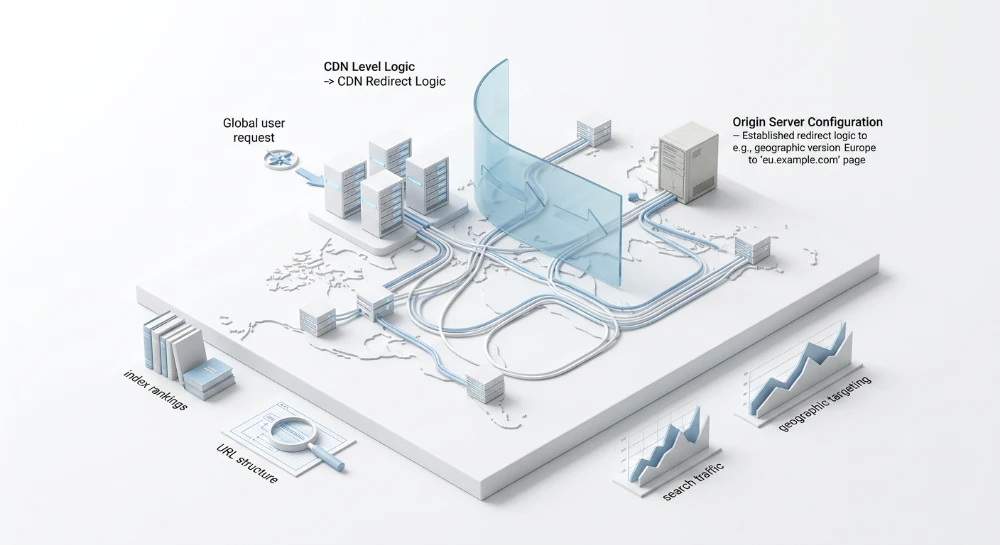
Edge computing introduces a severe architectural disconnect during request routing. The origin server processes incoming payloads without inherent knowledge of the client-to-edge connection state. When a CDN sits in front of Apache, it often terminates the initial encryption handshake at the edge node. The traffic reaching the origin infrastructure arrives over unencrypted port 80.
This structural gap breaks local redirection logic.
Cloudflare encryption mode mismatches
Edge proxies dictate connection protocols through specific encryption modes that frequently clash with origin routing rules. Cloudflare Flexible SSL provides encryption exclusively between the client browser and the edge node. The proxy forwards the request to the origin server over standard HTTP. If the origin server contains a blanket rule forcing HTTPS, it issues a 301 redirect back to the client.
The client retries via HTTPS. The edge node intercepts the secure request, decrypts it, and forwards it to the origin as HTTP again.
An infinite external redirect loop executes instantly. The origin server continually demands encryption it cannot see, while the edge proxy continually strips the encryption before forwarding the request. Full SSL and strict variants alter this behavior by enforcing end-to-end encryption. The edge node establishes a secure connection to the origin. If the origin server lacks a valid certificate or expects unencrypted traffic, the SSL handshakes fail or trigger an inverse routing loop.
| Proxy Encryption Mode | Client to Edge Routing | Edge to Origin Routing | Origin Conflict Trigger |
|---|---|---|---|
| Flexible | Encrypted | Unencrypted | Origin forces HTTPS via port 80 evaluation |
| Full | Encrypted | Encrypted | Origin forces HTTP via port 443 evaluation |
| Strict | Encrypted | Encrypted | Origin forces HTTP or certificate validation fails |
Proxy header extraction
Standard environment variables evaluate incorrectly behind reverse proxies. The HTTPS variable registers as off when the edge communicates with the origin via HTTP, regardless of the client URL. Edge servers inject specific headers into the payload to preserve the original protocol state before stripping the encryption layer.
Extracting the X-Forwarded-Proto header prevents endless loop execution. Apache must evaluate this proxy-supplied header instead of relying on the local server port listener.
- Identify the presence of the proxy header in the incoming payload
- Evaluate the exact string value matching the client protocol
- Bypass local HTTP forcing rules if the edge request was secure
Writing logic using
RewriteCond %{HTTP:X-Forwarded-Proto} !https
acts as the critical condition check. It evaluates the string value passed by the proxy infrastructure. If the edge communicates via HTTP but passes the secure flag in the header, the condition fails. The rule bypasses execution.
RewriteEngine On
RewriteCond %{HTTPS} off
RewriteCond %{HTTP:X-Forwarded-Proto} !https
RewriteRule ^(.*)$ https://%{HTTP_HOST}%{REQUEST_URI} [L,R=301]
Omitting the proxy header condition guarantees an external redirect loop under Flexible configurations. The origin server blindly triggers the HTTPS redirect, completely unaware the client already possesses a secure session at the edge layer. Stacking both local and proxy conditions ensures the rewrite logic accurately maps the routing path regardless of the network topography.
Regex execution and flag configuration failures
Regular expressions dictate the parsing logic for URI modification. Syntax precision directly determines server stability. A single unanchored pattern triggers internal recursion. The server interprets the rewritten target as a new source payload, feeding it back into the execution pipeline.
Capture groups and backreference repetition
Parentheses define capture groups in rule conditions. The engine extracts these string sequences and stores them in memory variables. Backreferences inject these stored strings into the target destination.
Recursion occurs when backreferences append data without invalidating the original match condition. Engine execution passes over the rule, applies the backreference, alters the URI, and restarts. The new URI still matches the loose capture group. The server duplicates the backreference payload repeatedly until it hits the internal limit.
- Engine extracts string sequences via an open capture group
- Rule interpolates the string into the destination path
- Altered path re-triggers the original matching condition
- Loop repeats until catastrophic execution crash
Regex quantifier misconfigurations
Greedy quantifiers consume matching characters relentlessly. Using the dot character paired with a zero-or-more quantifier causes broad, uncontrolled matches. Writing a pattern like
^(.{0,})$
captures literally any URI path. If the destination sits within the same root directory, the rule rewrites the rewritten path.
Consider a rule routing traffic to a dedicated subfolder. The engine matches the root request, forwards it to the folder, and restarts the parsing phase. The loose quantifier matches the new subfolder path, forwarding it again to a nested structure.
RewriteRule ^(.{0,})$ /app/$1 [L]
This exact syntax guarantees infinite internal routing. The request transforms into
/app/app/app/index.php
. Anchoring patterns using exact start and end delimiters prevents this recursive traversal.
Execution loop behavior: [L] flag vs END flag
Flag deployment controls the routing pipeline termination sequence. Misunderstanding flag behavior acts as the primary catalyst for syntax-driven loops.
The Last flag stops processing the current rule block. It does not terminate the engine. If the URI string was modified, Apache injects the new string back at the very beginning of the configuration file. The entire ruleset evaluates the new URI.
Apache v2.4 introduced a hard termination protocol. The END flag stops all processing immediately. No re-injection occurs. The server finalizes the routing request exactly as modified by that specific line.
| Directive | Execution Scope | Loop Risk Level | Apache Version |
|---|---|---|---|
| [L] Flag | Halts current iteration, triggers pipeline restart if URI changed | High recursion probability | All versions |
| END Flag | Absolute termination of the parsing engine | Zero recursion probability | v2.4 and newer |
Application protocols for control flags
Appending specific modifiers changes the application layer protocol response and logical evaluation rules.
- [R=301]: Forces an external HTTP redirect. The server stops internal mapping and sends a 301 status code back to the client. This translates internal URL changes into visible SERP updates.
- [NC]: Bypasses case sensitivity evaluation. The engine treats uppercase and lowercase characters identically during pattern matching operations.
- [OR]: Links conditional statements. The engine processes the rule if either the preceding or current condition resolves true. Omitting this defaults to an implicit logical AND condition.
- QSA: Injects the original query string into the target URL. The server merges existing parameters with new ones defined in the rule, preserving API variables and conversion tracking parameters.
- QSD: Strips the query string entirely from the modified request. Available in Apache v2.4, this flag drops legacy parameters to prevent duplicate content indexing in SEO.
SEO and server performance degradation mechanisms
Unoptimized rule execution instantly degrades infrastructure efficiency and search visibility. Every regex evaluation consumes CPU cycles. When rules loop, this consumption compounds exponentially.
Infrastructure exhaustion and metric spikes
Routing logic failures manifest directly in application performance metrics. Network requests get trapped in the parsing pipeline. The server must process each configuration directive sequentially before generating a response.
- TTFB increases stem from the server dedicating massive execution time to resolving conflicting internal mappings before dispatching the initial byte.
- Latency spikes dominate external loops due to the requirement of complete network round trips for every recursive request.
- Server load limits collapse when Apache worker processes lock into infinite rewrite loops, starving new client connections of available compute resources.
Apache utilizes a strict fail-safe mechanism to prevent total hardware lockup during endless internal mapping. The core LimitInternalRecursion directive defaults to a hard limit of 10 concurrent iterations. Reaching this exact threshold triggers 500 Internal Server Error payload generation. The daemon forcibly terminates the active connection, aborts the rewriting engine, and drops a 500 status payload directly to the client. The system avoids complete memory exhaustion. Users and search bots receive a fatal error.
Search engine crawling and indexation failures
Algorithmic crawlers operate on strict computational limits. Routing loops squander these quotas instantly.
| Degradation Vector | Technical Mechanism | Outcome |
|---|---|---|
| Crawl Budget depletion | Bots spend allotted milliseconds processing status headers instead of parsing HTML | New content remains undiscovered and unindexed |
| Indexability drop | Crawlers hit predefined maximum hop thresholds | URL classification as a redirect error |
| Link equity dilution | Passing authority signals through excessive sequential 3xx headers | Severe ranking suppression across clustered topics |
Excessive 3xx response iterations dismantle URL authority. A single, direct 301 Moved Permanently signals algorithms to consolidate ranking signals at the target destination. Chaining multiple 301 Moved Permanently or 302 Found directives degrades this transmission architecture. The crawler must validate every intermediate header. Signal decay occurs at each hop.
Bots abandon recursive paths abruptly. A URL caught in an endless loop returns rapid sequences of 301 Moved Permanently or 302 Found statuses bouncing between conflicting endpoints. The search engine flags the entire path as critically flawed. Indexing stops. The target HTML is never rendered. Associated search terms drop off the SERP entirely.
Debugging .htaccess logic via server logs and headers
Routing anomalies require raw state inspection at the server level. Blindly modifying regex patterns yields unpredictable outcomes. Diagnostic workflows must target explicit raw data sources: Apache error logs and primary server configuration files. Standard error logging captures fatal application crashes but ignores the granular logic of URL routing. You must manually escalate the log verbosity to expose the underlying conditional logic.
Deploying LogLevel rewrite:Trace6 for mod_rewrite tracing
Modifying the logging directive within the virtual host configuration or main server file forces Apache to output step-by-step routing decisions. This circumvents the black-box nature of URL rewriting.
LogLevel alert rewrite:trace6This exact deployment initiates comprehensive mod_rewrite tracing. The Apache error logs output every evaluated regular expression, matched string, and applied condition in real time. You see precisely which line in the configuration file triggered the recursive loop. The output density is extreme. Running trace level 6 generates massive disk I/O. Revert the configuration immediately after capturing the failing request to prevent server latency.
Browser dev tools network tab workflow
Client-side diagnostics provide the external viewpoint of a loop. High-velocity routing failures trigger browser-level termination, displaying ERR_TOO_MANY_REDIRECTS before manual inspection can occur. A strict browser dev tools Network tab workflow prevents critical data loss during these forced termination events.
- Open the developer console and navigate directly to the Network tab.
- Enable the Preserve log setting to retain HTTP request data across forced navigations.
- Initiate the request to the problematic URL.
- Filter the captured traffic by Status to isolate the rapid sequence of 3xx responses.
Location HTTP response header extraction
Every 3xx response carries a target destination embedded within the payload. Location HTTP response header extraction reveals the exact path the server instructs the client to follow. Compare this extracted string against the initial request payload to pinpoint the conflict.
A request headers vs response headers mismatch drives the majority of protocol and subdomain infinite loops. The client requests a secure path. The server evaluates a flawed condition and responds with an insecure destination. The client follows the new path. The server triggers the condition again. The cycle repeats endlessly.
| Diagnostic Target | Expected State | Failure Indicator |
|---|---|---|
| Location Extraction | Single defined destination path | Alternating targets bouncing across sequential responses |
| Protocol Match | Secure request yields secure target | Insecure target returned for a secure request |
| Host Structure | Consistent subdomain usage | Stripped subdomains injected into the Location header |
ENV_REDIRECT_STATUS monitoring
External loops hit the client directly. Internal loops crash the server silently. Apache terminates internal routing after a strict hop limit, usually throwing a 500 Internal Server Error without sending a single 3xx response to the browser.
Apache populates ENV_REDIRECT_STATUS during internal requests. Monitoring this specific environment variable exposes invisible routing anomalies. When a rewrite rule triggers an internal pass, the server updates the status code. A standard request registers a 200 code. A faulty rule that continuously alters the internal path without terminating causes the variable to reflect the recursive failure. The HTML rendering engine halts. The server drops the connection instantly.
Auditing rule chains with external validation tools
Manual log analysis exposes isolated routing failures. Bulk validation requires automated crawling to surface logic collisions operating across the entire site architecture. External tools simulate client behavior. They map the exact sequence of hops triggered by complex routing rules across thousands of URLs simultaneously.
Architectural flaws hide within nested directory structures. Standard browser testing limits visibility to single-page interactions. Deploying specialized validation software maps the full scope of internal and external loops before search engine bots detect them.
Screaming frog configuration for chain detection
Default crawler configurations often terminate connections after a minimal number of hops. This behavior masks deep recursive loops. Proper spider setup forces the tool to follow extended routing sequences to their final destination or failure point.
Configure the crawler to capture granular header data.
- Navigate to Configuration > Spider > Advanced interface
- Enable Always Follow Redirects to force continuous path tracing
- Adjust Max Redirects to Follow threshold to capture extended failure chains
- Navigate to Configuration > Spider > Extraction panel
- Enable HTTP Headers extraction to capture Location directives during each hop
Execute the crawl across the root domain. Generate the exact failure path mapping through Reports > Redirects > Redirect & Canonical Chains. The output details the status code of every node in the sequence. You identify exactly which URL triggered the loop and which condition forced the infinite recursion.
Syntax testing via redirect checkers
Web-based tools validate specific URL behaviors completely isolated from local environment variables. Testing requires distinct syntax variations to trigger potential protocol, subdomain, or trailing slash conflicts intentionally.
Inject specific query permutations to expose edge-case logic failures.
| Syntax Test Target | Input Variation | Expected Resolution Behavior |
|---|---|---|
| Protocol and Host Normalization | http://example.com | Forces HTTPS and definitive WWW or non-WWW structure in a single hop |
| Directory Slash Enforcement | https://example.com/folder | Appends terminal slash or routes strictly to the exact clean URL path |
| Case Sensitivity Bypass | HTTPS://Example.COM/Path/ | Normalizes domain characters to lowercase before matching secondary conditions |
| Parameter Retention | https://example.com/old?utm=test | Transfers query strings unmodified to the new destination path |
Post-Resolution state clearing protocols
Fixing the faulty rule in the configuration file represents only half the resolution process. Aggressive caching layers trap outdated routing logic. Clients and edge servers execute defunct loops until purged manually.
Browsers cache permanent routing directives aggressively. Developers frequently test corrected rules only to see loops persist locally. The local client bypasses the origin server entirely, relying on its corrupted internal cache memory.
Execute strict state clearing protocols immediately after patching the server logic.
- Initiate local state termination by clearing browser cache. Target the local network cache specifically and execute hard reloads on testing clients.
- Trigger CDN cache invalidation. Purging the edge cache globally forces all distributed edge nodes to request fresh routing instructions directly from the origin server.
- Establish continuous HTTP status code verification. Monitor structural URLs daily via API polling.
Continuous verification proves critical during vast architectural shifts. Domain consolidations and HTTPS migrations alter foundational asset delivery. A single unpurged edge node serving an old protocol rule reinstates the infinite loop for specific geographic regions. Automated monitoring guarantees the updated routing logic propagates flawlessly across all caching tiers.