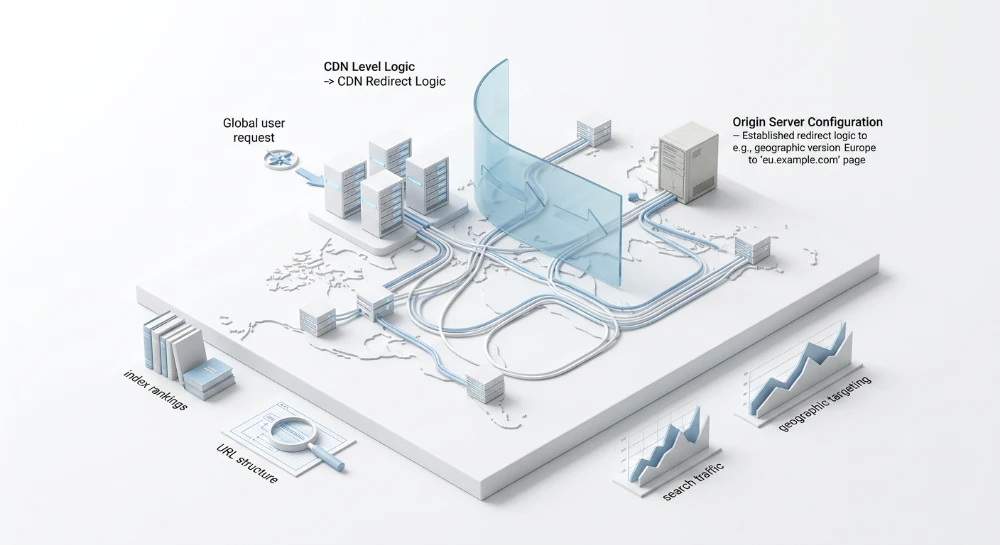
Understanding how origin server configurations clash with CDN-level logic requires mapping the exact request lifecycle between the client, the edge node, and the backend infrastructure. A reverse proxy intercepts every incoming request. This middle layer caches assets and manages routing before the request ever reaches the main database. Contradictory instructions between the edge and the backend create immediate routing failures. A standard 301 redirect placed in an Apache configuration file triggers an infinite loop if the edge node forces an HTTPS rewrite via a conflicting origin fetch parameter. SEO suffers immediately. Crawlers drop the URL from the SERP.
Edge server configurations operate on route priority algorithms that dictate which rules execute first. These algorithms process page rules, worker scripts, and cache headers before initiating an origin fetch. The origin fetch parameter defines how the edge node communicates with the backend server to retrieve non-cached HTML. If the origin server responds with a 302 redirect but the edge node holds a cached 301 redirect, the browser receives conflicting directives. The route priority logic defaults to the edge response. The backend logic gets ignored. Technical SEO requires strict alignment between these two environments to maintain a high CTR.
Foundational HTTP redirect codes dictate indexation behavior within technical SEO infrastructure. The 301 redirect transfers ranking signals to a new destination. The 302 redirect signals a short-term move without equity transfer. Modern specifications introduce the 307 temporary redirect and 308 permanent redirect to maintain the original POST or GET method during the redirect hop. Implementing these codes requires strict separation of duties. Edge-level rules handle global protocol forces like HTTP-to-HTTPS. The origin server manages CMS specific routing and granular structural changes. Mixing these responsibilities without a defined hierarchy causes immediate protocol failures and blocks API data exchanges.
Edge logic vs origin configuration pipeline architecture
Reverse proxy behavior fundamentally alters request routing pathways. The edge node intercepts incoming requests long before they hit the origin server configuration mechanisms. This interception creates a multi-tiered execution pipeline. Edge rules fire first. Origin rules fire last. If an edge node maps a request to a redirect directive, the origin fetch never happens. The backend remains completely blind to the transaction. This architectural bypass saves compute resources but introduces critical synchronization risks for technical SEO.
CDN-level redirect logic execution order operates on absolute determinism. Systems parse incoming requests against predefined route priority schemas. The evaluation sequence processes rules top-down until it hits a terminating match. Host-based conditions evaluate the requested domain or subdomain payload. Pattern-based redirects scan the URI path using regular expressions or wildcards. The moment the edge identifies a valid match condition, it halts further evaluation and serves the HTTP response directly to the client.
| Match Condition Type | Route Priority Schema | Evaluation Logic and Trigger Mechanics |
|---|---|---|
| Exact Match | Highest (1) | Triggers only when the incoming URL matches the target string byte-for-byte. Bypasses all regex processing overhead. |
| Host-based conditions | High (2) | Evaluates the Host header to route traffic across specific subdomains or handle apex domain normalization. |
| Pattern-based redirects | Medium (3) | Utilizes regex to intercept dynamic URI structures, handle query parameters, and map massive category migrations. |
| Catch-all Wildcard | Lowest (4) | Acts as a fallback net for traffic that bypasses stricter configuration thresholds. |
Requests that bypass edge match conditions fall through the pipeline to the origin server. Here, web server software executes localized routing directives. Apache rewrite rules (.htaccess) process at the directory level or within the main virtual host configuration. Apache relies on the
mod_rewrite
module, evaluating rules line-by-line. Engineers stack a
RewriteCond
to establish the match condition, immediately followed by a
RewriteRule
to execute the pattern-based redirect. The directory-level execution of
.htaccess
allows granular folder control but introduces disk-read latency on high-traffic environments, directly impacting Time to First Byte metrics.
Nginx architectures handle origin routing differently. Nginx reads configurations into memory on startup. Nginx redirect directives (nginx.conf) live within the primary configuration file inside specific
server
or
location
blocks. This eliminates per-request disk reads and drastically accelerates the execution pipeline.
-
Nginx uses the
returndirective to execute fast, exact-match redirects without evaluating complex regex syntax. -
Nginx relies on the
rewritedirective when pattern-based redirects require URI manipulation before executing the hop. -
Apache evaluates every
.htaccessfile in the directory tree upwards until it hits the document root, multiplying execution time. -
Apache regex evaluations via
RewriteRuleconsume heavy CPU cycles during concurrent request spikes.
Pipeline conflicts emerge when technical teams silo these configurations. An SEO specialist pushes Apache rewrite rules to handle a massive site migration. The devops team simultaneously deploys an edge-level rule to strip trailing slashes from the URL structure. The CDN-level redirect logic execution order intercepts the trailing-slash request first. The edge serves its specific redirect. The origin server never receives the payload. The CMS logic sits dead in the water. Managing this architecture requires strict mapping of every redirect scenario across both environments to prevent conflicting responses from hijacking the intended ranking signals.
Diagnosing protocol conflicts and ERR_TOO_MANY_REDIRECTS
Protocol conflicts destroy crawlability instantly. The split connection architecture of a reverse proxy introduces a critical vulnerability point. Traffic flows from client to edge, then edge to origin. If the protocol requirements misalign between these two distinct legs, the routing pipeline collapses. Browsers detect the cyclical routing logic and terminate the session, throwing a terminal ERR_TOO_MANY_REDIRECTS warning.
Misconfigured HTTP-to-HTTPS redirect rules cause the most severe protocol conflicts. An edge proxy intercepts a secure client request but downgrades the origin fetch to unencrypted HTTP. The CMS evaluates the incoming payload. Standard origin security configurations dictate a mandatory upgrade to HTTPS. The origin responds with a redirect directive pointing back to the secure URL.
The edge passes this redirect back to the client. The client executes the new request over HTTPS. The edge intercepts it, downgrades the origin fetch to HTTP again, and triggers the exact same origin response. This mechanism defines redirect loop identification at its core. Search engine crawlers interpret this endless cycle as a dead endpoint and drop the URL from the active crawl queue.
SSL full (strict) implementation requirements
Resolving this cycle requires strict alignment of origin protocol policy overrides. The edge must enforce end-to-end encryption. SSL Full (strict) implementation requirements mandate that the edge connects to the origin exclusively via port 443 using HTTPS.
Deploying strict SSL protocols introduces distinct validation hurdles. The origin server must host a cryptographic certificate signed by a globally trusted certificate authority. Self-signed certificates fail validation under strict edge policies. When the edge proxy attempts the origin fetch and encounters an invalid, expired, or self-signed certificate, it abruptly severs the connection. These specific validation failures act as HTTP 502 Bad Gateway triggers. The edge refuses to bypass the certificate mismatch, replacing a potential redirect loop with a hard gateway error.
X-Forwarded-Proto header mismatches
Origin applications frequently misinterpret incoming proxy traffic. A load balancer might handle SSL termination at the infrastructure boundary, forwarding the decrypted request to the CMS over an internal network on port 80. The application receives unencrypted HTTP traffic. It reflexively executes an internal security rule and issues a redirect to HTTPS.
Edge proxies inject specialized HTTP headers to preserve client connection context. The most critical is the X-Forwarded-Proto header, which tells the origin whether the original user connected via HTTP or HTTPS. X-Forwarded-Proto header mismatches occur when the origin server ignores this injected context. The origin server relies blindly on the physical port connection rather than the proxy header.
To systematically handle origin redirection error procedures, infrastructure teams must force the origin to respect proxy headers:
- Configure the origin server block to parse the X-Forwarded-Proto header on incoming requests.
- Instruct the CMS application layer to map the forwarded protocol variable directly to its internal HTTPS detection logic.
- Disable application-level protocol redirects entirely if edge-level protocol enforcement is active.
- Whitelist the specific IP ranges of the edge proxy network to establish trusted header processing.
Origin fetch configuration mapping
System administrators must map the exact behavior of origin fetches against specific edge routing profiles. Different edge connection modes radically alter the request payload arriving at the origin server.
| Edge Proxy Policy | Edge-to-Origin Protocol | Origin Certificate State | Origin Response Payload | Resulting Browser State |
|---|---|---|---|---|
| Flexible | HTTP | Irrelevant | Redirect to HTTPS | ERR_TOO_MANY_REDIRECTS |
| Full | HTTPS | Unverified / Expired | 200 OK | Successful Fetch |
| Full (Strict) | HTTPS | Verified CA Signed | 200 OK | Successful Fetch |
| Full (Strict) | HTTPS | Invalid / Self-Signed | Connection Dropped | HTTP 502 Bad Gateway |
Operating in Full mode without strict validation masks underlying origin infrastructure decay. The edge encrypts the traffic but completely ignores the cryptographic validity of the origin certificate. Expired origin certificates persist unnoticed. The site functions normally until compliance auditing tools scan the direct origin IP and expose the insecure architecture.
Rules engine overrides in CloudFront and azure CDN
Shifting redirect logic to the network edge eliminates origin processing latency and prevents architectural conflicts. Relying on origin server configuration pipelines for mass URL redirection forces the CDN to pass the request, wait for the origin to process the rewrite rule, and pass the response back to the client. Edge compute environments intercept the request before origin evaluation. Engineers configure redirect overriding protocols at the edge to override, modify, or completely preempt the origin server.
Lambda@Edge serverless execution patterns
AWS CloudFront handles edge logic through Distribution behaviors and Lambda@Edge functions. The distribution behavior defines the path pattern matching. When a client requests a resource, CloudFront evaluates the path pattern and triggers the associated serverless execution patterns. Deploying edge logic URL redirect implementation requires attaching the Lambda function to the correct event trigger.
CloudFront provides four distinct execution phases in the edge compute environment:
- Viewer Request: The function executes the moment CloudFront receives the HTTP request from the client, before checking the edge cache.
- Origin Request: The function executes only on a cache miss, immediately before CloudFront forwards the request to the origin server.
- Origin Response: The function executes when CloudFront receives the response payload from the origin, before caching the object.
- Viewer Response: The function executes right before CloudFront returns the requested file to the client, regardless of whether it was a cache hit or origin fetch.
URL redirection must occur at the Viewer Request phase. Intercepting the request here allows the Lambda function to generate a direct HTTP 301 or 308 response. The edge node terminates the connection and sends the redirect straight back to the client. The request never reaches the cache evaluation phase. It never generates an origin fetch. This execution pattern preserves compute resources and provides the fastest possible execution time for SEO initiatives.
Overriding origin logic during the Origin Response phase is structurally different. The edge node allows the origin fetch to complete. If the origin returns an erroneous HTTP 302, the Lambda function intercepts that payload, rewrites the status code to 301, modifies the Location header, and passes the corrected response to the Viewer Response phase. This pattern corrects origin misconfigurations dynamically but still incurs the latency penalty of the origin round-trip.
Azure CDN rules engine configuration thresholds
Azure CDN utilizes a rules engine that evaluates traffic against defined match conditions and executes specific actions. The architecture processes rules sequentially. Order of execution dictates the conflict resolution strategies in edge compute environments. The engine processes Rule 1, then Rule 2, progressing chronologically down the configuration list.
Administrators must map rule precedence accurately to prevent logical collisions. If multiple rules match a single request, the configuration dictates whether subsequent rules execute or if processing halts immediately.
| Match Condition Type | Evaluation Logic | Execution Priority | Override Behavior |
|---|---|---|---|
| Request URL | Exact string or Regex match | High | Preempts origin fetch immediately upon match. |
| Request Header | Key/Value presence | Medium | Allows specific user-agent or API routing overrides. |
| URL Path | Directory structure analysis | Medium | Triggers directory-level rewrite protocols. |
| Server Variable | Environment state assessment | Low | Used for complex fallback routing scenarios. |
A standard Azure CDN Rules Engine configuration thresholds setup limits the number of rules per endpoint. Hitting these limits requires consolidating logic using Regular Expressions. Overly complex Regex statements increase CPU cycles at the edge and risk execution timeouts. Consolidate overlapping URL paths into single pattern-matching conditions to maintain optimal processing speed.
Conflict resolution strategies in edge compute environments
Deploying edge rules creates an isolated configuration layer that operates blindly alongside the origin server. If the edge forces a secure HTTPS connection but the origin requires HTTP for internal API routing, infinite loops occur. Resolving these protocol collisions requires a strict hierarchy of operations.
Edge proxy rules hold absolute authority. Implement the following conflict resolution strategies to stabilize the infrastructure:
- Halt execution on match. Configure Azure rules or Lambda functions to stop evaluating subsequent edge rules once a redirect condition is met. This prevents overlapping edge logic from overwriting the intended URL destination.
- Isolate legacy origin paths. Exclude specific API endpoints and backend CMS admin directories from edge-level forced redirects. Create explicit bypass rules for these paths before the primary redirect logic executes.
- Normalize the URI structure at the viewer request. Strip trailing slashes and force lowercase characters via edge compute before passing the request to the origin. This prevents the origin from issuing secondary redirects for canonicalization purposes.
- Audit request header persistence. Ensure the edge compute script forwards the necessary headers so the origin understands the request context. Stripping critical headers during edge interception causes the origin to misinterpret the protocol state.
Deploying redirect overriding protocols shifts the technical SEO responsibility entirely to the CDN operations team. The origin server configuration mechanisms become secondary fallbacks. By executing HTTP redirects directly from the edge network, engineers bypass origin processing constraints, lower time-to-first-byte latency, and enforce immediate compliance with desired URL structures.
Geographic routing and Geo-DNS redirection protocols
Edge compute networks excel at spatial logic. Geo Redirection deployment configurations intercept incoming requests before they traverse the backbone network. This architectural pattern leverages geographic routing algorithms to analyze the client connection at the network layer. You route traffic based on hard coordinates instead of relying on client-side script execution. Fast. Efficient.
The routing process requires precise Geo-location data mapping. Edge servers query localized databases during the initial request phase. The system matches the viewer network address to a standardized country code. If the mapping criteria aligns with a configured edge rule, the node executes the logic immediately. The central origin infrastructure remains untouched.
Geo-DNS Latency-Based routing logic
Initial connection paths depend heavily on network resolution. Geo-DNS latency-based routing logic does not blindly send traffic to the closest physical point. It evaluates real-time network congestion and structural latency. The nameserver provides records pointing to the optimal edge environment based on actual millisecond response times.
When the edge node identifies a mismatch between the requested path and the user locale, it activates specific origin fetch bypass triggers. The node formulates and returns the routing response directly to the client without querying the backend infrastructure. Configure these bypass triggers based on strict logical conditions:
- Viewer country code mismatch against the requested localized directory structure.
- Language header threshold triggers requiring specific regional domain resolution.
- Absence of explicit locale-override cookies indicating a persistent user preference.
- Known crawler user agents bypassing the geographical redirect to ensure unhindered global access.
Implementation of temporary localization redirection
SEO requires strict control over localized routing environments. Executing permanent redirects for regional mapping destroys indexation accuracy. Search engines typically execute crawl paths from specific geographic zones. A permanent redirect rule forces all global crawlers into a single regional folder. You must utilize temporary routing protocols.
Implement a 302 Temporary redirect or a 307 Temporary redirect for all network-level forced navigation. The 302 Temporary redirect serves standard GET operations for standard HTML document retrieval. The 307 Temporary redirect guarantees that the connection method remains entirely intact during the redirect sequence. This distinction proves critical during data submissions where a POST payload to a localized API endpoint must not downgrade to a GET request during the routing jump.
| Routing Protocol | Method Preservation | Origin Interaction | Implementation Scenario |
|---|---|---|---|
| 302 Temporary redirect | False | Standard bypass | Basic regional folder routing for standard HTML assets. |
| 307 Temporary redirect | True | Strict bypass | Localized API payload submissions requiring data retention. |
Caching infrastructure and HTTP header management
Edge nodes cache HTTP responses based strictly on status codes and origin directives. Misconfigured cache retention parameters for routing protocols cause severe indexation delays and stale routing states. A 3xx response stored indefinitely at the edge overrides all subsequent origin configuration modifications. You must explicitly define CDN cache TTL settings to separate permanent architecture changes from volatile routing conditions.
Establish discrete TTL thresholds for different response types. Permanent routing configurations handle long-term structural adjustments and support extended edge retention to minimize origin fetch latency. Temporary logic requires zero-cache or strictly limited TTL directives. Inject explicit Cache-Control headers using the s-maxage directive. This governs the edge node retention lifecycle independently of the client-side browser cache.
Programmatic invalidation via API
Manual cache clearing through provider interfaces fails to scale during enterprise deployments. Cached 3xx responses generate routing conflicts immediately after edge logic updates. You must rely on automated invalidation schemas.
Execute purge CDN cache API commands as integrated steps within your deployment pipeline. Target discrete URL paths rather than executing global zone purges. Global purges instantly degrade edge performance and force full origin fetches for unaffected HTML and static assets. Submit a precise JSON payload to the edge provider's purge endpoint containing only the modified routing paths.
POST /client/v4/zones/{zone_id}/purge_cache
Content-Type: application/json

{
  "files": [
    "https://www.example.com/deprecated-directory/",
    "https://www.example.com/legacy-route.html"
  ]
}
Request and response header architecture
Routing environments depend on precise header preservation and manipulation. The proxy evaluates incoming Request headers to calculate match conditions before determining the routing destination. Upon matching a rule, the edge node formulates specific Response headers to instruct the client application. Errors in this exchange break the entire resolution chain.
Location header syntax validation demands absolute precision. The Location header dictates the exact destination of the jump. Malformed strings, missing protocol declarations, or incorrect trailing slash implementations cause immediate failure. Always enforce absolute URL formats in the Location payload. Relative paths trigger unpredictable resolution behavior across different client agents.
| Syntax Condition | Invalid Location Header | Valid Location Header | Resolution Outcome |
|---|---|---|---|
| Protocol Omission | Location: www.example.com/new/ | Location: https://www.example.com/new/ | Prevents network-level protocol confusion. |
| Relative Pathing | Location: /folder/page/ | Location: https://www.example.com/folder/page/ | Guarantees exact domain routing context. |
| Trailing Slash mismatch | Location: https://example.com/path | Location: https://example.com/path/ | Eliminates secondary origin-level slash routing. |
Host context and custom debugging
Modifying routing paths at the edge risks dropping the original request context. The Host header must remain entirely intact during any necessary origin fetches. If the reverse proxy arbitrarily rewrites the Host header to match an internal server hostname, the origin server loses the ability to process dynamic routing logic based on the requested domain.
Manage Host header and Forwarded host persistence meticulously. Implement X-Forwarded-Host headers within your edge configuration to preserve the original client request hostname through the proxy layer. Origin environments rely strictly on this persisted data to maintain domain context during internal execution cycles.
Isolating rule execution requires custom header injection. Edge-generated routing rules and origin-generated directives often produce identical status codes. You cannot differentiate the source relying solely on the HTTP response status. Implement X-Debug-Redirect parameters to expose the exact origin of the routing command.
- Inject the X-Debug-Redirect key into the Response header payload within the edge rules engine.
- Assign discrete identification strings as the header value to isolate specific triggering conditions.
- Query the response payload to validate header presence, confirming the edge logic executed successfully over the origin routing pipeline.
This header injection operates invisibly to standard users while providing engineers with immediate confirmation of the execution layer. The presence of the designated string guarantees the proxy intercepted the request and applied the intended localized or pattern-based rule before origin interaction.
SEO implications of Edge-Level redirect chains
Edge configurations operating independently from origin routing logic frequently generate hidden redirect chains. Every hop between proxy nodes and the primary server multiplies latency. This architectural flaw disrupts the direct access path search engines require for efficient indexing.
Search engine crawlers allocate finite computational resources to evaluate a domain. Crawl Budget depletion scales linearly with the complexity of your routing pipeline. When an edge node receives a request, strips a trailing slash, and passes the query to the origin which then enforces a secure protocol, the crawler must process multiple network exchanges to reach a single HTML document. Prolonged chains exhaust this allocation quickly.
High-volume routing fragmentation forces the crawler to abandon the execution path before rendering the final URL.
Link equity dilution mapping
Consolidated ranking power deteriorates across fragmented server architectures.
Mapping dilution requires tracking the inbound request through the proxy layer down to the origin fallback. A single route might encounter an edge rule rewriting a geographic directory, followed by an origin directive stripping parameters. Each subsequent node in the chain acts as a friction point. The final destination URL absorbs only a fractured percentage of the inbound equity.
Ranking signals distortion parameters
Multiple conflicting routing layers obscure canonical directives. Search algorithms map anchor text and behavioral signals to specific endpoints to determine relevance. When edge logic alters the path mid-flight, the connection between the user query and the rendered HTML payload breaks.
The algorithm drops the query intent mapping. SERP visibility collapses as the system struggles to consolidate the primary ranking signals against the target page.
Identifying crawler traps
Misaligned configurations between execution environments routinely trap bots in infinite routing cycles. A proxy rule enforcing lowercase formatting combined with an origin rule requiring capitalized custom parameters creates a closed execution loop. You must identify crawler traps immediately to prevent severe SEO degradation.
- Monitor server logs for identical request IPs hitting paired variations of a single URL within milliseconds.
- Track execution time anomalies where bot sessions remain active on a single directory path without downloading payload data.
- Isolate parameter-handling discrepancies between the edge rules engine and the primary CMS routing logic.
Index coverage report parameter analysis
Google Search Console exposes pipeline failures directly through the Index Coverage report. Engineers must evaluate specific classification parameters to diagnose integration failures between the proxy layer and origin configurations.
| Coverage Status | Architectural Trigger | SEO Impact |
|---|---|---|
| Page with redirect | The crawler processed the edge or origin routing command and updated its internal map successfully. | Temporary stagnation in ranking signals while the algorithm consolidates equity to the new destination. |
| Redirect error | The routing chain exceeded maximum hop thresholds or encountered an infinite crawler trap loop. | Complete critical failure. The URL drops from the index and severs all associated ranking equity. |
Sudden volume spikes in the 'Page with redirect' category indicate broad edge-level rule deployments overriding historical origin structures. This pattern requires immediate cross-referencing against expected deployment behaviors.
The 'Redirect error' status flags terminal pipeline failures. These errors surface when edge logic conflicts directly with origin directives, forcing the bot to abandon the crawl entirely. Resolving these parameters demands strict alignment between proxy execution conditions and your primary server environment.
Technical auditing and response header analysis
Browser network panels lie. Local caching, service workers, and background pre-fetching obscure the actual routing layer. Engineers execute raw CLI commands to strip away client-side interference and expose the exact protocol exchange occurring across the network pipeline.
Redirect tracing via command line
Terminal utilities provide the unvarnished response sequence. Execute cURL commands to bypass intermediary distortions. Using the specific parameter string isolates the exact point of execution.
curl -I -L https://example.com/legacy-routeThe parameter combination dictates strict diagnostic behavior. The switch forces the server to return only the headers, conserving bandwidth and accelerating the test sequence. The subsequent parameter commands the client to aggressively follow every Location header until it hits a terminal status or fails entirely. Analyzing this raw output reveals the exact injection point of the routing command.
Status code output analysis
The architectural distinction between a 301 Permanent redirect and a 308 Permanent redirect fundamentally alters method preservation during the hop. Edge computing environments frequently default to legacy status codes. This creates silent failures across dynamic endpoints.
A 301 Permanent redirect converts POST requests to GET requests upon following the destination URL. The 308 Permanent redirect strictly enforces method preservation. If an origin server expects a POST payload for an API endpoint, but the edge proxy intercepts the request and forces a 301 redirection, the payload drops instantly. The network connection succeeds, but the application layer fails. Verify the exact status code output directly in the terminal response to confirm method preservation aligns perfectly with origin database requirements.
Crawler configuration for Edge-Node spoofing
Validating thousands of routes requires enterprise crawling infrastructure. Standard configurations in Screaming Frog SEO Spider and Sitebulb merely validate baseline fallback routing. To accurately audit conditional edge logic, these tools must be calibrated to spoof specific edge-node environmental triggers.
Engineers manipulate the crawler request parameters to simulate diverse client states and trigger hidden proxy logic.
- Inject custom HTTP request headers matching internal routing triggers to bypass standard edge cache rules.
- Modify User-Agent strings to force device-specific mobile or bot-routing protocols strictly at the edge.
- Route the crawler through external proxy IPs to validate localized latency-based routing logic.
- Disable cookie acceptance to test fallback routing paths deployed for stateless client requests.
Mapping pipeline execution paths
Identifying the exact locus of a configuration conflict requires mapping the execution path backward from the failure point. Discrepancies between edge proxy behavior and origin configuration create isolated diagnostic signatures embedded directly within the response headers.
The following mapping isolates the execution layer responsible for the active routing command.
| Diagnostic Signature | Execution Layer | Resolution Action |
|---|---|---|
| Server header returns proxy identifier on the initial 3xx response. | Proxy Layer | Audit Edge rules or serverless compute functions intercepting the request. |
| Server header returns origin environment signature. | Origin Server | Verify local rewrite directives and CMS routing tables. |
| Multiple identical Location headers appended in a single network response. | Conflict Zone | Deduplicate redundant rules existing simultaneously at both proxy and origin environments. |
| Method shifts from POST to GET after a redirection hop. | Proxy Layer | Upgrade legacy 301 Permanent redirect edge rules to strict 308 Permanent redirect protocols. |
The execution map dictates the precise remediation vector. Pinpointing the exact point of header modification eliminates overlapping deployments, prevents redundant processing cycles, and restores linear routing architecture.