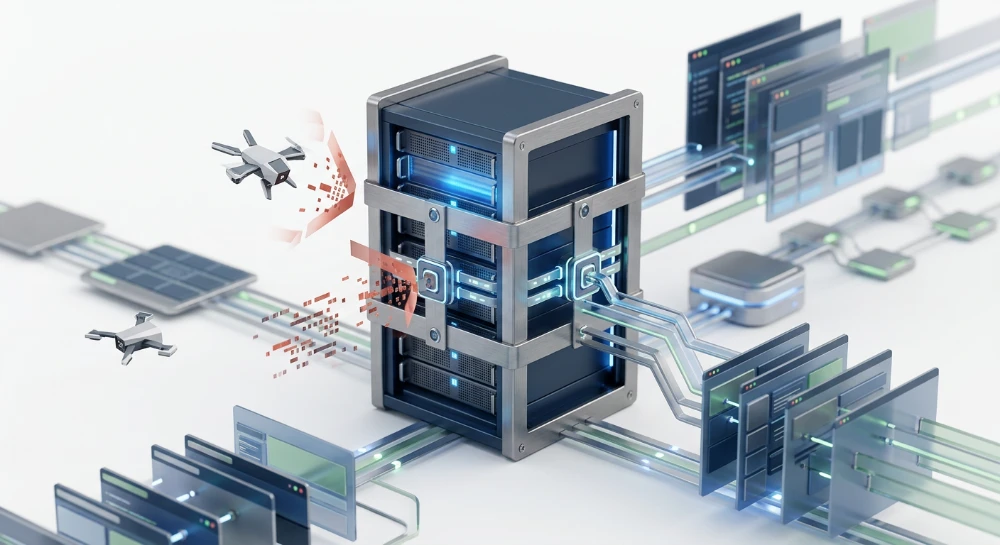
Identifying indexing blockers unique to autonomous agent crawlers requires an immediate shift in server architecture configuration. Deterministic bots process static HTML or predefined rendering paths based on rigid rulesets. Probabilistic autonomous agents operate differently. They evaluate information contextually to supply generative models with real-time data. This mechanical divergence forces network administrators to rewrite access rules far beyond standard SEO parameters.
Traditional search indexers rely on predictable crawl budgets. A deterministic bot requests a URL, parses the code, and extracts links. The process is strictly linear. Autonomous agent systems like OAI-SearchBot or ClaudeBot run on probabilistic models driven by external user prompts. They ignore standard navigational hierarchy. They attempt to retrieve specific data fragments through dynamic queries. If a server intercepts these non-linear requests using legacy validation thresholds, it terminates the connection.
This architectural split breaks default security configurations. A standard CMS might serve content flawlessly to a traditional search bot while simultaneously dropping connections from an autonomous crawler.
Auditing accessibility demands mapping the exact technical gap between these retrieval systems. Server environments must recognize headless user agents without triggering default rate limits. This is a mandatory operational baseline. A standard web application firewall frequently misclassifies probabilistic data ingestion as an aggressive scraping attack. Resolving this conflict involves parsing request signatures and transport layer security fingerprints directly at the edge layer. Server configurations must permit generative engines to ingest live data via an API or direct network path without hitting automated security walls.
Architectural divergence: Traditional crawlers vs. autonomous agent systems
Traditional search indexers follow hardcoded directives. Googlebot and Bingbot execute deterministic crawling patterns. They read server rules, parse sitemaps, and traverse internal link clusters sequentially. The operation relies on static URL discovery. A predefined crawl budget controls the frequency. System architects build entire server environments around this predictable mathematical cadence.
Autonomous agent crawlers obliterate this predictability. Systems executing probabilistic web conduct standards operate without structural reverence for site architecture, bypassing conventional taxonomy to satisfy dynamic entity resolution requests. GPTBot, ClaudeBot, PerplexityBot, OAI-SearchBot, and CCBot deploy primarily in response to real-time user prompts. Their trajectory relies on immediate context resolution. Navigation silos mean nothing to them. They target precise data fragments to construct immediate answers.
This operational discrepancy forces a total reevaluation of request handling parameters. Agentic AI systems utilize complex headless user agents to extract raw payload data. These agents emulate human navigation patterns through synthetic personas. The underlying engine applies behavioral profiling to adapt its traversal strategy mid-session based on the data it encounters during the crawl. If the LLM needs a specific data table on a deeply nested page to fulfill a query, the crawler attempts a direct strike on that URL fragment, entirely ignoring canonical paths or pagination logic.
Data extraction shifts from delayed indexing to immediate consumption. Real-time data ingestion algorithms dictate this concurrent workflow. The AI grabs the unrendered text, parses the code, vectorizes the content, and feeds it into the context window within milliseconds. A traditional bot maps the directory structure for future reference. An autonomous agent retrieves discrete data points for immediate prompt resolution.
Server administrators must map the exact technical thresholds separating these two crawler classes to prevent accidental connection drops.
| Operational Parameter | Traditional Indexers | Autonomous Agent Systems |
|---|---|---|
| Execution Model | Deterministic scheduled runs | Probabilistic prompt-driven actions |
| Traversal Logic | Sequential link extraction | Contextual deep-link targeting |
| Data Utilization | Delayed SERP cataloging | Real-time context window ingestion |
| Request Identity | Static static signatures | Dynamic synthetic personas |
Identifying the failure points in access control requires auditing specific server access patterns unique to generative platforms.
- Asymmetrical request velocity spikes decoupled from standard crawl schedules.
- Direct deep-link requests bypassing established internal hierarchy patterns.
- Unpredictable headless environment queries isolating specific code fragments.
- Navigational adjustments triggered by real-time data ingestion algorithms mid-session.
Run a deep technical crawl to identify 4xx errors, missing meta tags, and indexation blockers.
WAF configurations and CDN bottlenecks impacting LLM indexation
Edge infrastructure acts as the primary gatekeeper for incoming server requests. WAF deployments and CDN architectures routinely misclassify generative engine requests as hostile data scraping attempts. Security layers across Cloudflare, Akamai, Imperva, Fastly, and AWS CloudFront rely on threat intelligence models trained on legacy traffic patterns. These models evaluate requests using strict bot-score thresholds that fail to account for the unique network behavior of AI agents.
Aggressive anti-scraping defenses interpret probabilistic traversal logic as vulnerability scanning. Super Bot Fight Mode environments evaluate incoming requests against known signature databases and behavioral heuristics. AI agents execute unpredictable deep-link queries that mirror malicious extraction tools. The WAF assigns a low bot score. The system drops the connection instantly.
Rate limiting rules present a distinct architectural bottleneck for Live Web Retrieval.
- Bandwidth spike mitigation protocols trigger when asymmetrical request velocity exceeds standard thresholds.
- IP-based rules block entire cloud provider subnets where generative platforms host their infrastructure.
- Geographic filtering policies reject queries originating from specific data centers used by LLM routing networks.
Generative platforms require high-velocity data ingestion to populate the context window during real-time prompt resolution. This sudden burst of requests violates strict WAF traffic shaping policies. The CDN edge server steps in to protect the origin server from perceived malicious activity. It severs the Live Web Retrieval connection.
Failure mechanisms and edge severance
The immediate consequence of these severed connections is a surge in 403 Forbidden status codes. The AI system cannot access the raw HTML. The crawler discards the target URL from its indexing queue. This creates a silent visibility failure.
| WAF Security Protocol | Triggering AI Behavior | Edge Server Response |
|---|---|---|
| Aggressive Anti-Scraping Defenses | Unpredictable headless environment queries | Immediate 403 Forbidden |
| Rate Limiting Rules | High-velocity context window ingestion | Connection delay or connection reset |
| IP-based Rules | Requests from unverified cloud provider subnets | Hard edge block |
| Bandwidth Spike Mitigation | Asymmetrical deep-link queries | Traffic throttling and dropped packets |
Origin servers remain completely unaware of the blocked attempt because the request never bypasses the CDN layer. Network administrators must audit security perimeters specifically for false positives targeting generative platforms. Adjusting bot-score sensitivity prevents critical infrastructure from suffocating AI reach. Misconfigured WAF environments permanently lock digital assets out of generative engines.
Session state traps and complex cookie wall vulnerabilities
Authentication protocols demand persistent client behavior. They expect stateful interactions across multiple requests. Autonomous agent crawlers operate strictly as stateless entities. When an LLM indexing system requests a URL, it drops all prior context immediately after the connection closes. It does not store session cookies. It does not carry over state from previous exchanges. This architectural flaw creates a massive indexing barrier. Security layers demand identity verification. The stateless crawler drops the prompt and retries the connection raw. Identity management blockades trigger almost instantly.
Complex cookie walls act as hard indexing blockers.
A server intercepts the initial request to serve a consent banner. It expects the client to return a specific session token or an ephemeral token before releasing the actual payload. The crawler only sees the intercept page. It ingests the consent text. The target URL data remains invisible. AI discoverability evaporates entirely.
- Session tokens expire upon connection closure, leaving the crawler without valid credentials for deep-link traversal.
- Ephemeral tokens generated for cross-site request forgery protection block subsequent probabilistic queries from distributed IPs.
- Identity management frameworks interpret missing session states as anomalous behavior and restrict network access.
Interactive verification and turnstile bottlenecks
Security perimeters rely heavily on interactive verification. CAPTCHAs and JS Challenges present insurmountable obstacles for autonomous bots. Cloudflare Turnstile and managed challenges analyze browser telemetry, hardware concurrency, and interaction latency. LLM agents lack these human markers. They fail the managed challenge by default.
| Authentication Protocol | Crawler Limitation | System Failure State |
|---|---|---|
| Complex Cookie Walls | Inability to parse or persist consent cookies | Indexing the consent banner instead of target HTML |
| Cloudflare Turnstile | Lack of interactive browser telemetry | Connection drop at the edge layer |
| Managed Challenges | Inability to bypass behavioral JS Challenges | Infinite redirect loops and empty payload delivery |
| CAPTCHAs | Failure to process logic grids | Complete indexation block |
Stateless crawlers routinely brute-force these barriers without context. They hit the identical URL repeatedly because they lack the required session token to proceed. The server registers high-velocity, unauthenticated traffic bouncing off a login or consent wall. This mismatch triggers a 429 response. The server logs the anomaly. The crawler gets blackholed. Persistent 429 responses instruct the agentic system to deprioritize the domain permanently.
Bulk Google and Yandex index checker
Verify agency reports and track live SERP status in Google and Yandex to protect your SEO ROI.
JavaScript execution failures and Client-Side hydration latency
Modern SPA architectures prioritize client-side rendering. This approach offloads view construction entirely to the browser. Clients download a barebones HTML shell and rely on JavaScript payloads to build the visual interface dynamically. Autonomous agents process the web using a different operational logic. They prioritize speed, low latency, and stateless data ingestion over user experience. When an LLM crawler encounters an SPA, it extracts the initial HTML payload immediately. If that document lacks structured data or visible text, the crawler registers a blank page. The system abandons the execution cycle.
Headless Chromium instances power the majority of modern agentic frameworks. These instances attempt to execute JavaScript. Rendering engines allocate strict compute thresholds for script evaluation. Heavy, render-blocking scripts push DOM construction past the crawler timeout limit. The agent terminates the connection before the rendering pipeline completes the visual tree.
DOM hydration timeouts and AJAX dependencies
Hydration converts a static HTML skeleton into a fully interactive DOM tree. This sequence requires subsequent AJAX queries to populate dynamic data fields. Traditional search indexers historically afford generous rendering budgets to process complex pages over minutes or hours. Agentic systems operate on probabilistic retrieval cycles requiring instant payload delivery. They lack the built-in latency tolerance of legacy deterministic crawlers.
The hydration timeline misaligns directly with the agent execution window. An LLM initiates a GET request. The edge server returns the framework skeleton. The crawler parses the document head but immediately encounters a massive JavaScript bundle. It begins script execution. AJAX calls fire asynchronously to fetch necessary data payloads. The crawler hits its internal timeout threshold before the network resolves the fetch. The connection closes abruptly. The resulting DOM remains incomplete.
| Architectural Component | Execution Bottleneck | System Failure State |
|---|---|---|
| Synchronous JavaScript Bundles | Render-blocking asset delivery delays initial parsing | Crawler drops connection due to strict timeout limits |
| Asynchronous AJAX Calls | Data fetching latency exceeds agent wait tolerance | Empty HTML payload extraction |
| Client-Side Routing | Virtual transitions lack direct URI server mappings | Failure to discover or map sub-pages |
Client-Side routing bottlenecks
Virtual routing replaces native browser navigation with script-driven state changes. URL modification occurs via the History API without triggering a complete page reload. This mechanism breaks stateless discovery protocols. Crawlers follow explicit hypertext references mapped to distinct server-side endpoints. When a platform relies exclusively on virtual DOM manipulation, the crawler sees a single entry point.
The absence of static link architectures prevents deep resource discovery. An agent lands on the index route and scans the parsed DOM for anchor elements containing fully qualified URL paths.
- Script-bound event listeners replace standard anchor routing attributes
- Dynamic content components populate only after specific scroll events trigger
- Route transitions execute via asynchronous module loading
- Framework state management obfuscates the raw source hierarchy
Execution failures compound exponentially across the site hierarchy. A crawler failing to render the primary navigation menu loses access to the entire underlying category tree. The agent receives an isolated, unlinked payload. The engine flags the domain as lacking relevant informational depth. Subsequent LLM queries bypass the architecture entirely.
Server log analysis protocols for AI bot traffic anomalies
Raw server logs bypass analytics interfaces to reveal the exact interaction layer between the server and headless agents. Reliance on standard analytics scripts creates blind spots. JavaScript-based tracking completely misses blocked requests. Log file analysis provides the definitive technical audit trail for identifying crawling suppression. Traffic anomalies generated by probabilistic systems leave precise cryptographic and network-level footprints.
Query extraction parameters for nginx and Apache
Standard log configurations often omit critical request headers necessary for deep agent identification. Modifying Nginx.conf or the Apache configuration to capture the full request signature is a mandatory baseline. Custom log formats isolate specific crawler behaviors and expose missing metadata.
log_format ai_audit '$remote_addr - $remote_user [$time_local] '
'"$request" $status $body_bytes_sent '
'"$http_referer" "$http_user_agent" '
'"$http_sec_fetch_mode" "$ssl_cipher" "$ssl_protocol"';
Applying this modified syntax captures the underlying TLS data and fetch metadata required to distinguish genuine autonomous activity from generic scraping scripts. Extracting this data requires precise command-line query execution. Network administrators run curl commands to simulate the exact header payloads and observe server-side response anomalies directly at the terminal.
- Execute raw requests via curl passing specific user agents to map exact infrastructure response codes
- Import the customized log outputs directly into Screaming Frog SEO Spider via the Log File Analyzer module
- Cross-reference parsed log events against live crawl data to identify orphaned URL paths accessed exclusively by automated agents
- Query Cloudflare Radar datasets to benchmark expected traffic volume patterns for specific crawlers across the broader network
Filtering logic: Isolating AI activity from malicious scrapers
Spoofed user agents flood server environments constantly. Relying solely on the declared user agent string results in heavily skewed data. Verification requires a multi-layered filtering protocol targeting the network and transport layers. Genuine autonomous agents exhibit distinct, verifiable network behaviors.
| Verification Protocol | Technical Parameter | Analysis Application |
|---|---|---|
| Reverse DNS Verification | rDNS lookup match | Confirms the querying IP address resolves to infrastructure explicitly owned by the AI organization. |
| HTTP Request Signatures | Header sequencing | Analyzes the exact order and presence of specific headers unique to the specific crawler architecture. |
| TLS Fingerprints | JA3 / JA4 hashes | Matches the cryptographic handshake signature of the requesting client against known headless browser profiles. |
| Sec-Fetch-Mode | Navigate vs. Cors | Differentiates between a direct HTML document request and a background API data fetch. |
Detecting crawling suppression and response code anomalies
Analyzing the distribution of non-200 responses highlights the exact structural bottlenecks. Server logs reveal the specific point of failure in the request lifecycle. Traffic volume drops rarely happen universally. They occur at specific infrastructure intersections.
You must filter the raw log data for distinct error clusters.
- Isolate 404s tied to historical directory architectures to verify if the crawler is utilizing outdated training data rather than real-time discovery
- Identify spikes in 5xx errors which indicate server resource exhaustion triggered by aggressive concurrent polling from probabilistic agents
- Extract edge server logs containing cf-mitigated headers to flag requests dropped at the routing layer before reaching the origin server
The presence of a cf-mitigated header indicates an active block at the edge. The request never touches the origin CMS database. This metadata confirms that a security layer misclassified the AI crawler. Matching the IP addresses from these mitigated requests against verified rDNS logs provides the exact scope of the traffic suppression. Adjusting the infrastructure requires exact knowledge of these failure points. Analyzing the log trail removes the guesswork from technical SEO remediation.
Detect stealthy content rewrites, relevance drops, and injected spam links.
Optimizing API gateways and rendering architectures for generative engines
Client-side dependencies kill machine readability. When an autonomous agent attempts to ingest a page reliant on DOM hydration, latency creates a partial read. You must shift the processing burden from the client back to the server. Infrastructure remediation requires deploying SSR or SSG architectures to guarantee immediate code delivery.
Deploying rendering fallbacks at the edge
Relying on client-side execution for indexation assumes the crawler allocates infinite compute per URL. This is architecturally unsound. Generative engines operate on strict timeout thresholds. Implementing a dynamic rendering fallback via edge servers ensures probabilistic agents receive fully compiled HTML. The routing layer inspects the user agent string. If it detects a known AI crawler, the edge server bypasses the dynamic application payload. It serves a pre-rendered, flat HTML document instead. Adjusting your rendering pipeline requires precise caching and static generation protocols.
- Configure SSR pipelines to output static snapshots of dynamic content upon request from verified IP ranges
- Implement SSG for core informational directories to eliminate database query latency during high-frequency polling events
- Cache pre-rendered payloads at edge nodes to reduce origin server load when multiple agents simultaneously index the same cluster
Configuring access protocols and directives
Access control mechanisms must differentiate between human users, deterministic indexers, and autonomous agents. Standard robots.txt rules often lack the granularity needed for probabilistic systems. You need precision. Establish clear allowlists and routing instructions using specialized directives. The introduction of LLMs.txt provides a dedicated channel to feed context directly to model-training crawlers. Implementing specific instructions ensures the crawler ingests high-signal data without wasting resources on application state architecture. Use X-Robots-Tag at the HTTP response level to manage indexation on raw non-text assets. Review the following matrix to map directives to their intended machine behaviors.
| Directive Type | Implementation Layer | AEO Function |
|---|---|---|
| robots.txt | Root Directory | Defines crawl budgets and strict path exclusions for distinct probabilistic agents. |
| LLMs.txt | Root Directory | Supplies condensed contextual markdown and metadata specifically formatted for rapid ingestion. |
| X-Robots-Tag | HTTP Header | Controls indexing of raw data feeds and document assets outside the standard HTML tree. |
Data structuring and semantic transmission
Generative engines bypass unstructured visual layouts. They seek raw data points and semantic relationships. To achieve AEO, the infrastructure must surface entities directly. Injecting JSON-LD Schema.org structured entities into the pre-rendered HTML removes ambiguity. The parser maps the entity relationships instantly without analyzing textual proximity. You must optimize API data endpoints for machine consumption. Exposing raw API endpoints to AI crawlers creates a direct pipeline for real-time data retrieval.
Implementing MCP servers standardizes this communication. MCP governs how external systems feed context to language models. Semantic headers facilitate this handshake at the network edge. Secure data ingestion requires configuring explicit entity definitions.
- Assign granular JSON-LD attributes to uniquely define datasets, authors, and factual assertions
- Configure MCP servers to handle direct queries from autonomous agents seeking real-time system state data
- Apply semantic headers to explicitly declare content freshness and entity schema definitions at the network layer
The core objective is frictionless ingestion. Every HTTP request must return mathematically unambiguous data. By aligning API gateways, static fallbacks, and schema directives, the infrastructure guarantees absolute machine readability.