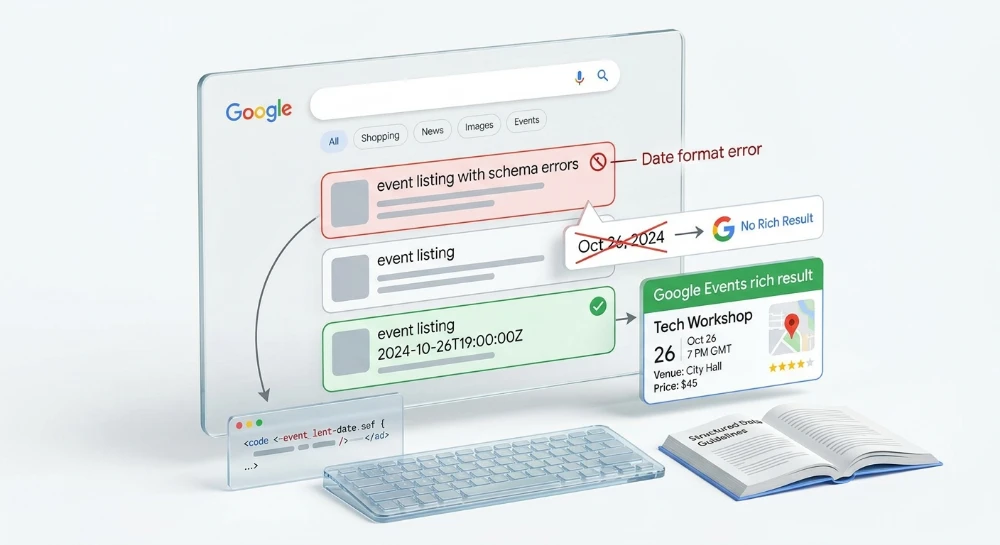
Format errors of a date in event schema block Google Events rich results because Googlebot requires strict ISO 8601 compliance to parse temporal data. The schema.org/Event payload structure depends on exact datetime values to establish entity relationships within the HTML source code. Search algorithms instantly reject payloads containing localized date strings or missing time zone offsets. This validation failure immediately strips the URL of rich snippet eligibility.
A single malformed date string instantly drops an event listing from the dedicated Google Events pack at the top of the SERP.
Listings positioned in this specialized widget routinely capture a CTR exceeding 40% for localized queries. Losing this visual placement forces the page back into standard blue-link results and reduces organic visibility volume. Google Search Console flags these syntax failures directly under the Enhancements tab. Administrators tracking API data will see these issues isolated within the Unparsable Structured Data report or the dedicated Event snippets report. The reporting interface categorizes these specific faults as Invalid date format or Missing time zone offset.
Core architecture of the schema.org/event payload
Google executes event markup validation by extracting structured data payloads injected directly into the page architecture. Modern SEO implementations rely on JSON-LD to deliver this entity data. JSON-LD decouples the semantic vocabulary from the visual presentation layer. The entire dataset sits cleanly within a dedicated script tag in the page header or body.
Deploying schema via Microdata binds the vocabulary directly to individual HTML tags. This interleaved approach forces the crawler to parse the entire visual node tree to reconstruct the event properties. Microdata bloats the code structure and introduces rendering latency during the crawling phase. JSON-LD eliminates this overhead. Googlebot extracts the standalone JSON object instantly without executing heavy DOM rendering cycles.
Mandatory payload elements
The parser requires a strict hierarchy of key-value pairs to establish the baseline entity. Missing a single mandatory node completely invalidates the object and halts rich result processing. The event architecture relies on five absolute directives:
- @context: Defines the vocabulary space and must point exclusively to schema.org to trigger validation.
- @type: Declares the specific event category classification.
- name: The string value defining the exact entity title.
- location: The spatial parameter mapping where the entity occurs.
- startDate: The temporal anchor initiating the timeline.
Parsing eventAttendanceMode for entity mapping
Search algorithms use the eventAttendanceMode property to determine the physical or digital nature of the entity. This classification dictates the specific architectural requirements for the location node. Supplying conflicting parameters triggers an immediate logic mismatch in the indexer.
Google parses the attendance mode property to map the expected location syntax.
| Declared Mode | Required Location Node | Parsing Logic Requirement |
|---|---|---|
| OfflineEventAttendanceMode | Place | Requires a distinct physical address mapping including a PostalAddress or valid geographic coordinates. |
| OnlineEventAttendanceMode | VirtualLocation | Demands a valid URL where the digital broadcast or stream occurs. |
| MixedEventAttendanceMode | Array | Forces the crawler to look for an array containing both a Place object and a VirtualLocation object. |
Transmitting an offline attendance parameter while supplying a virtual location URL causes a schema failure. The crawler flags the contradiction and immediately suspends eligibility for the specialized SERP widget. Synchronizing the attendance mode with the correct spatial properties ensures seamless entity extraction and prevents silent validation drops.
Mandatory schema properties: Startdate, enddate, and doortime
The chronological architecture of an event entity controls its lifecycle in the index. Search engines process temporal nodes to execute precise rendering and expiration logic within the SERP widget. Supplying incomplete or misclassified time parameters directly compromises entity extraction.
Schema date vs schema DateTime parameter types
Crawlers parse temporal values through two distinct data types defined by the schema vocabulary. Selecting the incorrect type creates logic conflicts during indexing and alters how the engine evaluates the lifespan of the entity.
- Date: Assigns a specific calendar day to the entity. This type operates exclusively at the day level and omits granular time data. It functions optimally for multi-day festivals or static exhibitions where a specific launch hour is either irrelevant or intentionally undefined.
- DateTime: Combines the calendar day with exact hour and minute parameters. This explicit format directs the indexer to map precise execution times for structured occurrences like webinars, theatrical performances, or timed professional workshops.
Technical specifications for timeline properties
Constructing a valid temporal payload requires mapping the entity against specific chronological nodes. Each property serves a distinct architectural function in the search engine interpretation logic.
| Schema Property | Data Type Requirement | Algorithmic Function |
|---|---|---|
| startDate | Date or DateTime | The required temporal anchor. Omitting this node triggers an immediate payload rejection and disqualifies the page from localized event features. |
| endDate | Date or DateTime | The expiration boundary. It signals the exact chronological moment the crawler should terminate the event visibility in search results. |
| doorTime | DateTime | Maps venue access logistics prior to the actual start time. It separates physical audience admission timing from the formal performance schedule. |
| previousStartDate | Date or DateTime | Maintains historical temporal continuity. Applied specifically when an event timeline shifts, allowing the indexer to reconcile the new start date against previously crawled data. |
SERP visibility duration logic and enddate failures
The indexing engine relies entirely on temporal boundaries to manage active event listings. A missing endDate attribute forces search algorithms to apply default expiration constraints. This reliance on fallback logic directly truncates the operational lifespan of the entity.
Without an explicit expiration node, the indexer drops the event from the SERP widget immediately after the startDate elapses. A three-day industry conference lacking an endDate will vanish from enriched results at midnight following the first day. Search engines automatically interpret the missing parameter as a single-day occurrence to preserve search relevance.
Strict schema validation protocols treat the omission of the endDate on multi-day entities as a critical payload deficiency. While the script might parse without triggering a complete syntax failure, the absence of a defined termination boundary restricts the algorithm from sustaining continuous visibility. Supplying precise end parameters ensures the entity remains anchored in the SERP throughout its entire lifecycle. This prevents premature indexing drops and sustains organic reach until the final physical or virtual interaction concludes.
ISO 8601 syntax implementation and time zone declarations
Search engines enforce rigid temporal parsing rules based on the ISO 8601 standard. Deviating from this syntax guarantees extraction failures and immediate loss of rich result eligibility. The crawler does not infer dates from contextual clues. It requires absolute mathematical precision within the structured data payload.
Base Date nodes accept a simplified format. Use
YYYY-MM-DD
exclusively for multi-day occurrences without specific daily launch times. Precision-dependent entities demand the full DateTime string. The compiler expects
YYYY-MM-DDThh:mm:ss+00:00
to process exact temporal states.
| Data Type | Syntax Pattern | Implementation Context |
|---|---|---|
| Schema Date |
YYYY-MM-DD
|
Full-day events or broad timeline boundaries where exact hours are irrelevant. |
| Schema DateTime (Floating) |
YYYY-MM-DDThh:mm:ss
|
Implicit local time. Highly risky for virtual events serving global audiences. |
| Schema DateTime (Offset) |
YYYY-MM-DDThh:mm:ss-05:00
|
Explicit time zone anchoring. Mandatory for webinar and live-stream schema. |
Time offset mechanics and UTC synchronization
The uppercase T operates as the literal string separator between the calendar date and the 24-hour time block. Immediately following the seconds value, the indexer looks for the time zone designator. Explicit declaration prevents localization conflicts across global data centers.
UTC and GMT function as the baseline for all temporal schema processing. Appending
+00:00
or the Z designator to the DateTime string anchors the event to Coordinated Universal Time. Search algorithms ingest this baseline and dynamically convert the SERP display based on the query origin IP. Omitting the designator forces the engine to guess the correct time zone based on server IP or geographical cues embedded elsewhere in the HTML. This ambiguity degrades rendering reliability.
Regional time zones require strict mathematical offset declarations relative to UTC. Standard implementation demands a plus or minus symbol followed by two-digit hour and minute values.
-
Eastern Standard Time (EST):
-05:00 -
Central Standard Time (CST):
-06:00 -
Pacific Standard Time (PST):
-08:00 -
Central European Time (CET):
+01:00 -
India Standard Time (IST):
+05:30
Parsing failures from localized date string injections
Dynamic CMS environments frequently corrupt the schema payload by injecting localized date strings. Outputting values like October 12, 2024 or 12/10/24 directly into the JSON-LD script breaks the compiler. The extraction engine expects a contiguous numeric string segmented strictly by hyphens and colons.
When the parser encounters alphabetical characters, spaces, or forward slashes, execution halts. The node is dropped. Regional date formatting creates severe ambiguity at the parser level. A string reading 05/06/2024 represents May 6th in North American localization but June 5th in European configurations. The ISO 8601 standard eliminates this algorithmic confusion through the strict year-month-day hierarchy.
Passing raw localized output bypasses the validation schema entirely. The crawler registers the payload as containing an empty or malformed temporal node. This syntax violation overrides all other valid attributes within the object. The entity immediately drops out of the active event index.
Diagnostics for malformed date values and parsing errors
Engineers must parse the diagnostic data provided by GSC to restore active entity status. The platform captures structural anomalies during the crawling phase. These errors populate directly under the Enhancements tab. Identifying the exact failure point requires cross-referencing item reports against the raw DOM payload.
The diagnostic workflow requires precise navigation within the GSC interface. Access the Events report to review the entity trend chart. The system separates entities into a binary status: valid nodes versus those rejected due to schema violations. The Details table isolates the precise property triggering the compiler rejection, allowing engineers to pinpoint the exact line of failing code.
GSC error warnings and algorithmic triggers
Validation failures typically fall into distinct categorization buckets based on how the parser interprets the temporal node. The extraction engine flags nodes that fail the strict syntax validation check.
| GSC Error Designation | Algorithmic Trigger | Payload Resolution |
|---|---|---|
| Invalid date format in field 'startDate' | Injection of localized date strings or absence of the required 'T' separator between date and time integer values. | Strip localized formatting. Implement contiguous ISO 8601 standard syntax. |
| missing time zone offset | The datetime string lacks a precise UTC modifier. The algorithm detects temporal ambiguity. | Append standard hour/minute offset or Z designation directly to the temporal string. |
Isolating syntax failures in application/ld+json
Beyond logical property errors, structural payload failures block parsing entirely. A single misplaced character inside the script block triggers a fatal processing halt. GSC flags this explicitly as an 'Invalid JSON document' syntax error. The crawler stops. No schema attributes are extracted. This total failure overrides all other validation checks, dropping the entity from the index immediately.
Isolating these syntax failures requires manual inspection of the markup array.
- Extract the raw HTML source directly to bypass DOM manipulation applied by client-side browser extensions.
- Locate the specific application/ld+json node containing the target schema declaration.
- Scan for trailing commas following the key-value pairs associated with temporal properties.
- Verify proper string encapsulation via double quotes. Single quotes cause immediate JSON compilation failure.
- Confirm the absence of unescaped whitespace inside the date property values.
Malformed array structures frequently hide within nested objects. If the temporal property sits within an improperly closed object bracket, the entire script tag fails validation. Engineers must trace the bracket hierarchy. The temporal node must correctly bind to the parent entity without structural leakage. Analyzing the raw script output line by line is the only definitive method for resolving fatal syntax blocks.
Syntax validation via rich results test and URL inspection
Once structural logic is repaired, the validation phase begins. Testing must occur outside the live index first. Google provides the Rich Results Test utility precisely for this workflow. Paste the modified code snippet directly into the tool rather than testing the live URL immediately. This isolates the markup from server-side caching or CDN delays.
Manual code execution confirms syntax integrity before deployment.
- Input the raw application/ld+json payload into the code tab of the Rich Results Test.
- Execute the analysis and monitor the Events eligibility status indicator.
- Expand the parsed property list under the detected items panel.
- Verify the temporal attributes map precisely to the expected fields without triggering non-critical warnings.
Raw code validation confirms syntax, but DOM rendering dictates what Google actually processes. Client-side frameworks frequently inject or alter markup post-load. The URL Inspection tool reveals the exact DOM state captured by the rendering engine.
Run a live test on the target URL. Open the rendered HTML tab. Search the source output for the specific event script node. If the temporal properties differ from your raw code test, a JS conflict exists. Rendering latency strips nested schema objects before the crawler snapshot fires. Engineers must compare the rendered output line-by-line against the base file to isolate client-side rendering blockages.
Semantic compliance via schema.org validator
The Rich Results Test focuses strictly on SERP features. It ignores broader semantic compliance. To guarantee absolute adherence to the vocabulary standard, feed the script source into the Schema Markup Validator.
This external parser flags deprecated properties that search engines might silently ignore today but penalize tomorrow. It provides a raw, unfiltered view of entity nesting. Testing against the core standard ensures the node structure remains intact even if rich snippet eligibility requirements shift.
| Diagnostic Tool | Primary Function | Render Context | Key Output Metric |
|---|---|---|---|
| Rich Results Test | Eligibility verification | Static code or Live DOM | Feature availability status |
| URL Inspection | DOM capture analysis | Live JS rendering engine | Rendered HTML source |
| Schema Validator | Strict vocabulary check | Static code | Global semantic compliance |
Executing live URL verification
Deployment to the production server requires final verification. Execute the live URL test within the Rich Results Test interface. This confirms server configurations, firewalls, and rendering scripts do not block the crawler from accessing the repaired payload.
Review the rendered screenshot capture. Ensure the event snippet registers as eligible with zero syntax warnings. A clean validation status acts as the definitive technical clearance. If discrepancies appear between the static code test and the live URL test, the architecture contains a middleware interference layer. Identify the caching protocol or script manager modifying the HTML head before final validation succeeds.
CMS event markup configuration and output overrides
Default CMS date functions prioritize human-readable output. This behavior fundamentally breaks structured data parsing. You must decouple the frontend rendering from the backend schema injection. Relying on default post meta generates invalid payloads.
Modern CMS platforms utilize the article publication timestamp as the fallback date variable. This maps the moment a page was published rather than the actual event occurrence. Overriding these native variables requires direct intervention in the theme architecture or schema plugin configurations.
Schema plugin field mapping
Off-the-shelf SEO plugins automate schema generation based on generic template logic. You must intercept this routing. Target the custom meta boxes specifically designated for event parameters.
- Navigate to the global schema template settings for the targeted custom post type.
- Wipe the default date variables mapped to the start and end properties.
- Map the custom field keys storing the precise event schedule data.
- Enable strict timezone formatting if the plugin interface provides a structural modifier toggle.
Failure to remap these fields results in static publication dates appearing across all event snippets. A dynamically generated dynamic page must pull strictly from its specific meta values.
PHP injection logic for structural modification
GUI configurations often lack the granularity required for complex offset calculations. Server-side manipulation guarantees correct payload architecture. Intercept the schema array before it compiles into the HTML. You can utilize native CMS hooks to parse raw custom fields, assign precise timezones, and force the correct string output.
$raw_event_date = get_post_meta($post_id, 'raw_event_start', true);
$event_timezone = new DateTimeZone('America/New_York');

$datetime_object = new DateTime($raw_event_date, $event_timezone);
$iso_formatted_date = $datetime_object->format('c');

$schema_payload['startDate'] = $iso_formatted_date;
Instantiating a PHP DateTime object allows explicit timezone definitions. This bypasses the default server clock configuration. Relying on legacy functions risks inheriting localized server offsets that misalign with the actual venue location. The format character 'c' forces the string into the required structural compliance.
Event technology platform API integration
Enterprise architectures rarely rely on manual data entry. Event schedules flow through API pipelines from ticketing CRMs and management software. Synchronizing this external data directly into the DOM requires a dedicated transformation layer. The CMS must not blindly pass external date strings into the output.
| API Source Format | Transformation Logic | Target Schema Output |
|---|---|---|
| Unix Timestamp (1702483200) | Cast integer to DateTime object, apply venue timezone | 2023-12-13T11:00:00-05:00 |
| Localized String (12/13/2023 11:00 AM) | Parse via regex/date format, assign explicit offset | 2023-12-13T11:00:00-05:00 |
| Fragmented JSON (Separate Date/Time keys) | Concatenate strings, convert to cohesive DateTime object | 2023-12-13T11:00:00-05:00 |
Webhook payloads update dynamically as schedules shift. Set up dedicated REST endpoints in the CMS to accept incoming JSON. Cast incoming timestamps or divergent format strings immediately upon receipt. Write the transformed ISO string directly to the database. This strict middleware validation guarantees the final rendered markup always reflects the upstream truth source without caching stale or malformed timezone data.
Synchronizing ticket offers and event status modifiers
Search algorithms validate the chronological integrity between an event commencement and its commercial availability. The
startDate
property dictates the physical or virtual kickoff. Inside the nested
offers
object, the
validFrom
parameter defines the exact timestamp when a transaction becomes active. These two nodes share a strict logical dependency.
A
validFrom
timestamp occurring after the
startDate
triggers a fatal logic error. Parsers interpret this as an impossible state. The ticket sale cannot begin after the event has already started. If your API pushes a default fallback date into the offer node that eclipses the event date, the rich result drops from the SERP. Calibrate the
validThrough
property to terminate precisely at the
startDate
, or at a designated cutoff point prior to the event conclusion.
Event state enumerations
Schedules fail. Venues change. When real-world logistics force an update, the CMS must not delete the page or return a 404 error. Deleting the URL severs the entity history. Modify the payload using standard schema enumerations within the
eventStatus
property to signal the change directly to the crawler.
- Scheduled events require the baseline declaration.
"eventStatus": "https://schema.org/EventScheduled"This confirms the event proceeds exactly as detailed in the current markup.
- Canceled events demand status overrides without data destruction.
"eventStatus": "https://schema.org/EventCancelled"
Complete cessation. Leave the original
startDate
intact. The crawler uses the legacy date to resolve the cancellation against user queries searching for the specific abandoned instance.
- Postponed events trigger specific algorithmic tracking protocols.
"eventStatus": "https://schema.org/EventRescheduled"Modifying the payload for a rescheduled event requires precise property migrations to maintain indexing continuity. You cannot merely overwrite the primary date.
Algorithmic rescheduling logic
When an event shifts to a new timeframe, the payload architecture must bridge the old entity data to the new reality. Replacing the date string blindly breaks the continuity. Search engines rely on explicit mapping to understand that a queried historical date relates to the newly proposed schedule.
| Schema Property | Pre-Reschedule State | Post-Reschedule State |
|---|---|---|
| eventStatus | EventScheduled | EventRescheduled |
| startDate | Original target date | New confirmed date |
| previousStartDate | Null or omitted | Populated with original target date |
| endDate | Original conclusion date | New confirmed conclusion date |
The original date migrates directly into the
previousStartDate
node. The new, active date occupies the standard
startDate
field. This structural handshake prevents the search index from assuming the rescheduled event is an entirely new entity competing with a cached ghost version of the original schedule.
Update the nested offer dates simultaneously. If the reschedule pushes the event back by three months, the
validThrough
parameters on all active ticket objects must extend to match the new timeline. Failing to synchronize the commercial nodes with the modified event properties invalidates the entire structure upon the next crawl.
Indexing protocols for enriched results restoration
Once the JSON-LD payload reflects the correct syntax and synchronized states, the next phase is forcing a cache refresh. Passive crawling introduces unacceptable latency for time-sensitive entities. Search engines require active signals to update the SERP cache.
Navigate to GSC and deploy the URL Inspection tool for the modified event page. Execute a live test to confirm the parser reads the updated DOM without triggering syntax warnings. Trigger the Request Indexing protocol immediately after validation. High-volume platforms managing hundreds of rescheduled items must bypass manual submission. Rebuild the XML sitemap with updated lastmod nodes and ping the search engine endpoints. Enterprise infrastructures should integrate the Indexing API to push modified event entities directly into the processing queue.
Google search essentials compliance checks
Payload syntax perfection does not guarantee SERP visibility. Alignment between the structured data and the rendered HTML is a strict requirement. Discrepancies between the JSON-LD code block and the user-facing text often trigger manual actions for structured data spam.
A manual action neutralizes all rich result eligibility across the entire domain. The recovery process from a penalty is significantly longer than resolving a simple parsing error. Ensure the following compliance gates are met before forcing a recrawl.
- Visual parity exists between the structured date parameters and the text rendered in the viewport.
- Hidden schema nodes containing deceptive timeframes or injected keywords are purged entirely from the source code.
- The event location resolves to a valid physical address mapping, avoiding abstract or virtual coordinates for offline operations.
- Ticket availability statuses in the Offer node exactly match the inventory state on the purchasing interface.
Monitoring restoration metrics and maps integration
Restoration follows a distinct trajectory. Tracking recovery requires specific filtering within the GSC Performance report. Isolate the data by applying the Search Appearance filter set to Events. Impression volume is the primary diagnostic metric.
Clicks will lag behind impressions. The initial goal is verifying that the algorithms have reinstated the URL into the enriched results pool. Zero impressions after a week of confirmed indexing indicates a severe quality threshold failure, not a syntax error.
| Recovery Phase | Diagnostic Focus | Expected KPI Trajectory |
|---|---|---|
| Ingestion (0-48 Hours) | GSC Enhancements Report | Invalid items shift to Valid state |
| SERP Surfacing (3-7 Days) | GSC Performance Report | Impression velocity increases under Events filter |
| Entity Synchronization (7-14 Days) | Google Maps Knowledge Panel | Updated dates render on local business profiles |
Local business profiles pull event data through entity reconciliation. The Google Maps interface relies heavily on accurate structured data mapping to attach an event to a specific venue. Monitor the venue knowledge panel from multiple IP coordinates. A successful schema update pushes the revised event timeline to the local entity card, restoring visibility to foot traffic and localized mobile queries. Failure to surface here despite valid GSC status points to a disjointed location parameter failing to match the established venue entity.